German Word Order: The Clear Guide to Main Clauses, Subordinate Clauses, and the Verb-Second Rule
Quick Answer
German word order is built around the verb: in most main clauses the conjugated verb is in position 2 (V2), while in subordinate clauses the verb typically goes to the end. Once you learn what counts as position 1, how separable verbs split, and how to stack time, manner, and place, German sentences become predictable instead of intimidating.
German word order is easiest when you treat it as verb placement: in most main clauses the conjugated verb is in position 2 (the V2 rule), while in subordinate clauses the conjugated verb typically moves to the end. Master those two patterns, plus how separable verbs split and where to park extra verbs, and you can build correct sentences even with limited vocabulary.
German is a major world language with roughly 90 million native speakers and well over 100 million total speakers, depending on the count and definition (Ethnologue, 27th edition, 2024). It is an official language in multiple countries and a key second language across Europe, so getting sentence structure right pays off quickly in real conversations.
If you want more everyday phrases to plug into these patterns, pair this guide with how to say hello in German and how to say goodbye in German.
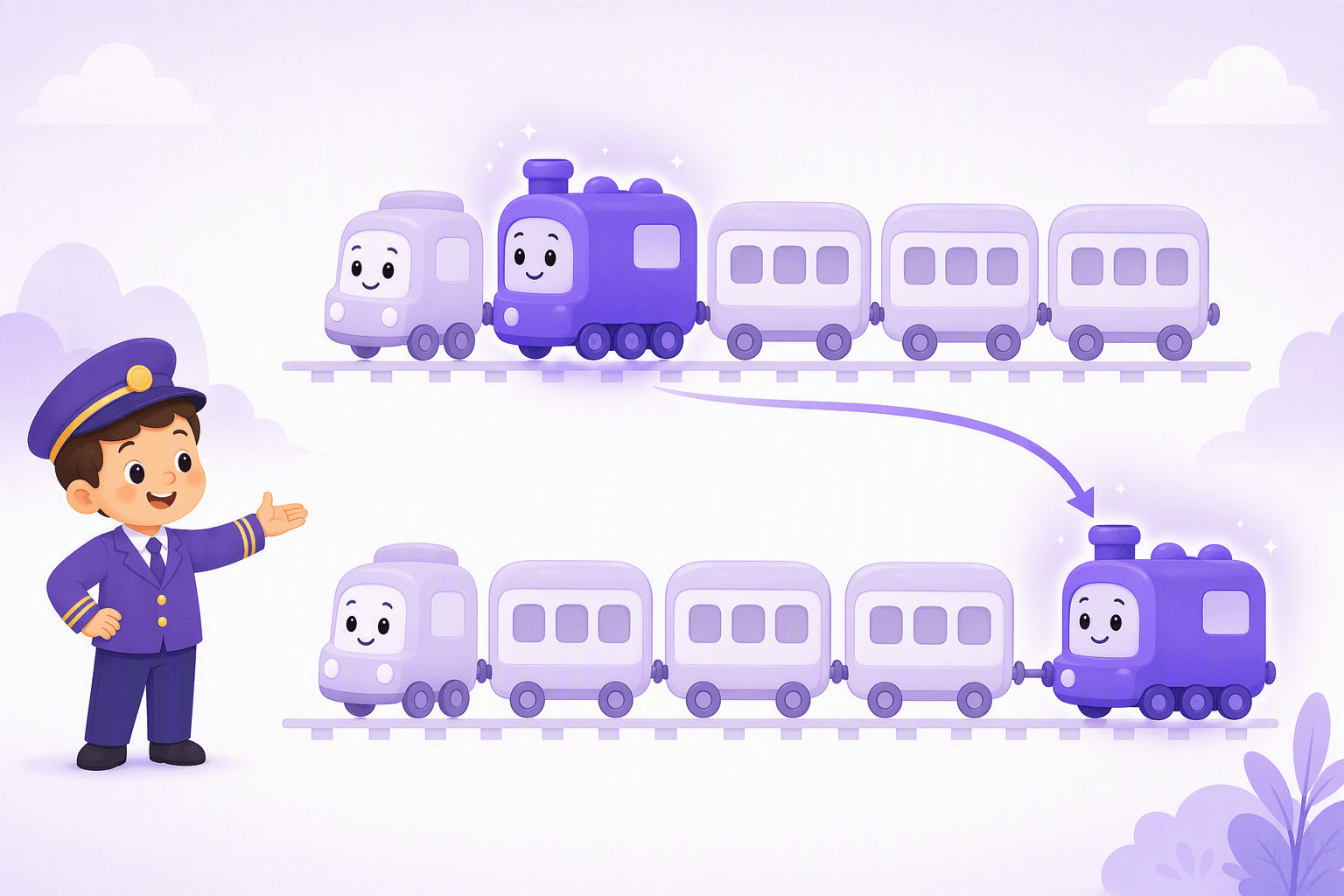
The one idea that makes German word order predictable
German is not “free word order”. It is structured word order with flexible position 1.
In practical terms: decide what you want to put first (topic, time, place, contrast), then put the conjugated verb second, and everything else falls into place. Reference grammars like Duden’s Die Grammatik treat this as the backbone of clause structure, and the Goethe-Institut teaches it early because it unlocks real sentence building.
What “position 2” actually means
Position 2 is the second element, not the second word.
These are all valid because the verb is the second element:
- Ich komme heute. (subject first)
- Heute komme ich. (time first)
- Nach der Arbeit komme ich nach Hause. (full phrase first)
A common learner mistake is thinking German always wants the subject first. German often starts with time or context, especially in storytelling and daily planning.
Main clauses: the V2 rule in real life
A “main clause” is a clause that can stand alone as a full sentence. In German, that usually means V2.
Basic pattern: one element, then the verb
Use this as your default template:
- Position 1: one element (subject or something else)
- Position 2: conjugated verb
- Middle field: objects, adverbs, negation
- End: extra verbs (infinitives, participles), separable prefixes
Examples:
- Ich lerne heute Deutsch.
- Heute lerne ich Deutsch.
- In der Bahn lerne ich heute Deutsch.
Notice how the subject moves after the verb when something else takes position 1. That is not “inversion” in the English sense, it is just German doing V2.
Yes/no questions: verb-first (V1)
When you ask a yes/no question, the verb goes first:
- Kommst du heute?
- Hast du Zeit?
This is one of the cleanest patterns in German. If you can form a statement, you can usually form a yes/no question by moving the conjugated verb to the front.
Commands: verb-first (V1)
Imperatives also start with the verb:
- Komm bitte rein.
- Sag das noch mal.
If you are practicing polite requests, connect this with how to say I love you in German too, because many relationship phrases rely on the same verb placement patterns.
Subordinate clauses: verb-final (most of the time)
A subordinate clause (Nebensatz) is introduced by a subordinating conjunction or a relative pronoun. In these clauses, German typically sends the conjugated verb to the end.
This is the pattern that makes German feel “backwards” to English speakers, but it is consistent. Work by linguists like Helbig and Buscha (their learner-focused grammar is widely used in German teaching) emphasizes that learners should treat subordinate clauses as a separate word-order system, not a small tweak.
weil, dass, wenn: the classic verb-at-the-end triggers
- Ich bleibe zu Hause, weil ich krank bin.
- Ich weiß, dass er heute nicht kommt.
- Wenn du Zeit hast, ruf mich an.
The conjunction (weil/dass/wenn) occupies the “slot” that would normally allow V2, so the verb is pushed to the end.
Relative clauses: verb-final with der/die/das
Relative clauses also tend to be verb-final:
- Das ist der Film, den ich gestern gesehen habe.
- Das ist die Person, die hier arbeitet.
The relative pronoun (den/die) introduces the clause, and the verb goes to the end. If there is a participle plus auxiliary, the auxiliary is last.
Two verbs at the end: the “verb bracket” feeling
German often stacks verbs at the end of a subordinate clause:
- ..., weil ich morgen früh aufstehen muss.
- ..., weil ich das nicht machen kann.
- ..., weil ich ihn gestern gesehen habe.
A useful mental model from many teaching grammars is the Satzklammer (sentence bracket): the conjugated part opens the bracket in main clauses, and the non-conjugated parts close it at the end. In subordinate clauses, the whole “verb cluster” tends to close at the end.
💡 Fast self-check
If you see weil/dass/wenn/ob/als/obwohl, assume verb-final and build the sentence from the end backwards: decide the verb first, then fill in the middle.
Separable verbs: why German sentences “split”
Separable verbs are a top reason learners feel lost, because the prefix can look like it wandered off. It did not, it is doing its job.
In main clauses: prefix goes to the end
-
Ich stehe um 7 Uhr auf.
(aufstehen, to get up) -
Wir fangen um acht an.
(anfangen, to start)
The conjugated stem is in position 2 (V2), and the prefix closes the sentence bracket.
In subordinate clauses: usually stays together at the end
- ..., weil ich um 7 Uhr aufstehe.
- ..., weil wir um acht anfangen.
This is one of the most satisfying “click” moments in German: main clause splits, subordinate clause reunites.
With modals: the infinitive stays together at the end
When you use a modal verb (können, müssen, wollen, dürfen, sollen, mögen), the separable verb is usually an infinitive at the end, so it appears together:
- Ich muss um 7 Uhr aufstehen.
- Ich will heute einkaufen gehen.
For a deeper dive into modals, see our related grammar content like German modal verbs explained.
The middle field: where objects and adverbs usually go
Once you have the verb in the right place, the next challenge is the “middle field”, everything between the conjugated verb and the end of the clause.
German allows movement for emphasis, but there are strong defaults that make you sound natural.
Time, manner, place (TMP): a reliable default
A common neutral order is:
Time (wann) + Manner (wie) + Place (wo/wohin)
- Ich gehe morgen mit meiner Schwester in die Stadt.
- Wir essen heute Abend zusammen zu Hause.
This guideline is taught widely in learner materials, including Goethe-Institut grammar explanations, because it reduces “random adverb placement”.
🌍 Why Germans often start with time
In everyday German, planning talk is constant: appointments, trains, opening hours, deadlines. Starting with time (Heute, Morgen, Am Montag) is a natural way to anchor the listener, and it fits perfectly into position 1 without breaking the V2 rule.
Direct vs indirect objects: a practical beginner rule
There are many nuances, but this beginner-safe guideline works:
- Pronouns tend to come earlier than full noun phrases.
- Dative often comes before accusative when both are nouns.
Examples:
- Ich gebe ihm das Buch.
- Ich gebe das Buch meinem Bruder.
- Ich gebe es ihm. (pronouns early)
If you are learning cases, connect this with German cases explained, because case marking is what allows some flexibility.
Negation with nicht: place it near what you negate
Nicht usually negates what comes after it, or the whole predicate when placed late.
- Ich esse nicht viel. (not much)
- Ich esse heute nicht. (not today / not at all today)
- Ich gehe nicht nach Berlin. (not to Berlin)
A common learner error is putting nicht at the very end automatically. In many sentences, the end is reserved for verbs, prefixes, and heavy information.
Word order with two clauses: commas and “verb position reset”
When you combine clauses, German word order “resets” inside each clause. The comma is not decoration, it signals structure.
Main clause + subordinate clause
- Ich bleibe zu Hause, weil ich krank bin.
- Weil ich krank bin, bleibe ich zu Hause.
Both are correct. If the subordinate clause comes first, it fills position 1 of the main clause, so the main clause still obeys V2:
- Weil ich krank bin, bleibe ich zu Hause. (verb is second element of the main clause)
Main clause + main clause (coordinating conjunctions)
With und/aber/oder/denn, you typically keep V2 in the second clause:
- Ich komme heute, aber ich bleibe nicht lange.
- Wir können gehen, oder wir warten noch.
But with denn, the second clause is still a main clause (V2), unlike weil:
- Ich gehe nach Hause, denn ich bin müde. (V2)
- Ich gehe nach Hause, weil ich müde bin. (verb-final)
This contrast is a high-value detail because English “because” maps to both denn and weil depending on structure.
Common word-order problems (and clean fixes)
These are the mistakes that keep showing up in learner writing and speech, even at intermediate levels.
Mistake 1: putting the verb in position 3
Wrong pattern: two elements before the verb.
- Incorrect: Heute ich gehe ins Kino.
- Correct: Heute gehe ich ins Kino.
Fix: choose only one element for position 1. If you want both time and subject early, German still requires the verb to be second element.
Mistake 2: forgetting verb-final in subordinate clauses
- Incorrect: ..., weil ich bin müde.
- Correct: ..., weil ich müde bin.
Fix: train “weil equals verb at the end” as a reflex.
Mistake 3: separable prefix left behind in subordinate clauses
- Incorrect: ..., weil ich um 7 Uhr stehe auf.
- Correct: ..., weil ich um 7 Uhr aufstehe.
Fix: in subordinate clauses, glue the separable verb back together at the end.
Mistake 4: scattering extra verbs
- Incorrect: Ich habe gesehen gestern den Film.
- Correct: Ich habe gestern den Film gesehen.
Fix: keep the participle or infinitive near the end. German likes to “close” with the verb material.
⚠️ A trap from English
English often keeps the verb near the subject. German often keeps the conjugated verb early (V2) but pushes other verb parts late. Try not to translate word-by-word, translate clause-by-clause.
How word order changes tone: emphasis without changing meaning
German uses word order to manage what the listener should pay attention to first. This is one reason German can feel blunt or overly direct to learners, when it is actually just efficient.
Fronting for emphasis (position 1 as a spotlight)
Compare:
- Ich habe heute keine Zeit. (neutral)
- Heute habe ich keine Zeit. (today specifically)
- Keine Zeit habe ich heute. (strong emphasis, can sound dramatic)
Linguist Harald Weinrich’s work on text and discourse in German is often used in advanced teaching to show how German organizes information flow. You do not need the theory to benefit from the practice: move one element to position 1 when you want contrast.

Keeping it natural in conversation
In casual speech, Germans often start with:
- Also, ... (so, well)
- Dann, ... (then)
- Ehrlich gesagt, ... (honestly)
These fillers still count as position 1 elements. The verb still needs to be second element of the clause that follows.
If you want to hear how native speakers actually do this at speed, movie dialogue is ideal because it is time-pressured and full of fronting. For listening practice, browse the blog and then jump into clip-based study in Wordy at the end.
Mini practice: build sentences with a “verb plan”
A practical method is to decide your verb structure first, then place everything else.
Step 1: choose your clause type
- Main clause: V2
- Yes/no question: V1
- Subordinate clause: verb-final
Step 2: decide your verb “tail”
Ask: do you need an infinitive, participle, or separable prefix?
- Ich will heute früher gehen. (infinitive tail)
- Ich habe das schon gesagt. (participle tail)
- Ich stehe jeden Tag um 7 Uhr auf. (prefix tail)
Step 3: fill the middle with TMP
- Ich stehe jeden Tag um 7 Uhr auf. (time stacked)
- Ich stehe um 7 Uhr sofort auf. (manner inserted)
As you get comfortable, you can bend TMP for emphasis, but keeping it consistent early on makes your German easier to understand.
A quick note on “bad German” you might hear in media
Movies and TV sometimes use nonstandard word order to show character, region, or stress. That does not mean the grammar rules are fake.
If a character is angry, they may front objects or drop parts of the sentence. If a character is joking, they may exaggerate structure. This is one reason it helps to learn “clean” patterns first, then notice deviations as style.
If you are curious about strong language in German dialogue, our guide to German swear words explains what you will hear and what to avoid repeating.
Putting it all together with real phrases
Here are a few sentence frames you can reuse immediately:
-
Heute + V2 + ...
Heute gehe ich früher nach Hause. -
Ich glaube, dass ... + verb-final
Ich glaube, dass er heute keine Zeit hat. -
..., weil ... + verb-final
Ich komme nicht, weil ich arbeiten muss. -
Wenn ... + verb-final, + main clause V2
Wenn du willst, können wir später telefonieren.
Once these feel automatic, you can plug in vocabulary from your other study lists, like the 100 most common German words, and your sentences will stay grammatical even as they get longer.
Practice plan: how to internalize German word order
Memorizing rules is not enough. You need fast pattern recognition.
- Write 10 main clauses with different position 1 elements (time, place, object).
- Convert each into a yes/no question (V1).
- Add a weil-clause to each sentence (verb-final).
- Read them out loud, focusing on where the verb lands.
If you learn with clips, pause after the first half of a sentence and predict the verb ending. German often “promises” a structure early and pays it off late, especially in subordinate clauses.
At the end of your session, pick one scene and shadow it: repeat the line with the same rhythm and word order. That is where word order stops being a rule and becomes a habit.
If you want structured listening practice that reinforces these patterns automatically, Wordy uses real movie and TV clips with interactive subtitles, so you can see V2 and verb-final order in context while you build vocabulary at the same time.
Frequently Asked Questions
What is the verb-second (V2) rule in German?
Does German always put the verb at the end?
Where do time, manner, and place go in German?
What happens to separable verbs in German word order?
How do I know what counts as 'position 1' in German?
Sources & References
- Goethe-Institut, 'Grammatik: Satzbau und Wortstellung' (accessed 2026)
- Institut für Deutsche Sprache (IDS), Grammatik und Sprachwissen resources (accessed 2026)
- Duden, 'Die Grammatik' (accessed 2026)
- Ethnologue, 27th edition, 2024
Start learning with Wordy
Watch real movie clips and build your vocabulary as you go. Free to download.


