Quick Answer
The most important German food words to know are Brot (bread), Fleisch (meat), Gemüse (vegetables), Obst (fruit), and Getränk (drink). German food vocabulary is built on compound words. Kartoffelsalat (potato salad), Schweinebraten (roast pork), Rindfleischsuppe (beef soup), so learning root words lets you decode hundreds of menu items instantly.
German food vocabulary is one of the most rewarding areas of the language to learn. Once you understand how German compound words work, a single menu becomes a puzzle you can solve: Kartoffelsuppe is potato (Kartoffel) soup (Suppe), Rindfleisch is beef (Rind) meat (Fleisch), and Apfelsaft is apple (Apfel) juice (Saft).
With approximately 132 million speakers worldwide according to Ethnologue's 2024 data, German is the most spoken native language in the European Union. Whether you are ordering at a Biergarten in Munich, navigating a bakery in Vienna, or reading a menu in Zürich, food words are among the first vocabulary you will actually use every single day.
"German compound nouns are not merely a grammatical curiosity, they are the primary mechanism by which the language expands its vocabulary. Nowhere is this more evident than in food terminology, where root words combine with remarkable transparency." (DWDS, Berlin-Brandenburgische Akademie der Wissenschaften)
This guide covers the essential German food vocabulary organized by category: fruits, vegetables, meat, bread, classic dishes, beer, and restaurant phrases. Master these 80+ words and you will be able to handle any German-speaking dining situation with confidence.
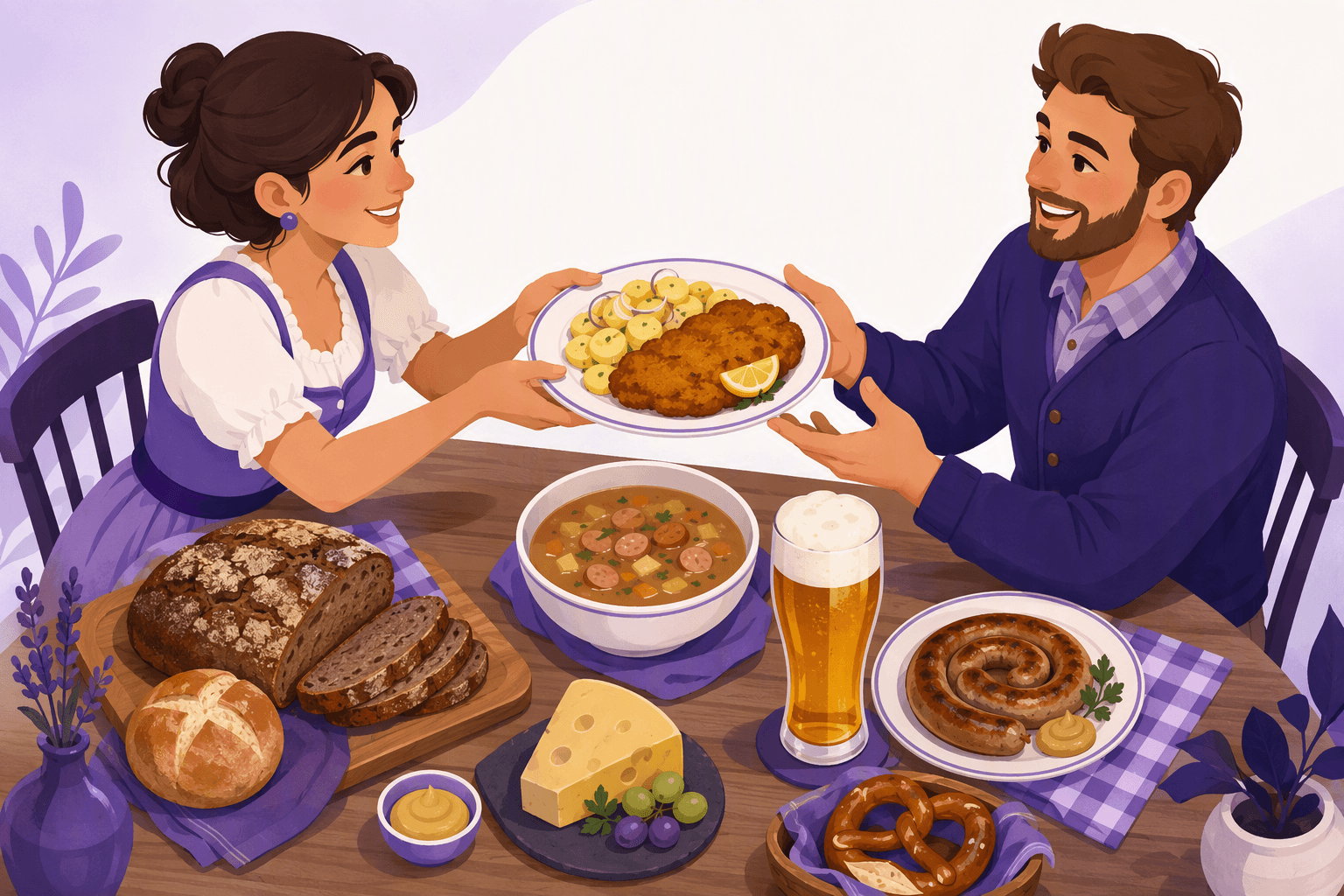
Quick Reference: Core Food Categories
| English | German | Pronunciation |
|---|---|---|
| Food | das Essen | dahs EH-sen |
| Drink | das Getränk | dahs geh-TRENK |
| Bread | das Brot | dahs broht |
| Meat | das Fleisch | dahs flysh |
| Fish | der Fisch | dehr fish |
| Fruit | das Obst | dahs ohpst |
| Vegetables | das Gemüse | dahs geh-MÜ-zeh |
| Cheese | der Käse | dehr KAY-zeh |
| Egg | das Ei | dahs eye |
| Butter | die Butter | dee BOO-ter |
| Milk | die Milch | dee milkh |
| Sugar | der Zucker | dehr TSOO-ker |
| Salt | das Salz | dahs zahlts |
| Pepper | der Pfeffer | dehr PFEH-fer |
| Water | das Wasser | dahs VAH-ser |
| Rice | der Reis | dehr ryse |
| Pasta/Noodles | die Nudeln | dee NOO-deln |
| Soup | die Suppe | dee ZOO-peh |
| Salad | der Salat | dehr zah-LAHT |
| Cake | der Kuchen | dehr KOO-khen |
| Ice cream | das Eis | dahs eyes |
| Breakfast | das Frühstück | dahs FROO-shtük |
| Lunch | das Mittagessen | dahs MIT-tahg-eh-sen |
| Dinner | das Abendessen | dahs AH-bent-eh-sen |
| Snack | der Snack / die Zwischenmahlzeit | dehr snek / dee TSVISH-en-mahl-tsyte |
💡 German Noun Genders
Every German noun has a grammatical gender: der (masculine), die (feminine), or das (neuter). Food nouns follow no predictable pattern: der Käse (cheese) is masculine, die Milch (milk) is feminine, das Brot (bread) is neuter. The best strategy is to always learn the article together with the noun.
Fruits, das Obst
Germany may not be tropical, but German markets carry an impressive range of fruits. The word Obst (ohpst) is a collective noun for fruit in general, while die Frucht (frookht) refers to a single fruit.
| English | German | Pronunciation | Note |
|---|---|---|---|
| Apple | der Apfel | dehr AHP-fel | Germany's most popular fruit |
| Banana | die Banane | dee bah-NAH-neh | |
| Strawberry | die Erdbeere | dee EHRT-beh-reh | Literally 'earth berry' |
| Cherry | die Kirsche | dee KEER-sheh | |
| Grape | die Traube | dee TROW-beh | |
| Pear | die Birne | dee BEER-neh | |
| Lemon | die Zitrone | dee tsee-TROH-neh | |
| Orange | die Orange | dee oh-RAHN-zheh | Also 'die Apfelsine' in northern Germany |
| Peach | der Pfirsich | dehr PFEER-zikh | |
| Plum | die Pflaume | dee PFLOW-meh | Key ingredient in Pflaumenkuchen |
Notice the compound word logic at work: Erdbeere is literally "earth berry" (Erde + Beere). Similarly, Apfelsine (an older word for orange used in northern Germany) comes from "apple from China." According to the Duden, Erdbeere has been in use since the 9th century, making it one of the oldest German fruit names.
Vegetables, das Gemüse
German cuisine relies heavily on potatoes, cabbage, and root vegetables. The word Kartoffel (potato) appears in dozens of compound words, learning it unlocks an entire family of dishes.
| English | German | Pronunciation | Note |
|---|---|---|---|
| Potato | die Kartoffel | dee kar-TOF-fel | Root of many compound words |
| Cabbage | der Kohl | dehr kohl | |
| Carrot | die Karotte / die Möhre | dee kah-ROT-teh / dee MÖ-reh | Regional variation |
| Onion | die Zwiebel | dee TSVEE-bel | |
| Tomato | die Tomate | dee toh-MAH-teh | 'Paradeiser' in Austria |
| Cucumber | die Gurke | dee GOOR-keh | |
| Bean | die Bohne | dee BOH-neh | |
| Pea | die Erbse | dee EHRP-seh | |
| Mushroom | der Pilz | dehr pilts | |
| Asparagus | der Spargel | dehr SHPAR-gel | Germans celebrate Spargelzeit (asparagus season) |
🌍 Spargelzeit. Asparagus Season
Every spring from mid-April to June 24 (Johannistag), Germany enters Spargelzeit, asparagus season. White asparagus (Spargel) is considered a delicacy, and restaurants create entire menus around it. According to the Goethe-Institut, Germans consume roughly 1.5 kg of asparagus per person annually, making them the largest asparagus consumers in Europe. Missing Spargelzeit is like missing Christmas for food-loving Germans.
Meat, das Fleisch
Germany is known for its meat-heavy cuisine. Understanding the root words Schwein (pig), Rind (cattle), Huhn/Hähnchen (chicken), and Kalb (veal) lets you decode virtually any meat dish on a German menu.
| English | German | Pronunciation | Note |
|---|---|---|---|
| Pork | das Schweinefleisch | dahs SHVY-neh-flysh | Schwein (pig) + Fleisch (meat) |
| Beef | das Rindfleisch | dahs RINT-flysh | Rind (cattle) + Fleisch (meat) |
| Chicken | das Hähnchen | dahs HAYN-khen | 'Hendl' in Bavaria/Austria |
| Veal | das Kalbfleisch | dahs KAHLP-flysh | |
| Lamb | das Lammfleisch | dahs LAHM-flysh | |
| Sausage | die Wurst | dee voorst | 1,500+ varieties in Germany |
| Ham | der Schinken | dehr SHIN-ken | |
| Bacon | der Speck | dehr shpek | |
| Ground meat | das Hackfleisch | dahs HAHK-flysh | Also 'Gehacktes' or 'Faschiertes' (Austria) |
| Duck | die Ente | dee EN-teh |
The compound word system is transparent here: if you know Fleisch means "meat," you can decode Schweinefleisch (pork), Rindfleisch (beef), Kalbfleisch (veal), and Lammfleisch (lamb) without memorizing them separately. According to research from the Institut für Deutsche Sprache in Mannheim, food-related compound nouns account for one of the largest productive categories in modern German word formation.
German Bread Culture, die Brotkultur
Germany's bread tradition is unmatched anywhere in the world. With over 3,200 registered bread varieties according to the Deutsches Brotinstitut, German Brotkultur was inscribed on the UNESCO Intangible Cultural Heritage list in 2014. Bread is not merely a side dish, it is the foundation of two daily meals.
| English | German | Pronunciation | Note |
|---|---|---|---|
| Bread | das Brot | dahs broht | |
| Bread roll | das Brötchen | dahs BRÖRT-khen | 'Semmel' in Bavaria/Austria, 'Schrippe' in Berlin |
| Pretzel | die Brezel | dee BREH-tsel | Also 'Breze' in Bavaria |
| Whole grain bread | das Vollkornbrot | dahs FOL-korn-broht | |
| Rye bread | das Roggenbrot | dahs ROG-en-broht | |
| Pumpernickel | der Pumpernickel | dehr POOM-per-nik-el | Dense Westphalian rye bread |
| Sourdough bread | das Sauerteigbrot | dahs ZOW-er-tyg-broht | |
| Bread slice | die Scheibe Brot | dee SHY-beh broht |
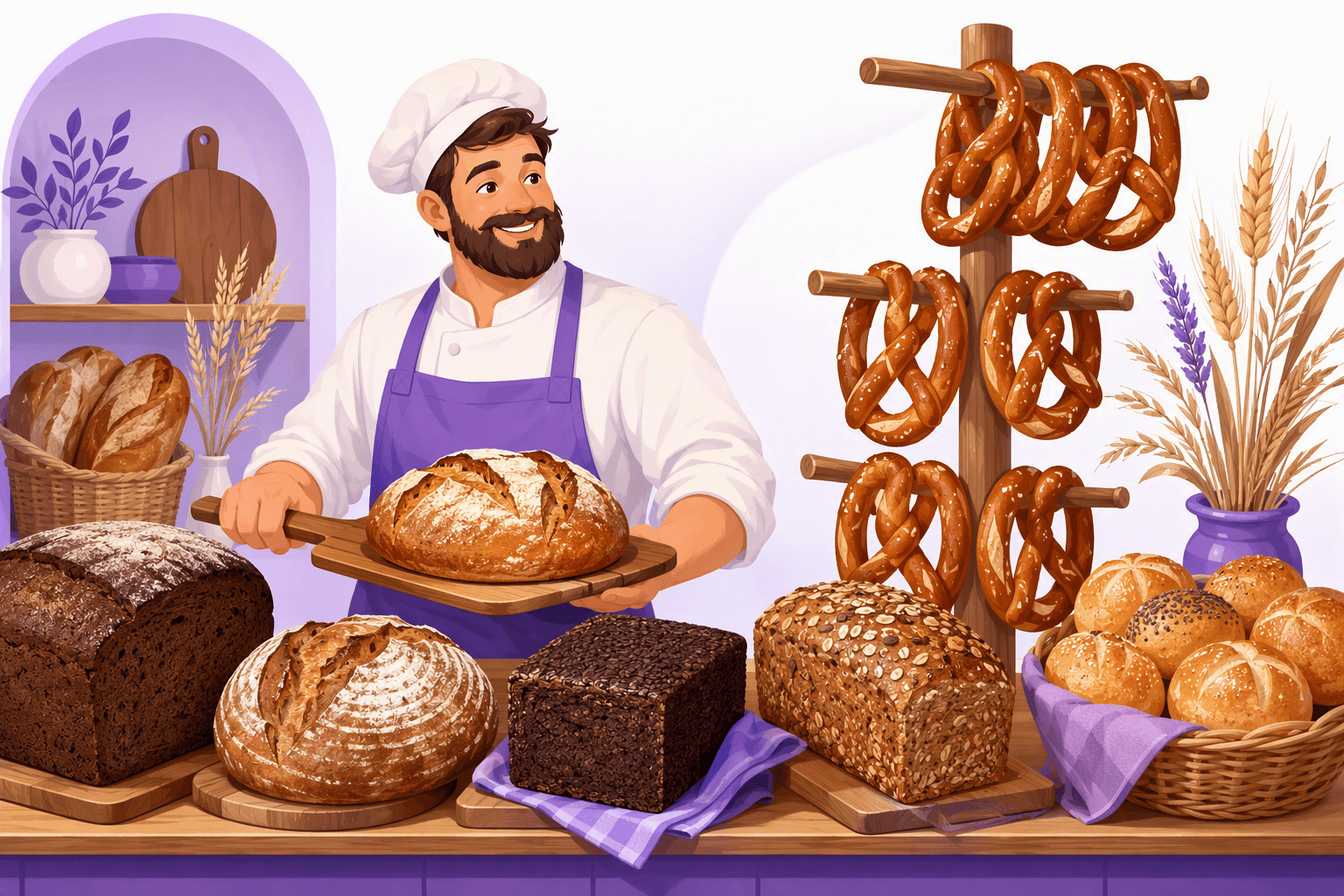
🌍 Abendbrot. The Cold Dinner Tradition
One of the most distinctly German food customs is Abendbrot (AH-bent-broht), literally "evening bread." Rather than cooking a hot dinner, many German families eat a cold evening meal of sliced bread with cheese, cold cuts (Aufschnitt), pickles, and spreads. This tradition dates back centuries and remains common, especially in northern Germany. If you are invited to a German home and they offer Abendbrot, expect a simple but satisfying spread, not a hot multi-course meal.
The word Brötchen itself is a diminutive of Brot, the suffix -chen makes it "little bread." But regional names for a simple bread roll reveal the diversity of German dialects: Brötchen (standard/north), Semmel (Bavaria/Austria), Schrippe (Berlin), Wecke (Hesse), Rundstück (Hamburg). According to the DWDS, the word Semmel derives from Latin simila (fine wheat flour) and has been used since the Old High German period.
Classic German Dishes. Typische Gerichte
These are the dishes you will encounter repeatedly on German menus. Understanding the compound word structure helps you identify ingredients at a glance.
| English | German | Pronunciation | Note |
|---|---|---|---|
| Schnitzel (breaded cutlet) | das Schnitzel | dahs SHNIT-sel | 'Wiener Schnitzel' = veal, 'Schnitzel Wiener Art' = pork |
| Bratwurst (fried sausage) | die Bratwurst | dee BRAHT-voorst | |
| Sauerkraut (fermented cabbage) | das Sauerkraut | dahs ZOW-er-krowt | Sauer (sour) + Kraut (cabbage) |
| Potato salad | der Kartoffelsalat | dehr kar-TOF-fel-zah-laht | Northern: mayo-based; Southern: vinegar-based |
| Roast pork | der Schweinebraten | dehr SHVY-neh-brah-ten | |
| Beef soup | die Rindfleischsuppe | dee RINT-flysh-zoo-peh | |
| Potato soup | die Kartoffelsuppe | dee kar-TOF-fel-zoo-peh | |
| Meatballs | die Frikadellen | dee free-kah-DEL-en | 'Buletten' (Berlin), 'Fleischpflanzerl' (Bavaria) |
| Goulash | das Gulasch | dahs GOO-lahsh | |
| Dumplings | die Knödel / die Klöße | dee KNÖR-del / dee KLÖR-seh | Knödel (south), Klöße (north) |
| Spätzle (egg noodles) | die Spätzle | dee SHPETS-leh | Swabian specialty |
| Currywurst | die Currywurst | dee KOO-ree-voorst | Berlin's iconic street food since 1949 |
💡 Wiener Schnitzel vs. Schnitzel Wiener Art
By Austrian and German culinary law, Wiener Schnitzel must be made from veal (Kalbfleisch). The far more common pork version is technically called Schnitzel Wiener Art ("Viennese-style schnitzel"). Ordering Wiener Schnitzel and receiving pork would be grounds for a legitimate complaint in any reputable restaurant, this distinction matters to German and Austrian diners.
"The German kitchen is a kitchen of compound words: every dish tells you its ingredients and preparation method in its name alone. This transparency is unique among European culinary traditions and makes German menus remarkably navigable for learners." (Goethe-Institut, Cultural Studies Program)
Beer Vocabulary, das Bier
Germany is synonymous with beer culture, and the vocabulary around it is essential for any social situation. The Reinheitsgebot (Beer Purity Law) of 1516 established that beer could only contain water, barley, and hops, a standard that shaped German brewing for over 500 years.
| English | German | Pronunciation | Note |
|---|---|---|---|
| Beer | das Bier | dahs beer | |
| Wheat beer | das Weizenbier / das Weißbier | dahs VYT-sen-beer / dahs VICE-beer | Weizen (north) / Weiß (Bavaria) |
| Pilsner | das Pils | dahs pills | Most popular beer style in Germany |
| Dark beer | das Dunkelbier | dahs DOON-kel-beer | |
| Draft beer | das Fassbier / vom Fass | dahs FAHS-beer / fom fahs | |
| Beer garden | der Biergarten | dehr BEER-gar-ten | |
| Beer purity law | das Reinheitsgebot | dahs RINE-hites-geh-boht | Bavarian law from 1516 |
| Cheers! | Prost! | prohst! | Always make eye contact when toasting |
⚠️ Beer Toasting Etiquette
When toasting with Prost!, you must make eye contact with each person you clink glasses with. Germans take this seriously, the superstition says that failing to make eye contact brings seven years of bad luck (specifically bad luck in romantic matters). Also, always clink the bottom of your glass, not the rim. These small customs mark the difference between a tourist and someone who understands German culture.
Germany has over 1,500 breweries producing more than 5,000 different beers. Each region has its specialties: Kölsch is exclusive to Cologne, Altbier to Düsseldorf, Weißbier to Bavaria, and Berliner Weiße (a sour wheat beer, often mixed with raspberry or woodruff syrup) to Berlin. According to the Duden, the word Bier has been attested in German since the 9th century.
Restaurant Phrases. Im Restaurant
Knowing food words is only half the battle. These phrases will help you navigate ordering, paying, and communicating dietary needs in any German-speaking restaurant.
| English | German | Pronunciation | Note |
|---|---|---|---|
| The check, please | Die Rechnung, bitte | dee REKH-noong, BIT-teh | |
| I would like... | Ich hätte gern... | ikh HET-teh gehrn | |
| A table for two | Einen Tisch für zwei | EYE-nen tish für tsvy | |
| The menu, please | Die Speisekarte, bitte | dee SHPY-zeh-kar-teh, BIT-teh | |
| Enjoy your meal! | Guten Appetit! | GOO-ten ah-peh-TEET | |
| Meal greeting | Mahlzeit! | MAHL-tsyte! | Lunchtime greeting in workplaces |
| I am vegetarian (m/f) | Ich bin Vegetarier/Vegetarierin | ikh bin veh-geh-TAH-ree-er/-in | |
| I am allergic to... | Ich bin allergisch gegen... | ikh bin ah-LEHR-gish GAY-gen | |
| Without... | Ohne... | OH-neh | |
| Tip/Gratuity | das Trinkgeld | dahs TRINK-gelt | 5-10% is standard in Germany |
| Waiter/Waitress | der Kellner / die Kellnerin | dehr KEL-ner / dee KEL-ner-in | |
| Delicious! | Lecker! | LEK-er |
🌍 Mahlzeit!, The German Meal Greeting
Mahlzeit! is one of those uniquely German customs that baffles newcomers. Between roughly 11:30 and 13:30, colleagues greet each other with Mahlzeit! in offices, hallways, and elevators throughout Germany. It functions as both "enjoy your meal" and simply "hello" during lunch hours. The Gesellschaft für deutsche Sprache (GfdS) has noted that while younger Germans sometimes find it old-fashioned, it remains deeply embedded in German workplace culture, especially in traditional industries.
Austrian and Swiss Differences
If you travel beyond Germany's borders to Austria or Switzerland, be prepared for some vocabulary surprises. German food words vary significantly across the three main German-speaking countries.
| Standard German | Austrian German | Swiss German | English |
|---|---|---|---|
| Brötchen | Semmel | Weggli | Bread roll |
| Pfannkuchen | Palatschinken | Omelette | Pancake/crepe |
| Sahne | Obers | Rahm | Cream |
| Tomate | Paradeiser | Tomate | Tomato |
| Kartoffel | Erdapfel | Härdöpfel | Potato |
| Aprikose | Marille | Barille | Apricot |
| Hackfleisch | Faschiertes | Gehacktes | Ground meat |
| Pfannkuchen (Berlin) | Krapfen | Berliner | Jelly donut |
The word Palatschinken (Austrian for pancake/crepe) comes from Hungarian palacsinta, reflecting centuries of Habsburg culinary exchange. Paradeiser (tomato) derives from the Italian pomodoro tradition of calling tomatoes "paradise apples." These are not merely dialect differences, they are distinct culinary vocabularies shaped by centuries of separate cultural history.
The Power of Compound Words
The single most useful principle for German food vocabulary is the compound word system. Once you learn a handful of root words, you can decode hundreds of combinations.
Key root words:
- Kartoffel- (potato): Kartoffelsalat, Kartoffelsuppe, Kartoffelpuffer, Kartoffelbrei
- Schwein(e)- (pork): Schweinefleisch, Schweinebraten, Schweinshaxe, Schweineschnitzel
- Rind(er)- (beef): Rindfleisch, Rinderbraten, Rindfleischsuppe, Rindersteak
- -suppe (soup): Kartoffelsuppe, Gulaschsuppe, Tomatensuppe, Zwiebelsuppe
- -salat (salad): Kartoffelsalat, Gurkensalat, Wurstsalat, Krautsalat
- -kuchen (cake): Apfelkuchen, Pflaumenkuchen, Käsekuchen, Streuselkuchen
If you see Rindfleischsuppe on a menu and know Rind (cattle), Fleisch (meat), and Suppe (soup), you immediately know it is beef soup, no dictionary needed. This transparency is one of the genuine advantages German offers to food-loving language learners.
Practice with Real German Content
Food vocabulary comes alive when you encounter it in context, at a restaurant, watching a cooking show, or following a recipe. German films and series frequently feature meal scenes that use exactly the vocabulary covered in this guide, from family Abendbrot scenes to Biergarten conversations.
Our guide to the best movies for learning German includes recommendations across different genres and dialects, many of which feature memorable food and dining scenes. Movies set in Bavaria will expose you to Weißwurst, Breze, and Maß Bier, while Berlin-based films showcase Currywurst and Döner Kebab culture.
Wordy lets you practice food vocabulary in real context through German films and shows with interactive subtitles. When a food word appears in dialogue, you can tap it to see the translation, hear the pronunciation, and save it for review. Explore our blog for more German learning guides, or visit our German learning page to start building your vocabulary today.
Frequently Asked Questions
What is the German word for food?
How many types of bread are there in Germany?
What is the Reinheitsgebot?
What does Mahlzeit mean in German?
What is the difference between German and Austrian food vocabulary?
Sources & References
- Duden, Die deutsche Rechtschreibung, 28. Auflage (2024)
- Goethe-Institut, German language and culture resources
- DWDS (Digitales Wörterbuch der deutschen Sprache), Berlin-Brandenburgische Akademie der Wissenschaften
- Ethnologue: Languages of the World, 27th edition (2024)
- UNESCO, Intangible Cultural Heritage: German Bread Culture (2014)
Start learning with Wordy
Watch real movie clips and build your vocabulary as you go. Free to download.


