How to Say Excuse Me in German: Entschuldigung, Verzeihung, and 15 Real Options
Quick Answer
The most common way to say excuse me in German is 'Entschuldigung' (ent-SHOOL-dee-goong). It's safe for strangers, shops, and public spaces. For more formal or serious apologies, Germans often use 'Verzeihung' (fehr-TSY-oonk) or 'Es tut mir leid' (ess toot meer LYTE).
The most common way to say excuse me in German is Entschuldigung (ent-SHOOL-dee-goong), and it covers everything from getting a stranger’s attention to apologizing after a small mistake. If you need something more formal, Verzeihung (fehr-TSY-oonk) is a classic option, and for a direct apology Germans often choose Es tut mir leid (ess toot meer LYTE).
German is spoken by roughly 90 million native speakers and well over 100 million total speakers, depending on the count and definition, per Ethnologue’s 2024 entry. It is an official language in Germany, Austria, Switzerland, Belgium, Luxembourg, and Liechtenstein, and “excuse me” choices shift slightly by region, age, and setting.
If you want a broader foundation for polite openers and closers, pair this guide with how to say hello in German and how to say goodbye in German.

| English | German | Pronunciation | Formality |
|---|---|---|---|
| Excuse me / Sorry | Entschuldigung | ent-SHOOL-dee-goong | polite |
| Excuse me (short, spoken) | 'tschuldigung | CHUL-dee-goong | casual |
| Excuse me (more formal) | Verzeihung | fehr-TSY-oonk | formal |
| Sorry (direct apology) | Es tut mir leid. | ess toot meer LYTE | polite |
| Sorry (casual loanword) | Sorry! | SOR-ree | casual |
| Pardon? (I didn't catch that) | Bitte? | BIT-tuh | polite |
| Sorry? (I didn't catch that) | Wie bitte? | vee BIT-tuh | polite |
| Excuse me (getting attention) | Entschuldigen Sie, ... | ent-SHOOL-dee-gen zee | formal |
| Excuse me (getting attention) | Entschuldige, ... | ent-SHOOL-dee-guh | casual |
| Can I get past? | Darf ich mal vorbei? | darf ikh mahl for-BYE | polite |
| May I? | Darf ich? | darf ikh | polite |
| Excuse me (to interrupt) | Entschuldigung, dass ich störe. | ent-SHOOL-dee-goong, dahss ikh SHTUR-uh | polite |
| Sorry, one moment | Entschuldigung, einen Moment. | ent-SHOOL-dee-goong, EYE-nen moh-MENT | polite |
| Sorry, could you help me? | Entschuldigung, können Sie mir helfen? | ent-SHOOL-dee-goong, KUR-nen zee meer HEL-fen | formal |
| Sorry, where is ...? | Entschuldigung, wo ist ...? | ent-SHOOL-dee-goong, voh ist | polite |
| Sorry, I didn't mean to | Das war keine Absicht. | dahs vahr KYE-nuh AHP-zikht | polite |
| My mistake | Mein Fehler. | mine FAY-ler | casual |
The key idea: German has different "excuse me" jobs
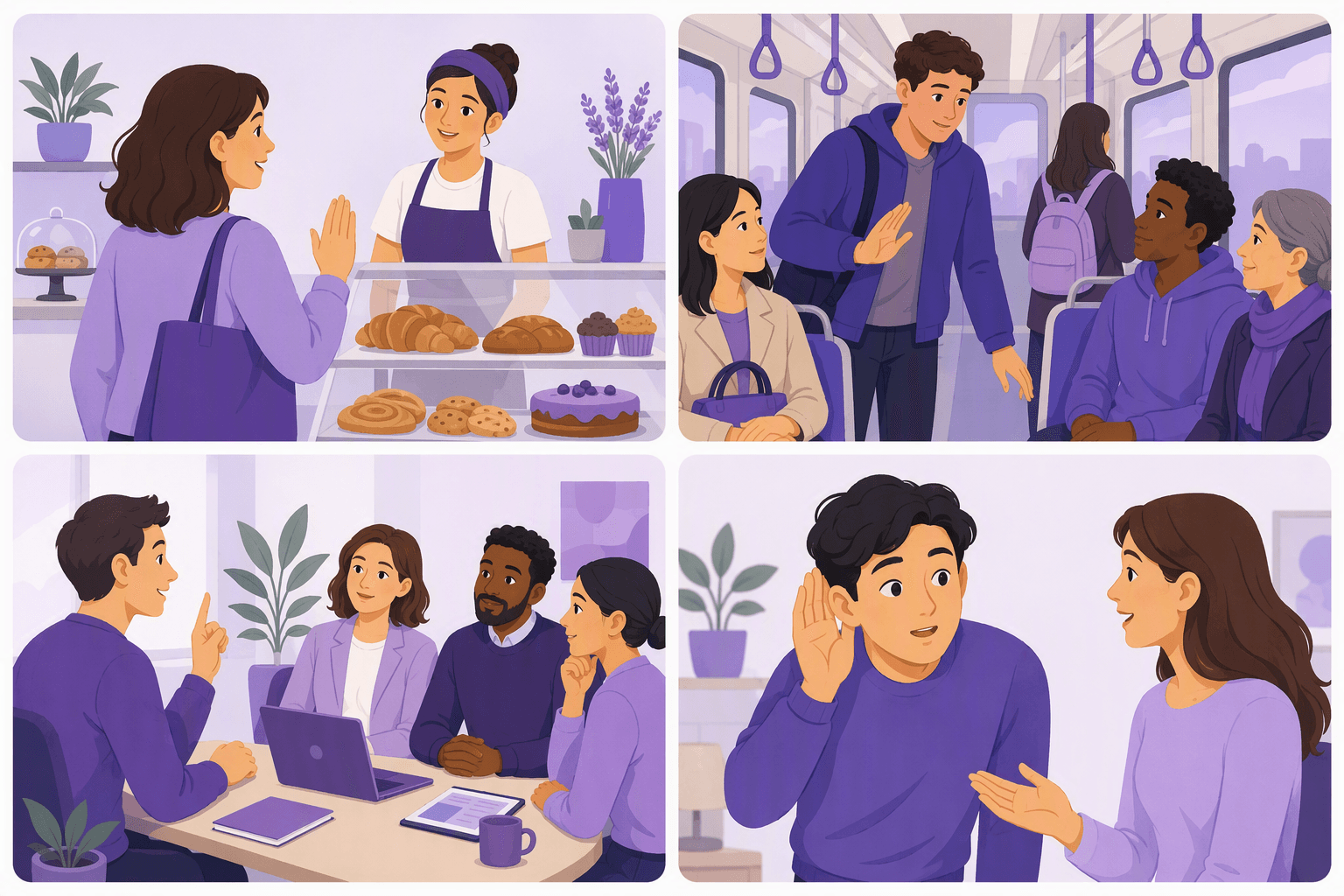
In English, “excuse me” can mean at least four different things: “move please,” “sorry,” “pardon?,” and “I’m about to interrupt you.” German splits those jobs more clearly.
That is why you will hear Entschuldigung everywhere, but also Bitte? / Wie bitte? when someone did not hear you, and Darf ich mal vorbei? when you need space.
Research on politeness and face-saving in interaction (Brown & Levinson, Politeness: Some Universals in Language Usage, Cambridge University Press) helps explain why Germans often prefer a short, efficient apology plus the practical request. In everyday German, sounding polite is less about long phrasing and more about choosing the right form and tone for the situation.
Entschuldigung
Entschuldigung (ent-SHOOL-dee-goong) is the safest default. Duden and DWDS both treat it as a standard apology and attention-getter, which matches how it works on the street.
Use it when you:
- bump into someone
- need to pass through a crowd
- want to ask a stranger a question
- want to start a polite request in a shop
What it feels like in real life
In German-speaking public spaces, people often keep a bit more personal distance than in some other cultures, and they value not forcing interaction. A quick Entschuldigung is a small signal that you noticed the other person and you are not ignoring them.
If you add a friendly nod and keep moving, it sounds natural. If you over-explain, it can feel heavy for a tiny situation.
/ent-SHOOL-dee-goong/
Literal meaning: Literally 'apology' or 'excuse'.
“Entschuldigung. Können Sie mir sagen, wo der Bahnhof ist?”
Excuse me. Can you tell me where the train station is?
This is the default in Germany, Austria, and Switzerland. It works for attention, small apologies, and polite requests.
’tschuldigung
’tschuldigung (CHUL-dee-goong) is what Entschuldigung often becomes in fast speech. You will hear it in crowded trains, busy sidewalks, and among younger speakers.
It is not rude, but it is clearly more casual. If you are speaking to staff, older strangers, or in a formal setting, the full Entschuldigung is safer.
💡 Pronunciation shortcut
If you struggle with ent-SHOOL-dee-goong, start with the middle: "SHOOL". Then add "ent-" and "-dee-goong" slowly. Germans will still understand you even if your rhythm is not perfect.
Verzeihung
Verzeihung (fehr-TSY-oonk) is a more formal “excuse me,” and it can sound a bit old-fashioned in casual contexts. It is still very useful when you want to show extra respect.
Use it when you:
- interrupt a meeting or formal conversation
- apologize to an older person when you want to sound careful
- correct yourself in a formal setting
DWDS connects verzeihen with “to forgive,” which is why Verzeihung can feel stronger than Entschuldigung. You are asking the other person to forgive you, not just acknowledging a small inconvenience.
/fehr-TSY-oonk/
Literal meaning: Related to 'to forgive'.
“Verzeihung, darf ich kurz etwas ergänzen?”
Excuse me, may I briefly add something?
Often used to sound especially respectful. In very casual settings it can feel stiff, so use it when the situation is clearly formal.
Es tut mir leid.
Es tut mir leid (ess toot meer LYTE) is a direct apology. If you truly want to say “I’m sorry,” this is usually the clearest choice.
It is common when:
- you are late
- you made a real mistake at work
- you hurt someone’s feelings
- you cannot do what someone asked
German also has Es tut mir leid, dass ... (“I’m sorry that ...”), which is useful when you need to name the problem.
The cultural nuance: clarity beats drama
A common learner mistake is trying to sound “very sorry” by stacking apologies. In many German contexts, one clear apology plus a concrete fix sounds more sincere than repeating the apology three times.
That matches what linguist Deborah Tannen describes in her work on conversational style: different cultures and communities signal sincerity differently, and what sounds warm in one style can sound excessive in another. In German-speaking settings, calm clarity often reads as respectful.
Bitte? and Wie bitte?
Bitte? (BIT-tuh) can mean “please,” “you’re welcome,” and also “pardon?” depending on intonation and context. For learners, this is confusing, but in real life it is simple: if you did not hear, you raise your intonation.
Wie bitte? (vee BIT-tuh) is a clearer “pardon?” and often sounds more polite than a bare Bitte?.
Use them when:
- you did not hear what someone said
- you want them to repeat
- you want to signal “I’m listening, but I missed it”
⚠️ Avoid the wrong 'excuse me'
Do not use "Bitte" to apologize after bumping into someone. In that situation, Germans expect "Entschuldigung" or "’tschuldigung". "Bitte" there can sound like you are saying "please" with no apology.
Entschuldigen Sie / Entschuldige: the grammar that changes the vibe
German “excuse me” often appears as a verb phrase:
- Entschuldigen Sie, ... (ent-SHOOL-dee-gen zee) formal
- Entschuldige, ... (ent-SHOOL-dee-guh) casual
This is where German politeness is very visible. The Sie form signals distance and respect. The du form signals familiarity.
If you are unsure, choose Sie with strangers. If someone says du to you first, you can usually switch.
If you want a deeper handle on formality and first impressions, start with how to say hello in German because greetings are where du vs Sie shows up immediately.
/ent-SHOOL-dee-gen zee, KUR-nten zee meer koorts HEL-fen/
Literal meaning: Literally 'Excuse (forgive) me'.
“Entschuldigen Sie, könnten Sie mir kurz helfen?”
Excuse me, could you help me for a moment?
A standard opener with strangers, staff, and formal situations. The 'Sie' form is the politeness marker.
Situation playbook: what to say, where
In a shop or restaurant
Start with Entschuldigung or Entschuldigen Sie, then ask your question. Germans often prefer a direct request after the opener.
Good patterns:
- Entschuldigung, können Sie mir helfen? (ent-SHOOL-dee-goong, KUR-nen zee meer HEL-fen)
- Entschuldigen Sie, ich hätte eine Frage. (ent-SHOOL-dee-gen zee, ikh HET-tuh EYE-nuh FRAH-guh)
If you want more practical service-language, German travel phrases can help, but in many daily interactions, these two lines carry you far.
On public transport or in crowds
Use short, functional phrases:
- ’tschuldigung (CHUL-dee-goong)
- Darf ich mal vorbei? (darf ikh mahl for-BYE)
In very tight spaces, Germans may not say anything at all, but if you touch someone or squeeze past, a quick apology is normal.
Interrupting someone (meeting, classroom, office)
Choose a slightly longer, polite line:
- Entschuldigung, dass ich störe. (ent-SHOOL-dee-goong, dahss ikh SHTUR-uh)
- Verzeihung, darf ich kurz ...? (fehr-TSY-oonk, darf ikh koorts)
In professional contexts, the Sie form is common unless the team has explicitly switched to du.
If you did something wrong
Use Es tut mir leid when the mistake matters. If you want to show responsibility, add a fix:
- Es tut mir leid. Ich mache das sofort. (ess toot meer LYTE. ikh MAH-khuh dahs zoh-FORT)
- Das war keine Absicht. (dahs vahr KYE-nuh AHP-zikht)
Duden’s usage notes for apology words align with this: German distinguishes between a small “excuse me” and a real apology.
If you want someone to repeat
Use:
- Wie bitte? (vee BIT-tuh)
- Entschuldigung? with rising intonation (ent-SHOOL-dee-goong)
A small cultural detail: Wie bitte? often sounds more respectful than a blunt Was? (“What?”), which can sound sharp with strangers.
Regional and social variation (Germany, Austria, Switzerland)
German is pluricentric, meaning multiple national standards exist. You will still be understood everywhere with Entschuldigung and Es tut mir leid, but you may notice differences in frequency and tone.
Switzerland: more softeners, less friction
In Swiss German speaking areas, people often use local dialect in daily life, but Standard German appears in formal writing and many service contexts. You may hear more “softening” strategies, like adding bitte in requests, even when the apology word is the same.
If you are curious how German changes across borders, German-speaking countries gives a broader map of where it is used and how it varies.
Austria: warmth plus directness
In Austria, many interactions feel slightly warmer in tone, but the same core phrases apply. The main learner takeaway is not to chase dialect forms early. Standard phrases plus friendly delivery work well.
Common learner mistakes (and how to fix them)
Mixing up "Bitte" and "Entschuldigung"
If you are apologizing, choose Entschuldigung or Es tut mir leid. If you are requesting, choose Bitte as “please.”
If you are asking someone to repeat, Bitte? is fine, but intonation matters.
Overusing "Verzeihung"
Verzeihung is correct, but if you use it every time you pass someone in a supermarket, you can sound overly formal. Keep it for interruptions and formal moments.
Forgetting the pronoun choice: Sie vs du
A lot of “politeness” in German is grammatical. If you use du with a stranger who expects Sie, your “excuse me” can sound too familiar, even if the words are correct.
If you want a quick reminder of polite defaults, how to say goodbye in German is useful because farewells also show Sie patterns clearly.
Mini script: three natural ways to start a question
These are the lines you will actually use in the street.
- Entschuldigung, wo ist ...? (ent-SHOOL-dee-goong, voh ist)
- Entschuldigen Sie, könnten Sie mir helfen? (ent-SHOOL-dee-gen zee, KUR-nten zee meer HEL-fen)
- ’tschuldigung, ich suche ... (CHUL-dee-goong, ikh ZOO-khuh)
Keep your question short. Germans often answer quickly and efficiently, and that is not coldness, it is cooperation.
🌍 Why German apologies can sound 'short'
In many German-speaking contexts, politeness is shown through correct forms, calm tone, and not wasting the other person’s time. A brief "Entschuldigung" plus the request respects the listener’s space. This often feels different to learners from cultures where warmth is shown through longer phrasing.
When not to use "excuse me" language
If someone is being aggressive or insulting, “excuse me” phrases will not fix the interaction. In those cases, the safest move is to disengage.
If you are learning the “other side” of German emotional language, read our guide to German swear words to recognize what you might hear, not to copy it into polite situations.
Practice with real dialogue (the movie and TV method)
The hardest part is not memorizing Entschuldigung, it is hearing it at full speed and choosing the right follow-up. That is why short clips help: you can replay the same situation (crowd, shop, office) and copy the timing.
A practical routine:
- Listen for the opener: Entschuldigung vs Wie bitte?
- Repeat with the same rhythm.
- Swap in your own request: wo ist, können Sie, darf ich.
For a broader strategy, how to learn a language with movies breaks down a method that works even if you only have 15 minutes a day.
Quick recap
Use Entschuldigung (ent-SHOOL-dee-goong) as your default “excuse me.” Use Verzeihung (fehr-TSY-oonk) when you want extra formality, and Es tut mir leid (ess toot meer LYTE) when you are truly apologizing. For “pardon?” choose Wie bitte?.
If you want to keep building polite, real German, continue with how to say I love you in German for relationship tone and register, and then reinforce everything through listening practice on /learn/german.
Frequently Asked Questions
What is the most common way to say excuse me in German?
Is 'Entschuldigung' the same as 'sorry'?
When should I use 'Verzeihung'?
How do Germans say 'excuse me' when squeezing past someone?
What is the difference between 'Bitte' and 'Entschuldigung'?
Is it rude to say English 'sorry' in German-speaking countries?
Sources & References
- Duden, 'Entschuldigung' and usage notes, accessed 2026
- DWDS (Digitales Wörterbuch der deutschen Sprache), entries for 'Entschuldigung' and 'verzeihen', accessed 2026
- Goethe-Institut, German etiquette and communication guidance, accessed 2026
- Ethnologue: Languages of the World, German language entry (27th edition, 2024)
- Brown, P. & Levinson, S. C., Politeness: Some Universals in Language Usage, Cambridge University Press
Start learning with Wordy
Watch real movie clips and build your vocabulary as you go. Free to download.


