Quick Answer
German humor is not humorless, but it is often drier, more situation-based, and more dependent on shared context than many visitors expect. Learn how irony, political satire, regional traditions, directness, and social boundaries shape what Germans find funny.
German humor is real, varied, and often very funny, but it tends to be drier, more contextual, and less performatively cheerful than visitors may expect. Germans enjoy absurdity, wordplay, self-mockery, political satire, and jokes about everyday systems, yet the same joke can land differently depending on region, age, relationship, and timing.
The old idea that Germans have no sense of humor is a cultural shortcut, not a useful description. German /ˈdɔʏtʃ/ is spoken by roughly 90 million native speakers, according to Ethnologue, across Germany, Austria, Switzerland, Liechtenstein, Belgium, Luxembourg, and worldwide communities. A language used across that range naturally has many comic styles.
If you already know how to say hello in German, humor is the next social layer to notice. A correct greeting opens a conversation. Recognizing a deadpan joke helps you understand what is happening inside it.
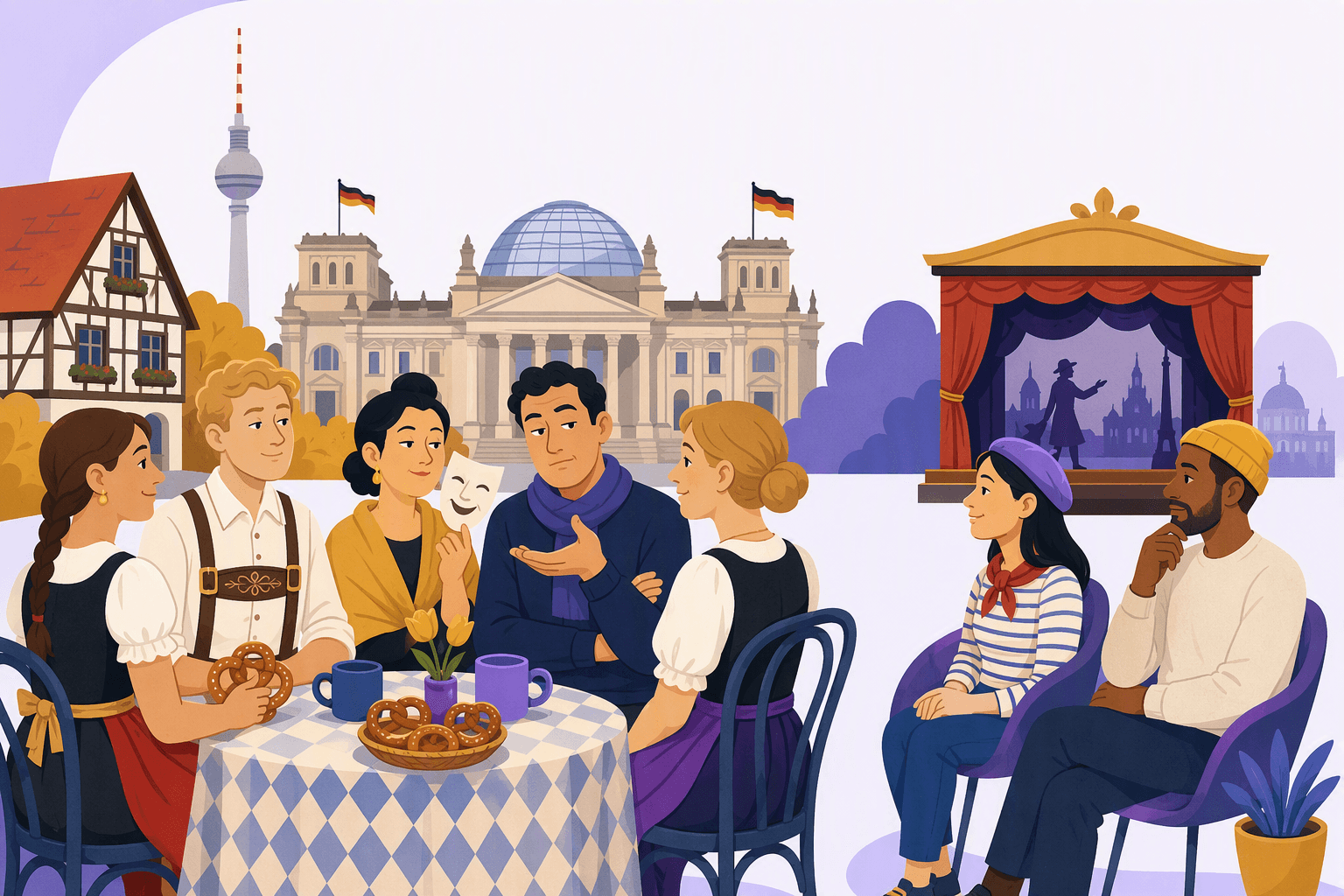
Why German humor can seem hard to read
German humor is often built around contrast. A speaker may describe an obviously ridiculous situation in a calm, serious voice, then allow the listener to notice the absurdity without being told when to laugh.
This can feel understated to learners used to expressive delivery, frequent smiling, or highly obvious punchlines. The humor is not absent. It may be hidden in tone, phrasing, timing, and shared knowledge.
The German noun Humor /huˈmoːɐ̯/ can refer to a general sense of amusement, while a Witz /vɪts/ is a joke. A Witz may be a short punchline joke, but it can also describe a funny idea, a clever remark, or an absurd situation.
Directness is not automatically hostility
German communication is often more direct than English-language small talk. A colleague who says a plan is unrealistic may simply be giving useful feedback, not attacking you.
That directness makes a certain kind of dry humor possible. A person can state something bluntly, pause, and reveal through tone that the comment is intentionally exaggerated. Learners sometimes interpret this as anger because they are listening only to the words.
The key question is whether the literal statement matches reality. If a friend looks at a train delay and says Perfekt, genau das habe ich heute gebraucht /pɛʁˈfɛkt ɡəˈnaʊ das ˈhaːbə ɪç ˈhɔʏtə ɡəˈbʁaʊxt/, meaning “Perfect, exactly what I needed today,” the contradiction signals irony.
Smiling is not the only signal
In some cultures, smiling softens ordinary requests, disagreement, or awkward moments. In Germany, speakers may use fewer visible signals in public, especially with unfamiliar people.
That can make a joke appear serious at first. Listen for a deliberately flat voice, an exaggeratedly formal phrase, a pause, or an impossible claim. These are common signals that the speaker expects you to recognize the joke yourself.
💡 Read the situation before the words
If the literal meaning is clearly opposite to the moment, you may be hearing irony. Wait for the speaker's tone and the group's reaction before assuming a blunt sentence is serious.
Dry irony and everyday absurdity
Dry irony is one of the most recognizable features of German comic style. It works especially well when people are dealing with minor frustration: paperwork, delays, technical failures, complicated rules, or bad weather.
Germany has a reputation for order and administrative precision, so bureaucracy is a reliable comic target. Jokes about forms, appointments, stamps, and rules work because the audience recognizes the experience.
The phrase typisch deutsch /ˈtʏpɪʃ dɔʏtʃ/, meaning “typically German,” can be affectionate, critical, or ironic. Someone may use it after an overly detailed discussion about recycling rules, punctuality, or whether a sign permits something.
Understatement creates the punchline
A common pattern is to react to a major inconvenience with a deliberately small assessment. After spilling coffee over a report, someone might say Das ist jetzt nicht optimal /das ɪst jɛtst nɪçt ɔptiˈmaːl/, meaning “That is not ideal right now.”
The humor comes from the gap between the mild wording and the obvious disaster. This form is close to British understatement, but the cultural references and delivery will differ.
German comedy also enjoys literal-mindedness. A character follows a rule so exactly that the rule becomes ridiculous. This is especially common in sketches about office life, customer service, family arguments, and public administration.
Loriot and the comedy of social discomfort
No discussion of German humor culture is complete without Loriot, the stage name of Vicco von Bülow. His sketches are famous for turning polite middle-class situations into escalating disasters.
In works such as Ödipussi /øˈdiːpʊsi/ and Papa ante portas /ˈpaːpa ˈantə ˈpɔʁtas/, as well as his television sketches, characters struggle with social etiquette, marriage, language, and status. The comedy is rarely based on loud punchlines. It comes from people trying too hard to remain civilized while everything falls apart.
One classic Loriot pattern is the overly precise conversation. Two people debate a tiny wording choice, a household object, or an etiquette rule until their relationship begins to crack. For learners, this style is useful because it reveals how much German comedy can depend on formality and exact language.
The joke is often not that a character is foolish. It is that everyone treats an absurd problem as if it were gravely important.
🌍 Politeness can be funny
German comedy frequently uses formal language to heighten absurdity. A character may say Darf ich? /daʁf ɪç/, meaning “May I?”, with extreme seriousness in a moment where permission is clearly no longer the real issue.
Kabarett: satire with a political purpose
German Kabarett /kabaˈʁɛt/ is a major tradition of political and literary comedy. It is closer to satirical stage commentary than to the glamorous dance-and-music meaning that the English word “cabaret” can suggest.
Performers use monologues, songs, parody, impersonation, and careful argument to criticize politicians, media narratives, corporate power, and social habits. The Deutsches Kabarettarchiv documents this tradition and its long place in German public culture.
Dieter Hildebrandt, especially through the political television program Scheibenwischer /ˈʃaɪbn̩ˌvɪʃɐ/, helped make political satire a mainstream form of television entertainment. The comedy expected viewers to follow current events and spot contradictions in public language.
This matters for learners because political jokes often require background knowledge. If a comedian references a coalition dispute, a tax policy, or a regional election, vocabulary alone will not explain the punchline.
Satire is often analytical
A Satire /zaˈtiːʁə/ may sound less spontaneous than stand-up comedy. That is partly the point. Many German satirists construct an argument, then expose its weakness by pushing it to an extreme.
Sigmund Freud’s Jokes and Their Relation to the Unconscious treats jokes as structured social acts rather than random bursts of laughter. That idea is useful here: comedy communicates belonging, criticism, tension, and permission to say what would otherwise be difficult.
Political satire can be sharp. A joke may target a public institution or ideology rather than invite everyone into a warm, shared laugh. It is often designed to make an audience uncomfortable before it makes them amused.
Karneval, Fasching, and public silliness
The loudest version of German humor appears during Karneval /kaʁnəˈvaːl/, called Fasching /ˈfaʃɪŋ/ in many southern and eastern regions and Fastnacht /ˈfastnaxt/ in other areas. The traditions vary greatly by region.
In Cologne, Mainz, and Düsseldorf, carnival season includes parades, costumes, satirical floats, music, and public speeches. A Büttenrede /ˈbʏtn̩ˌʁeːdə/ is a rhyming or comic speech, often delivered from a barrel-shaped podium and filled with topical jokes.
This is an important correction to the humorless-Germany stereotype. During carnival, cities can become intentionally noisy, theatrical, and ridiculous. People wear costumes, sing in dialect, poke fun at politicians, and greet strangers with local carnival expressions.
Yet carnival humor is regional. Someone from northern Germany may enjoy it, ignore it, or find it exhausting. Do not assume every German celebrates it with equal enthusiasm.
Local identity matters
Regional humor can rely on dialect, accent, and long-standing stereotypes. Bavarian, Rhineland, Berlin, Saxon, and northern German comic traditions all have different rhythms and social references.
A Berlin-style joke may sound blunt and impatient. Rhineland comedy can be more sociable and carnival-oriented. Bavarian humor may feature village life, authority, or local identity. These are broad patterns, not rules about individual people.
Mikhail Bakhtin’s Rabelais and His World examines carnival as a social space where normal hierarchies can be temporarily reversed. That framework helps explain why carnival jokes can be louder and more irreverent than everyday German interaction.
Teasing, insults, and friendship boundaries
German friends tease each other, but teasing is not a universal invitation. The safest humor with people you do not know well is gentle self-deprecation or a comment about a shared situation.
Avoid jokes about nationality, income, religion, appearance, disability, or family. These can feel intrusive quickly, especially when language learners cannot yet control tone precisely.
A playful insult can sound much harsher in a second language. Before copying expressions from films or online comments, learn the register and relationship behind them. Our guide to German swear words explains why literal translations rarely show the real severity of a phrase.
Self-mockery is a safe starting point
It is usually safer to joke about your own learning mistakes. For example, after mixing up an article, you can smile and say Mein Deutsch braucht noch Kaffee /maɪn dɔʏtʃ bʁaʊxt nɔx kaˈfeː/, meaning “My German still needs coffee.”
This works because it does not pressure anyone else to accept a joke at their expense. It also invites a friendly correction without making the conversation overly serious.
Do not force humor after every error. A simple Entschuldigung /ɛntˈʃʊldɪɡʊŋ/, meaning “sorry” or “excuse me,” is often better when you have caused a real inconvenience.
Wordplay and why it is difficult for learners
German wordplay can be wonderfully inventive because German compounds combine familiar words into long new labels. A Wortspiel /ˈvɔʁtʃpiːl/ is a pun or word game, and it may depend on double meanings, similar sounds, regional pronunciation, or compounds with surprising literal readings.
For example, umfahren /ˈʊmfaːʁən/ can mean “to drive around something” when the stress is on the first syllable, but “to run something over” when the stress shifts to the second syllable: umfahren /ʊmˈfaːʁən/. The spelling stays the same while the meaning changes dramatically.
This kind of joke is hard to translate because the joke lives in the sound system and grammar. It also rewards close listening, which is one reason comedy clips are useful study material.
Watch a scene once with subtitles, then replay it without them. Notice whether the laugh follows a word choice, a pause, a facial expression, or a cultural reference. That process builds the listening skill needed for real conversations.
Humor at work and in formal settings
German workplaces can be friendly, but humor often develops after colleagues know one another. Early interactions may focus on competence, clarity, and boundaries rather than personal banter.
A light joke about a shared meeting problem can work. Sarcasm toward a manager, mocking a client, or making personal jokes too early can damage trust. Observe the group first.
The same principle applies to greetings and farewells. Learn the appropriate level of formality before adding humor to it. Our guides to German greetings and goodbye phrases in German can help you establish the right tone.
⚠️ Do not copy every joke from television
Comedy scripts use exaggeration, fictional conflict, dialect, and taboo language. A phrase that is funny from a fictional character may sound rude, dated, or confusing when repeated by a learner in a real workplace or with strangers.
How to learn German humor through films and shows
Start with comedy you can understand partly through the situation. Family scenes, workplace misunderstandings, and travel mishaps give you visual clues that make the language easier to decode.
Choose short scenes and make a small humor notebook. Write the literal meaning, the intended meaning, the social relationship, and the trigger for the laugh. Over time, you will see recurring patterns: understatement, over-formality, contradiction, and rule-following taken too far.
Pay attention to what characters do after a joke. Do they laugh loudly, give a brief smile, change the subject, or answer with another dry line? Those reactions teach social timing better than a dictionary definition can.
Romantic comedy also offers useful clues about emotional restraint and indirect affection. Compare the comic tone with the phrases in our guide to saying I love you in German. The contrast between direct words and understated delivery is often part of the humor.
The practical rule: be curious, not performative
You do not need to become a German comedian to connect with German speakers. The strongest approach is to notice the humor already happening, respond naturally, and ask about references you do not understand.
A simple Ach so! /ax zoː/, meaning “Oh, I see,” or a smile can be enough when you realize someone was joking. If you miss a joke, it is fine to ask what made it funny. Many people enjoy explaining a local reference once they know you are genuinely interested.
German humor culture is not one thing. It ranges from quiet irony in a kitchen to loud carnival speeches, from carefully written political satire to ridiculous wordplay. Learn the context, listen for the mismatch between words and reality, and allow yourself time to recognize the joke.
Frequently Asked Questions
Do Germans really have no sense of humor?
What kind of jokes are popular in Germany?
Is sarcasm common in German?
Why is German political comedy called Kabarett?
Can German learners make jokes in German?
Sources & References
- Ethnologue, Languages of the World, 27th edition, 2024
- Duden, Wörterbuch entries for Humor, Witz, Ironie, and Satire, accessed 2026
- Goethe-Institut, German culture resources on Karneval and Kabarett, accessed 2026
- Deutsches Kabarettarchiv, institutional collections and history, accessed 2026
- Sigmund Freud, Jokes and Their Relation to the Unconscious, W. W. Norton
Start learning with Wordy
Watch real movie clips and build your vocabulary as you go. Free to download.


