Quick Answer
German music vocabulary includes everyday words such as Musik, Lied, Konzert, Band, and Sängerin, plus useful phrases for buying tickets, discussing lyrics, and reacting to a performance. This guide teaches the terms you will hear in German songs, at live shows, and in conversations with music fans.
| English | German | Pronunciation | Note |
|---|---|---|---|
| music | Musik | /muˈziːk/ | Feminine noun: die Musik. |
| song | Lied | /liːt/ | Neuter noun: das Lied, often traditional or artistic. |
| pop song | Song | /zɔŋ/ | Masculine noun: der Song, common in pop and rock. |
| concert | Konzert | /kɔnˈtsɛʁt/ | Neuter noun: das Konzert. |
| band | Band | /bɛnt/ | Feminine noun: die Band. |
| singer | Sänger | /ˈzɛŋɐ/ | Masculine form. |
| female singer | Sängerin | /ˈzɛŋəʁɪn/ | Feminine form. |
| lyrics | Liedtext | /ˈliːtˌtɛkst/ | Plural: Liedtexte. |
| melody | Melodie | /meloˈdiː/ | Feminine noun: die Melodie. |
| rhythm | Rhythmus | /ˈʁʏtmʊs/ | Masculine noun: der Rhythmus. |
| stage | Bühne | /ˈbyːnə/ | Feminine noun: die Bühne. |
| ticket | Karte | /ˈkaʁtə/ | A concert ticket is die Eintrittskarte. |
German music vocabulary is practical far beyond the classroom. Learn words such as Musik /muˈziːk/, Lied /liːt/, Konzert /kɔnˈtsɛʁt/, and Bühne /ˈbyːnə/ and you can understand event listings, introduce your favorite artist, buy a ticket, and follow much more of a German song.
German is spoken by roughly 130 million people worldwide and is an official or co-official language in six European countries: Germany, Austria, Switzerland, Liechtenstein, Belgium, and Luxembourg. That gives German-language music a wide audience and several distinct regional scenes.
For learners, music is also memorable input. A chorus repeats key structures, a singer makes word stress audible, and a live-performance clip supplies facial expression and context. Pair this guide with German pronunciation practice so you can hear the vowel length and final consonants that writing alone hides.
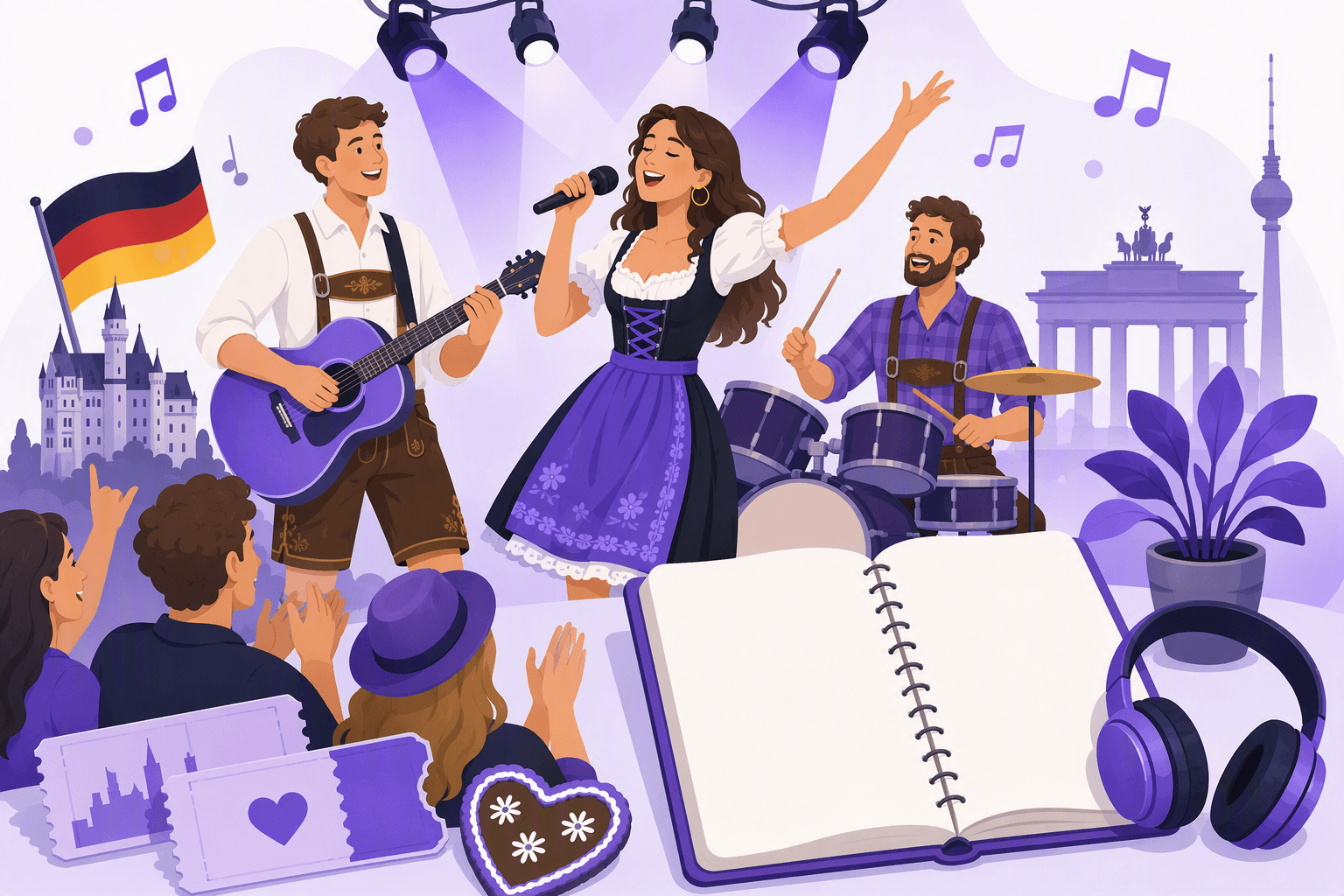
The words you need first
German nouns always have grammatical gender, so learn each music word with its article. This is not a decorative detail: the article affects adjectives, pronouns, and other words around the noun.
Musik
Musik /muˈziːk/ means music generally. It is feminine: die Musik /diː muˈziːk/.
- Ich höre gern Musik. /ɪç ˈhøːʁə ɡɛʁn muˈziːk/ means I like listening to music.
- Welche Musik magst du? /ˈvɛlçə muˈziːk maːkst duː/ means What music do you like?
- Die Musik ist zu laut. /diː muˈziːk ɪst tsuː laʊt/ means The music is too loud.
The verb hören /ˈhøːʁən/, to listen or hear, is the default verb with music. German often says Musik hören /muˈziːk ˈhøːʁən/ where English might say listen to music.
Lied
A Lied /liːt/ is a song, and it is neuter: das Lied /das liːt/. The plural is die Lieder /diː ˈliːdɐ/.
Use it for a song in the broad sense, especially folk songs, children’s songs, choral works, and art songs. In German classical music, Kunstlied /ˈkʊnstliːt/ refers to the art-song tradition associated with composers such as Franz Schubert, whose settings combine poetry and voice with piano.
- Das Lied kenne ich. /das liːt ˈkɛnə ɪç/ means I know that song.
- Mein Lieblingslied ist von... /maɪn ˈliːplɪŋsliːt ɪst fɔn/ means My favorite song is by...
- Wie heißt dieses Lied? /viː haɪst ˈdiːzəs liːt/ means What is this song called?
Song
Song /zɔŋ/ is also widely used, particularly for pop, rap, rock, and electronic releases. It is masculine: der Song /deːɐ zɔŋ/, with the plural die Songs /diː zɔŋs/.
The distinction is cultural rather than strict. A teenager discussing a new release may naturally say Dieser Song ist krass /ˈdiːzɐ zɔŋ ɪst kʁas/, while a choir director is more likely to say Lied /liːt/.
Konzert
A Konzert /kɔnˈtsɛʁt/ is a concert, and it is neuter: das Konzert /das kɔnˈtsɛʁt/. The plural is Konzerte /kɔnˈtsɛʁtə/.
- Wir gehen heute Abend auf ein Konzert. /viːɐ ɡeːən ˈhɔʏtə ˈaːbənt aʊf aɪn kɔnˈtsɛʁt/ means We are going to a concert tonight.
- Das Konzert war ausverkauft. /das kɔnˈtsɛʁt vaːɐ ˈaʊsˌfɛʁkaʊft/ means The concert was sold out.
- Hast du schon Karten? /hast duː ʃoːn ˈkaʁtn̩/ means Do you already have tickets?
For classical music, Konzert /kɔnˈtsɛʁt/ can also mean a concerto. Context tells you whether it is an event or a composition.
People, places, and instruments
At a show, a few concrete nouns unlock most announcements and small talk. Notice that German often creates precise compound nouns by joining familiar words.
Band
A music Band /bɛnt/ is feminine: die Band /diː bɛnt/. Although the English source word has no gender, standard German assigns it feminine gender.
Die Band kommt aus Hamburg /diː bɛnt kɔmt aʊs ˈhambʊʁk/ means The band is from Hamburg. For a solo musician, say Solokünstler /ˈzoːloˌkʏnstlɐ/ for a male solo artist or Solokünstlerin /ˈzoːloˌkʏnstləʁɪn/ for a female solo artist.
Sänger und Sängerin
A male singer is a Sänger /ˈzɛŋɐ/ and a female singer is a Sängerin /ˈzɛŋəʁɪn/. The verb is singen /ˈzɪŋən/, to sing.
German makes gendered forms visibly: add -in /ɪn/ for many feminine professional nouns. The plural Sängerinnen /ˈzɛŋəʁɪnən/ adds -nen, while Sänger /ˈzɛŋɐ/ can refer to an all-male or mixed group depending on context.
Bühne
The Bühne /ˈbyːnə/ is the stage. The long front rounded vowel /yː/ has no exact English equivalent: say an /iː/ sound while rounding your lips.
You might hear auf die Bühne kommen /aʊf diː ˈbyːnə ˈkɔmən/, to come onto the stage, or von der Bühne gehen /fɔn deːɐ ˈbyːnə ɡeːən/, to leave the stage. At festivals, Hauptbühne /ˈhaʊptˌbyːnə/ means main stage.
Instrumente
An instrument is an Instrument /ɪnstʁuˈmɛnt/, plural Instrumente /ɪnstʁuˈmɛntə/. Common examples include:
| English | German | IPA |
|---|---|---|
| guitar | Gitarre | /ɡiˈtaʁə/ |
| piano | Klavier | /klaˈviːɐ/ |
| drums | Schlagzeug | /ˈʃlaːktsɔʏk/ |
| bass | Bass | /bas/ |
| violin | Geige | /ˈɡaɪɡə/ |
| trumpet | Trompete | /tʁɔmˈpeːtə/ |
| keyboard | Keyboard | /ˈkiːbɔːʁt/ |
Schlagzeug /ˈʃlaːktsɔʏk/ literally combines Schlag /ʃlaːk/, strike, and Zeug /tsɔʏk/, stuff or equipment. This kind of compound is typical of German and useful for decoding unfamiliar vocabulary. For more on that pattern, see our guide to German compound words.
Genres you will see on German playlists
Genres are often international words, but German articles and pronunciation make them part of the language. A streaming service may label a category in English, while a German presenter talks about it using German grammar.
| Genre | German form | IPA | Useful context |
|---|---|---|---|
| pop | Pop | /pɔp/ | der Pop /deːɐ pɔp/ |
| rock | Rock | /ʁɔk/ | der Rock /deːɐ ʁɔk/ |
| hip-hop | Hip-Hop | /ˈhɪp hɔp/ | der Hip-Hop /deːɐ ˈhɪp hɔp/ |
| techno | Techno | /ˈtɛçno/ | der Techno /deːɐ ˈtɛçno/ |
| electronic music | elektronische Musik | /ɛlɛkˈtʁoːnɪʃə muˈziːk/ | Broad category |
| classical music | klassische Musik | /ˈklasɪʃə muˈziːk/ | Includes orchestral traditions |
| folk music | Volksmusik | /ˈfɔlksmuziːk/ | Regional and traditional styles |
| schlager | Schlager | /ˈʃlaːɡɐ/ | Catchy German-language pop style |
Schlager
Schlager /ˈʃlaːɡɐ/ is a German-language popular music tradition known for direct melodies, sentimental or celebratory lyrics, and choruses designed for group singing. The word comes from schlagen /ˈʃlaːɡən/, to hit, in the sense of a hit song.
Do not translate Schlager /ˈʃlaːɡɐ/ simply as pop. It has its own audience, television programs, festivals, and visual style across Germany, Austria, and parts of Switzerland. A fan may call a track ein Ohrwurm /aɪn ˈoːɐvʊʁm/, literally an earworm, when its melody will not leave their head.
Techno
Berlin’s association with Techno /ˈtɛçno/ is internationally significant. The city’s techno culture was added to Germany’s national inventory of intangible cultural heritage in 2024, recognizing its post-reunification history, community networks, clubs, DJs, and participatory dance culture.
In music conversation, Club /klʊp/ refers to a nightclub or venue, while der DJ /deːɐ deːˈʒeː/ is the disc jockey. You might say Der DJ legt auf /deːɐ deːˈʒeː leːkt aʊf/, meaning The DJ is playing a set. The separable verb auflegen /ˈaʊfˌleːɡən/ is worth learning as a whole phrase.
🌍 Music is not one German culture
German-language music is not limited to Germany. Austrian pop, Swiss rap, and artists from multilingual Belgium and Luxembourg all contribute different accents, identities, and local references. A word such as Dialekt /diaˈlɛkt/, dialect, matters especially in rap, folk traditions, and regional pop.
Talking about songs and lyrics
A lyric is a Liedtext /ˈliːtˌtɛkst/, plural Liedtexte /ˈliːtˌtɛkstə/. For the words of a track in a casual setting, people also say Lyrics /ˈlɪʁɪks/, an English borrowing.
Here are high-value reactions you can use after hearing a song:
| English | German | IPA |
|---|---|---|
| I love this song. | Ich liebe diesen Song. | /ɪç ˈliːbə ˈdiːzən zɔŋ/ |
| The lyrics are beautiful. | Der Liedtext ist schön. | /deːɐ ˈliːtˌtɛkst ɪst ʃøːn/ |
| The beat is great. | Der Beat ist super. | /deːɐ biːt ɪst ˈzuːpɐ/ |
| This melody is catchy. | Diese Melodie geht ins Ohr. | /ˈdiːzə meloˈdiː ɡeːt ɪns oːɐ/ |
| What is this song called? | Wie heißt dieser Song? | /viː haɪst ˈdiːzɐ zɔŋ/ |
| Put that song on again. | Mach den Song noch mal an. | /max deːn zɔŋ nɔx maːl an/ |
The phrase ins Ohr gehen /ɪns oːɐ ɡeːən/, literally to go into the ear, means a melody is catchy. It is related to Ohrwurm /ˈoːɐvʊʁm/, a tune stuck in your head.
For romantic lyrics, German has several registers. Ich liebe dich /ɪç ˈliːbə dɪç/ is direct and serious, while songwriters may use poetic imagery that would feel unusually intense in everyday speech. Our guide on saying I love you in German explains the social weight behind this phrase.
Concert and festival survival vocabulary
A live show involves logistics as well as music. These words help you read a venue website and ask simple questions.
- der Eintritt /deːɐ ˈaɪntʁɪt/ means admission.
- die Eintrittskarte /diː ˈaɪntʁɪtsˌkaʁtə/ means admission ticket.
- der Einlass /deːɐ ˈaɪnlas/ means doors opening or entry.
- ausverkauft /ˈaʊsˌfɛʁkaʊft/ means sold out.
- die Vorband /diː ˈfoːɐbant/ means opening act.
- die Zugabe /diː ˈtsuːɡaːbə/ means encore.
- das Festival /das fɛstiˈvaːl/ means festival.
- die Warteschlange /diː ˈvaʁtəˌʃlaŋə/ means queue.
Wann ist Einlass? /van ɪst ˈaɪnlas/ means When do doors open? Ask it at the venue or check it on the ticket. Das Konzert ist ausverkauft /das kɔnˈtsɛʁt ɪst ˈaʊsˌfɛʁkaʊft/ is disappointing but unambiguous: there are no tickets left.
At the end, audiences may call Zugabe! /ˈtsuːɡaːbə/ to request an encore. The response can be loud and collective, particularly at rock shows and festivals.
💡 Learn a whole chorus, not isolated words
Choose one chorus with clearly audible vocals. First read the German lyrics, then listen without pausing, then shadow two lines at a time. Repetition gives grammar a melody, which is more useful than memorizing an unconnected list of nouns.
Why German music is useful language input
Germany has a dense music ecosystem. The German Music Information Centre reports that around 14 million people in Germany make music in some form, from school ensembles and choirs to amateur orchestras and bands. That social participation explains why music vocabulary appears in daily conversation, local newspapers, school life, and public festivals.
Theodor W. Adorno’s Introduction to the Sociology of Music treats music as a social practice shaped by institutions, audiences, and technology, not merely as sound. That perspective helps learners notice that a Konzert /kɔnˈtsɛʁt/, a club night, and a football-stadium singalong each have their own language rules.
Peter Wicke’s Rock Music: Culture, Aesthetics and Sociology similarly places popular music within communities and media systems. For German learners, the useful lesson is simple: listen for who is speaking, where they are speaking, and what relationship the performers have with their audience.
A music video is especially effective because it offers several clues at once: rhythm, setting, gesture, subtitles, and repeated lines. If you are using films and series too, learning a language with movies provides a structured method for turning entertainment into active practice.
A practical way to use these words
Start with five nouns: Musik /muˈziːk/, Lied /liːt/, Song /zɔŋ/, Konzert /kɔnˈtsɛʁt/, and Band /bɛnt/. Then add one opinion sentence, such as Ich mag diesen Song /ɪç maːk ˈdiːzən zɔŋ/.
Next, follow one German-language artist or festival account. Save captions containing familiar terms, and write down one new phrase each week. When you can greet people naturally with Hallo /haˈloː/ and close a conversation with Tschüss /tʃʏs/, music recommendations become an easy reason to keep talking. See German hello phrases and natural German goodbyes for the social basics.
The aim is not to understand every metaphor in a song on the first listen. Recognize the hook, notice repeated verbs and nouns, and return to the same track until the phrases become familiar. That is how German music vocabulary becomes usable German.
Frequently Asked Questions
What is music called in German?
What is the difference between Lied and Song in German?
How do you say I like this song in German?
What music genres are popular in Germany?
Do German speakers use English music words?
Sources & References
- Goethe-Institut, German Language: Facts and Figures, accessed 2026
- Deutsches Musikinformationszentrum, Musikleben in Deutschland, accessed 2026
- Duden, Online Dictionary entries for Musik, Lied, Konzert, and Schlager, accessed 2026
- Deutscher Musikrat, German Music Council publications, accessed 2026
- Ethnologue, German, 27th edition, 2024
Start learning with Wordy
Watch real movie clips and build your vocabulary as you go. Free to download.


