Quick Answer
German food culture is built around bread and breakfast, a hot midday meal in many regions, and a lighter evening meal, plus strong etiquette around greetings, toasts, and paying. If you learn a few set phrases like 'Guten Appetit!' and understand customs like splitting bills and direct ordering, you will feel comfortable in German restaurants, beer gardens, and homes.
German food culture is practical, social, and surprisingly rule-governed: expect bread-centered breakfasts, direct ordering in restaurants, strong toast etiquette (eye contact matters), and a payment style where you often say the final amount you will pay. Learn a handful of fixed table phrases and you can eat comfortably anywhere from a Berlin lunch spot to a Bavarian beer garden.
If you want the basics of greeting and leaving politely before you even touch the menu, pair this with how to say hello in German and how to say goodbye in German.
| English | German | Pronunciation | Formality |
|---|---|---|---|
| Enjoy your meal! | Guten Appetit! | GOO-ten ah-peh-TEET | polite |
| Lunch time! (also: enjoy your meal) | Mahlzeit! | MAHL-tsyte | casual |
| Cheers! | Prost! | PROHST | casual |
| Cheers! (more general, also for non-alcohol) | Zum Wohl! | tsoom VOHL | polite |
| Excuse me (to get attention) | Entschuldigung! | ent-SHOOL-dee-goong | polite |
| A table for two, please. | Einen Tisch für zwei, bitte. | EYE-nen TISH fewr TSVY, BIT-tuh | polite |
| I'd like..., please. | Ich hätte gern ..., bitte. | ikh HEH-tuh gern, BIT-tuh | polite |
| Could we have the menu, please? | Könnten wir die Speisekarte haben, bitte? | KURN-ten veer dee SHPY-zuh-kar-tuh HAH-ben, BIT-tuh | polite |
| The bill, please. | Die Rechnung, bitte. | dee REH-khnoong, BIT-tuh | polite |
| Separately, please. | Getrennt, bitte. | geh-TREHNT, BIT-tuh | polite |
| Together, please. | Zusammen, bitte. | tsoo-ZAH-men, BIT-tuh | polite |
| Is service included? | Ist der Service inbegriffen? | ist dair SUR-vis IN-buh-grif-en | polite |
Why German food culture feels different (even if the food looks familiar)
German dining can feel straightforward, but the social signals are specific.
You will notice more directness in ordering, fewer check-ins from servers, and clearer boundaries between private and public space. Those patterns match what many learners experience as German conversational style: efficient, explicit, and less reliant on small talk.
Linguist Deborah Tannen’s work on conversational style is useful here, not because Germans are universally blunt, but because expectations about how much indirectness counts as polite vary by culture. In Germany, clarity can read as respectful.
A quick reality check: German is a major world language
German is spoken by tens of millions of people across Europe. Ethnologue estimates roughly 90 million native speakers, with many more using it as a second language (Ethnologue, 27th ed., 2024).
That matters for food culture because “German food” is not one thing. Austria, Switzerland, and regional Germany all share dishes and vocabulary, but the everyday rhythm of eating can shift a lot.
The daily rhythm: what Germans eat, and when
Germany has globalized food options, but meal structure still follows familiar patterns. The names of meals are also cultural signals, not just labels.
Frühstück
Frühstück (FROO-shtook) is breakfast, and it is often bread-based. Think rolls (Brötchen), butter, jam, cheese, cold cuts, and coffee.
In hotels, the breakfast buffet is a cultural institution. At home, it can be simple, but bread remains central.
Mittagessen
Mittagessen (MIT-tahk-ES-en) is lunch, and in many households it has traditionally been the warm meal of the day. Work schedules and commuting have changed this, but you still see the pattern in canteens and daily specials.
A common lunchtime greeting is Mahlzeit (MAHL-tsyte). Duden lists it as both a mealtime wish and a greeting used around midday (Duden, accessed 2026).
🌍 Why 'Mahlzeit' can sound odd to learners
In English, saying "meal time" to a coworker can feel childish. In German, "Mahlzeit!" is normal in offices, cafeterias, and even hallways around lunch. It is more like a time-of-day marker than a literal wish.
Abendbrot
Abendbrot (AH-bent-broht) literally means “evening bread.” It often refers to a lighter dinner: bread, spreads, cheese, cold cuts, salad, pickles.
Even if a family eats pasta or soup at night, they may still say “Abendbrot” to mean “simple dinner.” Duden treats it as a standard term, not a cute expression (Duden, accessed 2026).
Bread culture: why it matters more than you think
Germany’s bread culture is not just about taste, it is about identity and routine.
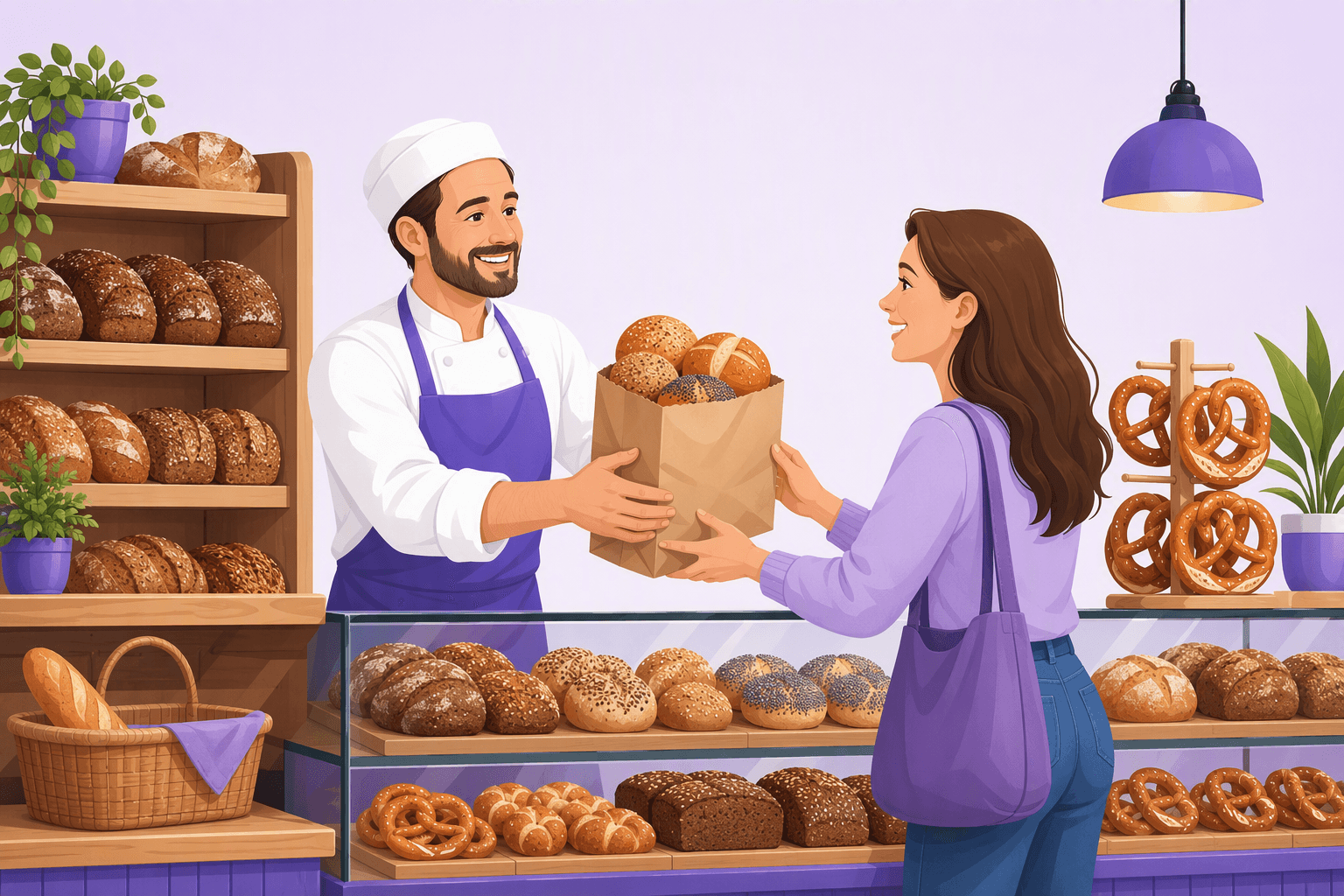
Bakeries are everywhere, and people often buy fresh bread or rolls daily. You will also hear strong opinions about crust, rye, sourdough, and what counts as “real” bread.
If you want to sound natural, learn these two words:
- Bäckerei (BEH-kuh-rye), bakery
- Brötchen (BRURT-khen), bread roll (the “ö” is like “er” in British “her”)
Ordering at a bakery: the polite direct style
German ordering is often concise. You do not need long softeners.
A normal pattern is: item + quantity + bitte.
Example: “Zwei Brötchen, bitte.” (TSVY BRURT-khen, BIT-tuh)
If you want a gentler tone, use Ich hätte gern... (ikh HEH-tuh gern), literally “I would gladly have,” which functions like “I’d like.”
Restaurant etiquette: what to expect at the table
The biggest surprises for visitors are usually not the food. They are the interaction rules.
Seating and greetings
In many places you can seat yourself, but not always. If you are unsure, ask.
Use: Einen Tisch für zwei, bitte. (EYE-nen TISH fewr TSVY, BIT-tuh)
If you join a table or approach staff, greet first. A quick Hallo or Guten Tag is expected. For more options, see how to say hello in German.
“Guten Appetit!” timing
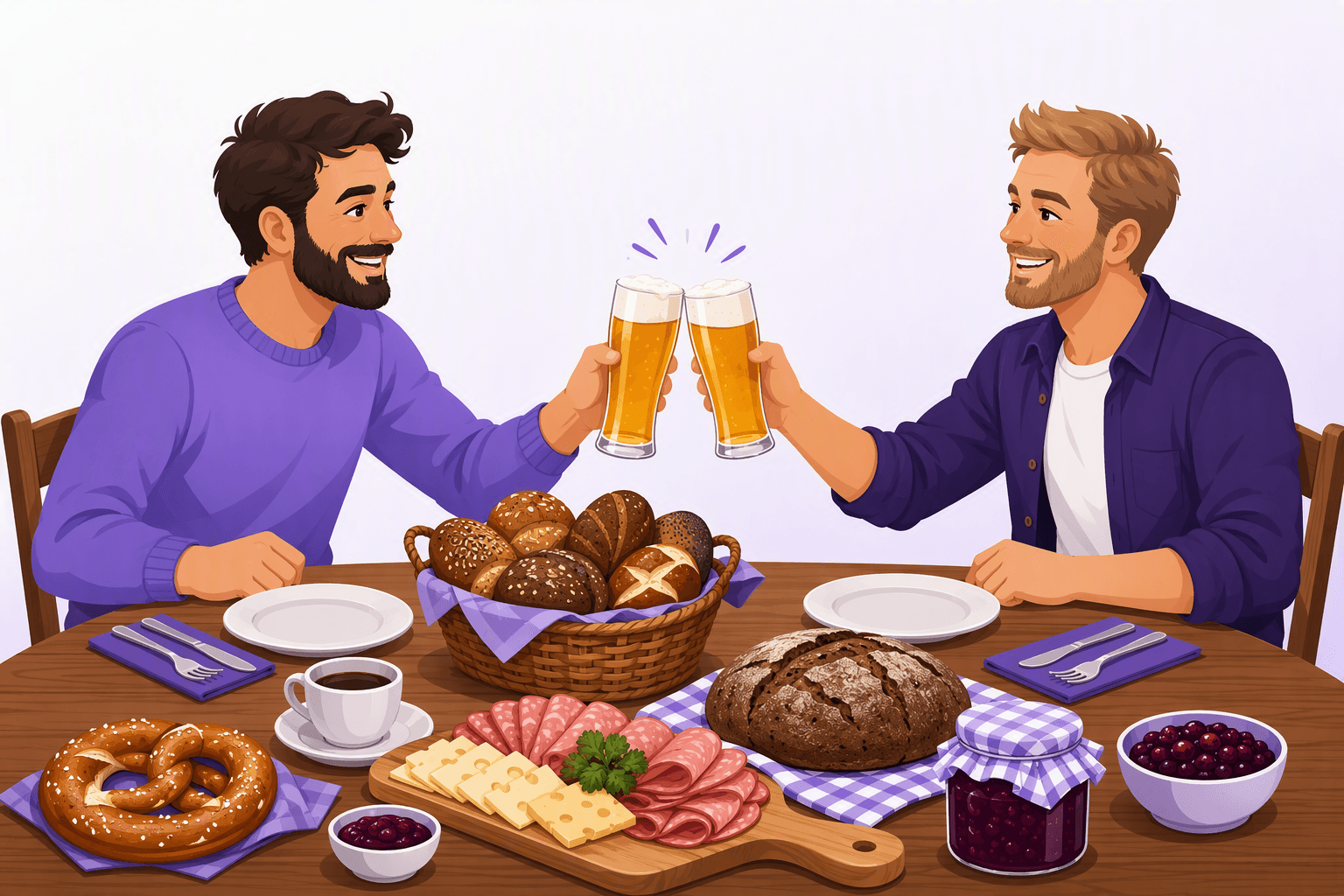
Guten Appetit! is typically said when everyone has food, or when food arrives. In a small group, one person says it and others echo it.
It is also normal to say it to nearby strangers in a shared setting, like a small canteen table, especially if you make eye contact.
Hands, posture, and the “visible hands” rule
A common norm is keeping hands visible at the table. Resting wrists on the table is fine, and often expected.
Elbows on the table can read as sloppy in formal settings, but in casual settings people are relaxed. Copy the most formal person at the table and you will be safe.
Asking for things: direct but polite
German requests often sound “short” to English speakers, but bitte does a lot of politeness work.
Useful lines:
- Könnten wir die Speisekarte haben, bitte? (KURN-ten veer dee SHPY-zuh-kar-tuh HAH-ben, BIT-tuh)
- Entschuldigung! (ent-SHOOL-dee-goong) to get attention
Paying and tipping: the part that confuses most visitors
Germany’s payment culture is one of the clearest examples of “different rules, same goal.” The goal is fairness and efficiency, not constant service performance.
The bill is not automatic
In many German restaurants, the server will not bring the bill until you ask. That is not neglect, it is giving you space.
Say: Die Rechnung, bitte. (dee REH-khnoong, BIT-tuh)
Splitting: “Getrennt” is your friend
Separate checks are common, but the process differs. Often, the server will go person by person and you say what you had.
Say: Getrennt, bitte. (geh-TREHNT, BIT-tuh)
If one person pays: Zusammen, bitte. (tsoo-ZAH-men, BIT-tuh)
Tipping: rounding up and saying the total
Many people tip by rounding up or adding a modest amount. The key behavior is you often state the total you want to pay.
Example: If the bill is 18,60, you might hand over cash and say “Zwanzig, bitte” (TSVAHN-tsikh, BIT-tuh), meaning “make it 20.”
💡 A simple tipping script that sounds natural
When paying, say the final number you want charged or returned. It signals the tip clearly and avoids awkward math at the table.
Beer gardens, wine regions, and the rules of toasting
Alcohol culture varies by region, but toast etiquette is remarkably consistent.
Prost
Prost! (PROHST) is the standard “cheers,” especially with beer. It is casual and widely used.
Zum Wohl
Zum Wohl! (tsoom VOHL) is also “cheers,” and can feel slightly more general or a touch more formal. It can be used with wine, sparkling water, anything.
Eye contact matters
Many Germans will tell you directly: make eye contact when clinking glasses. Whether or not every person believes the superstition, the behavior is common enough that skipping it can feel off.
Beer as culture, not just a drink
Germany’s beer identity is visible in local breweries, seasonal beers, and regional glassware. The Deutscher Brauer-Bund publishes accessible explanations of beer styles and consumption patterns (Deutscher Brauer-Bund, accessed 2026).
If you want to blend in, do not overperform “beer knowledge.” Ask what is local, and order that.
Regional food culture: Germany is not one table
Germany is a federal country with strong regional identities. Food vocabulary and habits can shift quickly.
North vs South (a practical learner lens)
In the north, fish and simpler sauces show up more often, and beer culture is strong but different from Bavaria. In the south, especially Bavaria and Baden-Württemberg, you see more dumplings, richer gravies, and stronger “traditional costume” tourism around festivals.
Your best strategy is to learn flexible phrases, not memorize one “German menu.”
Austria and Switzerland: similar language, different expectations
German is also an official language in multiple countries. That does not mean the same restaurant norms.
In Switzerland, for example, you may encounter Swiss German in speech, but Standard German in writing. In Austria, some food terms differ, and service style can feel slightly more “café-like” in certain settings.
Home invitations: what to bring, what to say, how to act
Being invited to someone’s home is where etiquette matters most, because the rules are less posted and more assumed.
Bring something small
A small gift is normal: flowers, chocolate, wine, or something from your home country. If you bring flowers, avoid red roses unless it is romantic.
Complimenting the food
Compliments are welcome, but keep them specific. Germans often prefer concrete praise over exaggerated enthusiasm.
Try:
- Das schmeckt super. (dahs SHMEHKT SOO-per), “This tastes great.”
- Sehr lecker. (zair LEH-ker), “Very tasty.”
Starting and finishing
Wait until everyone is served, then someone will likely say Guten Appetit. At the end, people may say Danke, das war lecker (DAHN-kuh, dahs vahr LEH-ker).
When leaving, use a clear goodbye. If you want options beyond “Tschüss,” see how to say goodbye in German.
The social side: Stammtisch, Vereine, and why food is organized
A lot of German social life is structured. Meals often sit inside that structure.
Stammtisch
Stammtisch (SHTAHM-tish) is a regulars’ table, often a recurring meetup at a specific bar or restaurant. Duden treats it as both the literal table and the group that meets there (Duden, accessed 2026).
If you see a sign that says “Stammtisch,” do not sit there unless invited. It can be reserved socially even without a formal reservation.
Clubs and shared meals
Germany has a strong tradition of associations (Vereine), from sports clubs to choirs. Shared meals after practice or events are common.
UNESCO’s listing on cooperative culture in Germany is not about food specifically, but it highlights a broader pattern: people organize shared interests through stable groups (UNESCO ICH, accessed 2026). Food often becomes the social glue for those groups.
What to say in real situations (with natural phrasing)
Below are a few high-utility phrases with context. These are the kinds of lines you actually hear in films and TV, which is why they stick well when you learn through clips.
Guten Appetit!
Use Guten Appetit! (GOO-ten ah-peh-TEET) when food arrives or before the first bite. It works in restaurants, homes, and work cafeterias.
/GOO-ten ah-peh-TEET/
Literal meaning: 'Good appetite'
“Guten Appetit! Soll ich dir noch Wasser einschenken?”
Enjoy your meal! Should I pour you some more water?
Often said once everyone has food. In casual settings, one person says it and others repeat it. It can also be said to nearby diners in a shared lunch setting.
Mahlzeit!
Use Mahlzeit! (MAHL-tsyte) around lunch, especially at work. It can be a greeting in the hallway, not only at the table.
/MAHL-tsyte/
Literal meaning: 'Meal time'
“Mahlzeit! Setzt du dich zu uns?”
Mahlzeit! Are you sitting with us?
Common in offices and cafeterias. It can feel abrupt to English speakers, but it is a normal lunchtime social signal.
Die Rechnung, bitte.
Use Die Rechnung, bitte. (dee REH-khnoong, BIT-tuh) to ask for the bill. Do not wait for it to appear automatically.
/dee REH-khnoong, BIT-tuh/
Literal meaning: 'The invoice, please'
“Entschuldigung, die Rechnung bitte. Und getrennt, bitte.”
Excuse me, the bill please. And separately, please.
In many German restaurants, the server will not bring the bill until you ask. Adding 'getrennt' or 'zusammen' immediately makes payment smoother.
Prost!
Use Prost! (PROHST) for a toast, especially with beer. Make eye contact when clinking glasses.
/PROHST/
Literal meaning: 'Cheers'
“Prost! Auf einen schönen Abend.”
Cheers! To a nice evening.
Very common in beer gardens and festivals. Eye contact is widely expected during toasts, even among friends.
How to learn German food culture faster with real media
Food culture is mostly scripts: what people say at predictable moments. That is why movie and TV clips work well for this topic.
When you hear the same lines in context, you learn timing, tone, and the “short polite” style that textbooks often miss. For a broader strategy, see how to learn a language with movies.
What to listen for in scenes
Focus on three recurring moments:
- Greeting the staff and the table
- Ordering with “Ich hätte gern...”
- Paying and saying the total
If you want more everyday vocabulary that shows up in these scenes, the 100 most common German words list is a good base.
⚠️ A quick note on humor and swearing at the table
German comedy and some friend groups use strong language casually, but it is risky as a learner because severity and social boundaries are context-heavy. If you are curious, read our guide to German swear words for meaning and when to avoid them.
A few “don’t do this” mistakes that foreigners make
Small mistakes are forgiven, but these are the ones that create awkwardness fast.
Sitting at a reserved social table
If you see “Stammtisch,” assume it is not for you. Ask before sitting.
Over-apologizing to get attention
One Entschuldigung is enough. Repeating it can feel anxious or pushy.
Waiting too long for the bill
If you are ready to leave, ask. The server is not rushing you, and you do not need to “signal” by stacking plates.
Using romantic language casually
Some learners overuse affectionate phrases because they sound cute in translation. If you are learning relationship language, keep it for the right context. Our how to say I love you in German guide breaks down what sounds natural vs too intense.
Closing: the simplest way to fit in
To fit into German food culture, do three things: greet first, use the standard meal phrases at the right moment, and understand that paying is a clear, spoken process. Once you do that, the rest is just enjoying good bread, good conversation, and a very organized kind of hospitality.
If you want to practice these lines the way they are actually spoken, learn with short scenes and repeat them until the rhythm feels automatic. You can find more culture and language guides on the Wordy blog and start structured listening practice on our German learning page.
Frequently Asked Questions
Do Germans say 'bon appétit'?
Is it rude to ask for separate checks in Germany?
How much do you tip in Germany?
What is the most important table etiquette in Germany?
What is 'Abendbrot'?
Sources & References
- Ethnologue, 27th edition, 2024
- Goethe-Institut, 'Landeskunde: Essen und Trinken' (accessed 2026)
- Duden, entries for 'Mahlzeit', 'Abendbrot', and 'Stammtisch' (accessed 2026)
- Deutscher Brauer-Bund, information pages on beer culture and consumption (accessed 2026)
- UNESCO Intangible Cultural Heritage, 'Cooperative idea and practice of organizing shared interests in cooperatives in Germany' (accessed 2026)
Start learning with Wordy
Watch real movie clips and build your vocabulary as you go. Free to download.


