Zodiac Signs in German: Names, Pronunciation, Dates, and How Germans Talk About Astrology
Quick Answer
The zodiac signs in German are Widder, Stier, Zwillinge, Krebs, Löwe, Jungfrau, Waage, Skorpion, Schütze, Steinbock, Wassermann, and Fische. Germans most often talk about them with phrases like 'Ich bin Widder' and 'Welches Sternzeichen hast du?'. Below you’ll get pronunciation, date ranges, and the cultural tone: astrology is common small talk, but many people treat it playfully rather than as a serious belief system.
The zodiac signs in German are Widder, Stier, Zwillinge, Krebs, Löwe, Jungfrau, Waage, Skorpion, Schütze, Steinbock, Wassermann, and Fische, and Germans usually talk about them with everyday phrases like "Ich bin Widder" and "Welches Sternzeichen hast du?".
If you’re learning German for real conversations, this topic is useful because it shows up in small talk, dating, and social media captions. It also teaches you a very German compound noun you will hear a lot: Sternzeichen.

Quick vocabulary: zodiac talk in German
Below is a practical list of the words you actually need. I’m using a vocabulary table (not a phrase table) because these are labels and nouns, not lines with meaningful formality differences.
| English | German | Pronunciation | Note |
|---|---|---|---|
| zodiac sign (star sign) | das Sternzeichen | dahs SHTEHRN-TSY-khen | Most common everyday term. |
| zodiac (astrological) | der Tierkreis | dehr TEER-kryss | More formal or written. |
| zodiac sign (technical) | das Tierkreiszeichen | dahs TEER-kryss-TSY-khen | Sounds technical, used in writing. |
| horoscope | das Horoskop | dahs hoh-ROH-skohp | The prediction or reading. |
| ascendant | der Aszendent | dehr ah-tsen-DEHNT | Also 'Aszendent' in charts. |
| birth chart | das Geburtshoroskop | dahs geh-BOORTS-hoh-ROH-skohp | Literally 'birth horoscope'. |
| constellation | das Sternbild | dahs SHTEHRN-bilt | Astronomy word, also used casually. |
| date of birth | das Geburtsdatum | dahs geh-BOORTS-dah-toom | Useful for confirming sign dates. |
💡 A quick culture note
In German, astrology talk often sits between joking and genuine interest. You can participate without sounding overly intense by adding softeners like "so ein bisschen" (kind of) or "irgendwie" (somehow).
The 12 zodiac signs in German (with pronunciation and dates)
German sign names are mostly direct translations, but a few are different enough to trip learners up. The biggest pronunciation traps are ö in Löwe and the ü in Schütze.
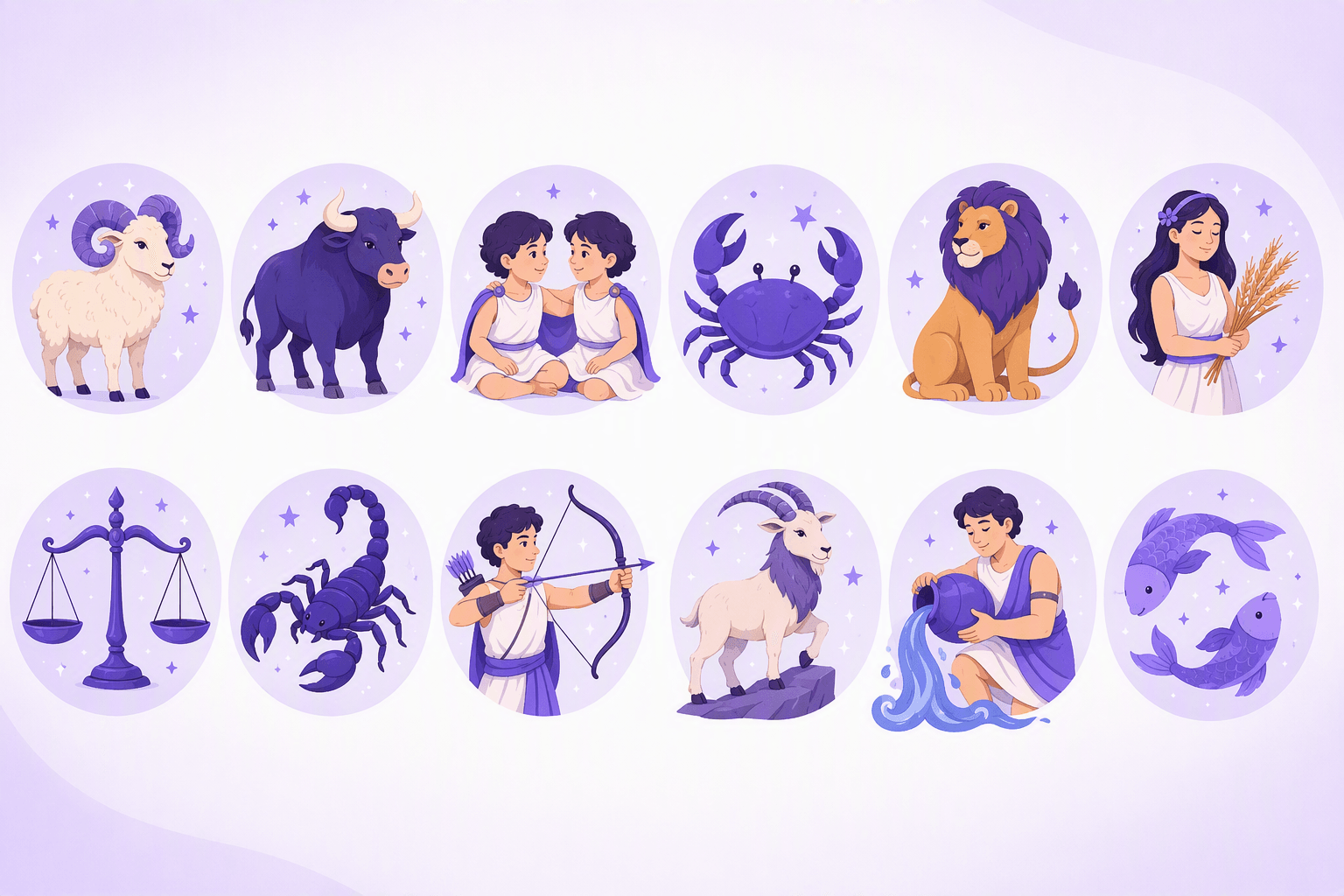
Widder
Widder (VID-der) is Aries, typically March 21 to April 19 in most Western horoscope lists. The word also means “ram,” which matches the symbol.
In conversation: "Ich bin Widder." If you want to sound less blunt, add "vom Sternzeichen her" (from a star-sign perspective).
Stier
Stier (SHTEER) is Taurus, typically April 20 to May 20. It means “bull.”
You’ll sometimes hear people connect it to stubbornness: "Stiere sind stur." That sentence is common and easy to recognize.
Zwillinge
Zwillinge (TSVIL-ling-uh) is Gemini, typically May 21 to June 20. It’s plural in German and literally means “twins.”
That plural matters: you say "Ich bin Zwilling" less often than "Ich bin Zwillinge" in casual astrology talk, even though the grammar looks odd to learners. Many speakers treat the sign label as a fixed name.
Krebs
Krebs (KREHPS) is Cancer, typically June 21 to July 22. The everyday meaning is “crab,” but it is also the common word for “cancer” (the illness).
This double meaning can feel heavy. In astrology contexts it’s normal, but if you’re unsure, you can say "Sternzeichen Krebs" to make the topic clear.
Löwe
Löwe (LUR-vuh) is Leo, typically July 23 to August 22. It means “lion.”
The ö is the key: shape your lips like you’re saying “oh,” but keep the tongue position closer to “eh.” If you want a deeper pronunciation foundation, our German pronunciation guide breaks down umlauts clearly.
Jungfrau
Jungfrau (YOONG-frow) is Virgo, typically August 23 to September 22. Literally “young woman” and also “virgin,” which is why it can sound a bit old-fashioned or churchy in English translation.
In German, it’s simply the established sign name, so it doesn’t usually feel awkward in astrology talk.
Waage
Waage (VAH-guh) is Libra, typically September 23 to October 22. It means “scales.”
This is one of the easiest to pronounce, but learners sometimes mis-stress it. Keep it simple: VAH-guh, two beats.
Skorpion
Skorpion (skor-PYOHN) is Scorpio, typically October 23 to November 21. It means “scorpion.”
You’ll also see Skorpion in biology contexts, so it’s a useful crossover word.
Schütze
Schütze (SHUET-tsuh) is Sagittarius, typically November 22 to December 21. It literally means “archer.”
The ü is the challenge. Think “oo” with a smile, as many German teachers describe it, and keep the tongue forward.
Steinbock
Steinbock (SHTINE-bok) is Capricorn, typically December 22 to January 19. Literally “ibex,” a mountain goat.
It’s a classic German compound: Stein (stone) + Bock (buck). Even if you don’t remember the animal, the word is memorable.
Wassermann
Wassermann (VAH-ser-mahn) is Aquarius, typically January 20 to February 18. Literally “water man,” meaning “water-bearer.”
This is another compound that feels very transparent once you know Wasser (water) and Mann (man).
Fische
Fische (FISH-uh) is Pisces, typically February 19 to March 20. It’s plural and means “fish.”
Like Zwillinge, it’s commonly used as a fixed sign label in casual talk.
🌍 Astrology vs astronomy: a German wording detail
German makes a clean everyday distinction between astrology and astronomy: "Astrologie" (ah-stroh-loh-GEE) vs "Astronomie" (ah-stroh-noh-MEE). If you’re talking about star signs, use "Astrologie" or "Horoskop", not "Astronomie", unless you mean the science.
How to ask and answer about zodiac signs in German
These are the lines you’ll actually hear in real life. Notice how often Germans keep it short and noun-focused.
The most common question patterns
-
"Welches Sternzeichen hast du?" (VEL-khes SHTEHRN-TSY-khen hahst doo)
This is direct and normal among peers. -
"Was bist du für ein Sternzeichen?" (vahs bist doo fuer ine SHTEHRN-TSY-khen)
Slightly more conversational, similar to “What sign are you?” -
"Wann hast du Geburtstag?" (vahn hahst doo geh-BOORTS-tahk)
Often used as a lead-in when someone forgot the date ranges.
If you’re practicing greetings and openers, pair this with our how to say hello in German guide so your small talk starts naturally.
Natural answers (from casual to careful)
- "Ich bin Löwe." (ikh bin LUR-vuh)
- "Mein Sternzeichen ist Waage." (mine SHTEHRN-TSY-khen ist VAH-guh)
- "Ich bin am 3. Oktober geboren, also Waage." (ikh bin ahm drit-ten ok-TOH-ber geh-BOH-ren, AHL-zoh VAH-guh)
A useful softener is "glaube ich" (I think), especially if you’re unsure: "Ich bin Skorpion, glaube ich."
Polite phrasing with strangers
With someone you don’t know well, you can add bitte and keep the tone light:
- "Darf ich fragen, welches Sternzeichen du hast?" (darff ikh FRAH-gen, VEL-khes SHTEHRN-TSY-khen doo hahst)
German politeness is often about phrasing and distance, not about adding lots of extra words. That idea lines up with what linguist Deborah Tannen discusses in her work on conversational style: people can interpret directness differently depending on cultural expectations and context.
How Germans actually use astrology in conversation
Astrology in German-speaking countries is common enough that most people know their sign, even if they don’t read horoscopes daily. German is spoken by roughly 90 million native speakers worldwide (Ethnologue, 27th edition, 2024), across multiple countries where this kind of small talk travels easily through shared media.
Where you’ll see it: magazines, apps, and dating profiles
You’ll still see Horoskop sections in print and online outlets, and you’ll see star signs in dating bios. The tone is often playful: “I’m a Capricorn, so I plan everything.”
If you want to understand the style of German everyday vocabulary, DWDS is a strong reference for how words like Horoskop appear in real usage examples (DWDS, accessed 2026). It’s a helpful way to check whether a word feels modern, old-fashioned, or tabloid-ish.
A common German stance: "Not serious, but fun"
A very typical move is to hedge:
- "Ich glaube nicht so dran, aber es ist witzig." (I don’t really believe in it, but it’s funny.)
That sentence lets you participate without committing. It also reflects a broader pragmatic pattern that linguist Penelope Brown (in her work on politeness with Stephen Levinson) describes as face-management: you reduce the risk of being judged for believing too strongly or for mocking someone else.
Astrology vocabulary that sounds natural (and what sounds weird)
Natural:
- Sternzeichen
- Horoskop
- Aszendent
- passt zu (fits with)
- typisch (typical)
Often too heavy for casual talk:
- Geburtshoroskop (fine, but sounds more “I’m really into it”)
- Konstellation (more astronomy-flavored unless the context is clear)
If your goal is everyday German, keep it simple and focus on the sign label plus one adjective.
Pronunciation pitfalls that matter (and quick fixes)
German learners often get understood even with imperfect pronunciation, but astrology words contain a few sounds that can change clarity.
Umlauts: ö and ü
- Löwe (LUR-vuh): don’t say “LOH-veh.”
- Schütze (SHUET-tsuh): don’t say “SHOOT-suh.”
If you want structured practice, combine this article with our German alphabet special characters guide, because umlauts show up everywhere, not just in zodiac words.
The "ch" sound in Sternzeichen
Sternzeichen ends with -zeichen (TSY-khen). That ch is the “ich” type sound for many speakers, not a hard “k.” If you replace it with “k,” you’ll still be understood, but it will sound noticeably foreign.
For a deeper breakdown, see our German pronunciation tips article.
Mini script: a realistic zodiac small-talk exchange
Here’s a short dialogue you can reuse. It’s the kind of rhythm you’ll hear in real life.
A: "Und, welches Sternzeichen hast du?"
B: "Ich bin Steinbock. Und du?"
A: "Waage. Passt das?"
B: "Keine Ahnung, ich lese sowas nicht. Aber klingt gut."
The key phrase here is "Passt das?" (Does that fit?), which keeps the tone light.
⚠️ A word to avoid in the wrong context
Because "Krebs" is also the everyday word for the illness cancer, don’t joke with it unless you know the person well and the context is clearly astrology. If you mean the sign, saying "Sternzeichen Krebs" makes your meaning explicit.
Zodiac signs, constellations, and a science footnote (without killing the vibe)
You’ll sometimes hear someone say, “Technically the constellations don’t match the horoscope dates.” That’s a real point, and it’s tied to how astrology uses a symbolic zodiac while astronomy uses measured constellation boundaries.
If you want an authoritative anchor for constellation definitions, the International Astronomical Union is the standard reference for modern constellation boundaries (IAU, accessed 2026). In everyday German conversation, though, people are almost always talking about the horoscope system, not astronomy.
A practical German phrase for this is:
- "Astronomisch gesehen ist das anders." (ah-stroh-NOH-mish geh-ZAY-en ist dahs AHN-ders)
Meaning: “Astronomically speaking, that’s different.”
Use it only if the conversation is already going in that direction.
How to practice with movie and TV clips (so it sticks)
Astrology talk is perfect for clip-based learning because it’s short, emotional, and repetitive: “I’m a Leo,” “That’s so Virgo,” “What sign are you?” You’ll hear it in dating scenes, friend-group banter, and comedy.
If you’re building a broader small-talk base, pair this with:
- How to say goodbye in German for natural exits after a chat
- How to say I love you in German if you’re learning romance-focused language
- German swear words if you want to recognize when a “fun” conversation turns into a heated one
A compact list you can memorize
If you only memorize one pattern, make it this:
- "Ich bin [Sternzeichen]."
- "Welches Sternzeichen hast du?"
Then learn the three tricky sign pronunciations first: Löwe, Schütze, Zwillinge.
🌍 Why 'Sternzeichen' is such a useful German word
"Sternzeichen" is a classic example of German’s love for compounds: one word that carries the whole concept. Once you start noticing compounds like this, German vocabulary becomes easier to guess, especially in everyday topics like hobbies, work, and relationships.
Want to learn this the way you’ll actually hear it?
To make these words automatic, practice them in short, real scenes with subtitles and repetition. Wordy’s movie and TV clips are built for exactly this kind of everyday topic: you hear the phrase, see it written, and review the vocabulary until it becomes effortless.
Frequently Asked Questions
How do you say 'zodiac sign' in German?
How do Germans say 'I’m a Leo'?
Are zodiac dates the same in German as in English?
Do Germans take astrology seriously?
What’s the difference between 'Horoskop' and 'Sternzeichen'?
Sources & References
- Ethnologue, 27th edition, 2024
- Duden, 'Sternzeichen' and zodiac sign entries, accessed 2026
- DWDS, Wortprofil and usage examples for 'Horoskop', accessed 2026
- International Astronomical Union (IAU), constellation boundaries and zodiac constellations reference, accessed 2026
Start learning with Wordy
Watch real movie clips and build your vocabulary as you go. Free to download.


