Quick Answer
German special characters are the umlauts ä, ö, ü and the Eszett ß. Umlauts usually change the vowel sound (and sometimes meaning), while ß marks an 's' sound after a long vowel or diphthong in standard spelling. This guide shows how to pronounce them, when to write them, and how to type them on any device.
German alphabet special characters are the umlauts ä, ö, ü and the letter ß (Eszett). Umlauts change how a vowel is pronounced and can change meaning, while ß signals an s sound after a long vowel or diphthong in standard spelling, and it is never used in Swiss Standard German.

Why these characters matter (more than you think)
German has about 90 to 100 million native speakers and well over 100 million total speakers worldwide, depending on how you count second-language users (Ethnologue, 27th edition, 2024). It is an official language in multiple countries, and it appears on passports, street signs, contracts, and subtitles across Europe.
If you skip umlauts or ß, people can often guess what you mean, but you lose precision. In some pairs, the difference is the whole point: schon vs schön, Mutter vs Mütter, Maße vs Masse.
If you are learning through real dialogue, these details show up constantly. Movie and TV subtitles are full of names, places, and everyday words with umlauts, and you will see ß in Germany and Austria even when characters are speaking fast.
For more everyday phrases where spelling and sound connect, see how to say hello in German and how to say goodbye in German.
The four special characters at a glance
Umlauts: ä, ö, ü
An umlaut is the two dots over a vowel. In modern German, it usually marks a different vowel quality (fronting and rounding), not just decoration.
A practical learner rule: treat ä/ö/ü as their own sounds, not as “a with dots”. If you replace them with plain a/o/u, you may still be understood, but you will sound noticeably off, and sometimes you will say a different word.
ß (Eszett)
ß represents a sharp “s” sound, like ss, and it helps signal vowel length in standard spelling. The current official rules are maintained by the Rat für deutsche Rechtschreibung and reflected in references like Duden (both accessed 2026).
You will also see ẞ (capital ß) in some contexts, but many systems still write SS in all caps.
Ä
ä is common in everyday words and in plural forms. For English speakers, the sound is often close to “eh”, but German vowel quality is tighter and more forward.
Pronunciation approximations:
- ä: often like EH (short) or EH with a slightly longer hold (long), depending on the word.
- When written äu, it is pronounced like German eu/äu: roughly OY.
Common examples:
- Mädchen (MAHT-khen): “girl” (diminutive ending -chen, with ch)
- Bär (BEHR): “bear”
- spät (SHPAYT): “late”
- Häuser (HOY-zer): “houses” (äu = OY)
💡 Typing fallback
If you cannot type ä, you can write ae. This is standard in names and email addresses: Müller becomes Mueller, and Käse becomes Kaese. Use the real umlaut in school and professional writing whenever you can.
Ö
ö is one of the biggest “accent tells” for German learners. It is not the same as English “oh”.
Pronunciation approximation:
- ö: think oe, roughly “er” in British “her” but with more lip rounding. A simple cue is “eh with rounded lips”.
Examples:
- schön (SHURN): “beautiful”
- hören (HUR-ren): “to hear”
- Köln (KURN): Cologne
A useful physical trick: start with EH (like “bed”), keep your tongue there, then round your lips as if you were saying OH. That rounded front vowel is the target.
Ü
ü is the rounded front vowel that English does not really have. It is extremely common in German, especially in everyday verbs and in plural patterns.
Pronunciation approximation:
- ü: ue, described as “oo with a smile” in many teaching traditions.
Examples:
- müde (MUE-duh): “tired”
- Tür (TUEHR): “door”
- grün (GRUEN): “green”
- fühlen (FUE-len): “to feel”
If you replace ü with u, you can create a different word. A classic pair is:
- schwül (SHVUEL): humid, muggy
- schwul (SHVOOL): gay
That is a real-life reason to take ü seriously.
ß
ß is called Eszett (or scharfes S). It sounds like ss, but its spelling role is about vowel length and tradition.
The modern rule: long vowel or diphthong
In standard German spelling, ß appears after a long vowel or a diphthong, while ss appears after a short vowel (Rat für deutsche Rechtschreibung, accessed 2026; Duden, accessed 2026).
Minimal pairs learners actually meet:
- Maße (MAH-suh): measurements
- Masse (MAH-suh): mass, crowd (short vowel before ss)
- Straße (SHTRAH-suh): street
- dass (dahs): that (conjunction)
Even when the pronunciation of the s sound is similar, the spelling helps you predict vowel length when reading.
Switzerland: mostly ss
In Switzerland and Liechtenstein, it is normal to write ss instead of ß in most contexts. You will still hear the same “s” sound, but you will see Strasse where Germany writes Straße.
This is not “wrong German”, it is a regional standard. If you are writing for a Swiss audience, ss is often the expected choice.
Capitalization: ß vs SS
In all caps, many signs and documents use SS because older typefaces and systems lacked ẞ. You might see:
- STRASSE
- MASSE
Today, ẞ exists in Unicode and is increasingly supported, but SS is still common in real-world typography.
🌍 Why Germans notice ß
In Germany and Austria, ß is a visual marker of “this is German text”. When learners replace it with ss everywhere, it looks foreign in the same way that removing accents from French looks foreign. People will understand you, but it signals that you are writing with a non-native keyboard or habit.
How to type German special characters (phone and computer)
Typing is the practical bottleneck for most learners. The good news is that every major system supports these characters.

Windows
- US International keyboard: you can type umlauts with dead keys (varies by setup).
- Alt codes (numpad):
- ä: Alt+0228
- ö: Alt+0246
- ü: Alt+0252
- ß: Alt+0223
If you do not have a numpad, it is usually faster to add the German keyboard layout and switch when needed.
macOS
Hold Option and type:
- ä: Option+u, then a
- ö: Option+u, then o
- ü: Option+u, then u
- ß: Option+s
iOS and Android
Press and hold the base letter:
- a gives ä
- o gives ö
- u gives ü
- s gives ß (on many keyboards)
For learners, this is often the easiest method because it requires no memorization.
The safe fallback: ae, oe, ue, ss
When characters are unavailable:
- ä → ae
- ö → oe
- ü → ue
- ß → ss
This is standard in many names and systems. It is also why you will see both spellings in real life: Müller vs Mueller.
Spelling patterns that explain a lot of German
German spelling is not random. Once you see the patterns, umlauts stop feeling like exceptions.
Plurals and umlaut shifts
Many common nouns form plurals with an umlaut:
- Mutter (MOO-ter) → Mütter (MUET-ter): mothers
- Buch (BOOKH) → Bücher (BUE-kher): books
- Stadt (SHTAHT) → Städte (SHTEH-tuh): cities
Historically, these shifts connect to older sound changes. For learners, the practical takeaway is: when you learn a noun, learn its plural with the umlaut if it has one.
Comparative forms
Adjectives often show umlaut in comparative or related forms:
- alt (ahlt) → älter (EHL-ter): older
- groß (grohss) → größer (GRUR-ser): bigger
Notice how ß can appear in the base form (groß), but the comparative changes the spelling and sound.
ß as a reading hint
If you see ß, you can usually assume the vowel before it is long:
- Fuß (FOOSS): foot
- Gruß (GROOSS): greeting
This is one reason German spelling reforms kept ß in a specific role: it supports reading fluency.
Common learner mistakes (and how to fix them fast)
Mistake 1: turning ö into “oh”
If you say schön like “shone”, Germans will still get it, but it sounds like a different vowel category. Practice by alternating:
- schon (shohn): already
- schön (SHURN): beautiful
Record yourself and check if your lips are rounded on ö, but your tongue stays forward.
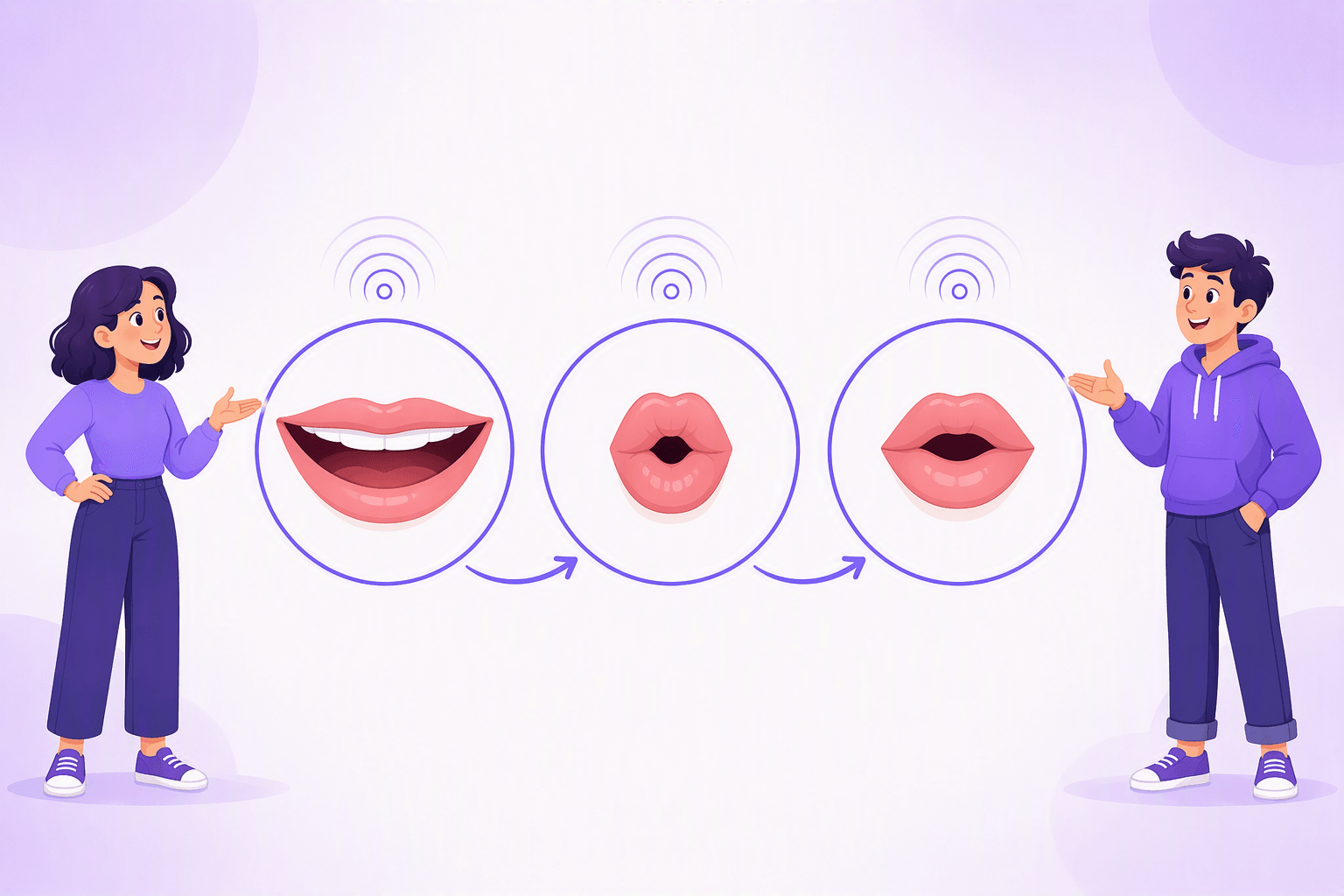
Mistake 2: turning ü into “oo”
This is the most common umlaut error. If you say müde with “moo”, it will not sound right.
Use the “oo with a smile” cue: keep the oo airflow, but spread your lips slightly. You should feel the vowel move forward in your mouth.
Mistake 3: writing ss everywhere
If you always write ss, you will look Swiss, or like your keyboard is limited. That is fine in quick notes, but for tests, emails, and subtitles, it is worth learning the ß rule.
Duden’s online guidance (accessed 2026) is a good reference if you want an authoritative check for a specific word.
Mistake 4: ignoring that umlauts can change meaning
Some pairs are not just spelling variants:
- schon vs schön
- Masse vs Maße
- wurde vs Würde (would be “dignity”, with ü)
Treat umlauts as meaning-bearing, not optional decoration.
⚠️ Names and official spelling
For people’s names, the “correct” spelling is whatever is on their official documents. Some families use Mueller, others use Müller. Do not “correct” someone’s name to add or remove an umlaut.
A culture note: umlauts in brands, signs, and jokes
German umlauts have a cultural afterlife outside German. English-language branding sometimes adds random umlauts to look “metal” or “Germanic”. Germans notice immediately, and it reads as stylized, not authentic German spelling.
Inside German-speaking countries, you also see umlauts used in wordplay, especially in advertising, because they are visually distinctive. That visual punch is part of why you should learn them early: they are everywhere in public text.
If you are watching German content, you will also see these letters in slang and strong language. If you are curious about how spelling and sound work there too, read our guide to German swear words. (Even when you do not use them, recognizing them helps you understand dialogue.)
How to practice with real speech (the fastest path)
Umlauts and ß are best learned with sound, not rules alone. A simple routine:
- Pick 10 high-frequency words with ä/ö/ü and 5 with ß.
- Listen for them in short clips, then repeat them out loud.
- Write them from memory, including the special character.
This combines perception, production, and spelling, which is exactly where learners usually break down.
If you want phrase-level practice where these letters show up naturally, start with greetings and relationship language: how to say hello in German, how to say goodbye in German, and how to say I love you in German.
A linguist-informed perspective (without the jargon)
German umlauts are a good example of how writing systems encode sound contrasts that matter for meaning. Peter Ladefoged’s work on vowel systems (in his phonetics textbooks) is often used to show how languages carve up vowel space differently, and German’s front rounded vowels (ö, ü) are a classic case.
For spelling, Theodor Ickler’s writing on German orthography is frequently cited in discussions of how reforms affect readability and learning. You do not need the debates to learn the rule, but it helps to know that modern German spelling is deliberately designed to support reading cues like vowel length.
For second-language learning, Paul Nation’s research focus on high-frequency vocabulary is a useful reminder: you will meet these characters early because the words are common, not rare. Learning them is not “advanced”, it is basic coverage.
Mini checklist: what to remember
- ä, ö, ü change vowel sounds and can change meaning.
- If you cannot type them, use ae, oe, ue as a standard fallback.
- ß is used after a long vowel or diphthong, ss after a short vowel (standard German).
- Switzerland generally uses ss instead of ß.
- Practice with real audio so your mouth learns the difference, not just your eyes.
Learn them in context with Wordy
The quickest way to make ä/ö/ü and ß feel normal is repeated exposure in real dialogue. Wordy’s short movie and TV clips make it easy to hear the vowel contrast, see the spelling in subtitles, and repeat the exact line until it sticks. Browse more guides on the Wordy blog when you are ready to level up.
Frequently Asked Questions
Are ä, ö, ü separate letters in the German alphabet?
When do I use ß vs ss in German?
How do you pronounce ü and ö for English speakers?
Is it wrong to write Mueller instead of Müller?
Do Germans care if I omit umlauts when texting?
Sources & References
- Duden, Rechtschreibung (online), accessed 2026
- Rat für deutsche Rechtschreibung, Amtliche Regelung der deutschen Rechtschreibung (online), accessed 2026
- Goethe-Institut, Deutsch lernen resources (online), accessed 2026
- Ethnologue, 27th edition, 2024
Start learning with Wordy
Watch real movie clips and build your vocabulary as you go. Free to download.


