Quick Answer
To improve German pronunciation fast, focus on the sounds English speakers usually miss: the two 'ch' sounds, umlauts (ä/ö/ü), German R, final consonant devoicing, and sentence stress. Mastering these few patterns makes your speech clearer than trying to copy an accent word by word.
German pronunciation gets much easier when you stop trying to imitate a specific accent and instead master a small set of high-impact rules: the two different German ch sounds, umlauts (ä/ö/ü), German R, final consonant devoicing, and German stress and rhythm. Fixing those patterns will make you noticeably clearer, even if your vocabulary is still basic.
German is also a high-value language to learn: Ethnologue lists German among the world’s largest languages by native speakers (Ethnologue, 27th edition, 2024), and it is an official language across multiple countries in Europe. If your goal is to understand real speech in films, interviews, and everyday conversations, pronunciation is the fastest way to reduce the gap between what you know and what you can actually hear.
If you want phrase practice that matches real spoken rhythm, pair this guide with how to say hello in German and how to say goodbye in German. Those short phrases are perfect for drilling sound patterns.
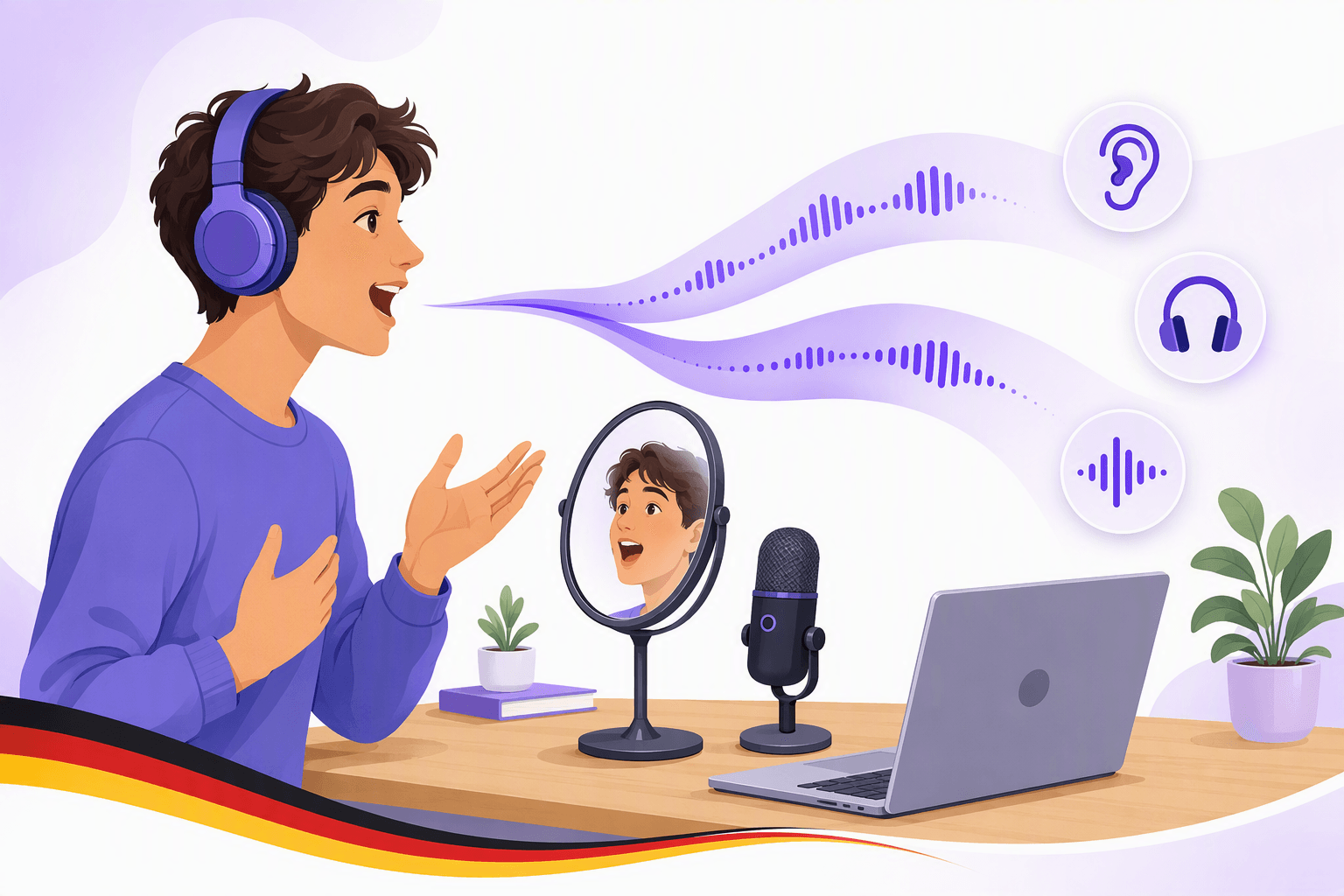
What to aim for: clarity over accent
A useful target is “comfortable intelligibility”: people understand you instantly without asking you to repeat. That is different from “sounding native,” and it is a better goal early on.
Phoneticians often separate segmentals (individual sounds) from suprasegmentals (stress, rhythm, intonation). J.C. Catford’s A Practical Introduction to Phonetics is a classic reference for thinking in terms of articulatory settings: where the tongue is, what the lips do, and how airflow changes. That mindset is exactly what you need for German.
German also has regional variation. The Institut für Deutsche Sprache (IDS) is a reliable reference point for how Standard German relates to dialects and regional standards (IDS, accessed 2026). Learn a standard baseline first, then enjoy the variety.
💡 A fast self-check
Record yourself saying: "Guten Tag, ich heiße Anna, und ich komme aus Berlin." Listen for: TAHK in Tag, a soft 'ich' sound, and clear vowel length. Repeat once a day for a week.
Tip 1: Learn the two ch sounds (the biggest German giveaway)
German has two common “ch” sounds that English speakers often collapse into one.
ich
Pronunciation: ish-like (front, soft)
In Standard German, ich is not “ick” and not a strong “sh.” It is a soft hiss made with the tongue close to the hard palate, further forward than English “sh.”
Try this: say “hee” slowly, freeze your tongue position, then exhale with friction. That gets you close to the ich sound.
Common words to drill:
- ich (ish-like)
- nicht (NISHT, with the same soft friction)
- vielleicht (fee-LYSHT)
ach
Pronunciation: back-throat (like clearing fog off glass)
After back vowels (a, o, u, au), ch is the ach sound, produced further back in the mouth.
Examples:
- ach (AHKH)
- Buch (BOOKH, not “book”)
- auch (OWKH)
Why it matters: mixing these two ch sounds can make you harder to understand than a strong accent would. Goethe-Institut pronunciation materials emphasize these contrasts because they are core to intelligibility (Goethe-Institut, accessed 2026).
Tip 2: Stop pronouncing w like English w
German w is pronounced like English v.
- wir = VEER
- Wasser = VAH-ser
- zwei = TSVY (z is its own issue, see Tip 6)
If you say “weer” for wir, Germans will still guess the meaning, but it signals “English speaker” instantly and can blur words in fast speech.
Tip 3: Master umlauts by changing lips, not tongue position
Umlauts are not decoration. They create different vowels, and German uses them to distinguish meaning.
ü
Pronunciation: ue (roughly "oo with smile")
Canonical reminder from the style guide: ü = ue, roughly “oo with a smile.”
Practice sequence:
- Say “ee” (smile).
- Keep your tongue where it is.
- Round your lips into “oo.”
Minimal pairs (meaning changes):
- schon (shohn) vs schön (shern-ish, with oe coloring)
- musste (MOOS-tuh) vs müsste (MUES-tuh)
ö
Pronunciation: oe (roughly "er" in British "her")
Think of ö as a rounded version of an “eh/er” vowel. The lips do more work than English speakers expect.
Examples:
- können = KUR-nen (canonical)
- mögen = MUR-gen (canonical)
Duden’s pronunciation guidance is useful here because it consistently marks vowel quality and stress (Duden, accessed 2026).
ä
Ä often sounds close to “eh” in many standard pronunciations, but it still matters in spelling and in some contrasts.
Examples:
- spät (SHPAYT)
- Mädchen (MED-khen, with the ich/ach issue again)
Tip 4: Learn vowel length, because it changes words
German vowel length is not a small nuance. It can distinguish words and it affects the “beat” of the language.
A practical rule:
- A single vowel followed by a single consonant is often long.
- Double consonants often signal a short vowel.
- “h” after a vowel often signals length (sehen, fahren).
Pairs to practice:
- bieten (BEE-ten) vs bitten (BIT-ten)
- Staat (SHTAHT) vs Stadt (SHTAHT with shorter vowel and crisper t, this one is subtle but real in careful speech)
⚠️ Avoid the English 'lazy vowel'
English reduces many unstressed vowels to a schwa. German does reduce sometimes, but less aggressively in careful Standard German. If every unstressed syllable becomes 'uh', your German can sound mumbled.
Tip 5: Final consonant devoicing (why Tag ends like TAHK)
German often devoices consonants at the end of a syllable:
- b becomes p
- d becomes t
- g becomes k
Canonical example from the style guide:
- guten Tag = GOO-ten TAHK
More examples:
- und often sounds like OONT (especially in fast speech)
- lieb can end closer to LEEP
- weg can end closer to VEK
This is not optional. If you keep the consonant voiced, you may still be understood, but you will sound less natural and sometimes create confusion in fast conversation.
Tip 6: German z is “ts,” and it shows up everywhere
German z is pronounced ts.
- Zeit = TSYTE
- zehn = TSAYN
- zusammen = tsoo-ZAH-men
This is one of the easiest “high return” fixes because it is consistent and immediately noticeable.
Tip 7: s vs ß vs sch, and the “sp/st” trap
German spelling gives you strong pronunciation clues.
-
sch = SH
Schule = SHOO-luh -
ß and ss usually signal a voiceless s (like English “s” in “see”) and often relate to vowel length rules.
Straße = SHTRAH-suh -
s at the start of a word before a vowel is often voiced (like English “z”).
Sonne = ZON-nuh
Now the trap:
- sp at the start of a word is often SHP
Sport = SHPORT - st at the start of a word is often SHT
Stadt = SHTAHT
This is why “Berlin street names” can be hard at first: Straße, Stadt, Sport, sprechen.
Tip 8: German r: pick one version and make it consistent
German R varies by region and speaker. You will hear:
- a uvular R in the back of the throat (common in Germany’s standard speech)
- a tapped or rolled R (more common in some regions and in careful diction)
What matters for learners is consistency and not inserting an English “r-coloring” everywhere.
A very practical pattern: in many standard pronunciations, -er at the end of a word becomes more like “-a” or “-uh” than a strong English r.
- besser often sounds like BESS-er (with a light ending)
- Lehrer often sounds like LAY-rer with a softened final syllable
If you want a safe baseline, aim for a light uvular R in the middle of words and a softened ending in -er.
Tip 9: Stress is usually on the first syllable, until it isn’t
German stress is predictable enough to help you, but you need a few rules.
General tendencies:
- Many native German words stress the first syllable: MUsik, WAsser, KINder (varies by word, but the tendency is strong).
- Separable verb prefixes are often stressed when separated: anRUFen, ich rufe DICH an.
- Many loanwords keep stress patterns closer to the source language, especially from French and English.
Marking stress is not just “sounding good.” It helps listeners segment speech. In listening research and teaching practice, stress cues are a major part of how learners find word boundaries.
Try this drill: clap only on stressed syllables.
- GOO-ten TAHK
- DAHN-kuh
- KUR-nen
If you need a structured set of everyday phrases to apply stress to, use how to say hello in German as your drill list.
Tip 10: Consonant clusters: don’t add extra vowels
English speakers often insert a small vowel to “help” pronounce clusters. German uses clusters heavily, and adding vowels can change the word shape.
Examples:
- spr- in sprechen: SHPREH-khen, not “suh-preh-chen”
- str- in Straße: SHTRAH-suh, not “suh-tuh-rah-suh”
- -ngst in Angst: AHNGST, keep it tight
A useful technique from practical phonetics (Catford) is to practice clusters backwards:
- Angst: start with “ngst,” then add “a” in front.
- sprechen: start with “chen,” then add “spre-” in front.
Tip 11: Sentence melody: German is not monotone, it is controlled
A stereotype says German is flat. In reality, German intonation is more “contained” than some English varieties, but it still uses pitch movement for meaning.
Two patterns to copy:
- Yes/no questions often rise at the end: Kommst du mit? (KOHMST doo MIT)
- Statements often fall: Ich komme morgen. (ish KOHM-uh MOR-gen)

If you keep rising at the end of every sentence (a common English habit), you can sound uncertain. If you fall too early, you can sound abrupt.
For politeness, intonation matters as much as words. If you are learning polite forms like Sie and greetings, pair this with how to say goodbye in German so you can practice a friendly fall in tone.
Tip 12: Use “minimal pairs” to train your ear, not just your mouth
Pronunciation improves fastest when your ear can reliably hear the contrast you are trying to produce.
Minimal pairs to rotate:
- schon vs schön (o vs ö)
- muss vs muss (short u) vs Muß is old spelling, but the vowel-length idea still matters in many pairs
- bieten vs bitten (long i vs short i)
- ich vs ach (front ch vs back ch)
- Weg vs weg (same spelling, but practice final devoicing and sentence stress)
John Wells’ Accents of English is a well-known work for understanding how sound systems vary across accents and why learners transfer habits from their first language. The key takeaway for German learners is to train contrasts systematically, not randomly.
🌍 A cultural pronunciation insight: 'clear' can read as 'serious'
In German-speaking workplaces, clear articulation is often associated with competence and reliability, especially in formal contexts like presentations or customer service. That does not mean you should sound stiff with friends, but it explains why many learners get positive feedback simply by cleaning up endings (Tag as TAHK) and keeping vowels distinct.
A short daily routine (10 minutes) that actually works
You do not need hours. You need repetition with feedback.

Minute 1 to 3: One sentence, perfect ch and endings
Say slowly, then at normal speed:
- Guten Tag. (GOO-ten TAHK)
- Ich komme aus Deutschland. (ish KOHM-uh ows DOYCHT-lahnt, keep final t)
Minute 4 to 6: Umlaut pairs
Alternate:
- schon / schön
- muss / müsste
- können / konnen (even if the second is not the target word, the contrast drill helps)
Minute 7 to 10: Record and shadow
Pick a short clip from a show, repeat one line until your rhythm matches. If you are learning through media, this is where a clip-based method shines because you can copy timing, not just sounds. For a broader strategy, see how to learn a language with movies.
Common mistakes that keep you stuck
Over-focusing on R
R is noticeable, but it is rarely the main reason you are misunderstood. Ch sounds, vowel length, and final devoicing usually matter more.
Ignoring stress marks in dictionaries
If a dictionary gives stress, use it. Stress errors can make a familiar word sound unfamiliar.
Practicing only single words
German is a rhythm language. Practice words inside short sentences so you learn linking and timing.
💡 Use 'high-frequency' practice words
If you want maximum payoff, practice with words you say every day: ich, nicht, und, danke, bitte, guten Tag. High-frequency words amplify small pronunciation improvements.
Where pronunciation meets real-life German
Pronunciation is not separate from vocabulary and social context. The same sound can feel different depending on what you are saying.
If you are learning affectionate phrases, you will hear softer delivery and more connected speech. A good practice target is how to say I love you in German, because it forces you to handle ich-Laut, vowel length, and sentence melody in short lines.
If you are curious about taboo language, pronunciation becomes even more important because small sound changes can accidentally create a stronger word than you intended. If you go there, read our guide to German swear words with extra caution and focus on recognition more than production.
A realistic benchmark: what “good German pronunciation” sounds like
Good learner pronunciation usually means:
- ch is consistently correct (ich vs ach)
- umlauts are distinct (u vs ü, o vs ö)
- final devoicing is automatic (Tag as TAHK)
- stress is stable and not English-shaped
- speech is not over-slow, but syllables are clean
That level is reachable in weeks, not years, if you practice contrasts and record yourself.
If you want to keep building from pronunciation into everyday listening, browse the Wordy blog for topic-based phrase lists and media-based learning methods, then pick one theme and stick with it for a month.
Frequently Asked Questions
What is the hardest German sound for English speakers?
How do I pronounce German ü correctly?
Do I need to roll the German R?
Why does German sometimes sound like it ends in t or k?
Is German pronunciation the same in Germany, Austria, and Switzerland?
Sources & References
- Goethe-Institut, 'Aussprache' learning materials, accessed 2026
- Duden, 'Aussprachewörterbuch' (pronunciation guidance), accessed 2026
- Institut für Deutsche Sprache (IDS), resources on Standarddeutsch and variation, accessed 2026
- Ethnologue, 27th edition, 2024
Start learning with Wordy
Watch real movie clips and build your vocabulary as you go. Free to download.


