Quick Answer
German compound words are single words formed by joining multiple words (usually nouns) into one, with the final element carrying the core meaning and gender. They look intimidating because German prefers building precise terms inside one word, often using linking sounds like -s- or -en-. Once you learn how to split them, they become one of the fastest ways to grow vocabulary.
German compound words are single German words built by joining smaller words together, and you can usually understand them by splitting them into parts and reading from right to left for the core meaning. They look long because German prefers putting precise descriptions inside one word (especially nouns), often adding a linking sound like -s- or -en- between parts.
German is spoken by roughly 90 million native speakers worldwide, plus many second-language speakers, and it is an official language in multiple European countries (Ethnologue, 27th edition, 2024). That means compound words are not a quirky classroom topic, they are a daily reality in news, work emails, and street signs.
If you are also building your everyday basics, pair this with how to say hello in German so you can actually use your new vocabulary in real conversations.
Why German compounds are so common (and so useful)
German compounds are a productivity tool. Instead of inventing a brand-new word for every new concept, German can combine existing words to create a precise label that most speakers can decode on the spot.
This is especially visible in public life: government, insurance, engineering, and education. You will see long compounds on forms, job ads, and official letters because they reduce ambiguity.
Linguist Donka Minkova’s work on compounding in English highlights a useful contrast: English also compounds (toothbrush, laptop), but German does it more aggressively and with fewer spaces. The underlying idea is similar, but German orthography tends to “glue” the pieces into one word.
The core rule: the last word is the boss
When you meet a long German noun, start at the end. The final element tells you what the thing is, and everything before it narrows it down.
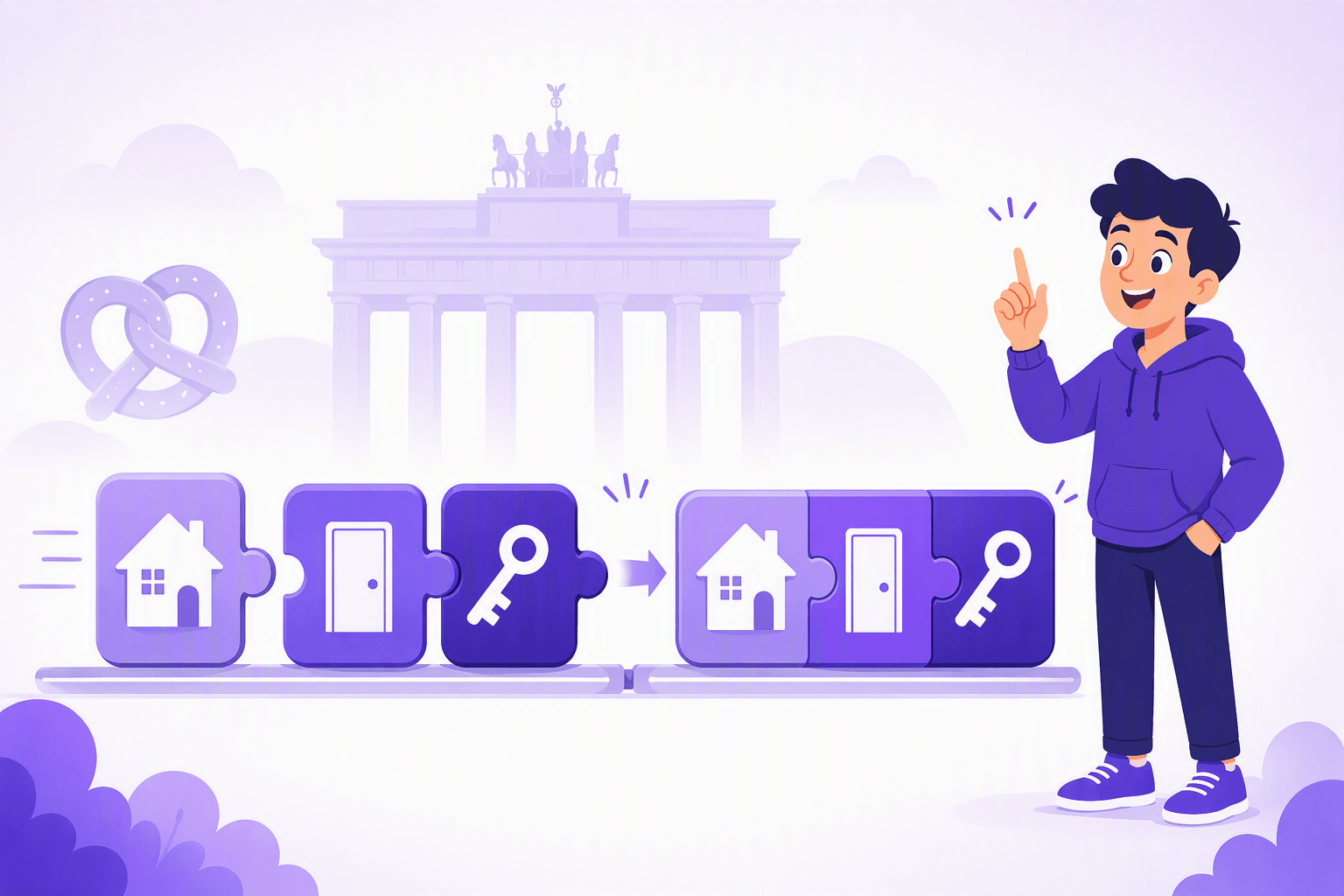
- Haustürschlüssel: the last part Schlüssel is the thing (a key).
- Krankenversicherungskarte: the last part Karte is the thing (a card).
Gender and plural come from the final noun
A huge learner win: the grammatical gender of a compound noun is the gender of the final noun. Same for the plural pattern in most cases.
- das Schloss (lock) → das Türschloss (door lock)
- die Karte (card) → die Versicherungskarte (insurance card)
This is one reason compounds are easier than they look. You do not have to guess gender from the first part.
How to split compounds fast (a practical method)
You do not need perfect linguistic analysis. You need a reliable “good enough” method that works while reading.
Step 1: Find the final noun
Look for a familiar noun ending or a known word at the end. In German signage and bureaucracy, the last chunk is often something common like -amt (office), -gesetz (law), -versicherung (insurance), -karte (card), -vertrag (contract).
Step 2: Work leftward in chunks
Split where you see known words, even if you are not sure about the exact boundary. Your goal is comprehension, not a morphology exam.
Step 3: Watch for linking elements (Fugenlaute)
German often inserts a small sound between parts. The most common is -s-, sometimes called Fugen-s. You also see -n-, -en-, -er-, and -e-.
Duden and DWDS both document these linking patterns across many entries (Duden, accessed 2026; DWDS, accessed 2026). They help pronunciation and readability, but they can feel random to learners.
💡 A fast decoding shortcut
If you see an -s- in the middle, try removing it and checking if the remaining pieces are real words: Arbeit + Zeit = Arbeitszeit, Kind + Garten = Kindergarten.
Pronunciation: where to put the stress
German compounds usually carry primary stress on the first element, with secondary stress later. That is why they can sound “bouncy” even when they look scary on paper.
A practical learner rule: stress the first big chunk clearly, then keep the rest steady.
- Krankenhaus (KRAHN-ken-howss)
- Krankenversicherung (KRAHN-ken-fer-ZEE-khu-rung)
If you want a deeper foundation for sound and rhythm, use a dedicated pronunciation guide, then return to compounds. Word length is less of a problem when your syllables are clean.
35 German compound words you will actually see
Below are real compounds that show up in daily life, school, work, and media. Each entry includes a clear pronunciation approximation.
| English | German | Pronunciation | Note |
|---|---|---|---|
| door key | Haustürschlüssel | HOWSS-tuer-SLUES-sel | Haus (house) + Tür (door) + Schlüssel (key). |
| door lock | Türschloss | TUER-shloss | Tür + Schloss (lock). |
| washing machine | Waschmaschine | VAHSH-mah-SHEE-nuh | Wasch- (wash) + Maschine (machine). |
| dishwasher | Geschirrspüler | guh-SHEER-SHPYOO-ler | Geschirr (dishes) + Spüler (rinsing device). |
| refrigerator | Kühlschrank | KUEHL-shrahngk | Kühl- (cool) + Schrank (cabinet). |
| remote control | Fernbedienung | FEHRN-buh-DEE-noong | Fern- (distant) + Bedienung (operation/control). |
| smartphone | Smartphone | SMAHRT-fohn | Often kept as a loanword, still functions like a noun in compounds. |
| train station | Bahnhof | BAHN-hohf | Bahn (rail) + Hof (yard/court). |
| timetable | Fahrplan | FAHR-plahn | Fahr- (travel) + Plan (plan). |
| ticket machine | Fahrkartenautomat | FAHR-kahr-ten-ah-toh-MAHT | Fahrkarte (ticket) + Automat (machine). |
| bicycle path | Fahrradweg | FAHR-raht-vehk | Fahrrad (bike) + Weg (path). |
| pedestrian zone | Fußgängerzone | FOOSS-gen-ger-TSOH-nuh | Fußgänger (pedestrian) + Zone (zone). |
| traffic jam | Verkehrsstau | fehr-KEHRS-shtow | Verkehr (traffic) + Stau (jam), with linking -s-. |
| speed limit | Geschwindigkeitsbegrenzung | guh-SHVAIN-dig-kites-buh-GREN-tsoong | Common on road signs and in driving theory. |
| emergency exit | Notausgang | NOHT-OWSS-gahng | Not (emergency) + Ausgang (exit). |
| first aid kit | Erste-Hilfe-Kasten | EHR-stuh HIL-fuh KAH-sten | Often written with hyphens, still a compound concept. |
| health insurance | Krankenversicherung | KRAHN-ken-fer-ZEE-khu-rung | Kranken- (sick/medical) + Versicherung (insurance). |
| health insurance card | Krankenversicherungskarte | KRAHN-ken-fer-ZEE-khu-rungs-KAHR-tuh | A classic multi-part noun chain. |
| doctor's office | Arztpraxis | AHRTS-prahk-sis | Arzt (doctor) + Praxis (practice). |
| appointment | Arzttermin | AHRTS-tehr-MEEN | Arzt + Termin (appointment). |
| toothbrush | Zahnbürste | TSAHN-BUER-stuh | Zahn (tooth) + Bürste (brush). |
| toothpaste | Zahnpasta | TSAHN-pahs-tah | Zahn + Pasta (paste). |
| birth certificate | Geburtsurkunde | guh-BOORTS-oor-KOON-duh | Geburt (birth) + Urkunde (certificate). |
| identity card | Personalausweis | pehr-zoh-NAHL-owss-vyss | Common in Germany, Austria, Switzerland. |
| tax return | Steuererklärung | SHTOY-er-er-KLEH-roong | Steuer (tax) + Erklärung (declaration). |
| work contract | Arbeitsvertrag | AHR-bites-fehr-TRAHK | Arbeit (work) + Vertrag (contract), with linking -s-. |
| working hours | Arbeitszeit | AHR-bites-tsyte | Arbeit + Zeit (time), with linking -s-. |
| job interview | Vorstellungsgespräch | FOR-shtell-oongs-guh-SHPREHKH | Vorstellung (introduction) + Gespräch (conversation). |
| university semester | Universitätssemester | oo-nee-fehr-zee-TEHTS-zeh-MEHS-ter | Universität + Semester, with linking -s-. |
| homework | Hausaufgaben | HOWSS-owf-gah-ben | Haus (home) + Aufgaben (tasks). |
| kindergarten | Kindergarten | KIN-der-gahr-ten | Kinder (children) + Garten (garden). |
| vacation request | Urlaubsantrag | OOR-lowps-ahn-trahk | Urlaub (vacation) + Antrag (application), with linking -s-. |
| environmental protection | Umweltschutz | OOM-velt-shoots | Umwelt (environment) + Schutz (protection). |
| climate change | Klimawandel | KLEE-mah-VAHN-del | Klima (climate) + Wandel (change). |
| favorite food | Lieblingsessen | LEEB-lings-ESS-en | Liebling (favorite) + Essen (food), with linking -s-. |
⚠️ Hyphens are normal in German
German can write compounds as one word, with hyphens, or as multi-part official labels. Hyphens often appear when readability matters, when abbreviations are involved, or when a term is being introduced in writing.
Linking elements: the famous Fugen-s (and friends)
If you have seen Arbeitszeit or Verkehrsstau and wondered why the -s- appears, you are not alone. The linking element is not a plural marker, and it is not a genitive ending you can always “translate.”
The IDS (Institut für Deutsche Sprache) treats these linking elements as part of German word formation, and they are best learned through exposure and pattern recognition (IDS, accessed 2026). Some stems strongly prefer -s-, others rarely take it, and regional or stylistic variation exists.
Common linking patterns you will notice
- -s-: Arbeit + Zeit = Arbeitszeit (AHR-bites-tsyte)
- -en- / -n-: some compounds insert -en- or -n- for flow
- -er-: can appear in certain traditional formations
Do not try to force a single rule. Instead, treat the linking element as a spelling and pronunciation bridge.
“Long words” in real German culture: where you actually meet them
The internet loves extreme examples, but everyday German compounds are usually practical, not theatrical. Still, there are a few cultural zones where long compounds are genuinely common.
Bureaucracy and administration
German public administration values precision. That is why you see compounds on forms and official websites, especially around taxes, residency, insurance, and education.
If you have ever learned formal greetings, you have already met the same “precision mindset” in politeness. Compare casual hellos with formal address in how to say goodbye in German, where register changes are explicit and rule-governed.
Engineering and workplace language
German industry and technical writing often build terms by stacking nouns. This is efficient inside a company where everyone shares the same domain knowledge.
Translator and linguist Mark Twain famously joked about German word length in his essay on the language, but the modern reality is less about absurdity and more about compact technical labeling. In practice, teams shorten long compounds quickly once a term becomes familiar.
Media headlines and humor
Headlines like compact words because they save space and feel punchy. Humor also plays with compounding because you can create a “too-precise” label for a situation and it lands as a joke.
That same creativity shows up in slang and insults too. If you are curious about how German builds expressive language beyond polite compounds, see our guide to German swear words, but keep it context-aware.
How compounds interact with cases (without overthinking it)
Compounds do not change the case system, they just carry it on the final noun. That means articles and adjective endings attach to the whole compound.
- der neue Arbeitsvertrag (the new work contract)
- mit dem Personalausweis (with the ID card)
- wegen der Geschwindigkeitsbegrenzung (because of the speed limit)
If you can handle articles and cases on simple nouns, you can handle them on compounds. The only extra work is reading.
A mini “movie and TV” listening trick for compounds
Compounds are easier to learn by ear than by staring at them. In dialogue, you often hear the stress pattern and can guess the boundary.
Try this routine:
- Listen for the final noun first (Karte, Vertrag, Termin).
- Rewind and catch the modifier chunk (Krankenversicherungs-, Arbeits-, Arzt-).
- Say it back with clear chunking.
This pairs well with learning through real clips, because you hear compounds in situations: a receptionist asking for your Krankenversicherungskarte, or a character complaining about a Steuererklärung.
If you want more “high-frequency first” vocabulary to support this, use the 100 most common German words list as your base layer, then add compounds on top.
Common learner mistakes (and how to avoid them)
Mistake 1: Translating left to right
If you translate Haustürschlüssel as “house door key” and stop there, you might miss the point that it is a key. Always anchor on the final noun.
Mistake 2: Guessing gender from the first part
Learners see Haustür- and want to use die. But Schlüssel is masculine, so it is der Haustürschlüssel.
Mistake 3: Pronouncing every letter with equal weight
German compounds need chunk stress. If you flatten everything, listeners struggle. Put a clear stress on the first chunk, then keep the rest flowing.
A quick note on “love words” and compounds
German can sound direct in emotional language, and compounds sometimes soften or specify feelings in a practical way (Lieblings- is a good example). If you are learning relationship language, how to say I love you in German helps you choose phrases that fit the moment, not just the dictionary meaning.
Practice: build your own compounds (the safe way)
You can create understandable compounds, but keep them plausible. Native speakers accept new compounds when they follow familiar patterns and solve a naming problem.
Try these templates:
- [Place] + [Thing]: Küchenlampe (kitchen lamp)
- [Purpose] + [Thing]: Schlafanzug (sleep suit, pajamas)
- [Person] + [Event]: Elternabend (parents’ evening)
When you invent a compound, test it by asking: would this appear on a sign, a product label, or a form? If yes, it is probably fine.
🌍 Why German compounds feel 'serious'
German compounds are not only about length, they signal a style: precise, categorical, and often institutional. In casual speech, Germans still use compounds constantly, but they also shorten, nickname, and rely on context. The “endless word” stereotype mostly comes from written domains where exact labeling is valued.
Wrap-up: the right mindset for German compound words
German compound words are a feature you can exploit. Learn to identify the final noun, recognize common linking elements, and pronounce in chunks, and long words stop being a wall and start being free vocabulary.
For more German learning paths, browse the Wordy blog and combine everyday phrases with real listening practice on learn German.
Frequently Asked Questions
Why does German have such long words?
How do I know the gender of a German compound word?
What is the -s- in words like Arbeitszeit?
Are German compound words only nouns?
Do Germans actually say the very long legal words out loud?
Sources & References
- Institut für Deutsche Sprache (IDS), resources on German word formation, accessed 2026
- Duden, entries and usage notes for German compounds and Fugen-s, accessed 2026
- DWDS (Digitales Wörterbuch der deutschen Sprache), compound entries and corpus examples, accessed 2026
- Ethnologue, 27th edition, 2024
Start learning with Wordy
Watch real movie clips and build your vocabulary as you go. Free to download.


