Quick Answer
The most useful Korean travel phrases are polite expressions built around 안녕하세요, 감사합니다, 주세요, and 죄송합니다. Learn these practical phrases with pronunciation to order food, ask directions, pay, and handle everyday situations respectfully in Korea.
| English | Korean | Pronunciation | Formality |
|---|---|---|---|
| Hello | 안녕하세요 | ahn-NYUHNG-hah-seh-yoh | polite |
| Thank you | 감사합니다 | gahm-SAH-hahm-nee-dah | formal |
| Excuse me / sorry | 죄송합니다 | chway-SOHNG-hahm-nee-dah | formal |
| Please give me... | 주세요 | joo-SEH-yoh | polite |
| How much is it? | 얼마예요? | uhl-MAH-yeh-yoh | polite |
| Where is...? | 어디예요? | uh-DEE-yeh-yoh | polite |
| It's okay | 괜찮아요 | gwen-CHAH-nah-yoh | polite |
Korean travel phrases can carry you through a trip even if you cannot hold a full conversation. Use polite endings, especially 요 /jo/, speak slowly, and point to a map or menu when necessary. Korean has about 80 million first-language speakers worldwide, according to Ethnologue, and it is the national language of both South and North Korea.
For a visitor to South Korea, the practical goal is not perfect grammar. It is being able to greet someone, make a clear request, understand a price, find a restroom, and show consideration. Begin with how to say hello in Korean, then build the travel set below.
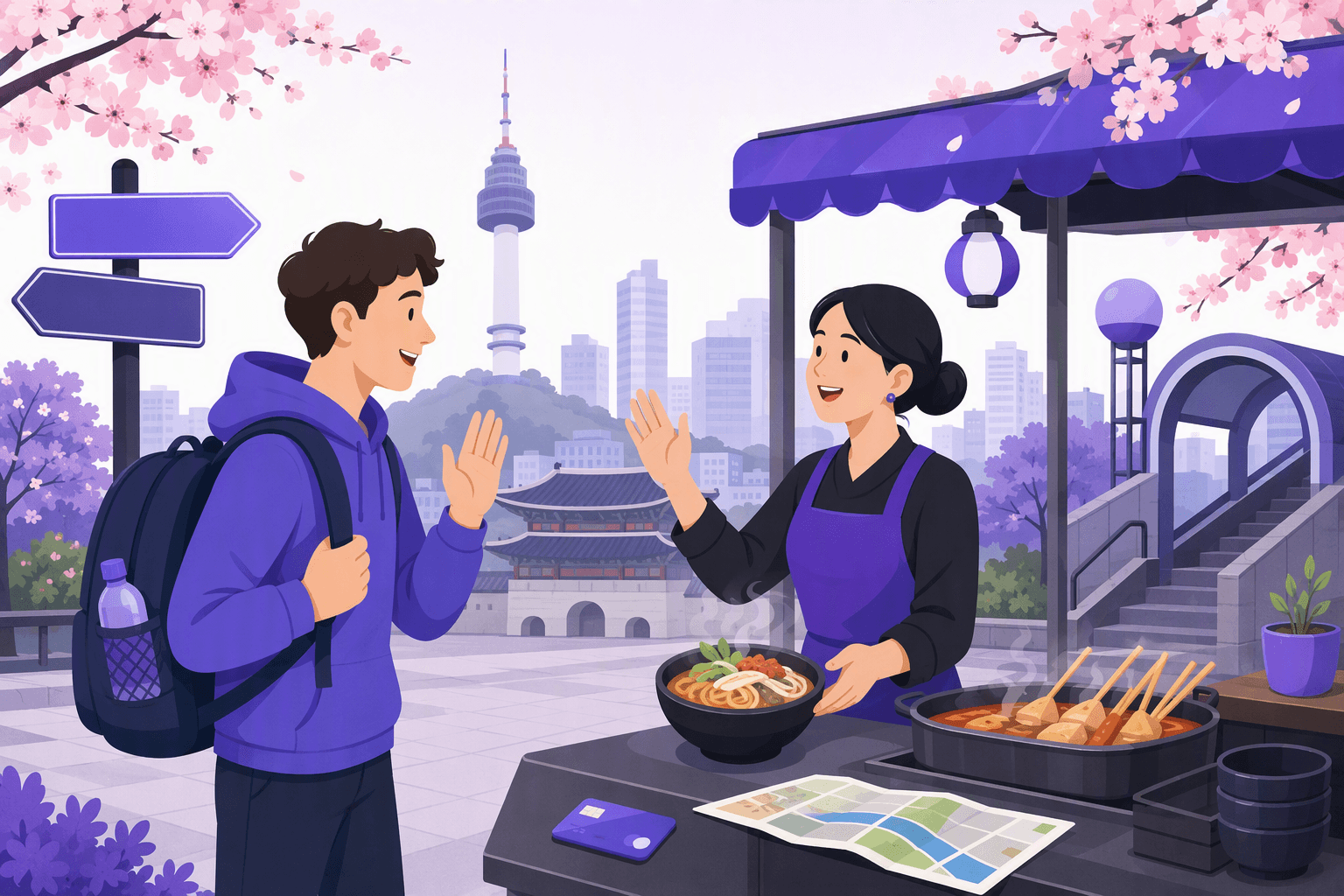
The polite Korean that tourists need
Korean has several speech levels. For travel, the safest choice is the polite style, often marked by 요 /jo/, or formal expressions such as 감사합니다 /kam.sa.ham.ni.da/.
Jaehoon Yeon and Lucien Brown, in Korean: A Comprehensive Grammar, treat honorifics and speech levels as central to Korean social meaning. A very simple sentence can sound considerate when its ending fits the relationship and setting.
You do not need highly formal business Korean. But avoid bare dictionary words, such as 물 /mul/ for water, when ordering. Say 물 주세요 /mul tɕu.se.jo/, meaning water, please, instead.
안녕하세요
안녕하세요 /an.njʌŋ.ha.se.jo/ is the standard polite hello for entering shops, meeting hotel staff, and addressing strangers.
/ahn-NYUHNG-hah-seh-yoh/
Literal meaning: Are you at peace?
“안녕하세요. 체크인하고 싶어요.”
Hello. I would like to check in.
Use this as a default greeting during the day. A small nod is appropriate, especially when speaking to older people or service staff.
A shop employee may greet you with 어서 오세요 /ʌ.sʌ o.se.jo/, meaning welcome. You do not need to repeat it back. A smile, nod, or 안녕하세요 /an.njʌŋ.ha.se.jo/ is enough.
감사합니다
감사합니다 /kam.sa.ham.ni.da/ is a formal, reliable thank-you for any stranger, employee, driver, or older person.
/gahm-SAH-hahm-nee-dah/
Literal meaning: I give thanks
“도와주셔서 감사합니다.”
Thank you for helping me.
This is appropriate after receiving service, directions, change, or assistance. It sounds respectful without sounding distant.
You may also hear 고마워요 /ko.ma.wʌ.jo/, a polite but warmer thank-you. Use 감사합니다 /kam.sa.ham.ni.da/ when unsure. The National Institute of Korean Language recognizes both as standard expressions, though their social tone differs.
죄송합니다
죄송합니다 /tɕwe.soŋ.ham.ni.da/ means sorry and is also an effective way to get someone’s attention politely. Use it before asking a stranger for directions or passing through a crowded place.
/chway-SOHNG-hahm-nee-dah/
Literal meaning: I am sorry
“죄송합니다. 화장실이 어디예요?”
Excuse me. Where is the restroom?
Use this before interrupting someone or when you have caused inconvenience. It is more respectful than a casual apology.
For a small accidental bump, 미안해요 /mi.an.he.jo/ is possible, but 죄송합니다 /tɕwe.soŋ.ham.ni.da/ is safer with strangers.
🌍 Use polite endings by default
In Korea, ending a request with 요 /jo/ makes a major difference. 주세요 /tɕu.se.jo/ is polite and useful. A bare noun, gesture, or command-like form can sound abrupt, even when the traveler does not intend it that way.
45 Korean travel phrases for real situations
Learn the first ten before your flight. The rest become useful as soon as you take public transport, sit down at a restaurant, or need help.
Greetings and basic courtesy
| English | Korean | IPA | When to use it |
|---|---|---|---|
| 1. Hello | 안녕하세요 | /an.njʌŋ.ha.se.jo/ | Default greeting |
| 2. Thank you | 감사합니다 | /kam.sa.ham.ni.da/ | Formal and safe |
| 3. Excuse me / sorry | 죄송합니다 | /tɕwe.soŋ.ham.ni.da/ | Get attention or apologize |
| 4. Please give me | 주세요 | /tɕu.se.jo/ | Add after an item |
| 5. Yes | 네 | /ne/ | Polite agreement |
| 6. No | 아니요 | /a.ni.jo/ | Polite refusal |
| 7. It is okay | 괜찮아요 | /kwɛn.tɕʰa.na.jo/ | Fine, no problem |
| 8. I do not understand | 이해 못 해요 | /i.hɛ mot hɛ.jo/ | When speech is too fast |
| 9. Please speak slowly | 천천히 말해 주세요 | /tɕʰʌn.tɕʰʌn.hi mal.hɛ tɕu.se.jo/ | Ask for slower speech |
| 10. Do you speak English? | 영어 할 수 있어요? | /jʌŋ.ʌ hal su i.sʌ.jo/ | Ask before switching languages |
영어 /jʌŋ.ʌ/ means English. If the answer is 조금 /tɕo.kɯm/, meaning a little, use short sentences and show the relevant address, image, or map.
Airport, hotel, and directions
| English | Korean | IPA | When to use it |
|---|---|---|---|
| 11. Where is the airport? | 공항이 어디예요? | /koŋ.haŋ.i ʌ.di.je.jo/ | Asking a taxi driver |
| 12. Where is the station? | 역이 어디예요? | /jʌ.ki ʌ.di.je.jo/ | Subway or rail travel |
| 13. Where is the restroom? | 화장실이 어디예요? | /hwa.dʑaŋ.ɕi.ri ʌ.di.je.jo/ | Essential public request |
| 14. Where is the exit? | 출구가 어디예요? | /tɕʰul.ɡu.ɡa ʌ.di.je.jo/ | Subway stations and malls |
| 15. Please call a taxi | 택시 불러 주세요 | /tʰɛk.ɕʰi pul.lʌ tɕu.se.jo/ | At a hotel or restaurant |
| 16. Please take me here | 여기로 가 주세요 | /jʌ.ɡi.ɾo ka tɕu.se.jo/ | Show the driver a map |
| 17. I have a reservation | 예약했어요 | /je.ja.kʰɛ.sʌ.jo/ | Hotel, restaurant, tour |
| 18. I would like to check in | 체크인하고 싶어요 | /tɕʰe.kʰɯ.in.ha.ɡo ɕi.pʰʌ.jo/ | At a hotel desk |
| 19. I would like to check out | 체크아웃하고 싶어요 | /tɕʰe.kʰɯ.a.ut.ha.ɡo ɕi.pʰʌ.jo/ | Leaving a hotel |
| 20. Can you keep my luggage? | 짐 맡아 주실 수 있어요? | /tɕim ma.tʰa tɕu.ɕil su i.sʌ.jo/ | Before check-in or after checkout |
The Korea Tourism Organization provides English support at many major transport hubs, but local signage is easier to follow when you recognize 역 /jʌk/, station, and 출구 /tɕʰul.ɡu/, exit. For more reading help, use a Hangul consonants and vowels guide before traveling.
| English | Korean | Pronunciation | Note |
|---|---|---|---|
| Airport | 공항 | gong-HAHNG | Useful for signs and taxi requests. |
| Station | 역 | yuhk | Used for subway and train stations. |
| Hotel | 호텔 | hoh-TEL | A common loanword. |
| Restroom | 화장실 | hwah-JAHNG-shil | The standard public term. |
| Menu | 메뉴 | meh-NYOO | Used in cafés and restaurants. |
| Receipt | 영수증 | yuhng-SOO-jeung | Ask for this after paying. |
| Card | 카드 | KAH-deu | For card payment. |
| Cash | 현금 | hyuhn-GEUM | Useful at markets and small stalls. |
Restaurant and café phrases
Food is one of the easiest places to practice Korean because menus, photos, and gestures provide context. In restaurants, use the staff call 저기요 /tɕʌ.ɡi.jo/ politely rather than shouting across the room.
주세요
주세요 /tɕu.se.jo/ means please give me. Put the item first: 물 주세요 /mul tɕu.se.jo/, water please, or 메뉴 주세요 /me.nju tɕu.se.jo/, menu please.
/mool joo-SEH-yoh/
Literal meaning: Water, please give
“물 두 잔 주세요.”
Two glasses of water, please.
Add 주세요 after the item you want. This short pattern works in restaurants, cafés, markets, and many shops.
| English | Korean | IPA | When to use it |
|---|---|---|---|
| 21. A menu, please | 메뉴 주세요 | /me.nju tɕu.se.jo/ | On arrival |
| 22. Water, please | 물 주세요 | /mul tɕu.se.jo/ | Restaurants and cafés |
| 23. This one, please | 이거 주세요 | /i.ɡʌ tɕu.se.jo/ | Point to an item |
| 24. Is this spicy? | 이거 매워요? | /i.ɡʌ mɛ.wʌ.jo/ | Before ordering |
| 25. Not spicy, please | 안 맵게 해 주세요 | /an mɛp.kɛ hɛ tɕu.se.jo/ | Request mild food |
| 26. I cannot eat this | 이거 못 먹어요 | /i.ɡʌ mot mʌ.ɡʌ.jo/ | Dietary restriction |
| 27. I am vegetarian | 저는 채식주의자예요 | /tɕʌ.nɯn tɕʰɛ.ɕik.tɕu.i.dʑa.je.jo/ | Explain dietary needs |
| 28. It is delicious | 맛있어요 | /ma.ɕi.sʌ.jo/ | Compliment food |
| 29. The bill, please | 계산해 주세요 | /ke.san.hɛ tɕu.se.jo/ | Ask to pay |
| 30. Can I pay by card? | 카드로 계산할 수 있어요? | /kʰa.dɯ.ɾo ke.san.hal su i.sʌ.jo/ | Confirm payment method |
맛있어요 /ma.ɕi.sʌ.jo/ is a warm, natural compliment to a cook or restaurant owner. It is more useful than memorizing elaborate praise, and it often begins a friendly interaction.
For detailed ordering language and dining etiquette, see the guide to Korean restaurant phrases.
Shopping, transport, and emergencies
Korea is highly card-friendly in cities, but street markets and small independent vendors may prefer cash. 현금 /hjʌn.ɡɯm/ means cash, while 카드 /kʰa.dɯ/ means card.
| English | Korean | IPA | When to use it |
|---|---|---|---|
| 31. How much is it? | 얼마예요? | /ʌl.ma.je.jo/ | Ask a price |
| 32. It is too expensive | 너무 비싸요 | /nʌ.mu pi.s͈a.jo/ | Decline politely |
| 33. Do you have another size? | 다른 사이즈 있어요? | /ta.ɾɯn sa.i.dʑɯ i.sʌ.jo/ | Shopping for clothes |
| 34. Can I try this on? | 입어 봐도 돼요? | /i.bʌ pwa.do twɛ.jo/ | Fitting room request |
| 35. Receipt, please | 영수증 주세요 | /jʌŋ.su.dʑɯŋ tɕu.se.jo/ | After payment |
| 36. Which line should I take? | 몇 호선 타야 해요? | /mjʌt ho.sʌn tʰa.ja hɛ.jo/ | Subway help |
| 37. Does this go to Seoul Station? | 이거 서울역 가요? | /i.ɡʌ sʌ.ul.jʌk ka.jo/ | Bus or train check |
| 38. Please stop here | 여기 세워 주세요 | /jʌ.ɡi se.wʌ tɕu.se.jo/ | Taxi request |
| 39. I am lost | 길을 잃었어요 | /ki.rɯl i.ɾʌ.sʌ.jo/ | Ask for help |
| 40. Please help me | 도와주세요 | /to.wa.dʑu.se.jo/ | Urgent but polite |
| 41. I need a doctor | 의사가 필요해요 | /ɰi.sa.ɡa pʰi.ɾjo.hɛ.jo/ | Medical need |
| 42. Please call the police | 경찰 불러 주세요 | /kjʌŋ.tɕʰal pul.lʌ tɕu.se.jo/ | Emergency |
| 43. I lost my passport | 여권을 잃어버렸어요 | /jʌ.kwʌ.nɯl i.ɾʌ.bʌ.ɾjʌ.sʌ.jo/ | Embassy or police |
| 44. Where is the pharmacy? | 약국이 어디예요? | /jak.ku.ɡi ʌ.di.je.jo/ | Medicine or supplies |
| 45. Goodbye | 안녕히 계세요 | /an.njʌŋ.hi ke.se.jo/ | When the other person stays |
안녕히 계세요
안녕히 계세요 /an.njʌŋ.hi ke.se.jo/ is a polite goodbye used when you are leaving and the other person is staying. For example, say it when departing a hotel reception desk or small shop.
If the other person is leaving and you remain, use 안녕히 가세요 /an.njʌŋ.hi ka.se.jo/. Korean distinguishes these two situations, which is why a simple English goodbye has more than one natural Korean equivalent. See how to say goodbye in Korean for more farewell choices.
🌍 The practical rule for Korean interactions
Greet first, make your request with 주세요 /tɕu.se.jo/ or a polite question ending in 요 /jo/, then say 감사합니다 /kam.sa.ham.ni.da/. This three-part pattern is enough for many tourist interactions and signals respect even when your grammar is limited.
Pronunciation and travel etiquette that matter
Korean pronunciation is generally consistent once you can read Hangul, but sounds may change slightly in connected speech. Do not worry about perfect accent during a short trip. Clear pacing, a polite ending, and visible context matter more than sounding native.
The consonant written ㅅ is often pronounced close to an English sh sound before ㅣ /i/. That is why 화장실 /hwa.dʑaŋ.ɕiɭ/, restroom, contains a sh-like sound in its final syllable.
When handing over a card, cash, or passport, using two hands is a considerate gesture, especially with older people. A small nod while saying 감사합니다 /kam.sa.ham.ni.da/ also fits naturally in service interactions.
Avoid using Korean casual speech copied from dramas with employees or strangers. Shows often portray close friends, family members, classmates, or tense conflicts. For context on speech levels beyond travel basics, read the Korean formal and informal speech guide.
💡 A five-phrase survival set
If you only memorize five phrases, choose 안녕하세요 /an.njʌŋ.ha.se.jo/, 감사합니다 /kam.sa.ham.ni.da/, 죄송합니다 /tɕwe.soŋ.ham.ni.da/, 이거 주세요 /i.ɡʌ tɕu.se.jo/, and 화장실이 어디예요? /hwa.dʑaŋ.ɕi.ri ʌ.di.je.jo/. They cover greetings, appreciation, requests, attention, and a common practical need.
Learn phrases through the situations where you will hear them
A phrase list becomes more memorable when it is attached to a scene: entering a convenience store, ordering coffee, tapping into the subway, or checking into a hotel. Practice each phrase aloud with the object or action it belongs to.
Watch short Korean scenes, pause after a request, repeat it, and then make one small change. For example, change 물 주세요 /mul tɕu.se.jo/ to 커피 주세요 /kʰʌ.pʰi tɕu.se.jo/, coffee please. That pattern practice prepares you for real conversations better than memorizing isolated translations.
For more listening-focused study before departure, explore Korean travel phrases for real situations and build your vocabulary around clips you can hear, replay, and use.
Frequently Asked Questions
What Korean phrases should tourists learn first?
Can I travel in South Korea using only English?
Is it rude to use casual Korean with strangers?
How do I politely ask for something in Korean?
Should I learn Hangul before visiting Korea?
Sources & References
- National Institute of Korean Language, Standard Korean Language Dictionary, accessed 2026
- King Sejong Institute Foundation, Korean Language Learning Materials, accessed 2026
- Korea Tourism Organization, Travel Information and Visitor Services, accessed 2026
- Ethnologue, Korean, 27th edition, 2024
- Jaehoon Yeon and Lucien Brown, Korean: A Comprehensive Grammar, Routledge
Start learning with Wordy
Watch real movie clips and build your vocabulary as you go. Free to download.


