Quick Answer
The most common way to say goodbye in Korean is '안녕히 가세요' (Annyeonghi gaseyo) when the other person is leaving, and '안녕히 계세요' (Annyeonghi gyeseyo) when you are the one leaving. Korean is unique among world languages in having two distinct goodbye phrases depending on who is staying and who is going, a distinction rooted in Confucian values of care and respect.
The Korean Art of Saying Goodbye
The most common way to say goodbye in Korean is 안녕히 가세요 (Annyeonghi gaseyo) when the other person is leaving, or 안녕히 계세요 (Annyeonghi gyeseyo) when you are the one departing. Unlike English, which uses a single "goodbye" regardless of who is leaving, Korean requires you to choose based on whether you are the one staying or going.
Korean is spoken by over 80 million people worldwide according to Ethnologue's 2024 data, and its farewell system is one of the most culturally revealing aspects of the language. The distinction between "go in peace" and "stay in peace" reflects a deeply Confucian worldview where speakers constantly signal care and awareness of the other person's situation.
"Korean farewell expressions encode the spatial relationship between speaker and listener at the moment of parting. This is not mere politeness; it is a grammatical requirement that forces speakers to acknowledge the other person's movements and well-being."
(Ho-Min Sohn, The Korean Language, Cambridge University Press, 1999)
This guide covers 17 essential Korean farewell phrases organized by category: the classic stay-or-go pair, casual goodbyes (반말 banmal), workplace farewells, polite expressions (존댓말 jondaenmal), and K-drama vocabulary. Each phrase includes Hangul, romanization, pronunciation, an example sentence, and cultural context.
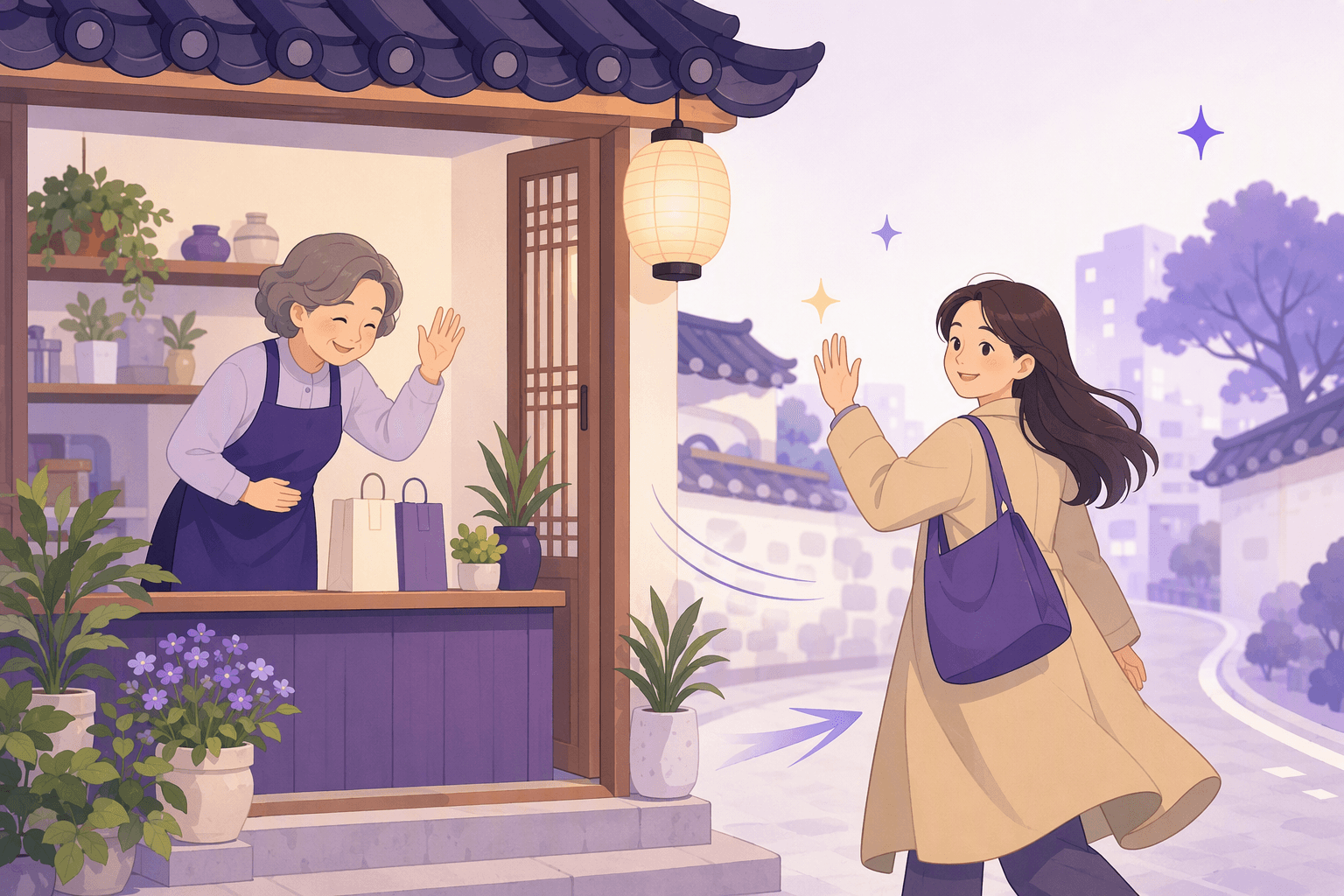
Quick Reference: Korean Goodbyes at a Glance
| English | Korean | Pronunciation | Formality |
|---|---|---|---|
| Goodbye (to person leaving) | 안녕히 가세요 | An-nyeong-hi ga-se-yo | polite |
| Goodbye (to person staying) | 안녕히 계세요 | An-nyeong-hi gye-se-yo | polite |
| Go well (casual) | 잘 가 | Jal ga | casual |
| Stay well (casual) | 잘 있어 | Jal i-sseo | casual |
| Bye (casual hello/goodbye) | 안녕 | An-nyeong | casual |
| See you next time | 다음에 봐요 | Da-eu-me bwa-yo | polite |
| See you tomorrow | 내일 봐 | Nae-il bwa | casual |
| You worked hard | 수고하셨습니다 | Su-go-ha-syeot-seum-ni-da | formal |
| I'll go first | 먼저 갈게요 | Meon-jeo gal-ge-yo | polite |
| Go carefully | 조심히 가세요 | Jo-sim-hi ga-se-yo | polite |
| Bye-bye (loanword) | 바이바이 | Ba-i-ba-i | casual |
| I had a good time | 즐거웠어요 | Jeul-geo-wo-sseo-yo | polite |
| Goodbye (very formal, leaving) | 안녕히 가십시오 | An-nyeong-hi ga-ship-shi-o | very formal |
| Take care of yourself | 몸 조심하세요 | Mom jo-sim-ha-se-yo | polite |
| Sleep well (casual) | 잘 자 | Jal ja | casual |
| See you later (casual) | 나중에 봐 | Na-jung-e bwa | casual |
| Good work (to colleague) | 수고하세요 | Su-go-ha-se-yo | polite |
The Two Forms of Goodbye
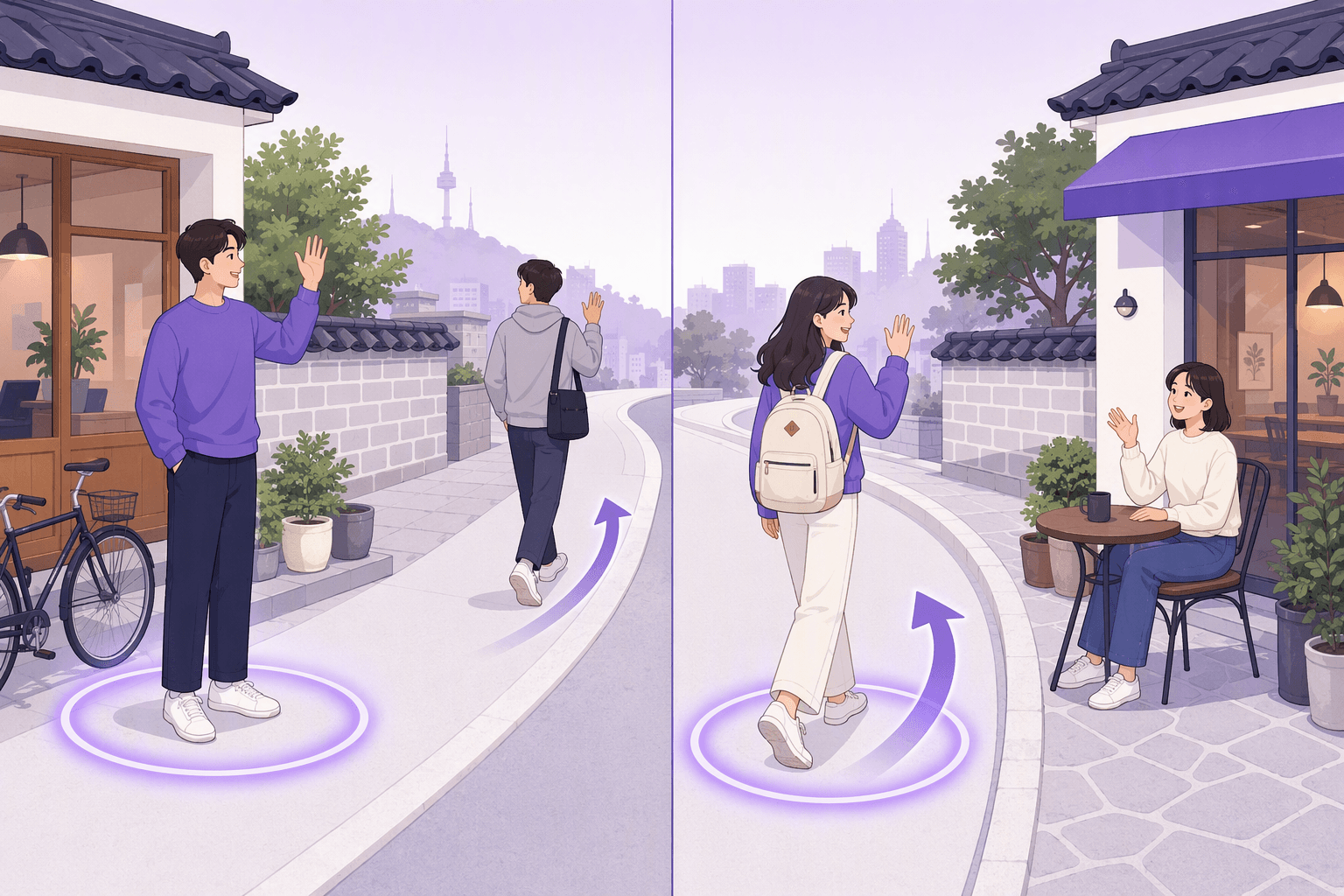
Korean is unique in splitting "goodbye" into two distinct phrases depending on who is leaving and who is staying. This is the single most important concept in Korean farewells, and getting it right immediately marks you as a thoughtful speaker.
| Situation | You Say | Literal Meaning |
|---|---|---|
| The other person is leaving, you stay | 안녕히 가세요 (Annyeonghi gaseyo) | Go in peace |
| You are leaving, the other person stays | 안녕히 계세요 (Annyeonghi gyeseyo) | Stay in peace |
| Both of you are leaving | 안녕히 가세요 (both say it) | Go in peace (mutual) |
안녕히 가세요 (Annyeonghi Gaseyo)
/An-nyeong-hi ga-se-yo/
Literal meaning: Go in peace
“안녕히 가세요! 조심히 운전하세요.”
Goodbye! Drive carefully.
Said to the person who is leaving while you remain. The root 가다 (gada) means 'to go.' This is the default polite farewell heard in shops, restaurants, and everyday encounters.
This is the goodbye you say when someone else is departing and you are staying behind. The construction breaks down clearly: 안녕히 (peacefully) + 가세요 (please go). You are literally wishing the departing person a peaceful journey.
You will hear this constantly in Korean daily life: from shopkeepers bidding farewell to customers, from hosts seeing off guests, and from anyone staying behind as another person leaves. It is often accompanied by a slight bow.
안녕히 계세요 (Annyeonghi Gyeseyo)
/An-nyeong-hi gye-se-yo/
Literal meaning: Stay in peace
“저 먼저 가볼게요. 안녕히 계세요!”
I'll get going now. Goodbye (stay well)!
Said to the person who is staying while you leave. The root 계시다 (gyesida) is the honorific form of 'to be/stay.' Signals respect for the person remaining.
This is the mirror image: you say it when you are the one leaving and the other person stays. The verb root shifts from 가다 (to go) to 계시다 (to stay, honorific). You are wishing the person who remains a peaceful stay.
💡 Both People Leaving?
When both parties are departing (leaving a restaurant together, ending a meeting where everyone heads home), both people say 안녕히 가세요 to each other. Neither person is staying, so 안녕히 계세요 does not apply. This is the one scenario where the distinction collapses.
안녕히 가십시오 (Annyeonghi Gashipshio)
/An-nyeong-hi ga-ship-shi-o/
Literal meaning: Go in peace (very formal)
“감사합니다. 안녕히 가십시오.”
Thank you. Goodbye (very formal).
The highest formality level of goodbye. Used in formal ceremonies, military contexts, news sign-offs, and official speeches. Sounds overly stiff in casual settings.
This is the formal-register version of 안녕히 가세요. As Yeon and Brown explain in Korean: A Comprehensive Grammar (Routledge, 2011), the -십시오 ending represents the deferential speech level used in institutional and ceremonial contexts. You will hear it in Korean news sign-offs, military addresses, and official events.
Casual Goodbyes (반말 Banmal)
These use the casual speech level and are strictly for close friends, siblings, or people younger than you. Using them with elders or strangers will cause offense.
잘 가 (Jal Ga)
/Jal ga/
Literal meaning: Go well
“잘 가! 집에 가서 쉬어.”
Bye! Go home and rest.
The casual equivalent of 안녕히 가세요. Said to the person leaving. Extremely common among friends, classmates, and in K-dramas. Short, warm, and direct.
The casual counterpart to 안녕히 가세요. Where the polite form wishes someone "peaceful going," 잘 가 wishes them "good going." It is the most common casual farewell in Korean and you will hear it in virtually every K-drama friendship scene. Check out our guide to the best Korean movies to hear it spoken naturally.
잘 있어 (Jal Isseo)
/Jal i-sseo/
Literal meaning: Stay well
“나 먼저 간다. 잘 있어!”
I'm heading out first. Stay well!
The casual equivalent of 안녕히 계세요. Said to the person staying. Less commonly heard than 잘 가; many young Koreans simply use 안녕 or 바이바이 for both directions.
The casual mirror of 잘 가, you say it to the person who stays behind while you leave. In practice, many younger Koreans skip this distinction in casual speech entirely and just use 안녕 or 바이바이 regardless of who is leaving or staying.
안녕 (Annyeong)
/An-nyeong/
Literal meaning: Peace / Well-being
“안녕! 내일 학교에서 봐.”
Bye! See you at school tomorrow.
The all-purpose casual greeting that works for both hello and goodbye. Context makes the meaning clear. The most versatile informal farewell among young Koreans.
Just as 안녕 works as a casual hello, it also works as a casual goodbye. The root meaning ("peace" or "well-being") carries the same well-wishing sentiment in both directions. Among young Koreans and in text messages on KakaoTalk, 안녕 has largely replaced the stay-or-go distinction in casual contexts.
바이바이 (Baibai)
/Ba-i-ba-i/
Literal meaning: Bye-bye (English loanword)
“오늘 재밌었어! 바이바이~”
Today was fun! Bye-bye~
Borrowed directly from English. Widely used by younger Koreans, especially in text messages and casual settings. Often written with a tilde (바이바이~) to add a cute, friendly tone.
A direct English loanword that has been fully adopted into casual Korean. It is especially popular in text messages and among younger speakers. The tilde character () is frequently added in writing (바이바이) to soften the tone and add warmth, a common practice in Korean digital communication.
Workplace Goodbyes
Korean workplace culture places enormous emphasis on mutual respect and acknowledging collective effort. These phrases are essential for navigating the Korean office environment.
수고하셨습니다 (Sugohasyeosseumnida)
/Su-go-ha-syeot-seum-ni-da/
Literal meaning: You have worked hard
“오늘 하루도 수고하셨습니다. 안녕히 가세요.”
You worked hard today as well. Goodbye.
The standard workplace farewell in Korean. Said to colleagues and superiors at the end of the workday. Acknowledges the other person's effort and labor, a deeply valued gesture in Korean corporate culture.
This is arguably the most important workplace phrase in the Korean language. It transcends a simple goodbye; it is an acknowledgment that the other person put in effort, that their work mattered. According to the National Institute of Korean Language (국립국어원), 수고 refers to toil or labor, and the phrase literally means "you have endured hard work."
The honorific marker -셨- makes this appropriate for speaking to superiors and colleagues. It is the standard end-of-day farewell in Korean offices, factories, and any shared work environment.
수고하세요 (Sugohaseyo)
/Su-go-ha-se-yo/
Literal meaning: Work hard / Keep up the good work
“저 먼저 퇴근합니다. 수고하세요!”
I'm heading home first. Keep up the good work!
Said to colleagues who are still working when you leave. Slightly less formal than 수고하셨습니다. Note: traditionally considered inappropriate to say to a direct superior; use 수고하셨습니다 instead.
A subtle but important distinction: 수고하셨습니다 (past tense, "you worked hard") is used when the work is done, while 수고하세요 (present/future, "keep working hard") is said to people who are still at their desks as you leave. Be careful with this one, because some older or more traditional superiors may find it presumptuous if a junior tells them to "keep working hard."
⚠️ Hierarchy Matters in Workplace Goodbyes
In traditional Korean corporate culture, saying 수고하세요 to your boss can be interpreted as a junior instructing a senior, which breaks hierarchical norms. The safest approach is to use 수고하셨습니다 with superiors and 수고하세요 with peers or juniors. Younger and more international workplaces are more relaxed about this, but when in doubt, default to the more formal option.
먼저 갈게요 (Meonjeo Galgeyo)
/Meon-jeo gal-ge-yo/
Literal meaning: I will go first
“죄송하지만 먼저 갈게요. 수고하셨습니다!”
Sorry, but I'll head out first. You worked hard!
Used when leaving before your colleagues at work. The word 먼저 (first) acknowledges that others are still working and softens the departure. Almost always followed by 수고하셨습니다.
In Korea's long-hours work culture, leaving before your colleagues can feel socially awkward. 먼저 갈게요 addresses this directly by explicitly acknowledging that you are leaving "first," implying you know others are still working and you appreciate their effort. It is almost always paired with 수고하셨습니다.
Polite and Caring Farewells
These phrases go beyond a simple goodbye to express genuine care for the other person's well-being.
조심히 가세요 (Josimhi Gaseyo)
/Jo-sim-hi ga-se-yo/
Literal meaning: Go carefully
“비 오니까 조심히 가세요.”
It's raining, so please go carefully.
A warm farewell expressing concern for the other person's safe journey home. Especially common at night, in bad weather, or when someone has a long commute. Shows genuine care beyond mere formality.
This farewell carries real emotional warmth. It is particularly common when someone is leaving at night, during bad weather, or when you know they have a long trip ahead. Parents say it to children, hosts say it to guests, and friends say it when they genuinely worry about someone's safety.
몸 조심하세요 (Mom Josimhaseyo)
/Mom jo-sim-ha-se-yo/
Literal meaning: Take care of your body
“요즘 감기 유행이에요. 몸 조심하세요.”
Colds are going around lately. Take care of yourself.
A farewell focused on health and well-being. Common during flu season, when someone has been sick, or as a general caring goodbye between people who will not see each other for a while.
Where 조심히 가세요 focuses on safe travel, 몸 조심하세요 focuses on physical health. It is the Korean equivalent of "take care of yourself" and carries a sense of sustained concern; you are not just worried about their trip home, but about their overall well-being until you meet again.
즐거웠어요 (Jeulgeoweosseoyo)
/Jeul-geo-wo-sseo-yo/
Literal meaning: It was enjoyable
“오늘 정말 즐거웠어요. 다음에 또 만나요!”
Today was really fun. Let's meet again next time!
Used after a social event, dinner, or outing to express that you had a good time. Often combined with another farewell phrase. The casual version is 즐거웠어 (Jeulgeoweosseo).
A social farewell that wraps up an enjoyable experience. Koreans commonly use it after dinners, outings, and gatherings as a warm signal that the time spent together was valued. It is almost always followed by a forward-looking phrase like 다음에 또 만나요 (let's meet again).
"See You" Phrases
These forward-looking farewells express the expectation of meeting again.
다음에 봐요 (Daeume Bwayo)
/Da-eu-me bwa-yo/
Literal meaning: See you next time
“오늘 감사했어요. 다음에 봐요!”
Thanks for today. See you next time!
A warm, forward-looking farewell. Works in almost any situation where you expect to see the person again. The casual version is 다음에 봐 (Daeume bwa).
The Korean equivalent of "see you next time." It strikes a perfect balance: polite enough for acquaintances and coworkers, warm enough for friends. The verb 보다 (boda, to see) in its polite form 봐요 keeps the tone respectful without being stiff.
내일 봐 (Naeil Bwa)
/Nae-il bwa/
Literal meaning: See you tomorrow
“내일 봐! 숙제 잊지 마.”
See you tomorrow! Don't forget the homework.
A casual farewell between classmates, close coworkers, or friends who will see each other the next day. The polite version is 내일 봐요 (Naeil bwayo).
Simple and direct, used when you know you will see the person the next day. It is a staple among students, daily coworkers, and friends with regular routines. If you are learning Korean, practice with native content on Wordy's Korean learning page to hear these phrases in their natural rhythm.
나중에 봐 (Najunge Bwa)
/Na-jung-e bwa/
Literal meaning: See you later
“나 먼저 간다. 나중에 봐!”
I'm heading out. See you later!
A relaxed casual farewell without a specific timeframe. 나중에 means 'later' or 'some other time.' The polite version is 나중에 봐요 (Najunge bwayo).
The vaguest of the "see you" farewells, it does not commit to a specific time, just a general expectation of meeting again. It is the Korean equivalent of a breezy "see ya" tossed over your shoulder as you leave.
Nighttime Farewell
잘 자 (Jal Ja)
/Jal ja/
Literal meaning: Sleep well
“늦었다. 잘 자! 좋은 꿈 꿔.”
It's late. Sleep well! Have good dreams.
The casual nighttime farewell, used when parting in the evening or ending a late-night phone call. Often followed by 좋은 꿈 꿔 (have good dreams). The polite version is 안녕히 주무세요 (Annyeonghi jumuseyo).
The go-to nighttime farewell among friends. The polite equivalent, 안녕히 주무세요 (Annyeonghi jumuseyo), uses the honorific verb 주무시다 (to sleep, honorific) and is appropriate for parents, elders, or anyone you address in polite speech.
🌍 K-Drama Farewell Vocabulary
Korean dramas are a goldmine for hearing natural farewell expressions. Watch for 잘 가 in school-setting dramas like Reply 1988, 수고하셨습니다 in office dramas like Misaeng, and the emotionally charged 안녕히 계세요 in melodramas like Crash Landing on You where characters part under dramatic circumstances. The staying-or-going distinction becomes especially poignant in scenes where one character must leave and the other cannot follow. Explore our best Korean movies list for more recommendations.
How to Respond to Korean Goodbyes
Knowing the correct response is just as important as initiating the farewell. Here are the key patterns.
| They Say | You Say | Situation |
|---|---|---|
| 안녕히 가세요 | 안녕히 계세요 | They stay, you leave |
| 안녕히 계세요 | 안녕히 가세요 | You stay, they leave |
| 잘 가 | 잘 있어 (or 안녕) | Casual: they stay, you leave |
| 수고하셨습니다 | 수고하셨습니다 (or 안녕히 가세요) | Workplace: echo or add goodbye |
| 조심히 가세요 | 네, 감사합니다 (Ne, gamsahamnida) | Thank them for caring |
| 다음에 봐요 | 네, 다음에 봐요 | Echo with agreement |
💡 The Safe Default
When unsure how to respond, simply echo the phrase back. This works for 수고하셨습니다, 다음에 봐요, and most other farewells. For the stay-or-go pair, remember to swap: if they say 가세요 (go), you say 계세요 (stay), and vice versa.
Practice With Real Korean Content
Reading about farewell phrases builds knowledge, but hearing them in context is what makes them stick. Korean dramas and films use these expressions constantly: the formal workplace goodbyes in Misaeng, the tearful 안녕히 계세요 in melodramas, and the rapid-fire 잘 가! 바이바이~ in youth-oriented shows all demonstrate how context shapes which goodbye a Korean speaker chooses.
Wordy lets you watch Korean content with interactive subtitles, tapping on any farewell phrase to see its meaning, speech level, and the staying-or-going context in real time. Instead of memorizing rules from a guide, you internalize the patterns through authentic conversations.
For more Korean learning resources, explore our blog for additional language guides, or visit our Korean learning page to start practicing today.
Frequently Asked Questions
What is the difference between 안녕히 가세요 and 안녕히 계세요?
How do you say goodbye casually in Korean?
What do Koreans say when leaving work?
Can 안녕 be used for both hello and goodbye?
What does 잘 자 mean and when do you use it?
How do you say 'see you later' in Korean?
Sources & References
- National Institute of Korean Language (국립국어원), Standard Korean Language Dictionary
- Sohn, H.-M. (1999). 'The Korean Language.' Cambridge University Press.
- Yeon, J. & Brown, L. (2011). 'Korean: A Comprehensive Grammar.' Routledge.
- King Sejong Institute Foundation, Korean Language Education Guidelines (2024)
- Ethnologue: Languages of the World, Korean language entry (2024)
Start learning with Wordy
Watch real movie clips and build your vocabulary as you go. Free to download.


