Quick Answer
Korean BBQ vocabulary helps you order meat, ask for side dishes, understand grilling roles, and follow basic table etiquette. Learn practical Korean words for cuts of meat, banchan, dipping sauces, drinks, and polite requests before your next barbecue meal.
Korean BBQ vocabulary starts with a few high-value words: 고기 /ko.ɡi/ means meat, 구이 /ku.i/ means grilled food, 삼겹살 /sam.ɡjʌp.sal/ is pork belly, 갈비 /kal.bi/ is ribs, and 반찬 /pan.tɕʰan/ means shared side dishes. Learn these terms plus polite requests such as 주세요 /tɕu.se.jo/, and you can order, grill, and eat at a Korean barbecue restaurant without guessing.
Korean is spoken by roughly 81 million people worldwide, according to Ethnologue's 27th edition. Food is one of the most approachable ways into that language because restaurant conversations repeat practical verbs, requests, numbers, and social routines. A Korean BBQ table gives you all of them at once.
Before your meal, learn how to say hello in Korean. A confident 안녕하세요 /an.njʌŋ.ha.se.jo/ at the door is a better opening than relying only on English.
| English | Korean | Pronunciation | Formality |
|---|---|---|---|
| A table for two, please. | 두 명이에요. | doo MYUNG-ee-eh-yoh | polite |
| Please give us pork belly. | 삼겹살 주세요. | sam-GYUP-sal joo-SEH-yoh | polite |
| Please give us more side dishes. | 반찬 좀 더 주세요. | ban-CHAN jom duh joo-SEH-yoh | polite |
| May I have water, please? | 물 좀 주세요. | mool jom joo-SEH-yoh | polite |
| Thank you for the meal. | 잘 먹겠습니다. | jal muk-ket-SUM-nee-dah | formal |
| This is delicious. | 맛있어요. | mah-SHIH-suh-yoh | polite |
What Korean BBQ Actually Means
Korean BBQ is not one fixed dish. The broad expression 고기구이 /ko.ɡi.ɡu.i/ combines 고기 /ko.ɡi/, meat, with 구이 /ku.i/, grilling or roasted food. A menu normally tells you which protein and cut you are ordering rather than simply offering Korean BBQ.
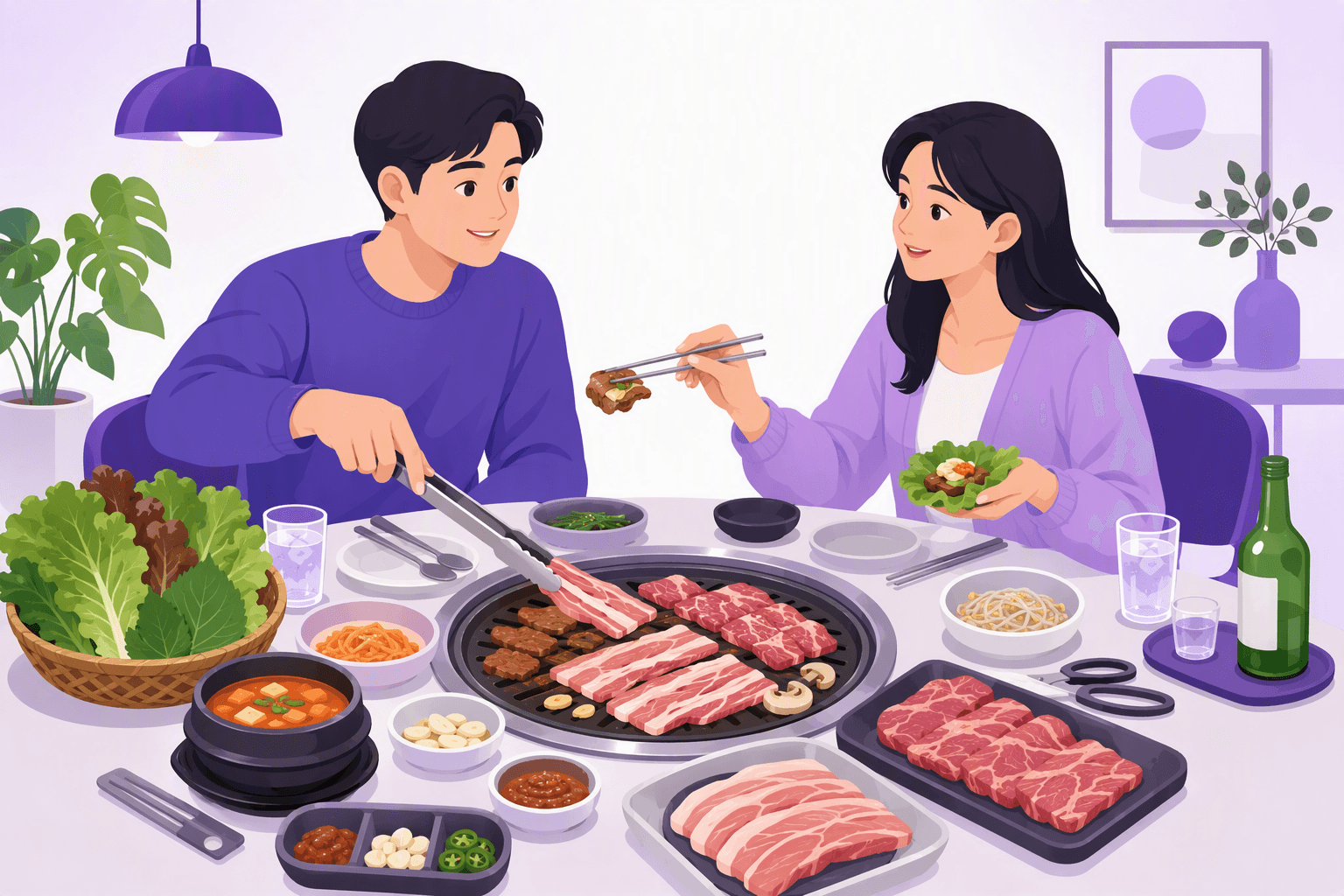
The tabletop grill is central, but so is the shared meal structure. Meat arrives raw, diners grill it in batches, and everyone combines it with rice, sauces, leafy wraps, and side dishes. This makes Korean BBQ a highly social meal, not just a way of cooking.
Food scholar Robert Ji-Song Ku examines how Korean food travels through migration, commerce, and identity in Dubious Gastronomy. That context matters at the table: Korean barbecue abroad may adapt its portions, banchan selection, or service style, while still preserving the shared-grill format.
Core Korean BBQ Menu Vocabulary
The menu can look intimidating because it may list individual cuts without an English category. Learn the most common words first, then use photos or ask staff for recommendations.
| English | Korean | Pronunciation | Note |
|---|---|---|---|
| Meat | 고기 | GOH-gee | IPA: /ko.ɡi/. A general word for meat. |
| Grilled meat | 고기구이 | GOH-gee goo-ee | IPA: /ko.ɡi.ku.i/. General name for Korean barbecue. |
| Pork belly | 삼겹살 | sam-GYUP-sal | IPA: /sam.ɡjʌp.sal/. Thick, fatty slices of pork. |
| Beef ribs | 갈비 | GAL-bee | IPA: /kal.bi/. Can refer to ribs or rib meat. |
| Marinated beef ribs | 양념갈비 | yang-NYUM-gal-bee | IPA: /jaŋ.njʌm.kal.bi/. Sweet-savory marinated ribs. |
| Beef brisket | 차돌박이 | cha-DOL-bah-gee | IPA: /tɕʰa.tol.pa.ɡi/. Thinly sliced, fast-cooking beef. |
| Pork shoulder | 목살 | mok-SAL | IPA: /mok.sal/. Leaner and firmer than pork belly. |
| Marinated meat | 양념 | yang-NYUM | IPA: /jaŋ.njʌm/. A seasoning or marinade. |
| Side dishes | 반찬 | ban-CHAN | IPA: /pan.tɕʰan/. Small shared dishes served with rice. |
| Kimchi | 김치 | GIM-chee | IPA: /kim.tɕʰi/. Fermented, seasoned vegetables, often cabbage. |
| Lettuce wrap | 상추쌈 | sang-CHOO-ssam | IPA: /saŋ.tɕʰu.s͈am/. Lettuce used to wrap meat and rice. |
| Soybean paste stew | 된장찌개 | dwen-JANG-jjee-geh | IPA: /twen.dzaŋ.t͈ɕi.ɡɛ/. A savory stew often ordered with meat. |
삼겹살
삼겹살 /sam.ɡjʌp.sal/ literally refers to three-layered flesh, describing pork belly's visible bands of meat and fat. It is among the most familiar Korean barbecue choices and is usually unseasoned, so the flavor comes from grilling, sauces, garlic, kimchi, and wraps.
Cook 삼겹살 /sam.ɡjʌp.sal/ until both sides are browned and the interior is fully cooked. Many restaurants provide kitchen scissors, called 가위 /ka.wi/, to cut it into bite-size pieces directly on the grill.
갈비
갈비 /kal.bi/ means ribs. On menus, it can refer to beef ribs, pork ribs, or rib meat prepared for grilling. The exact animal is often clarified with 소갈비 /so.kal.bi/, beef ribs, or 돼지갈비 /twe.dʑi.kal.bi/, pork ribs.
양념갈비 /jaŋ.njʌm.kal.bi/ is marinated rib meat. 양념 /jaŋ.njʌm/ means seasoning or marinade, usually a sweet-savory mixture involving soy sauce, garlic, sugar, fruit, or sesame oil. Because the marinade can burn, turn these pieces regularly and lower the heat if your table grill allows it.
목살
목살 /mok.sal/ is pork shoulder or neck meat. It is generally less fatty than pork belly and has a satisfying chew when grilled well. If you want a balanced order, pairing 삼겹살 /sam.ɡjʌp.sal/ with 목살 /mok.sal/ gives your group both a rich cut and a leaner one.
차돌박이
차돌박이 /tɕʰa.tol.pa.ɡi/ is very thinly sliced beef brisket. It cooks quickly, often in seconds, and should not be left on a hot grill while you are talking. Dip it in sesame oil with salt and pepper, called 기름장 /ki.ɾɯm.dʑaŋ/, or wrap it in lettuce.
Side Dishes, Sauces, and Wraps
A Korean BBQ table is built around contrast. Rich grilled meat becomes lighter with crisp leaves, sharp kimchi, raw garlic, and salty-fermented sauces. The Korean Food Promotion Institute presents Korean meals as combinations of staple foods, side dishes, and fermented seasonings, rather than isolated main courses.
반찬 /pan.tɕʰan/ are the small dishes that arrive before or alongside the meat. They can include 김치 /kim.tɕʰi/, kimchi; 콩나물 /kʰoŋ.na.mul/, seasoned soybean sprouts; 어묵볶음 /ʌ.muk.p͈ok͈ɯm/, stir-fried fish cake; and 감자샐러드 /kam.dʑa.sel.lʌ.tɯ/, potato salad.
Kimchi is especially significant. UNESCO recognizes 김장 /kim.dʑaŋ/, the communal making and sharing of kimchi, as Intangible Cultural Heritage. At barbecue, grilled 김치 /kim.tɕʰi/ can be placed at the edge of the grill, where it picks up pork fat and becomes sweeter.
A wrap is called 쌈 /s͈am/. Put lettuce, called 상추 /saŋ.tɕʰu/, in your palm, add a piece of meat, rice, garlic, kimchi, and a little sauce, then eat it in one bite if practical. The combined form 상추쌈 /saŋ.tɕʰu.s͈am/ means lettuce wrap.
The two sauces most worth recognizing are 쌈장 /s͈am.dʑaŋ/, a thick savory paste for wraps, and 기름장 /ki.ɾɯm.dʑaŋ/, sesame oil seasoned with salt and often pepper. Use small amounts of 쌈장 /s͈am.dʑaŋ/, because its fermented soybean base is intense.
🌍 The one-bite wrap convention
A Korean wrap, or 쌈 /s͈am/, is often assembled as a single mouthful. Do not build an oversized wrap that spills across the table. Smaller wraps make it easier to taste the meat, sauce, rice, and vegetables together.
Essential Restaurant Phrases
The phrase 주세요 /tɕu.se.jo/ is the workhorse of a Korean restaurant. It means please give me or please give us, and you can place an item before it: 물 주세요 /mul tɕu.se.jo/, water please, or 맥주 주세요 /mɛk.tɕu tɕu.se.jo/, beer please.
To ask for more of something, use 좀 더 주세요 /tɕom tʌ tɕu.se.jo/, meaning please give us a little more. For example, 상추 좀 더 주세요 /saŋ.tɕʰu tɕom tʌ tɕu.se.jo/ means please give us more lettuce.
When staff bring food, 감사합니다 /kam.sa.ham.ni.da/ is a safe formal thank-you. When you begin eating, 잘 먹겠습니다 /tɕal mʌk.kɛs.sɯm.ni.da/ expresses appreciation for the meal. It is a conventional phrase, not a literal announcement that you are a good eater.
At the end, say 계산해 주세요 /kje.san.ɦɛ tɕu.se.jo/, please calculate the bill. You can also ask 계산서 주세요 /kje.san.sʌ tɕu.se.jo/, please give us the bill. Finish with 안녕히 계세요 /an.njʌŋ.ɦi kje.se.jo/ when staff remain at the restaurant, a phrase explained in our guide to saying goodbye in Korean.
Grilling Etiquette That Matters
At a shared grill, one person often takes responsibility for turning and cutting the meat. This person may be the host, the oldest diner, or simply the person sitting closest to the grill. Offer help, but do not repeatedly interfere with someone already managing the cooking.
Use separate utensils for raw and cooked meat whenever the restaurant provides them. If there is only one pair of tongs, ask staff what they prefer, or move cooked pieces to a clean plate before eating. Food safety matters more than performing etiquette perfectly.
Korean dining etiquette also pays attention to age and social hierarchy. In a formal group, wait for the eldest person to begin eating or drinking. If someone older pours you a drink, receive it with both hands or support your right wrist with your left hand.
Linguist and educator Young-Key Kim-Renaud has written extensively about Korean language and culture, including how social relationships shape speech. The same awareness appears at a barbecue table: politeness is not about memorizing a rigid rulebook, but about noticing who you are eating with and responding respectfully.
💡 A useful drinking rule
When drinking with older people in a formal setting, turn your head slightly away when taking a sip. Among close friends, this formality is often relaxed. Observe the table first, then follow its level of formality.
Drinks and Useful Food Add-Ons
소주 /so.dʑu/ is Korea's well-known clear distilled spirit, while 맥주 /mɛk.tɕu/ is beer. A mixture of the two is called 소맥 /so.mɛk/, combining the first syllables of the drink names.
A common non-alcoholic request is 물 /mul/, water. If you want cold water, ask for 찬물 /tɕʰan.mul/. 공깃밥 /koŋ.ɡit.p͈ap/ is an individual bowl of rice, and 냉면 /nɛŋ.mjʌn/ is cold noodle soup often ordered toward the end of a barbecue meal.
The contrast between hot grilled meat and cold 냉면 /nɛŋ.mjʌn/ is intentional. Its chilled broth, noodles, and vinegar-mustard seasoning refresh the palate. Many diners also order 된장찌개 /twen.dʑaŋ.t͈ɕi.ɡɛ/, soybean paste stew, with rice.
For more restaurant language beyond barbecue, see our Korean restaurant phrases guide. If a meal with friends becomes personal, Korean has affectionate expressions too, covered in how to say I love you in Korean.
A Simple Korean BBQ Ordering Plan
For two people, begin with one fatty pork option, such as 삼겹살 /sam.ɡjʌp.sal/, and one leaner or beef option, such as 목살 /mok.sal/ or 차돌박이 /tɕʰa.tol.pa.ɡi/. Add rice or 된장찌개 /twen.dʑaŋ.t͈ɕi.ɡɛ/ if you want a fuller meal.
Use the banchan rather than treating them as leftovers. Try grilled pork with garlic, kimchi, and 쌈장 /s͈am.dʑaŋ/ in a lettuce wrap, then try the same meat with only sesame oil. Comparing combinations is part of the meal.
The goal is not to pronounce every menu item perfectly. Learn 고기 /ko.ɡi/, 반찬 /pan.tɕʰan/, 주세요 /tɕu.se.jo/, and 맛있어요 /ma.s͈i.s͈ʌ.jo/ first. Those four words let you recognize the food, request what you need, and respond warmly when the meal is good.
Frequently Asked Questions
What is Korean BBQ called in Korean?
What should I say when I enter a Korean BBQ restaurant?
Do I cook Korean BBQ meat myself?
What are banchan at Korean BBQ?
Is it polite to ask for more side dishes in Korean?
Sources & References
- National Institute of Korean Language, Standard Korean Language Dictionary, accessed 2026
- Korean Food Promotion Institute, Korean Food Guide, accessed 2026
- UNESCO, Kimjang: Making and Sharing Kimchi in the Republic of Korea, accessed 2026
- Ethnologue, Korean, 27th edition, 2024
- Robert Ji-Song Ku, Dubious Gastronomy: The Cultural Politics of Eating Asian in the USA, University of Hawaii Press
Start learning with Wordy
Watch real movie clips and build your vocabulary as you go. Free to download.


