Quick Answer
To speak Korean at a restaurant, start with polite basics like '안녕하세요' (ahn-NYUHNG-hah-seh-yoh), then order with '주세요' (joo-SEH-yoh) and ask for the bill with '계산서 주세요' (geh-SAHN-suh joo-SEH-yoh). This guide gives you 35+ practical phrases with pronunciation, plus Korean BBQ and dining etiquette so you sound natural, not textbook.
The Short Answer
To speak Korean at a restaurant, use polite staples like 안녕하세요 (ahn-NYUHNG-hah-seh-yoh) to greet, order with ... 주세요 (joo-SEH-yoh), and ask to pay with 계산서 주세요 (geh-SAHN-suh joo-SEH-yoh). These three patterns cover most real situations, from a Seoul lunch spot to a Korean BBQ table abroad.
Korean is spoken by roughly 82 million people worldwide, according to Ethnologue (27th edition, 2024), and you will hear restaurant Korean in Korea plus large diaspora communities in the US, China, Japan, and beyond. If you already know basic greetings, pair this guide with our hello phrases in Korean so your first impression matches the politeness level of the room.
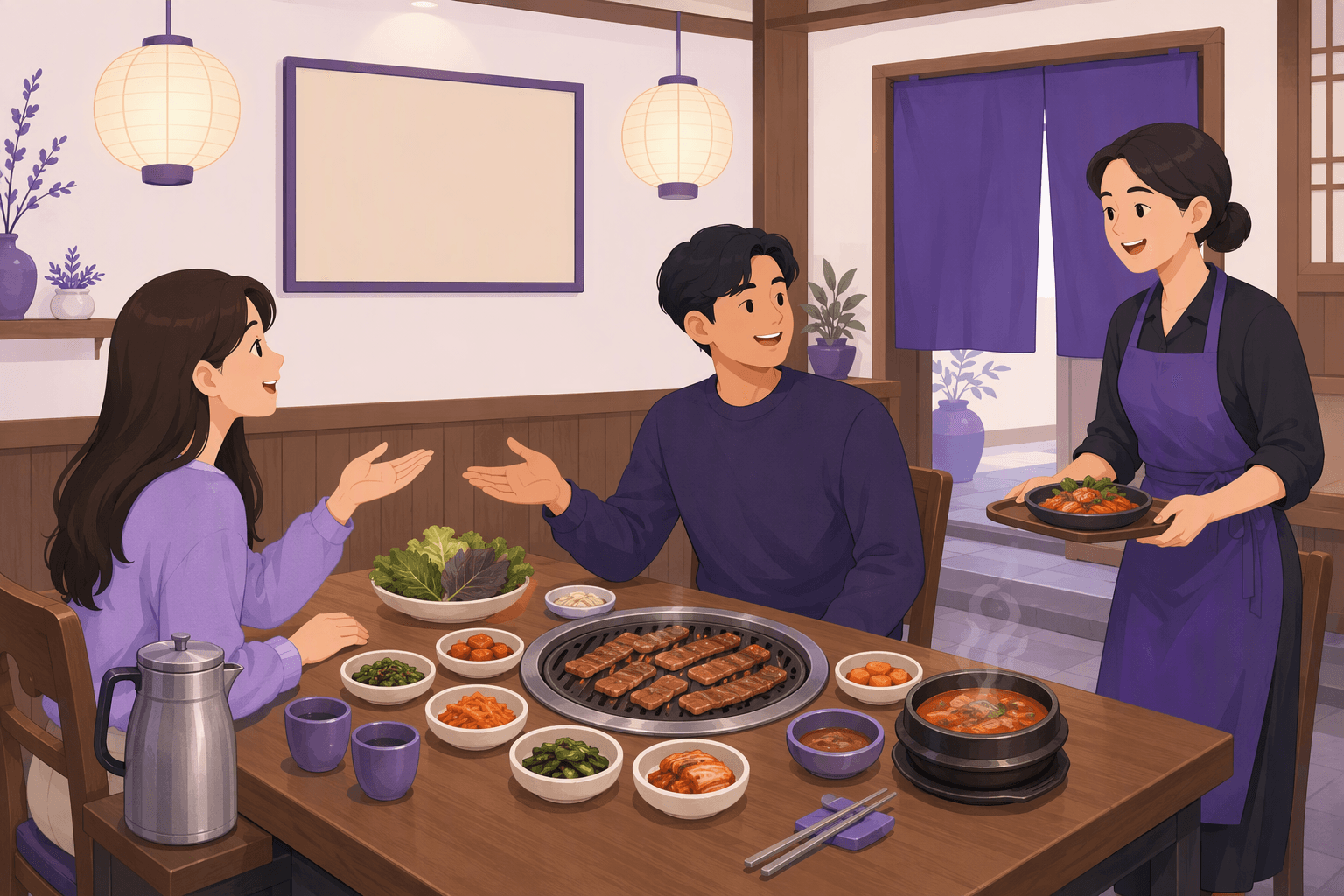
| English | Korean | Pronunciation | Formality |
|---|---|---|---|
| Hello (polite) | 안녕하세요 | ahn-NYUHNG-hah-seh-yoh | polite |
| Excuse me (to get attention) | 저기요 | juh-gee-YOH | polite |
| Please give me ... | 주세요 | joo-SEH-yoh | polite |
| This one, please | 이거 주세요 | ee-guh joo-SEH-yoh | polite |
| One more, please | 하나 더 주세요 | hah-nah duh joo-SEH-yoh | polite |
| How much is it? | 얼마예요? | uhl-mah-yeh-yoh | polite |
| It's delicious | 맛있어요 | mah-shee-ssuh-yoh | polite |
| Please leave out ... | ... 빼 주세요 | ... bbeh joo-SEH-yoh | polite |
| Water, please | 물 주세요 | mool joo-SEH-yoh | polite |
| The bill, please | 계산서 주세요 | geh-SAHN-suh joo-SEH-yoh | polite |
| Thank you | 감사합니다 | gahm-SAH-hahm-nee-dah | formal |
Why restaurant Korean feels different from textbook Korean
Restaurant talk in Korean is polite, fast, and pattern-based. You do not need perfect grammar to sound natural, you need the right endings and the right “service” words.
Korean also has clear speech levels. In restaurants, 해요체 (the “-요” style) is the default polite mode for customers and staff, which is why you will see 주세요, 있어요, 예요 ending in -요.
Linguist Sohn Ho-min, in his work on Korean, describes how honorifics and speech levels are built into everyday interaction, not reserved for ceremonies. Restaurants are one of the most consistent places you will feel that system in action.
💡 One rule that saves you
If you are unsure, end your sentence with "-요" and add "주세요" for requests. It is rarely perfect, but it is almost always acceptable.
Getting a table and starting the meal
안녕하세요
안녕하세요 (ahn-NYUHNG-hah-seh-yoh) is the safest greeting when you enter. It is polite and works with staff of any age.
In a busy place, you might hear staff greet you first, and you can simply echo it back. That “mirror greeting” is normal and not awkward.
/ahn-NYUHNG-hah-seh-yoh/
Literal meaning: A polite greeting used at any time of day.
“안녕하세요. 두 명이에요.”
Hello. It's two people.
In restaurants, this greeting sets a polite tone immediately. Pair it with the number of people to move things along.
두 명이에요
To say how many people are in your party, use the pattern [number] 명이에요 (myung-ee-yeh-yoh). For two people: 두 명이에요 (doo myung-ee-yeh-yoh).
If you only remember one number, remember 한 (hahn) and 두 (doo). You can also hold up fingers, which is common in loud restaurants.
자리 있어요?
자리 있어요? (jah-ree ee-ssuh-yoh) means “Is there a seat/table available?” It is useful when the host has not approached you yet.
If the restaurant is full, you may be asked to wait. In Korea, waiting lists are common, and many places will call your phone number or use a kiosk.
Getting the server’s attention (without sounding rude)
저기요
저기요 (juh-gee-YOH) is the standard “Excuse me” to call staff. It is direct, but not rude, and it is used constantly.
Avoid shouting 여기요 unless you are copying locals and the vibe is very casual. 저기요 is safer for learners.
/juh-gee-YOH/
Literal meaning: A polite attention-getter, like 'excuse me' or 'over here.'
“저기요, 물 좀 주세요.”
Excuse me, please give me some water.
Many Korean restaurants expect you to call staff when you need something. Some tables also have a call button, especially in BBQ places.
잠시만요
잠시만요 (jahm-shee-mahn-yoh) means “Just a moment.” Staff may say it to you when they are busy.
You can also use it if you need a second to decide. It sounds natural and buys you time.
Ordering: the three patterns that do most of the work
Korean ordering is surprisingly formulaic. Once you learn these, you can order almost anything by pointing at a menu.
주세요
주세요 (joo-SEH-yoh) is “Please give me.” Attach it to the item name.
- 김치찌개 주세요 (gim-chee-jjee-geh joo-SEH-yoh): Kimchi stew, please.
- 이거 주세요 (ee-guh joo-SEH-yoh): This one, please.
In the Standard Korean Language Dictionary (국립국어원), 주다 is the verb “to give,” and 주세요 is the polite request form you will hear everywhere.
/joo-SEH-yoh/
Literal meaning: Polite request form of 'to give.'
“불고기 하나 주세요.”
One bulgogi, please.
In restaurants, '주세요' is the default ordering verb. Even if your noun is imperfect, the pattern signals your intent clearly.
... 하나요 / ... 두 개요
If you want to specify quantity quickly, you can say the item plus a number and a counter, then end with -요. For example: 맥주 두 개요 (maek-joo doo geh-yoh), “Two beers.”
Counters vary, but staff will usually understand even if you use 개 (geh) as a general counter. The King Sejong Institute materials often teach 개 early for that reason.
... 빼 주세요
... 빼 주세요 (bbeh joo-SEH-yoh) means “Please leave out ...” It is the cleanest way to handle dislikes and restrictions.
Examples:
- 양파 빼 주세요 (yahng-pah bbeh joo-SEH-yoh): No onions, please.
- 고수 빼 주세요 (goh-soo bbeh joo-SEH-yoh): No cilantro, please.
⚠️ Allergies: be extra explicit
If it is a serious allergy, do not rely on a single phrase. Say the ingredient, say you cannot eat it, and confirm: "알레르기가 있어요. ... 들어가요?" (ahl-leh-leu-gee-gah ee-ssuh-YOH. ... deul-uh-gah-yoh?) meaning "I have an allergy. Does it contain ...?"
Useful questions when you do not understand the menu
추천해 주세요
추천해 주세요 (choo-cheon-heh joo-SEH-yoh) means “Please recommend (something).” It is polite and invites the server to help.
In many Korean restaurants, staff take pride in steering you toward the house specialty. You will often get a confident answer, not a long discussion.
이거 뭐예요?
이거 뭐예요? (ee-guh mwo-yeh-yoh) is “What is this?” Pointing is normal, especially with picture menus.
If you want a slightly more polite version, add 저기요 first.
매워요?
매워요? (meh-wuh-yoh) means “Is it spicy?” This is one of the highest value questions you can learn.
If you want to set your preference, add 안 매운 거 있어요? (ahn meh-woon guh ee-ssuh-yoh), “Do you have something not spicy?”
Korean BBQ: phrases and etiquette that matter
Korean BBQ is its own mini-culture. The language you need is simple, but the expectations are specific.
Korea Tourism Organization guidance often highlights that BBQ is communal: shared grill, shared side dishes, and a rhythm of ordering more as you go. That is why “one more” phrases are so common.
고기 더 주세요
고기 더 주세요 (goh-gee duh joo-SEH-yoh) means “More meat, please.” You can swap 고기 for anything.
If you are ordering another round of the same item, you can also say 이거 하나 더요 (ee-guh hah-nah duh-yoh), “One more of this.”
이거 구워 주세요
In some BBQ places, staff grill for you. If you want help, you can say 이거 구워 주세요 (ee-guh goo-wuh joo-SEH-yoh), “Please grill this.”
If the restaurant is self-grill, staff may still come by to change the grill plate. You can ask directly.
불 좀 세게 해 주세요
불 좀 세게 해 주세요 (bool johm seh-geh heh joo-SEH-yoh) means “Please make the heat stronger.” For lower heat: 약하게 (yah-kah-geh), “weaker.”
These are the kinds of small control phrases that make you feel confident at the table.
🌍 Why side dishes keep appearing
In many Korean meals, banchan (side dishes) are part of the meal structure, not separate paid items. Refills are common for basics like kimchi or pickled radish, but policies vary by restaurant and by dish.
Asking for refills, extras, and small fixes
물 좀 주세요
물 좀 주세요 (mool johm joo-SEH-yoh) is “Water, please.” The 좀 (johm) softens the request, similar to “just” in English.
Some restaurants serve water automatically, others do not. Asking is normal.
반찬 더 주세요
반찬 더 주세요 (bahn-CHAHN duh joo-SEH-yoh) means “More side dishes, please.” If you want a specific one, point and say 이거 더 주세요.
휴지 있어요?
휴지 있어요? (hyoo-jee ee-ssuh-yoh) means “Do you have tissues?” This is useful in BBQ places and casual spots.
You can also ask for a fork: 포크 있어요? (poh-keu ee-ssuh-yoh). Many places have them, even if chopsticks are the default.
Compliments and polite responses
맛있어요
맛있어요 (mah-shee-ssuh-yoh) means “It’s delicious.” It is the most common compliment you will use.
If you want to sound a bit more expressive, you can say 진짜 맛있어요 (jin-jjah mah-shee-ssuh-yoh), “It’s really delicious.”
/mah-shee-ssuh-yoh/
Literal meaning: Polite way to say something tastes good.
“와, 이거 진짜 맛있어요.”
Wow, this is really delicious.
Complimenting the food is always welcome. In small restaurants, it can lead to extra friendliness, small service extras, or recommendations for what to try next.
괜찮아요
괜찮아요 (gwen-CHAH-nah-yoh) means “It’s okay.” You can use it to say “No, thanks” politely.
Example: if staff offers something you do not want, say 괜찮아요, 감사합니다 (gwen-CHAH-nah-yoh, gahm-SAH-hahm-nee-dah).
Paying and leaving
In many Korean restaurants, you pay at the counter near the exit. Even if you ask for the bill at the table, the final payment often happens standing up.
계산서 주세요
계산서 주세요 (geh-SAHN-suh joo-SEH-yoh) is “The bill, please.” It is the phrase most learners search for, and it works.
If you are ready to pay right away, you can also say 계산할게요 (geh-SAHN-hal-geh-yoh), “I’ll pay.”
카드 돼요?
카드 돼요? (kah-deu dweh-yoh) means “Does card work?” or “Can I pay by card?” It is short and very common.
If you need a receipt, ask 영수증 주세요 (young-soo-jeung joo-SEH-yoh).
잘 먹었습니다
잘 먹었습니다 (jahl muhg-uh-ssuhm-nee-dah) is a classic phrase said after a meal, meaning “I ate well,” or “Thank you for the meal.”
It is polite, slightly formal, and very Korean in feel. You can say it to staff as you leave.
If you want more leaving phrases, see our goodbye guide in Korean.
Mini scripts you can copy in real life
Short scripts reduce stress because you do not have to build sentences on the spot.
Script 1: Walk in, get seated, order one item
- 안녕하세요. 두 명이에요. (ahn-NYUHNG-hah-seh-yoh. doo myung-ee-yeh-yoh.)
- 저기요. 이거 주세요. (juh-gee-YOH. ee-guh joo-SEH-yoh.)
- 물 좀 주세요. (mool johm joo-SEH-yoh.)
Script 2: Ask about spice and remove an ingredient
- 이거 뭐예요? (ee-guh mwo-yeh-yoh?)
- 매워요? (meh-wuh-yoh?)
- 양파 빼 주세요. (yahng-pah bbeh joo-SEH-yoh.)
Script 3: Korean BBQ, order more, pay
- 고기 더 주세요. (goh-gee duh joo-SEH-yoh.)
- 반찬 더 주세요. (bahn-CHAHN duh joo-SEH-yoh.)
- 계산서 주세요. (geh-SAHN-suh joo-SEH-yoh.)
- 잘 먹었습니다. (jahl muhg-uh-ssuhm-nee-dah.)
Common mistakes learners make (and the quick fixes)
Mixing casual endings with polite service talk
If you use plain casual endings (like dropping -요) with staff, it can sound abrupt. Keep -요 and 주세요 and you will be fine.
This aligns with what many Korean teaching curricula emphasize: speech level is not “advanced grammar,” it is basic social meaning.
Overusing 죄송합니다 for normal requests
죄송합니다 can be appropriate, but it is stronger than “excuse me” in many contexts, closer to “I’m sorry.” For calling staff, 저기요 is usually the better fit.
If you want a deeper look at “excuse me” style phrases, compare with how apologies work in other contexts, then practice with real clips. Wordy-style learning works well here because you can hear the tone, not just memorize the words.
Translating “Can I get...” too literally
English ordering often uses “Can I get...?” Korean ordering usually uses 주세요 or a short noun phrase. Simpler sounds more native.
Practice with real scenes (movies, K-dramas, and variety shows)
Restaurant scenes are some of the most reusable language you can mine from Korean media. You will hear the same requests, the same polite endings, and the same rhythm of ordering more.
If you are building listening skill, pair this with a broader base of high-frequency words from our 100 most common Korean words. And if you want to understand why certain tones are risky, keep our Korean swear words guide as a reference so you recognize what not to repeat.
💡 A simple listening drill
Watch one restaurant clip twice. First time, only listen for "-요" endings and "주세요." Second time, repeat the full request out loud, matching speed and intonation.
A quick cultural map: what feels polite in Korean restaurants
Politeness in Korean is not only about “being nice,” it is about choosing the right level for the relationship and setting. Scholar Brown and Levinson, in their work on politeness, frame many polite choices as “face” management, and Korean speech levels make that visible in grammar.
Also, Korean dining is often shared. Dishes arrive in waves, and ordering again mid-meal is normal. That is why 하나 더 주세요 is more useful than memorizing ten separate menu items.
Finally, do not be surprised if staff sound brisk. Efficient service can sound “short” to English ears while still being fully polite in Korean.
Keep going: what to learn next
Once you can order and pay, the next step is small talk: greetings, goodbyes, and friendly closings. Start with our hello phrases in Korean, then add leave-taking from how to say goodbye in Korean.
If you want a fun, high-motivation phrase set for real conversations, see how to say I love you in Korean. Different setting, same politeness logic, you still choose the right level for the relationship.
When you are ready, practice these restaurant lines with short clips so you can copy timing and tone, not just vocabulary. You can also explore more Korean learning paths on our Korean learning page.
Frequently Asked Questions
What is the most polite way to order in Korean?
How do you ask for the check in Korean?
How do you ask for water or refills in Korean?
Is it normal to call the server in Korea?
What Korean phrases help with dietary restrictions?
Sources & References
- National Institute of Korean Language (국립국어원), Standard Korean Language Dictionary (표준국어대사전), accessed 2026
- King Sejong Institute Foundation, Korean language learning materials and phrasebooks, accessed 2026
- Ethnologue: Languages of the World, Korean language entry (27th edition, 2024)
- Korea Tourism Organization, Korea travel and dining etiquette guidance, accessed 2026
Start learning with Wordy
Watch real movie clips and build your vocabulary as you go. Free to download.


