Quick Answer
The most common way to say good night in Korean is '잘 자요' (Jal jayo) in polite speech or '잘 자' (Jal ja) among close friends. For elders and people of higher status, the honorific form '안녕히 주무세요' (Annyeonghi jumuseyo) is essential, it uses the special honorific sleep verb 주무시다 instead of the plain 자다. Korean good-night phrases shift dramatically across speech levels, and choosing the right one shows cultural awareness and respect.
Saying Good Night the Korean Way
The most common way to say good night in Korean is 잘 자요 (Jal jayo) in polite speech, or 잘 자 (Jal ja) among close friends. Both literally mean "sleep well," but the speech level you choose (polite, casual, or honorific) carries as much meaning as the words themselves.
Korean is spoken by over 80 million people worldwide according to Ethnologue's 2024 data, and its nighttime farewell system reveals something fundamental about the language: Korean does not simply have one "good night." Instead, the phrase transforms depending on the listener's age, your relationship, and the social context. An elder requires the honorific verb 주무시다 (jumusida). A close friend gets the stripped-down 잘 자. A coworker might hear 푹 쉬세요 (rest well). And a romantic partner on KakaoTalk might receive 좋은 꿈 꿔~ (have good dreams~) with a tilde for warmth.
"Korean honorific verbs like 주무시다, 드시다, and 계시다 are not optional politeness markers. They are lexical replacements that a speaker must use when the subject of the verb is socially superior. Failure to use them constitutes a grammatical and social error."
(Ho-Min Sohn, The Korean Language, Cambridge University Press, 1999)
This guide covers 16 essential Korean good-night phrases organized by speech level and context: polite everyday phrases, casual expressions for friends, honorific forms for elders, romantic and text-message goodnights, and workplace evening farewells. Each includes Hangul, romanization, pronunciation, an example sentence, and cultural context.
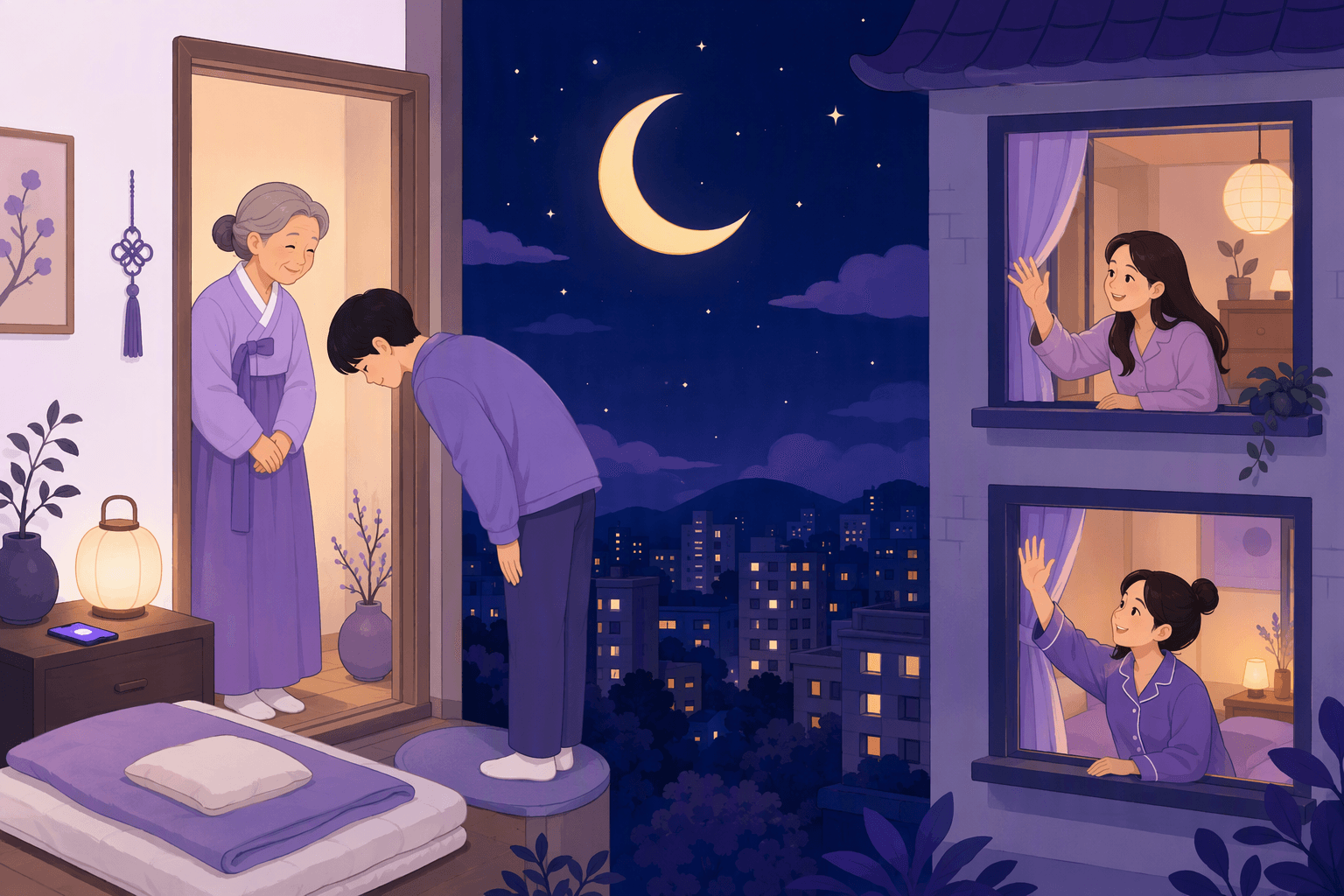
Quick Reference: Korean Good-Night Phrases at a Glance
| English | Korean | Pronunciation | Formality |
|---|---|---|---|
| Sleep well (polite) | 잘 자요 | Jal ja-yo | polite |
| Sleep well (casual) | 잘 자 | Jal ja | casual |
| Please sleep peacefully (honorific) | 안녕히 주무세요 | An-nyeong-hi ju-mu-se-yo | formal |
| Have good dreams (casual) | 좋은 꿈 꿔 | Jo-eun kkum kkwo | casual |
| Have good dreams (polite) | 좋은 꿈 꾸세요 | Jo-eun kkum kku-se-yo | polite |
| See you tomorrow (casual) | 내일 봐 | Nae-il bwa | casual |
| Rest well (casual) | 푹 쉬어 | Puk swi-eo | casual |
| Rest well (polite) | 푹 쉬세요 | Puk swi-se-yo | polite |
| Have a comfortable night | 편안한 밤 되세요 | Pyeon-an-han bam doe-se-yo | polite |
| You worked hard (evening work farewell) | 수고하셨습니다 | Su-go-ha-syeot-seum-ni-da | formal |
| Sleep well (formal) | 안녕히 주무십시오 | An-nyeong-hi ju-mu-ship-shi-o | very formal |
| Good night (English loanword) | 굿나잇 | Gun-na-it | slang |
| I'll sleep first (casual) | 나 먼저 잘게 | Na meon-jeo jal-ge | casual |
| Sleep tight (casual) | 푹 자 | Puk ja | casual |
| See you tomorrow (polite) | 내일 봐요 | Nae-il bwa-yo | polite |
| Sweet dreams (polite) | 좋은 꿈 꾸세요 | Jo-eun kkum kku-se-yo | polite |
The Honorific Sleep Verb: 주무시다 vs. 자다
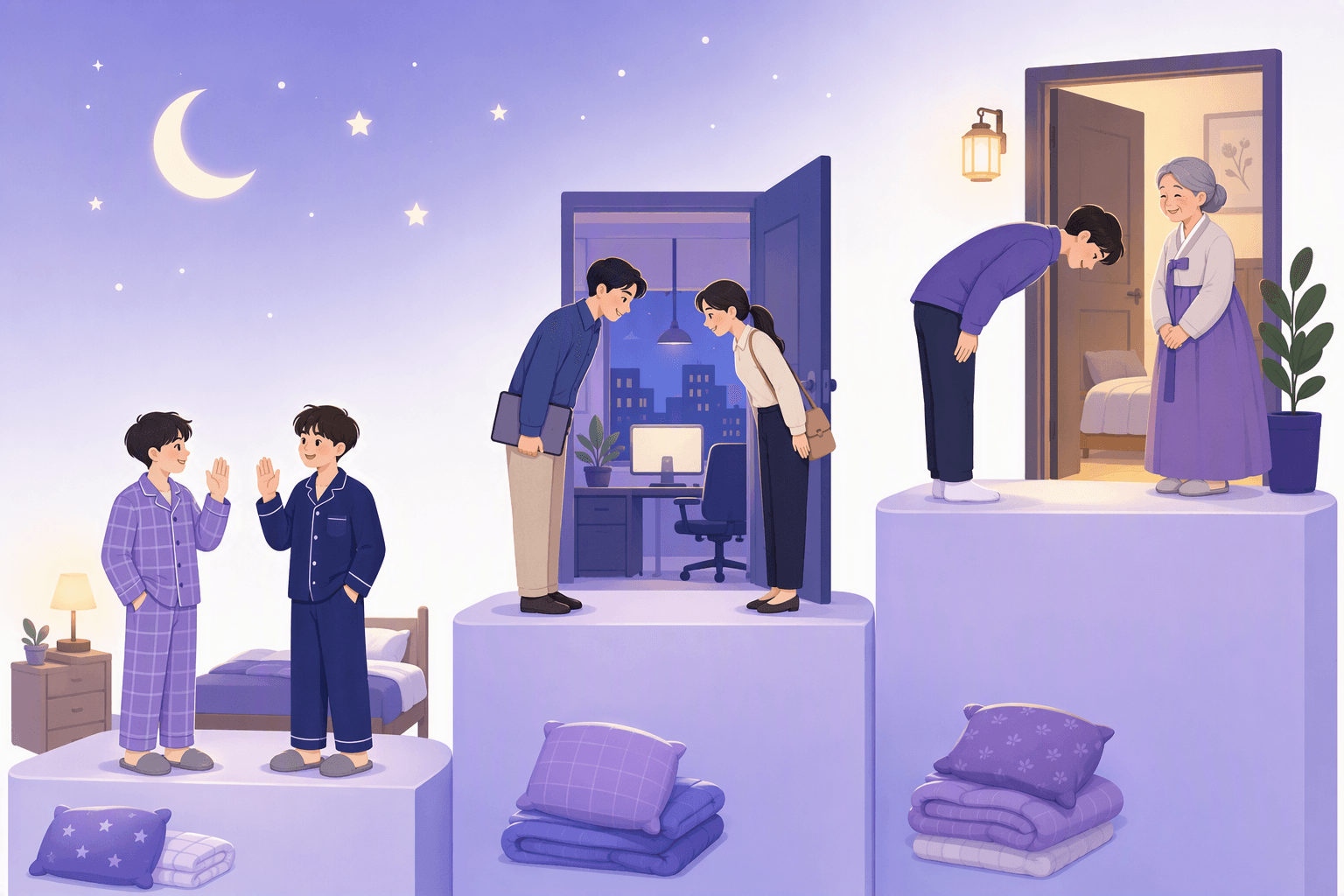
Before exploring individual phrases, you need to understand one critical distinction. Korean has two verbs for "to sleep," and choosing the wrong one can cause real offense.
| Verb | Romanization | Meaning | Used For |
|---|---|---|---|
| 자다 | jada | to sleep (plain) | Yourself, friends, younger people, children |
| 주무시다 | jumusida | to sleep (honorific) | Parents, grandparents, elders, superiors |
According to Yeon and Brown in Korean: A Comprehensive Grammar (Routledge, 2011), 주무시다 belongs to a small set of Korean honorific verbs that completely replace their plain counterparts when the subject is a respected individual. You do not add a politeness suffix to 자다; you swap the entire verb.
This means "sleep well" said to your grandmother is 안녕히 주무세요 (using 주무시다), not 잘 자세요 (using 자다). The latter, while grammatically polite in its ending, uses the wrong verb entirely and sounds disrespectful.
⚠️ Never Say 잘 자세요 to Elders
A common mistake among Korean learners is saying 잘 자세요 to an older person, thinking the -세요 polite ending is sufficient. It is not. Korean honorifics require the honorific verb 주무시다, not just a polite verb ending. 잘 자세요 sounds as awkward to Korean ears as the difference between "Did your father eat?" and "Did your father dine?", except the Korean version carries real social consequences.
Polite Good-Night Phrases (존댓말)
These phrases are your safe defaults for most everyday situations: coworkers, acquaintances, people you are not close enough with to use casual speech.
잘 자요 (Jal Jayo)
/Jal ja-yo/
Literal meaning: Sleep well
“오늘 고생했어요. 잘 자요!”
You worked hard today. Sleep well!
The standard polite good-night phrase for most situations. Uses the plain sleep verb 자다 with the polite -요 ending. Appropriate for coworkers, acquaintances, and people your age in polite speech.
This is the Korean good-night phrase you will use most often. The construction is straightforward: 잘 (well) + 자요 (sleep, polite). It hits the middle ground of Korean politeness: respectful without being stiff, warm without being overly familiar.
You will hear 잘 자요 at the end of evening gatherings, on phone calls winding down at night, and in polite text messages. It is the equivalent of a friendly "sleep well" in English, suitable for the widest range of relationships.
좋은 꿈 꾸세요 (Joeun Kkum Kkuseyo)
/Jo-eun kkum kku-se-yo/
Literal meaning: Please dream good dreams
“잘 자요. 좋은 꿈 꾸세요!”
Sleep well. Have sweet dreams!
A warm, polite way to wish someone pleasant dreams. Often paired with 잘 자요 as a two-part good-night message. Common in text messages and as a gentle sign-off to evening conversations.
This is Korean's equivalent of "sweet dreams." The verb 꾸다 means "to dream" and takes the polite ending -세요. It is almost always used as a follow-up to 잘 자요 rather than as a standalone goodnight, creating a gentle two-part farewell: "Sleep well. Have good dreams."
편안한 밤 되세요 (Pyeonanhan Bam Doeseyo)
/Pyeon-an-han bam doe-se-yo/
Literal meaning: May it become a comfortable night for you
“오늘 하루 수고 많으셨어요. 편안한 밤 되세요.”
You worked hard today. Have a comfortable night.
An elegant, slightly formal good-night wish. Common in professional settings, from service staff to customers, and in polished text messages. Carries a gentle, caring tone.
A refined good-night expression that you will encounter in professional and semi-formal contexts. Hotel staff might say it to guests. A team leader might type it in a company group chat after a long day. It is warmer than a simple 잘 자요 and carries a sense of genuine care for the other person's evening rest.
푹 쉬세요 (Puk Swiseyo)
/Puk swi-se-yo/
Literal meaning: Rest deeply
“많이 피곤하시죠? 오늘 푹 쉬세요.”
You must be really tired. Rest well tonight.
Focuses on deep rest rather than sleep specifically. Especially common after a hard day of work, during illness, or when someone is visibly exhausted. The adverb 푹 means 'deeply' or 'thoroughly.'
The adverb 푹 (puk) adds emphasis; it means "deeply" or "thoroughly," turning a simple "rest" into "rest completely." This phrase is particularly appropriate when you know the listener has had a tiring day or is not feeling well. It carries more empathy than a generic goodnight.
Casual Good-Night Phrases (반말)
These are strictly for close friends, siblings, romantic partners, or people clearly younger than you. Using them with elders or strangers is a social mistake.
잘 자 (Jal Ja)
/Jal ja/
Literal meaning: Sleep well
“늦었다. 나 먼저 잘게. 잘 자!”
It's late. I'm going to sleep first. Good night!
The most common casual good-night phrase in Korean. Used between close friends, siblings, and romantic partners. A staple in K-dramas; you will hear it in virtually every nighttime scene between characters of equal status.
The casual counterpart to 잘 자요, stripped of the polite -요 ending and left at its most direct. This is the goodnight you will hear most often in Korean dramas between friends and couples. It is short, warm, and intimate.
If you watch K-dramas, pay attention to the shift from 잘 자요 to 잘 자 between two characters, as it often signals that their relationship has crossed from formal acquaintance into genuine closeness. Check out our guide to the best Korean movies to hear these speech-level shifts in action.
좋은 꿈 꿔 (Joeun Kkum Kkwo)
/Jo-eun kkum kkwo/
Literal meaning: Dream good dreams
“잘 자~ 좋은 꿈 꿔!”
Good night~ Sweet dreams!
The casual 'sweet dreams.' Extremely popular in KakaoTalk messages between friends and partners. Often written with a tilde (좋은 꿈 꿔~) for added warmth and cuteness.
The casual version of "sweet dreams," universally popular in text messages. On KakaoTalk (South Korea's dominant messaging app used by over 90% of the population) 좋은 꿈 꿔 is one of the most common nighttime sign-offs. The tilde character (~) is almost always added in writing to soften the tone.
푹 쉬어 (Puk Swieo)
/Puk swi-eo/
Literal meaning: Rest deeply
“오늘 진짜 힘들었지? 푹 쉬어.”
Today was really tough, right? Get some good rest.
A caring casual phrase used when a friend is tired or has had a hard day. More empathetic than 잘 자; it acknowledges that the person needs rest. Common among close friends after long days.
Where 잘 자 is a standard goodnight, 푹 쉬어 carries extra care. You would say it to a friend who just finished exams, came home from a grueling shift, or is recovering from being sick. It says, "I know you're exhausted. Please rest properly."
내일 봐 (Naeil Bwa)
/Nae-il bwa/
Literal meaning: See you tomorrow
“잘 자! 내일 봐~”
Good night! See you tomorrow~
A forward-looking casual goodnight used when you will see the person the next day. Common among classmates, daily coworkers, and friends with regular routines. The polite version is 내일 봐요 (Naeil bwayo).
Often paired with 잘 자 as a combination farewell: "Sleep well! See you tomorrow." It is a staple among Korean students and young coworkers who see each other daily. The forward-looking nature of the phrase adds optimism: you are not just saying goodnight, you are already looking ahead to the next meeting.
나 먼저 잘게 (Na Meonjeo Jalge)
/Na meon-jeo jal-ge/
Literal meaning: I will sleep first
“너무 졸려. 나 먼저 잘게. 잘 자!”
I'm so sleepy. I'm going to sleep first. Good night!
Used when you are going to bed before the other person, in a shared space, on a late-night call, or in a group chat. The word 먼저 (first) softens the departure, acknowledging the other person is still awake.
The nighttime equivalent of the workplace phrase 먼저 갈게요 (I'll go first). Just as leaving work before colleagues requires acknowledgment in Korean culture, going to sleep before someone else in a shared context (a group chat, a late-night phone call, a dormitory) calls for this softening phrase. It says, "I know you are still up, but I need to sleep."
푹 자 (Puk Ja)
/Puk ja/
Literal meaning: Sleep deeply
“힘들었지? 오늘 푹 자!”
Tough day, right? Sleep tight tonight!
Combines the emphatic adverb 푹 (deeply) with 자 (sleep). More forceful than 잘 자; it urges someone to truly crash out. Used when a friend is clearly exhausted.
The intensified version of 잘 자. While 잘 means "well," 푹 means "deeply" or "soundly," so 푹 자 carries the sense of "really knock out tonight." It is the Korean equivalent of "sleep tight" or "crash hard."
Honorific Good-Night Phrases
These phrases are reserved for parents, grandparents, teachers, and other respected elders. They use the honorific sleep verb 주무시다, which is not optional; it is required.
안녕히 주무세요 (Annyeonghi Jumuseyo)
/An-nyeong-hi ju-mu-se-yo/
Literal meaning: Please sleep peacefully
“할머니, 안녕히 주무세요. 좋은 꿈 꾸세요.”
Grandmother, please sleep well. Have sweet dreams.
The proper good-night phrase for parents, grandparents, and elders. Uses the honorific verb 주무시다 instead of 자다. This is what Korean children say to their parents every night; omitting it can feel disrespectful.
This is the most important honorific good-night phrase in Korean. Korean children say 안녕히 주무세요 to their parents and grandparents every night; it is part of the fabric of family life. The phrase combines 안녕히 (peacefully) with 주무세요, the polite imperative form of 주무시다 (to sleep, honorific).
As the National Institute of Korean Language (국립국어원) notes in its Standard Korean Language Dictionary, 주무시다 is the designated honorific replacement for 자다, falling into the same category as 드시다 (honorific for 먹다, to eat) and 계시다 (honorific for 있다, to be/stay).
안녕히 주무십시오 (Annyeonghi Jumushipshio)
/An-nyeong-hi ju-mu-ship-shi-o/
Literal meaning: Please sleep peacefully (very formal)
“사장님, 안녕히 주무십시오.”
Mr. President, please sleep well.
The highest formality level for 'good night.' Used in extremely formal situations: addressing a company president, during formal ceremonies, or in military contexts. Rare in daily life but essential in institutional settings.
The most formal good-night expression in Korean. The -십시오 ending signals maximum deference. You will encounter this in formal speeches, military contexts, and when addressing someone of very high status. In everyday life it would sound unnaturally stiff, like saying "I bid you a restful slumber" in English.
Text Message and KakaoTalk Goodnights
Korean digital communication has developed its own set of good-night conventions, especially on KakaoTalk, the messaging app used by virtually all South Koreans.
굿나잇 (Gunnait)
/Gun-na-it/
Literal meaning: Good night (English loanword)
“오늘 재밌었어! 굿나잇~”
Today was fun! Good night~
A Konglish adaptation of English 'good night,' written in Hangul. Popular among younger Koreans in casual texts and social media. Often accompanied by moon or sleeping-face emojis.
English loanwords adapted into Hangul (known as Konglish) are increasingly common in casual Korean text communication. 굿나잇 is a direct phonetic transcription of "good night" and functions as a trendy, casual alternative to 잘 자. It is most common among teens and young adults on social media and in group chats.
🌍 KakaoTalk Goodnight Culture
Late-night KakaoTalk messaging is a significant part of Korean social life, especially among younger people. A typical goodnight exchange might look like: "잘 자~ 좋은 꿈 꿔! 🌙" (Sleep well~ Sweet dreams!) followed by "ㅋㅋ 너도! 내일 봐~" (haha you too! See you tomorrow~). The shorthand ㅈㅈ (the consonants of 잘 자) is also widely used, similar to how English speakers might text "gn" for "good night." These abbreviated forms are strictly for close friends in digital contexts.
Evening Workplace Farewells
When leaving work late at night, Korean workplace culture calls for specific phrases that acknowledge the shared effort of a long day.
수고하셨습니다 (Sugohasyeosseumnida)
/Su-go-ha-syeot-seum-ni-da/
Literal meaning: You have worked hard
“오늘 야근하시느라 수고하셨습니다. 푹 쉬세요.”
Thank you for working overtime today. Please rest well.
The standard workplace farewell at any hour, but especially meaningful during late-night departures. When paired with 푹 쉬세요 at night, it acknowledges both the effort and the need for recovery.
While 수고하셨습니다 is a general workplace farewell (covered more fully in our Korean goodbye guide), it takes on special weight during late-night departures. When a colleague leaves at 11 PM after overtime, saying 수고하셨습니다 followed by 푹 쉬세요 (rest well) carries genuine empathy, acknowledging both the sacrifice and the human need for recovery.
In Korean work culture, where long hours remain common, this nighttime combination functions as more than a goodbye. It is a small act of solidarity.
🌍 K-Drama Good-Night Scenes
Korean dramas use good-night phrases as powerful emotional markers. In romantic K-dramas, the shift from 잘 자요 (polite) to 잘 자 (casual) between love interests signals growing intimacy. In family dramas, a child's nightly 안녕히 주무세요 to their parents reinforces familial bonds. And in workplace dramas like Misaeng, the late-night 수고하셨습니다 captures the bittersweet reality of Korean corporate life. Watch for these moments; they reveal the speech level system in its most emotionally charged form. Our Korean movie recommendations include many titles where you can observe these patterns.
Good-Night Speech Level Summary
Here is the complete speech-level breakdown for the core good-night phrases.
| Speech Level | "Sleep well" | "Sweet dreams" | "Rest well" |
|---|---|---|---|
| Casual (반말) | 잘 자 | 좋은 꿈 꿔 | 푹 쉬어 |
| Polite (존댓말) | 잘 자요 | 좋은 꿈 꾸세요 | 푹 쉬세요 |
| Honorific | 안녕히 주무세요 | 좋은 꿈 꾸세요 | 편안히 쉬세요 |
| Very formal | 안녕히 주무십시오 | , | 편안히 쉬십시오 |
💡 When in Doubt, Use 잘 자요
If you are unsure which good-night phrase to use, 잘 자요 is your safest bet for most situations. It is polite without being stiff, warm without being overly familiar. The only exception is when speaking to someone clearly older or of higher status; then always switch to 안녕히 주무세요 with the honorific verb 주무시다.
How to Respond to Korean Good-Night Phrases
| They Say | You Say | Notes |
|---|---|---|
| 잘 자요 | 잘 자요 (or 네, 잘 자요) | Echo it back |
| 잘 자 | 잘 자! (or 응, 너도) | Casual echo or "yeah, you too" |
| 안녕히 주무세요 | 안녕히 주무세요 (or 네, 주무세요) | Echo the honorific form |
| 좋은 꿈 꿔 | 너도! (Neodo, You too!) | Casual response |
| 푹 쉬세요 | 네, 감사합니다. 잘 자요 | Thank them, then wish them goodnight |
| 수고하셨습니다 (late night) | 수고하셨습니다. 푹 쉬세요 | Echo, then add "rest well" |
Practice With Real Korean Content
Reading about good-night phrases builds your foundation, but hearing them spoken naturally by native speakers is what transforms knowledge into instinct. Korean dramas are especially rich in nighttime scenes: late-night phone calls between characters, family bedtime routines, and after-work farewells all showcase how speech levels shift in real-time based on relationships and emotions.
Wordy lets you watch Korean content with interactive subtitles, tapping on any good-night phrase to see its meaning, speech level, and the relationship dynamics behind the speaker's choice. Instead of memorizing a list, you absorb the patterns from authentic Korean conversations with natural intonation, facial expressions, and context.
For more Korean language guides, explore our blog for articles on greetings, farewells, and cultural context, or visit our Korean learning page to start practicing with native content today.
Frequently Asked Questions
What is the most common way to say good night in Korean?
What is the difference between 잘 자 and 안녕히 주무세요?
How do Koreans say good night in text messages?
What does 주무시다 mean and why is it important?
Do Koreans actually say 'good night' like in English?
What do Koreans say when leaving work late at night?
Sources & References
- National Institute of Korean Language (국립국어원), Standard Korean Language Dictionary
- Sohn, H.-M. (1999). 'The Korean Language.' Cambridge University Press.
- Yeon, J. & Brown, L. (2011). 'Korean: A Comprehensive Grammar.' Routledge.
- King Sejong Institute Foundation, Korean Language Education Guidelines (2024)
- Ethnologue: Languages of the World, Korean language entry (2024)
Start learning with Wordy
Watch real movie clips and build your vocabulary as you go. Free to download.


