Quick Answer
Chuseok is Korea's major autumn harvest holiday, when families gather, honor ancestors, share food, and often travel to their hometowns. Learn its traditions, signature foods, etiquette, and Korean phrases to use during the holiday.
Chuseok, written 추석 and pronounced /tɕʰu.sʌk̚/, is Korea’s major autumn harvest holiday. Families gather, honor ancestors, eat foods such as 송편 /soŋ.pʰjʌn/, visit ancestral graves, and exchange warm holiday wishes. If you are visiting Korea or speaking with Korean friends, the safest greeting is 즐거운 추석 보내세요 /tɕɯl.ɡʌu̯n tɕʰu.sʌk̚ po.ne.se.jo/, meaning “Have a happy Chuseok.”
In South Korea, Chuseok is one of the year’s largest family travel periods. It is not simply a food festival or a Korean version of Thanksgiving. It is a holiday shaped by lunar time, family duty, remembrance, regional cooking, and the realities of modern city-to-hometown travel.
Korean has roughly 81 million speakers worldwide according to Ethnologue, with the great majority living on the Korean Peninsula. That global community means Chuseok is also observed in Korean diaspora households, though the schedule and customs naturally vary. Before learning holiday phrases, it helps to understand why this celebration carries such weight.
| English | Korean | Pronunciation | Formality |
|---|---|---|---|
| Have a happy Chuseok | 즐거운 추석 보내세요 | jul-GUH-oon CHOO-suk boh-neh-SEH-yoh | polite |
| Have an abundant Hangawi | 풍성한 한가위 되세요 | poong-SUHNG-hahn hahn-GAH-wee dweh-SEH-yoh | polite |
| Did you get home safely? | 고향에 잘 도착했어요? | goh-HYAHNG-eh jahl doh-CHAHK-hehss-UH-yoh | polite |
| Enjoy the holiday | 연휴 잘 보내 | yuhn-HYOO jahl boh-neh | casual |
| Thank you for the holiday gift | 명절 선물 고마워요 | myuhng-JUHL suhn-MOOL goh-mah-WUH-yoh | polite |
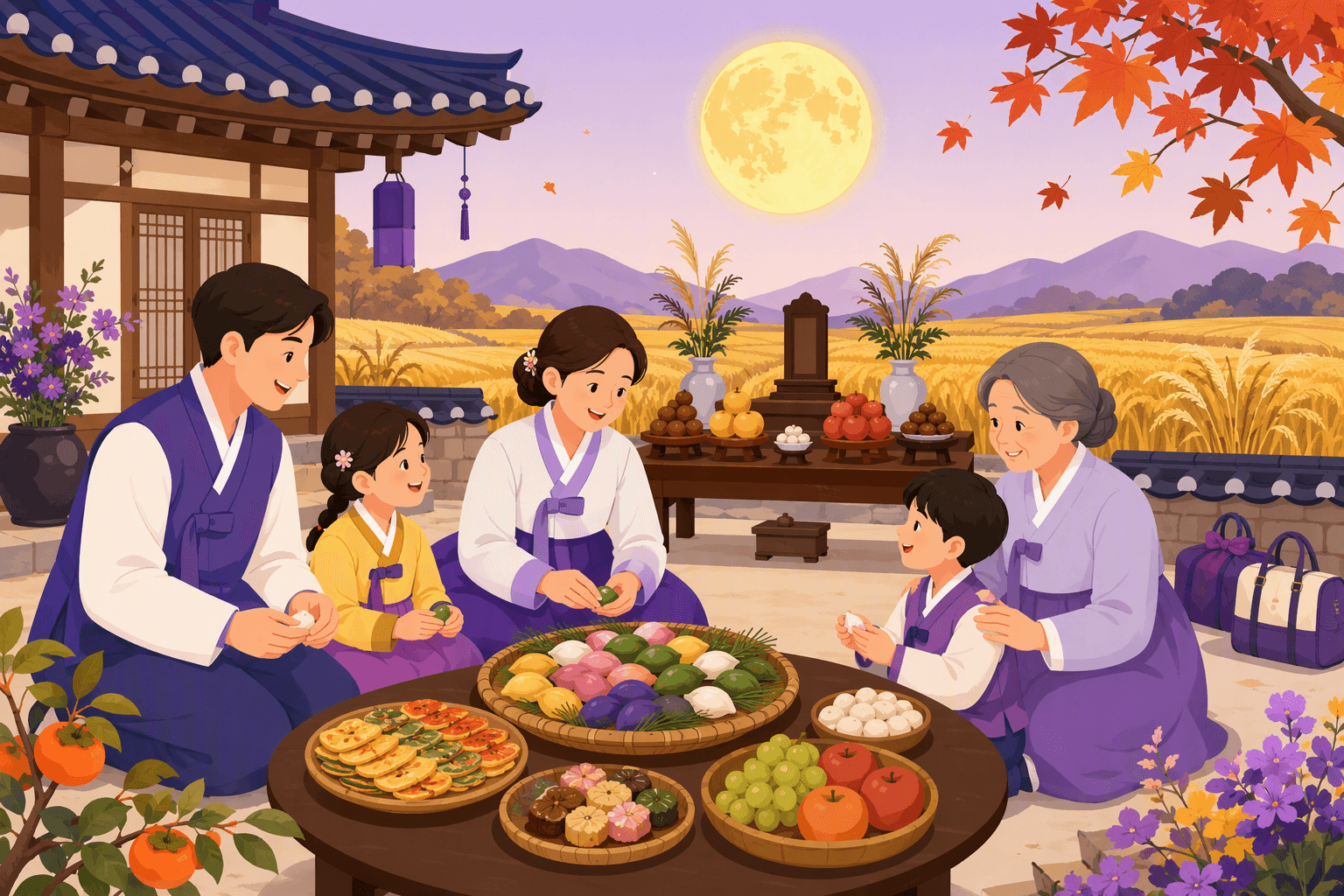
What Chuseok means
The word 추석 /tɕʰu.sʌk̚/ refers to the middle of autumn. Another traditional name is 한가위 /han.ɡa.wi/, a native Korean term associated with the full moon of the eighth lunar month. The holiday falls on lunar August 15, so its date changes on the Gregorian calendar every year.
South Korea recognizes a three-day Chuseok public holiday centered on that lunar date. For many workers and students, the practical holiday can feel longer when it meets a weekend or another public holiday. Trains, buses, highways, and domestic flights become intensely crowded as people travel from Seoul and other cities to their 고향 /ko.hjaŋ/, or hometown.
The full moon is central to the holiday imagery. It represents fullness, harvest, and hopes for the coming year. Yet Chuseok is not one uniform ritual performed identically in every family. Urban households, rural households, religious families, and younger generations may observe different parts of the tradition.
🌍 Chuseok is not just a Korean Thanksgiving
The Thanksgiving comparison can help English speakers grasp the family-and-harvest theme, but it can also hide important differences. Chuseok follows the lunar calendar and often includes ancestral memorial customs and grave visits. Its cultural frame is Korean family continuity, not a direct equivalent of a North American national story.
Anthropologist Laurel Kendall’s work on family, ritual, and social change in Korea is useful here because it shows how traditional obligations can persist while adapting to modern working life. A family may buy prepared holiday food instead of cooking every dish, for example, while still treating the gathering as meaningful.
Chuseok traditions families observe
차례
One of the best-known customs is 차례 /tɕʰa.ɾje/, a memorial rite for ancestors. Families arrange food on a table, make respectful bows, and honor deceased relatives. The exact sequence, food arrangement, and degree of formality differ by family and region.
Some households begin early in the morning. Others simplify the ritual, especially where relatives live far apart or where family members have different beliefs. Visitors should not assume every Korean family performs 차례 /tɕʰa.ɾje/, but they should recognize that it can be a serious and emotional part of the holiday.
성묘
Many families visit ancestral graves, a practice called 성묘 /sʌŋ.mjo/. They may clear weeds, tidy the site, bow, and spend time together outdoors. This connects the harvest season to remembrance and family lineage.
The activity is often paired with 벌초 /pʌl.tɕʰo/, the cutting of grass and weeds around graves. For people who live abroad, even a conversation about whether someone is going 성묘 /sʌŋ.mjo/ can be a personal question, so ask with care rather than curiosity alone.
귀성
The homeward trip is called 귀성 /kwi.sʌŋ/. News coverage regularly shows traffic jams and packed stations because millions of people travel around the holiday. The Korea Transport Institute and national transport agencies treat Chuseok travel as a major seasonal demand event.
A useful cultural point: “going home” may mean visiting parents in a city, grandparents in the countryside, or gathering at another relative’s home. It does not automatically mean a person’s literal birthplace. Family arrangements are increasingly flexible, particularly for younger adults and multicultural households.
For general everyday greetings before a holiday visit, review how to say hello in Korean. A careful greeting and polite speech level will matter more than attempting a long ceremonial statement.
Chuseok food and why it matters
Food during Chuseok is both celebratory and symbolic. The holiday table is often filled with seasonal ingredients, but the most recognizable dish is 송편 /soŋ.pʰjʌn/, a small rice cake made with rice flour and shaped like a half-moon.
송편
송편 /soŋ.pʰjʌn/ commonly contains sesame seeds, honey, red bean, chestnut, or beans. Families steam it on pine needles, which is connected to the word’s first syllable, 송 /soŋ/, meaning pine.
The half-moon shape is not an accident. A full moon becomes smaller after reaching its peak, while a crescent grows toward fullness. In popular cultural explanations, the growing half-moon represents future potential and prosperity.
/poong-SUHNG-hahn hahn-GAH-wee dweh-SEH-yoh/
Literal meaning: May it become an abundant Hangawi.
“풍성한 한가위 되세요. 가족분들과 행복한 시간 보내세요.”
Have an abundant Hangawi. Spend a happy time with your family.
한가위 is a traditional Korean name for Chuseok. This greeting sounds warm and seasonal, and is suitable for coworkers, neighbors, and older relatives.
전
Another common holiday food is 전 /tɕʌn/, a broad category of pan-fried savory foods. You might see vegetable, fish, meat, or mushroom versions, often coated in egg before frying.
Preparing 전 /tɕʌn/ can be a group activity, but it is also associated with substantial household labor. Modern discussions of Chuseok often address how families can share cooking, cleaning, travel, and caregiving responsibilities more fairly. Respecting the holiday does not mean treating unequal work as inevitable.
과일 and holiday gifts
Fruit, especially pears, apples, persimmons, and grapes, frequently appears on Chuseok tables and in gift sets. High-quality fruit boxes, cooking oil, canned goods, health supplements, and Korean beef are familiar seasonal gifts in South Korea.
Gift-giving is common, but it is not a requirement for every relationship. In a workplace, a small, professionally appropriate gift may be welcome. For close friends, a sincere message is often enough.
Useful Korean Chuseok greetings
Korean holiday greetings use polite endings because they are often sent to coworkers, elders, teachers, clients, and extended family. The ending 세요 /se.jo/ signals a courteous request or wish.
즐거운 추석 보내세요
즐거운 추석 보내세요 /tɕɯl.ɡʌu̯n tɕʰu.sʌk̚ po.ne.se.jo/ literally means “Please spend an enjoyable Chuseok.” It is the most dependable all-purpose greeting.
Use it in a text, a card, or an in-person conversation. It is warmer than a generic hello but not overly intimate.
/jul-GUH-oon CHOO-suk boh-neh-SEH-yoh/
Literal meaning: Please spend an enjoyable Chuseok.
“추석 연휴에 고향에 가세요? 즐거운 추석 보내세요.”
Are you going to your hometown during the Chuseok holiday? Have a happy Chuseok.
This is the safest greeting for colleagues, acquaintances, service workers, and relatives. Use it in the days leading up to Chuseok or during the holiday.
풍성한 한가위 되세요
풍성한 한가위 되세요 /pʰuŋ.sʌŋ.han han.ɡa.wi twe.se.jo/ means “Have an abundant Hangawi.” It has a traditional, polished tone and appears frequently on greeting cards, shop signs, and company messages.
The adjective 풍성한 /pʰuŋ.sʌŋ.han/ suggests abundance or richness. This makes the phrase especially appropriate for a harvest celebration.
연휴 잘 보내
With a close friend, you can say 연휴 잘 보내 /jʌn.hju tɕal po.ne/, “Enjoy the holiday break.” The word 연휴 /jʌn.hju/ means a consecutive holiday period.
Do not use this casual form with an older relative, manager, professor, or client unless your relationship clearly allows informal speech. Korean social language depends strongly on age, familiarity, and role. The speech-level distinctions in Korean greetings are useful preparation.
💡 A safe message to copy
즐거운 추석 보내세요. 가족분들과 행복하고 편안한 시간 보내세요.
This says: Have a happy Chuseok. Spend a happy and relaxing time with your family. It is warm, polite, and appropriate for most non-intimate relationships.
Chuseok etiquette for visitors and learners
If you are invited to a Chuseok meal, arrive on time, accept food graciously, and follow the host’s lead. You do not need to know every ritual. Quiet observation and simple respectful behavior are far better than performing a custom you do not understand.
Use both hands when giving or receiving an item from someone older, especially a gift or drink. At a formal table, wait until an older person begins eating or signals that you may start. These habits reflect respect, not rigid theater.
Avoid treating Korean relatives as a source of entertainment. Questions about marriage, work, age, and future plans can appear in family gatherings, but that does not mean visitors should ask them freely. If someone raises a personal topic, respond politely and redirect if needed.
A farewell also matters after a visit. Rather than ending with only 안녕 /an.njʌŋ/, use a polite goodbye such as 안녕히 계세요 /an.njʌŋ.hi ɡje.se.jo/ when leaving someone who remains behind. See Korean goodbye phrases for the distinction between common farewells.
How Chuseok is changing
Chuseok remains powerful, but it is changing with Korean society. More people live far from their extended family, work nontraditional schedules, or choose smaller gatherings. Some people travel overseas, rest at home, or meet friends instead of following a full ancestral-rite schedule.
The holiday can also carry pressure. Expensive travel, crowded roads, family expectations, and uneven domestic labor are recurring public concerns. A modern Chuseok greeting should leave room for different experiences, not assume that everyone is having an uncomplicated family reunion.
Korean media, films, and dramas often use the holiday setting to show family dynamics, awkward reunions, gift-giving, and generational conflict. Watching scenes with holiday meals can build cultural listening skills because characters shift between affectionate, formal, and frustrated speech. For more structured viewing practice, try learning Korean with K-dramas.
The Korean Language Society’s work on Korean language and cultural life also helps explain why holiday expressions matter. A phrase such as 풍성한 한가위 되세요 /pʰuŋ.sʌŋ.han han.ɡa.wi twe.se.jo/ does more than translate “happy holidays.” It evokes harvest, fullness, and a traditional seasonal vocabulary that many speakers recognize immediately.
A practical Chuseok checklist
Before Chuseok, send a polite greeting to Korean friends, coworkers, or teachers. Use 즐거운 추석 보내세요 /tɕɯl.ɡʌu̯n tɕʰu.sʌk̚ po.ne.se.jo/ if you want one reliable phrase.
During the holiday, expect many businesses to adjust hours, particularly on the main day. Check transport, restaurant, museum, and shop schedules in advance. In major cities, some tourist-focused services stay open, but local family-run businesses may close.
After the holiday, ask whether someone had a good break rather than assuming they traveled. The polite question 추석 잘 보냈어요? /tɕʰu.sʌk̚ tɕal po.nɛ.s͈ʌ.jo/ means “Did you spend Chuseok well?” It is a natural way to restart everyday conversation.
For affectionate messages to a partner during a family holiday, you can combine a Chuseok wish with the expressions in how to say I love you in Korean. Keep the relationship and speech level in mind, especially when messaging someone’s parents or older relatives.
Chuseok is best understood as a living holiday: rooted in harvest and ancestor remembrance, yet constantly reshaped by contemporary Korean life. Learn one respectful greeting, recognize the importance of 송편 /soŋ.pʰjʌn/ and family gatherings, and approach each household’s customs with attention rather than assumptions.
Frequently Asked Questions
What is Chuseok in Korea?
How long does Chuseok last?
What food is eaten during Chuseok?
What should I say to someone during Chuseok?
Is Chuseok the same as Korean Thanksgiving?
Sources & References
- UNESCO, Republic of Korea Intangible Cultural Heritage information, accessed 2026
- Korea Tourism Organization, Chuseok holiday guide, accessed 2026
- National Institute of Korean Language, Standard Korean Language Dictionary, accessed 2026
- Ethnologue, Korean, 27th edition, 2024
- Laurel Kendall, Getting Married in Korea: Of Gender, Morality, and Modernity, University of California Press
Start learning with Wordy
Watch real movie clips and build your vocabulary as you go. Free to download.


