Quick Answer
Korean greetings change based on politeness level. The safest all-purpose hello is '안녕하세요' (ahn-NYUHNG-hah-seh-yoh), while close friends often use shorter, casual forms like '안녕' (ahn-NYUHNG). This guide teaches greetings across formal, polite, and casual speech, with pronunciation and cultural context so you sound natural without being rude.
The key to Korean greetings is choosing the right politeness level: 안녕하세요 (ahn-NYUHNG-hah-seh-yoh) is the safest all-purpose hello, while 안녕 (ahn-NYUHNG) is for close friends and kids. Once you learn a few level-appropriate greetings, you can sound natural quickly without accidentally sounding too blunt or too stiff.
Korean is spoken by tens of millions of people worldwide. Ethnologue estimates roughly 82 million speakers across South Korea, North Korea, and large diaspora communities (Ethnologue, 27th edition, 2024). That global spread is one reason you will hear different styles, but the politeness system stays consistent.
If you are building your basics, pair this guide with our focused hello in Korean guide and the context-heavy goodbye guide.
| English | Korean | Pronunciation | Formality |
|---|---|---|---|
| Hello (polite, safe default) | 안녕하세요 | ahn-NYUHNG-hah-seh-yoh | polite |
| Hello (casual, friends) | 안녕 | ahn-NYUHNG | casual |
| Hello (very formal) | 안녕하십니까 | ahn-NYUHNG-hah-shim-NEE-kah | formal |
| Nice to meet you | 처음 뵙겠습니다 | CHUH-um BWEHP-gehss-seum-NEE-dah | formal |
| Nice to meet you (polite) | 만나서 반가워요 | mahn-NAH-suh bahn-GAH-wuh-yoh | polite |
| Welcome (staff to customer) | 어서 오세요 | UH-suh OH-seh-yoh | polite |
| Goodbye (you stay) | 안녕히 계세요 | ahn-NYUHNG-hee gyeh-SEH-yoh | polite |
| Goodbye (you go) | 안녕히 가세요 | ahn-NYUHNG-hee gah-SEH-yoh | polite |
| See you later (casual) | 나중에 봐 | nah-JOONG-eh bwa | casual |
| Take care / good work (to someone working) | 수고하세요 | soo-GOH-hah-seh-yoh | polite |
| Thank you (polite) | 감사합니다 | gahm-SAH-hahm-nee-dah | formal |
| Sorry / excuse me (polite) | 죄송합니다 | jweh-SOHNG-hahm-nee-dah | formal |
Why Korean greetings have "levels"
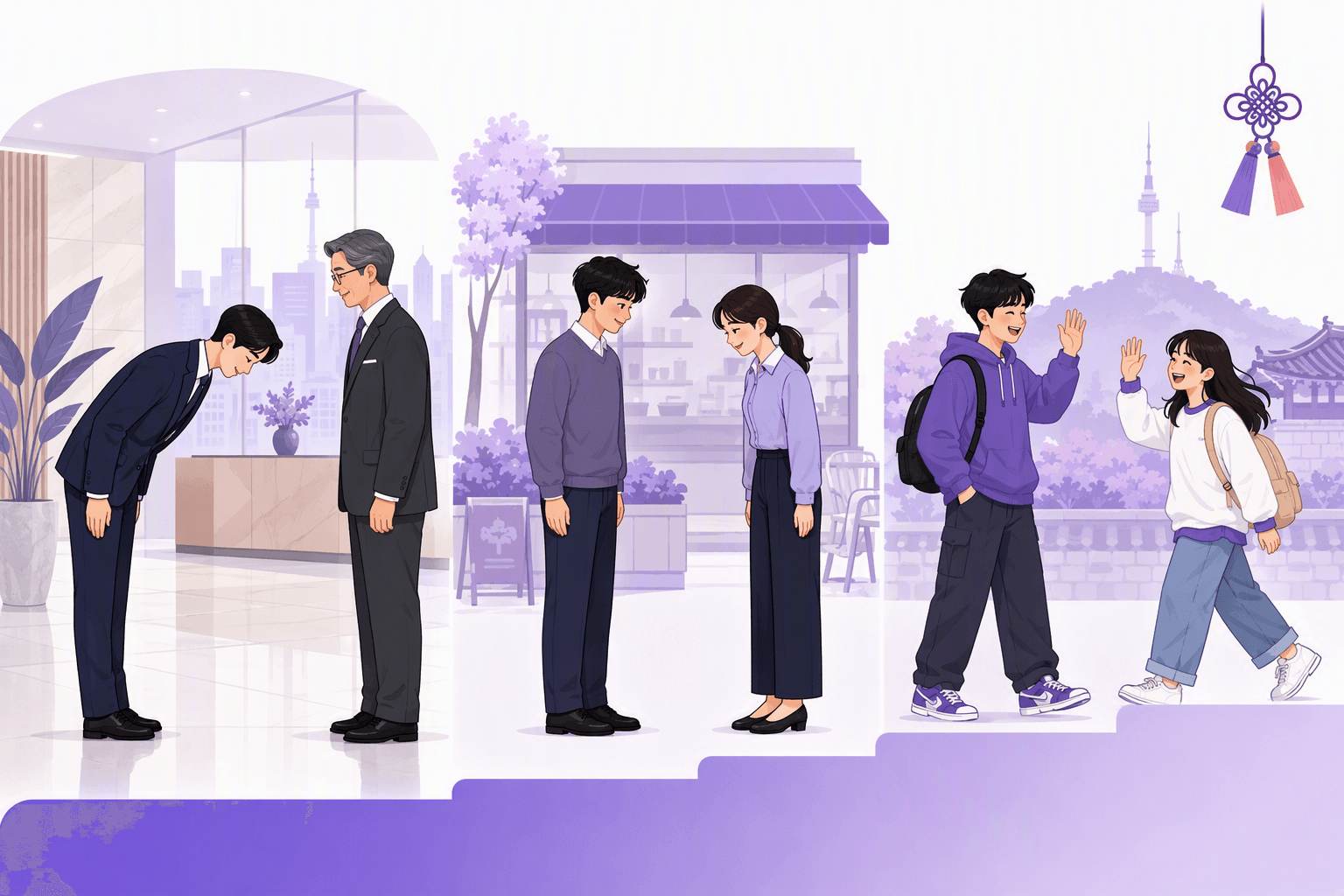
Korean greetings are not just vocabulary, they are social positioning. You are constantly signaling closeness, respect, and distance through word choice and verb endings.
Linguist Geoffrey Leech’s work on politeness (in Principles of Pragmatics, Longman) is useful here: greetings are not only information, they are relationship management. Korean makes that management visible in grammar.
The three levels you actually need
Most learners do not need every speech level on day one. In daily life, you can cover a lot with these three:
- Formal: used in announcements, customer service scripts, interviews, and very respectful first meetings.
- Polite: used with strangers, coworkers, older people, and most public interactions.
- Casual: used with close friends, siblings, and people clearly younger than you.
⚠️ A practical safety rule
If you are unsure, go one level more polite. Being slightly too polite sounds normal. Being too casual can sound disrespectful, especially across age lines.
The safest hello: 안녕하세요
안녕하세요
안녕하세요 (ahn-NYUHNG-hah-seh-yoh) is the default greeting you can use almost anywhere. It is polite, friendly, and not overly formal.
It literally relates to being at peace or well, but in real life it functions as a simple "hello." The National Institute of Korean Language’s dictionary (표준국어대사전, accessed 2026) lists 안녕하세요 as a standard greeting form.
/ahn-NYUHNG-hah-seh-yoh/
Literal meaning: A polite greeting related to being 'at peace/well.'
“안녕하세요. 처음 뵙겠습니다.”
Hello. Nice to meet you (formal).
This is the safest greeting for strangers, coworkers, and older people. A small bow or nod often accompanies it, especially in first meetings.
When it can sound too stiff
With close friends, 안녕하세요 can sound jokingly formal, like saying "Good afternoon" to your best friend. That is why you will hear shorter casual greetings in school settings, gaming chats, and among people the same age.
If you want more on how politeness shows up in daily talk, our Korean pronunciation guide explains why endings like -요 matter for tone as much as sound.
Casual greetings for friends: 안녕 and 뭐 해?
안녕
안녕 (ahn-NYUHNG) is casual and flexible. It can mean "hi" or "bye" depending on context.
Use it with friends, classmates, siblings, and kids. Avoid it with customers, bosses, or older strangers unless they clearly invite casual speech.
/ahn-NYUHNG/
Literal meaning: A casual greeting meaning 'peace' or 'well-being.'
“안녕! 오늘 학교 어땠어?”
Hey! How was school today?
Common among friends and younger people. With older people, it can feel too familiar unless you are very close.
뭐 해?
뭐 해? (mwoh HEH) means "What are you doing?" and works like a casual check-in. It is closer to "What’s up?" than a literal information request.
A polite version is 뭐 해요? (mwoh HEH-yoh), which you can use with someone you are friendly with but still keeping -요 politeness.
Very formal greetings: 안녕하십니까
안녕하십니까
안녕하십니까 (ahn-NYUHNG-hah-shim-NEE-kah) is very formal. You will hear it in news broadcasts, formal presentations, military contexts, and scripted customer-facing roles.
If you use it in normal daily life, it can sound like you are performing a role. That can be useful intentionally, for example, in a job interview.
/ahn-NYUHNG-hah-shim-NEE-kah/
Literal meaning: A highly formal greeting.
“안녕하십니까. 오늘 발표를 시작하겠습니다.”
Hello. I will begin today's presentation.
Used in formal speech and public settings. In casual situations it can sound theatrical or overly official.
"Nice to meet you" at different levels
First meetings in Korean often use set phrases. The key is matching the level to the situation.
처음 뵙겠습니다
처음 뵙겠습니다 (CHUH-um BWEHP-gehss-seum-NEE-dah) is formal and respectful. You might use it with a professor, a senior colleague, or someone you are meeting through business.
This phrase uses 뵙다, a humble verb for "to see/meet." That humble framing is a classic example of how Korean encodes social relations in verbs, a topic discussed widely in Korean pragmatics and honorifics research.
만나서 반가워요
만나서 반가워요 (mahn-NAH-suh bahn-GAH-wuh-yoh) is polite and friendly. It is common in everyday introductions, language exchanges, and meeting friends of friends.
A casual version is 만나서 반가워 (mahn-NAH-suh bahn-GAH-wuh), but do not use it upward in age or status.
💡 A natural intro combo
A very common sequence is: 안녕하세요 + (name)입니다 + 만나서 반가워요. It is simple, polite, and sounds normal in most social settings.
Goodbye is not one phrase in Korean
English has one "goodbye" that fits almost everywhere. Korean splits goodbye based on who is leaving.
If you want a deeper breakdown with more examples, see how to say goodbye in Korean.
안녕히 계세요
안녕히 계세요 (ahn-NYUHNG-hee gyeh-SEH-yoh) is said to someone who is staying. Think: "Stay well."
You say it when you leave a place, like leaving a friend’s house while they remain inside.
안녕히 가세요
안녕히 가세요 (ahn-NYUHNG-hee gah-SEH-yoh) is said to someone who is leaving. Think: "Go well."
You say it when you are staying, like seeing a guest out.
🌍 Why this matters culturally
Korean goodbyes often reflect the host-guest relationship. Even in casual settings, the language marks who is moving and who is remaining, which aligns with how Korean social etiquette treats entering and leaving as small rituals.
Service and workplace greetings you will hear constantly
Korean has greetings that are less about "hello" and more about acknowledging effort, presence, or the situation.

어서 오세요
어서 오세요 (UH-suh OH-seh-yoh) means "welcome." Staff say it to customers entering a store, cafe, clinic, or restaurant.
As a customer, you do not need to repeat 어서 오세요 back. A simple 안녕하세요 or nod is enough.
수고하세요
수고하세요 (soo-GOH-hah-seh-yoh) is tricky because it does not map cleanly to English. It acknowledges someone’s work or effort, like "take care" plus "good luck with work."
You might say it to a coworker you pass in the hallway, to a delivery person, or to staff as you leave. It is common, but it is also socially sensitive: it can sound like you are telling someone to work, so it is best used when the other person is clearly in a working role.
수고하셨습니다
수고하셨습니다 (soo-GOH-hah-SYUHSS-seum-NEE-dah) is more like "thank you for your hard work" after the work is done. You will hear it at the end of a meeting, shift, or group activity.
These phrases are taught explicitly in many King Sejong Institute materials (accessed 2026) because they are high-frequency and culturally loaded.
The "Did you eat?" greeting and what it really means
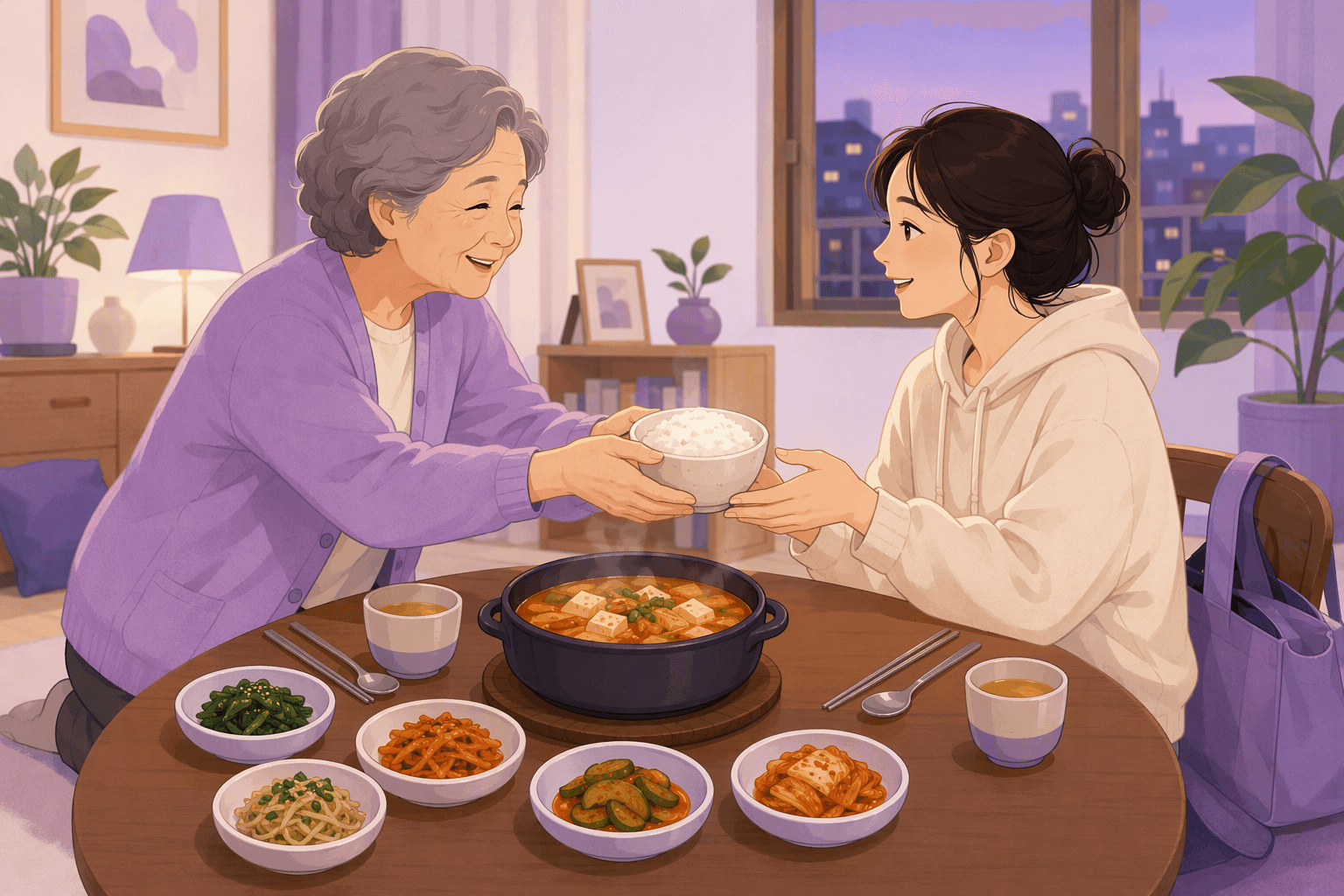
밥 먹었어?
밥 먹었어? (bahp muh-GUHSS-uh) literally asks "Did you eat?" but it often functions as a caring check-in. It can be used between close people, especially family, older relatives, or close friends.
A polite version is 밥 드셨어요? (bahp duh-SYUHSS-uh-yoh). This uses 드시다, an honorific verb for eating.
This is a good example of what linguistic anthropologist Anna Wierzbicka calls culture-shaped scripts (in Cross-Cultural Pragmatics, Mouton de Gruyter): languages package care and social closeness differently. In Korean, food is a common channel for that care.
🌍 Do not overuse it as a foreigner
If you use 밥 먹었어? with someone you just met, it can feel oddly intimate. Save it for relationships where casual warmth is already normal.
Pronunciation and body language that make greetings sound natural
A correct phrase can still feel off if the delivery is wrong. Korean greetings are short, but the performance matters.
The small bow
You do not need a deep bow in most everyday contexts. A small head dip or slight upper-body tilt is common with 안녕하세요, especially in first meetings or when greeting older people.
The -요 ending is a social signal
Learners often focus on vocabulary and forget endings. In Korean, endings like -요 are not decoration, they are the politeness marker people hear first.
If you want to train this with real audio, using short clips helps. That is also why video-based practice tends to work well for greetings, you can hear how quickly Koreans switch levels depending on who enters the scene. For more on learning through scenes, see how to learn a language with movies.
Common mistakes that make greetings awkward
Mixing levels in one sentence
A classic learner mistake is combining casual and polite endings together. For example, starting with 안녕하세요 and then switching to a casual verb ending can feel inconsistent.
If you start polite, stay polite until the other person clearly invites casual speech.
Using swear words as "friendly emphasis"
Some learners pick up strong expressions from dramas and try to use them as casual flavor. That can backfire fast, especially because Korean swearing is highly context-dependent and can be much harsher than subtitles suggest.
If you are curious, read our guide to Korean swear words, but treat it as recognition training, not a starter kit.
Overusing textbook greetings
Phrases like 좋은 아침입니다 exist, but they are less common than learners expect. Koreans usually just say 안녕하세요 in the morning, or they greet with context like "Did you sleep well?" among close people.
Practice plan: learn greetings through scenes, not lists
Memorizing greetings is easy. Using them at the right level is the real skill.
Step 1: pick one "safe" set
For most learners, this set covers daily life:
- 안녕하세요
- 만나서 반가워요
- 감사합니다
- 죄송합니다
- 안녕히 가세요 / 안녕히 계세요
Step 2: add one casual set for friends
Once you have Korean friends or classmates:
- 안녕
- 뭐 해?
- 나중에 봐
Step 3: listen for role-based greetings
In Korea, you will hear 어서 오세요 and 수고하세요 constantly. Learn them as situational signals, not direct translations.
For more high-frequency building blocks, our 100 most common Korean words list helps you recognize what surrounds greetings in real speech.
Quick vocabulary for talking about levels
Knowing a few meta-words helps you ask questions in class or understand explanations online.
| Concept | Korean | Pronunciation | Note |
|---|---|---|---|
| Politeness level | 높임말 | noh-PEEM-mahl | Honorific speech, used to show respect. |
| Casual speech | 반말 | bahn-MAHL | Informal speech, used with close friends or younger people. |
| Honorific suffix | -님 | neem | Added to titles/names to show respect (선생님, 고객님). |
| Teacher (honorific) | 선생님 | suhn-SENG-neem | Common respectful address, not only for school teachers. |
| Customer (honorific) | 고객님 | goh-GEHNG-neem | Service-industry respectful address. |
| Meal (casual word) | 밥 | bahp | Often used in greetings like '밥 먹었어?' |
A final cultural note: closeness is earned, not assumed
Korean can feel strict because it asks you to choose a level. But that structure also makes closeness meaningful.
When someone invites you into casual speech, it often signals real comfort. If you stay polite a little longer than necessary, most people will read it as respectful, not distant.
If you want to expand beyond greetings into relationship language, our I love you in Korean guide shows how affection also changes by level and context.
If you want to practice these greetings the way you actually hear them, use short TV and movie clips where characters switch politeness levels in real time. That context is where Korean greetings stop being phrases and start being social fluency.
Frequently Asked Questions
What is the safest Korean greeting to use with anyone?
Is 안녕 rude in Korean?
How do Koreans greet coworkers in an office?
What do Koreans say when they enter a store or restaurant?
Do Koreans greet by asking 'Did you eat?'
Sources & References
- National Institute of Korean Language (국립국어원), Standard Korean Language Dictionary (표준국어대사전), accessed 2026
- King Sejong Institute Foundation, Korean language learning materials and phrase guidance, accessed 2026
- Ethnologue: Languages of the World, Korean language entry (27th edition, 2024)
- Korean Language Society (한글학회), Korean language resources, accessed 2026
Start learning with Wordy
Watch real movie clips and build your vocabulary as you go. Free to download.


