Quick Answer
Korean etiquette is built around respect, age hierarchy, and choosing the right level of politeness in speech and behavior. Learn the core rules for greetings, titles, dining, drinking, gift-giving, and public manners so you can avoid common mistakes and sound natural in real Korean interactions.
Korean etiquette and customs are mainly about showing respect through language level, body language, and small routines like how you greet, pour drinks, and address people by title, so if you default to polite speech, follow age hierarchy, and use two hands for key exchanges, you will come across as considerate in most situations.
Korean is spoken by tens of millions of people worldwide, with South Korea and North Korea as the core countries, plus large diaspora communities, and Ethnologue (27th edition, 2024) places Korean among the world’s major languages by native speakers. That scale matters because etiquette norms are not niche, they shape daily life, workplaces, and media.
If you want phrase-level help alongside culture, pair this guide with how to say hello in Korean and how to say goodbye in Korean. If you want the opposite end of the politeness spectrum, see Korean swear words for what to avoid in mixed company.
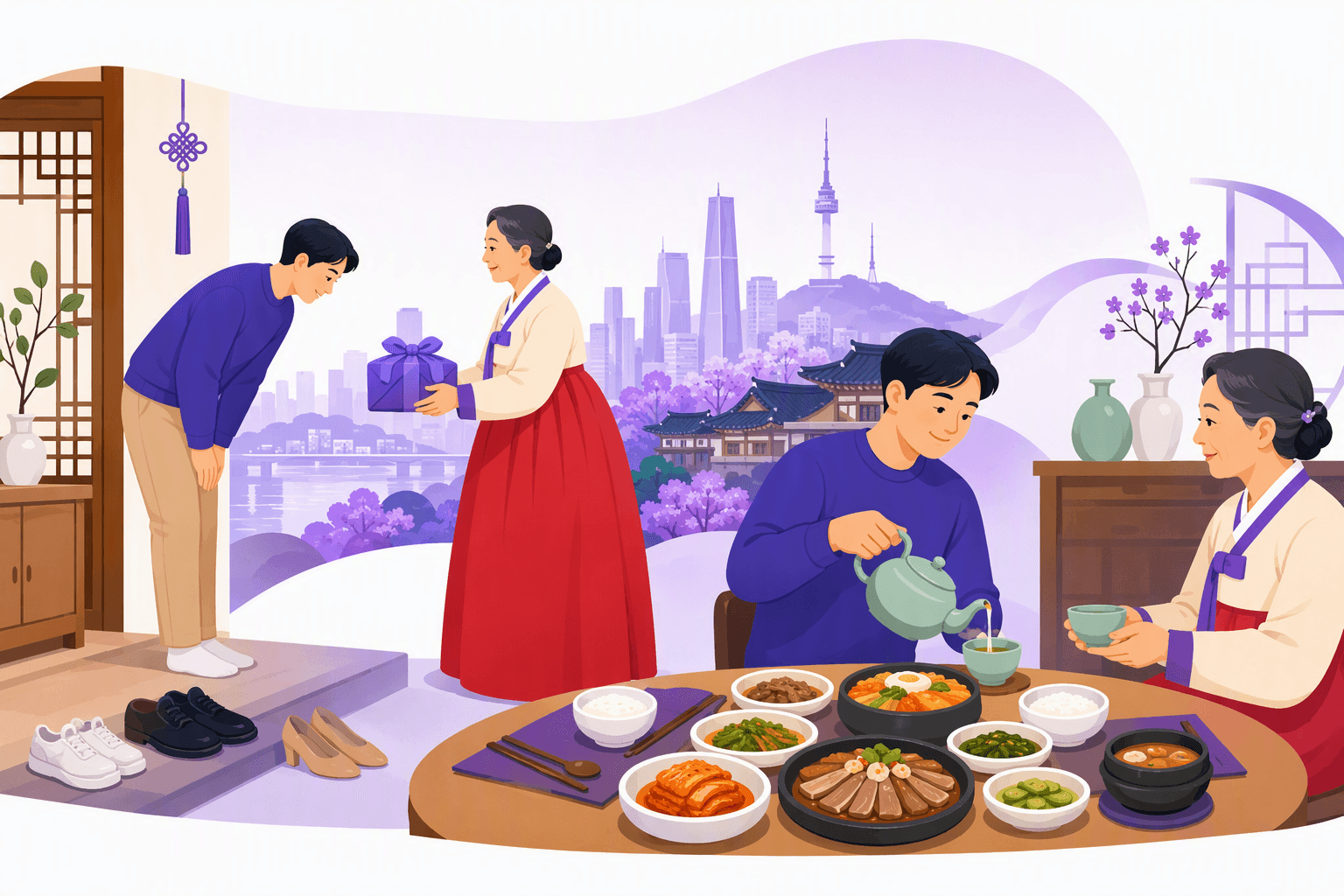
The big idea: hierarchy plus harmony
Korean etiquette is often described as “formal,” but the practical rule is simpler: people constantly manage distance and closeness. You show distance with honorifics, titles, and careful phrasing, then show closeness gradually as the relationship becomes safe.
This aligns with how sociolinguists describe politeness as social work. Penelope Brown and Stephen Levinson’s Politeness: Some Universals in Language Usage is a classic framework for understanding why indirectness and “face” matter in everyday interaction, and Korea is a strong example of that principle in action.
Why age matters so much
Age is a shortcut for expected speech level and behavior. In Korea, you will hear people ask about age early, not to be intrusive, but to choose the right language and social stance.
In practice, age connects to who speaks first, who pours drinks, who takes the “best” seat, and how directly you can disagree. If you treat age as a navigation tool rather than a test, interactions feel much easier.
눈치
눈치 /nun.tɕʰi/ is the skill of reading the room: noticing what others want, what they are implying, and what would be awkward to say out loud. It is not mind-reading, it is social attention.
In many Korean scenes, the “right” move is not the most honest sentence, it is the sentence that preserves smoothness. If you have strong opinions, you can still express them, but you often wrap them in softeners.
💡 A safe default
If you are not sure what level of politeness to use, choose polite speech and slightly indirect wording. Koreans rarely judge foreigners for being too polite, but they do notice when someone is casually blunt too early.
Greetings: bows, handshakes, and first impressions
A greeting in Korea is a package: words, posture, eye contact, and timing. The more formal the context, the more you should slow down and make the greeting clear.
안녕하세요
안녕하세요 /an.njʌŋ.ha.se.jo/ (ahn-NYUHNG-hah-seh-yoh) is the safest all-purpose greeting. It works for strangers, coworkers, shop staff, and older people.
A small bow while saying it is normal. The bow does not need to be deep unless the situation is very formal, like meeting a client or greeting someone’s parents.
인사
인사 /in.sa/ means greeting, and you will hear phrases like 인사드리다 /in.sa.dɯ.ɾi.da/, a more respectful “to offer greetings.” In workplaces, greeting properly is seen as basic professionalism, not extra politeness.
If you walk into a small room, greeting the group matters. In many offices, people greet when arriving and again when leaving.
Handshakes in business settings
Handshakes are common in business, often combined with a slight bow. If the other person is older or higher status, you can support your right forearm with your left hand during the handshake.
This “two-hand” support is a visual signal of respect, similar to how you might use two hands when giving a business card or a gift.
Names, titles, and how to address people
Addressing someone correctly is one of the fastest ways to sound culturally fluent. The key is that first names are not the default for adults.
씨
씨 /ɕi/ is a polite suffix used with a name, like “Mr./Ms.” in a broad sense, but it is not identical. You might hear 민수 씨, 지영 씨, and so on.
It is often used among coworkers of similar rank, or when you want polite neutrality. In very formal settings, titles can be better than 씨.
선생님
선생님 /sʌn.sɛŋ.nim/ means “teacher,” but it is also used as a respectful address for instructors, tutors, and sometimes professionals like clinicians in certain contexts. It is a safe respectful term when someone’s role is “guiding” you.
If you are learning Korean, you will hear it constantly. Using it correctly signals that you understand role-based respect.
사장님
사장님 /sa.dʑaŋ.nim/ is often used for “boss” or “owner,” including small business owners like a restaurant owner. You may hear customers use it to address someone running the place.
It can sound overly familiar if misused, but in many everyday service settings it is normal. When unsure, you can use 저기요 /tɕʌ.ɡi.jo/ to get attention politely, then switch to 감사합니다 /kam.sa.ham.ni.da/ (gahm-SAH-hahm-nee-dah).
Why “oppa” and “unni” are not generic
Korean kinship terms often extend beyond family, but they are still relationship words, not vocabulary labels. Using 오빠 /op͈a/ or 언니 /ʌn.ni/ assumes closeness and a specific speaker identity and age relation.
If you are not sure, do not force these terms. Many awkward moments in Korea come from copying K-dramas without the relationship context.
For romantic language that fits real situations, see how to say I love you in Korean.
Speech levels: politeness is grammar, not just tone
Korean politeness is built into verb endings and honorific markers. This is why “being polite” is not only about adding “please,” it is about choosing the right sentence shape.
The National Institute of Korean Language (국립국어원) publishes guidance on standard language and appropriate usage, and it is a useful reference when you want to understand what counts as “standard polite” vs casual speech.
존댓말
존댓말 /tɕon.dɛt̚.mal/ is polite speech. You will hear it in customer service, workplaces, and first meetings.
If you are a learner, mastering a stable polite style first is practical. It gives you a safe baseline across most contexts.
반말
반말 /pan.mal/ is casual speech used with close friends, younger people, and within families. It is not “rude” by itself, but it can be rude if you use it too early.
A common cultural pattern is that people negotiate the switch. Someone might ask to speak casually once they feel comfortable.
⚠️ A common learner mistake
Do not copy casual endings from dramas and use them with strangers. In Korean, casual speech can feel like you are placing yourself above the other person, even if your intention is friendly.
Dining etiquette: meals are social structure
Korean dining etiquette is one of the most visible parts of culture because it combines hierarchy, sharing, and ritual. The rules are not meant to be stressful, they are meant to keep the group coordinated.
When to start eating
In many settings, you wait for the oldest person or the most senior person to begin. In family meals, this can be quite clear.
If you are a guest, waiting a beat is a good habit. If others start immediately, you can follow.
Chopsticks and spoon basics
Korean meals often use both 젓가락 /tɕʌt̚.k͈a.ɾak/ (metal chopsticks) and 숟가락 /sut̚.k͈a.ɾak/ (spoon). A common norm is to use the spoon for rice and soup, and chopsticks for side dishes.
Avoid sticking chopsticks upright in rice. That resembles ritual offerings and can feel unsettling.
Sharing banchan and pace
Side dishes are shared, and people often eat at a similar pace. Taking the last piece without checking can feel inconsiderate, especially with elders.
A simple “드실래요?” style offer can smooth things out, but even without Korean, you can gesture and wait.
Kimchi, kimjang, and why food sharing matters
Korean food culture is not only taste, it is community. UNESCO’s Intangible Cultural Heritage listing for kimjang (making and sharing kimchi) highlights the social practice of preparing and distributing food together, which helps explain why sharing dishes and feeding guests is emotionally meaningful in Korea.
If someone insists you eat more, it is often care, not pressure. You can accept a small amount and show appreciation.
Drinking etiquette: pouring, refusing, and the “turn away” rule
Drinking culture varies by age group and workplace, but a few norms are widely recognized.
Pouring for others
A classic rule is: pour for others, not yourself. If you notice someone’s glass is low, offering a refill is polite.
When receiving a drink from someone older or senior, you often hold the glass with two hands or support it with the other hand.
Turning away when drinking with seniors
When drinking with older people or higher-status people, many Koreans turn their head slightly away while drinking. It is a small gesture that signals respect.
You do not need to exaggerate it. A subtle turn is enough.
How to refuse alcohol politely
Refusing is allowed, but direct refusal can feel abrupt. A soft refusal, gratitude, and a reason work well.
If you are learning phrases for this, focus on polite tone and short explanations. You can also accept and sip slowly, depending on your comfort and health.
🌍 Work dinners are not always optional
In some workplaces, 회식 (company dinner) can carry social pressure, even if norms are changing among younger workers. If you are new, watch what others do and mirror the level of participation that seems normal for your team.
Gift-giving etiquette: what matters more than the gift
Gift-giving in Korea is common for visits, holidays, and showing thanks. The presentation and the manner of giving often matter as much as the item.
Two hands
Giving and receiving with two hands is a strong default for gifts, business cards, and sometimes money envelopes. It visually communicates sincerity and respect.
If your hands are full, a brief apology and a careful handover still helps.
Opening gifts
In some contexts, people do not open gifts immediately in front of the giver, especially in formal situations. In close friendships, opening right away can be fine.
If you are unsure, follow the other person’s lead. If they set it aside, do the same.
Practical gifts are normal
Every culture has “safe gifts,” and Korea has many practical ones: food sets, fruit, health supplements, and household items. These can be more appreciated than decorative objects.
If you are visiting someone’s home, bringing something small is a strong signal of good manners.
Visiting homes: shoes, seating, and small routines
Home etiquette is where foreigners most visibly stand out, but it is also easy to get right.
Shoes off
Shoes off is standard in Korean homes, and often in some traditional restaurants or guesthouses. Look for a shoe area near the entrance.
Wear clean socks. It sounds obvious, but it matters in a shoes-off culture.
Seating and the “best spot”
In some homes, the most comfortable or central seat may be offered to a guest, but elders may also take the most honored position. Do not rush to sit.
Wait to be guided, or choose a modest spot if no one directs you.
Compliments and gratitude
Complimenting the food and thanking the host are high-value behaviors. Even simple Korean like 감사합니다 /kam.sa.ham.ni.da/ (gahm-SAH-hahm-nee-dah) goes far.
Public manners: small behaviors Koreans notice
Korea is not “more strict” in every way, but there are consistent expectations about not disturbing others in shared spaces.
Volume and personal space
On public transport, people often keep voices low. Phone calls can happen, but loud calls draw attention.
Personal space can be tight in crowded areas, but pushing without acknowledgment is frowned upon. A quick 죄송합니다 /tɕwe.sʰoŋ.ham.ni.da/ is useful if you bump someone.
Lines and order
Queuing is common and expected. Cutting in line is one of the fastest ways to create conflict.
If you are unsure where a line starts, watch the flow. In busy cafes, people may line up for ordering, then wait elsewhere for drinks.
Trash and cleanliness
Korea has strong norms around cleanliness, but public trash cans can be limited in some areas. People often carry small trash until they find a bin.
If you are traveling, plan for that. It is a practical detail that affects how “prepared” you look.
Dating and relationships: politeness shifts with closeness
Korean relationship etiquette is often about calibrating closeness. The language you use can change faster than your behavior, or vice versa, depending on the couple.
Meeting parents and elders
If you meet a partner’s parents, polite speech and modest behavior are expected. Greetings, small gifts, and careful listening matter.
Even if everyone is friendly, starting formal is safer. You can relax later if invited.
Public displays of affection
Norms vary by neighborhood and age group, but many couples keep PDA relatively subtle in public. Hand-holding is common, more intimate gestures can feel out of place in conservative settings.
If you are unsure, mirror your partner’s comfort level and the environment.
How to learn etiquette through real Korean scenes
Etiquette is hard to memorize as a checklist because it changes with context. The fastest way to internalize it is to watch real interactions and notice patterns.
If you are using clips, focus on three things:
- Who is older or higher status.
- What verb endings they use.
- What they do with their hands and posture during key moments.
This is also where dual subtitles help. If you want a setup that supports this style of learning, read our dual subtitles guide and the broader research-backed view in can you learn a language by watching TV.
Common mistakes foreigners make (and what to do instead)
Mistakes are normal. Koreans generally appreciate effort, especially when you show respect.
Mistake: using casual speech too early
Fix: stay in polite speech until someone clearly invites casual speech. If you are close friends, you will feel the switch happen naturally.
Mistake: calling adults by first name
Fix: use a title, or name plus 씨. In service settings, you can avoid naming entirely and use polite attention-getters.
Mistake: refusing too directly
Fix: soften with gratitude and a brief reason. Even in English, you can say “Thank you, I’m okay” with a warm tone.
Mistake: overdoing “K-drama” behavior
Fix: treat dramas as language input, not a behavior manual. Real life is often quieter and less explicit.
If you want to understand how Korean speech changes by situation, how to say hello in Korean is a good starting point because greetings show speech level choices immediately.
A practical “do this” checklist for your first week in Korea
Use this as a minimal set of habits that cover most situations.
- Greet first, with a small bow.
- Use polite speech by default.
- Use two hands for gifts, cards, and receiving drinks.
- Wait a moment before eating, especially with elders.
- Pour for others, and accept pours graciously.
- Keep your voice lower on public transport.
- When unsure, watch what the oldest person does and follow.
Final takeaway: respect first, then relax
Korean etiquette is not about perfection, it is about showing that you are paying attention to the other person’s comfort and status. Start polite, observe the room, and adjust gradually, and you will avoid most social friction while building real rapport.
If you want to train your ear for these moments, learning through short scenes helps because you can replay the same greeting, apology, or dinner exchange until it feels automatic. For more Korean basics you can use immediately, continue with how to say goodbye in Korean, then explore more learning paths on our Korean learning page.
Frequently Asked Questions
What is the most important rule of Korean etiquette?
Do Koreans bow or shake hands?
Is it rude to call someone by their first name in Korea?
What are the key rules for Korean dining etiquette?
How do I politely refuse something in Korean culture?
Sources & References
- National Institute of Korean Language (국립국어원), Korean language and speech etiquette resources, accessed 2026
- Korean Culture and Information Service (KOCIS), Guides to Korean culture and etiquette, accessed 2026
- UNESCO, Intangible Cultural Heritage: Kimjang, making and sharing kimchi, accessed 2026
- Ethnologue, 27th edition, 2024
Start learning with Wordy
Watch real movie clips and build your vocabulary as you go. Free to download.


