Can You Learn a Language by Watching TV? What the Research Says
Quick Answer
You can genuinely learn a language by watching TV — but only part of one. Research consistently shows television builds vocabulary and listening comprehension when you understand enough to follow, watch actively, and use subtitles strategically; what it cannot do alone is teach you to speak. This guide walks through the actual studies (Webb and Rodgers on vocabulary coverage, d'Ydewalle and Vanderplank on subtitles and captions, Krashen's comprehensible input), an honest table of what TV is good and bad at, the active-watching method, realistic timelines, and the best show types for each level.
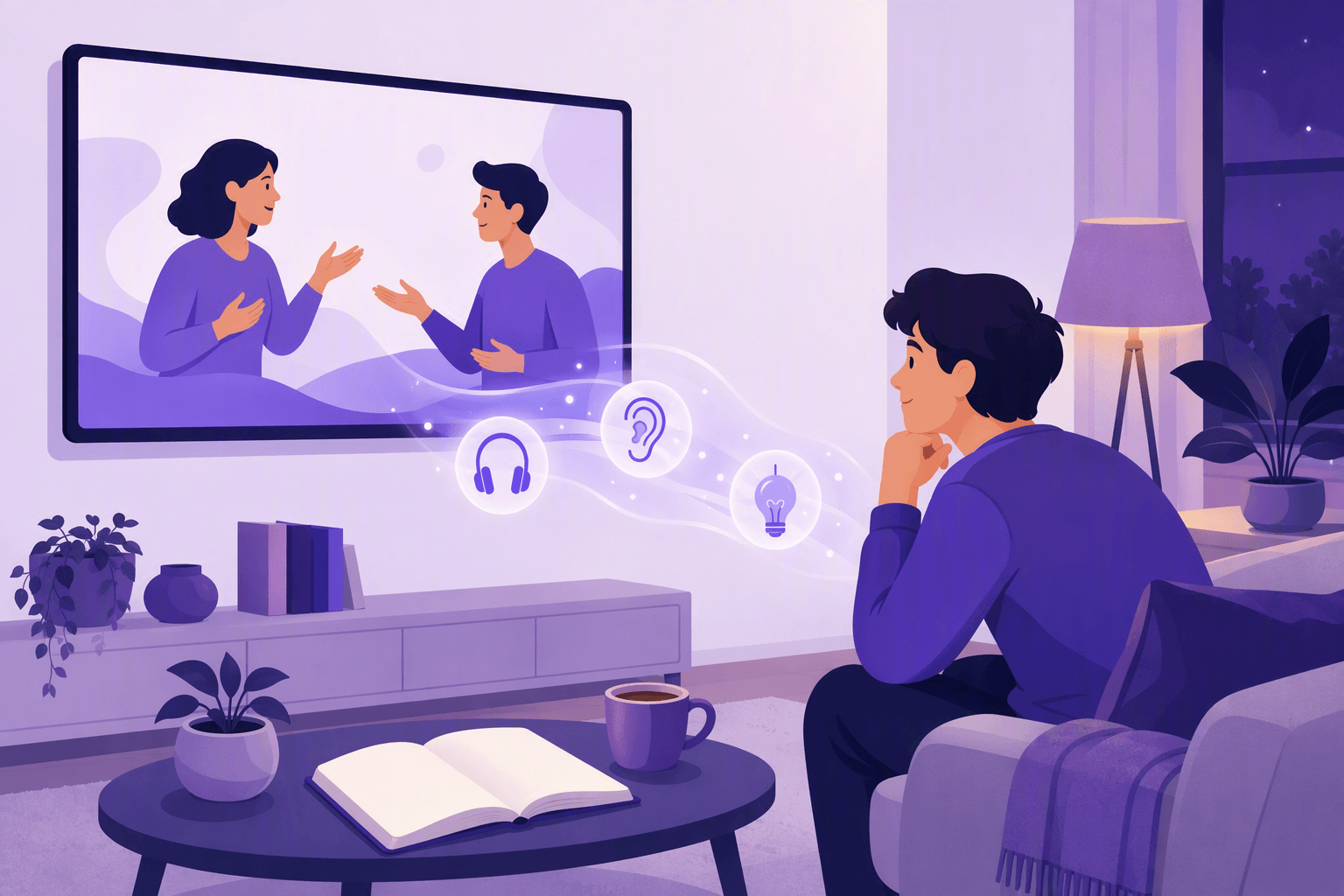
Yes — you can genuinely learn a language by watching TV, but only part of one. Decades of research show that television reliably builds vocabulary and listening comprehension under three conditions: you understand enough of the dialogue to follow it, you watch actively rather than letting it run in the background, and you use subtitles strategically. What no amount of watching does on its own is teach you to speak — production is a partly separate skill that needs its own practice. That is the honest answer, and the rest of this guide unpacks the evidence behind every clause of it.
The question matters because the promise is so seductive: replace flashcards with Netflix and absorb Spanish the way you absorbed your favorite sitcom quotes. The truth sits between the dream and the cynics' dismissal. TV is one of the most powerful learning inputs available — arguably the best free one — and it is also the most misused, because passive bingeing feels like study while teaching almost nothing.
What the research actually shows
Vocabulary: TV runs on the words you need most
The strongest evidence concerns what television is made of. Stuart Webb and Michael Rodgers analyzed the scripts of 88 television programs across genres ('The Vocabulary Demands of Television Programs', Language Learning, 2009) and, in a companion study, a corpus of over 300 movies ('The Lexical Coverage of Movies', Applied Linguistics, 2009). The headline finding: knowing the most frequent 3,000 word families, plus proper nouns, gives you roughly 95% coverage of TV and film dialogue — the threshold generally associated with adequate comprehension.
Two implications follow. First, TV dialogue is built almost entirely from the high-frequency conversational core of the language — exactly the vocabulary a learner needs most, repeated endlessly in context. Second, that same fact explains why native TV defeats beginners: below that core vocabulary, 95% coverage is out of reach and the show is noise. In a follow-up on "narrow viewing," Rodgers and Webb also found that episodes of the same series recycle vocabulary far more than unrelated programs — a research-backed argument for binge-watching one show rather than sampling many.
Subtitles: the most-studied variable
Subtitle research goes back decades, much of it from Géry d'Ydewalle's lab in Belgium — a country where subtitled foreign TV is the norm. With Marijke Van de Poel, he showed that children acquired measurable foreign vocabulary incidentally from watching a single short subtitled program ('Incidental Foreign-Language Acquisition by Children Watching Subtitled Television Programs', Journal of Psycholinguistic Research, 1999) — modest gains from minutes of exposure, but real, with no instruction at all.
For adults, the sharpest result concerns which subtitles. Holger Mitterer and James McQueen had Dutch participants watch English video with regional accents and found that English subtitles improved their subsequent perception of the accented speech, while Dutch subtitles harmed it (PLoS ONE, 2009). The mechanism is intuitive: target-language subtitles anchor unfamiliar sound to spelling, while native-language subtitles let your brain read the translation and tune the audio out. Consistent with that, Birulés-Muntané and Soto-Faraco found that Spanish students who watched a TV drama episode with English subtitles improved their English listening skills more than those watching with Spanish subtitles (PLoS ONE, 2016).
Captions keep learners in the game
Robert Vanderplank ran the classic classroom-adjacent study: learners watching BBC programs with same-language teletext captions over nine weeks ('The Value of Teletext Sub-titles in Language Learning', ELT Journal, 1988). Far from being a distraction, captions helped learners stay attentive, follow authentic speech, and extract usable chunks of language — provided they engaged with the material rather than merely sitting in front of it. His later book-length synthesis of the field reached the same balanced verdict: captioned viewing is a powerful aid for post-beginners when attention is paid, not a magic ambient method.
The theory that ties it together
Why should understanding a crime drama teach you anything? Because, in Stephen Krashen's framework, acquisition happens when you understand messages slightly above your current level — comprehensible input. Television is a delivery mechanism for exactly that: meaning supported by faces, action, and plot.
"Language acquisition does not require extensive use of conscious grammatical rules, and does not require tedious drill." — Stephen Krashen, Principles and Practice in Second Language Acquisition (1982)
The corollary cuts both ways: input only works when it is comprehensible. A show far above your level delivers no messages to understand, which is why level-matching and subtitles are not accessories to the method — they are the method.
What the research does not show
No study has documented anyone reaching conversational fluency from viewing alone. Comprehension-heavy learners routinely develop a large gap between what they understand and what they can say — the observation behind Merrill Swain's argument that producing language plays its own role in acquisition. TV also gives you no feedback, no pressure to retrieve words, and no practice organizing your own sentences in real time. Treat every "I became fluent from Netflix" anecdote with the same question: what else were they doing?
What TV is good at — and what it is not
| Skill | How well TV teaches it | Why |
|---|---|---|
| Everyday vocabulary | Very well | Dialogue is built from the top 3,000 word families, recycled constantly in context |
| Listening at native speed | Very well | The one skill almost nothing else trains as authentically |
| Pragmatics and culture | Well | How people actually greet, argue, apologize, and order food — textbooks fake this, TV cannot |
| Pronunciation (perception) | Moderately | Your ear improves, especially with target-language subtitles; your mouth still needs reps |
| Grammar | Weakly | Patterns are absorbed implicitly over long exposure; nothing is ever explained |
| Speaking | Barely | Zero practice retrieving and producing under time pressure |
| Writing | Barely | Different register, different skill |
The pattern is clean: TV excels at everything receptive and fails at everything productive. That is not a flaw to fix but a fact to plan around — pair watching with output practice, and the combination covers the whole skill.
The method: how to actually learn from what you watch
The difference between viewers who learn and viewers who do not is not talent or hours — it is technique. Five habits, in order of importance:
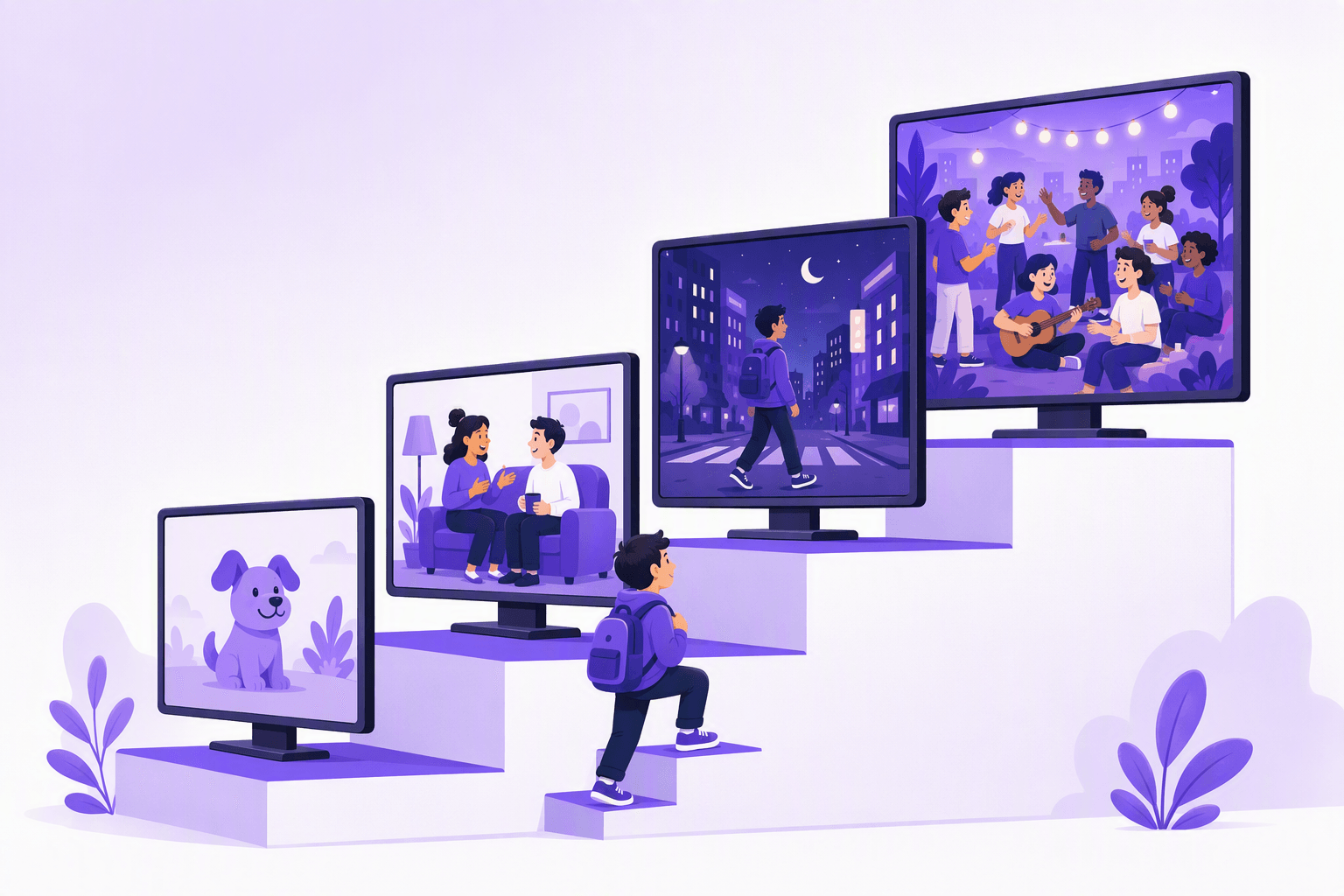
- Match the show to your level. If you cannot summarize a scene after watching it, the show is too hard, full stop. Step down to learner-made content or children's shows without shame; incomprehensible input teaches nothing regardless of quality.
- Climb the subtitle ladder. Own-language subtitles only for a first pass on something you could not otherwise follow; target-language subtitles as your default working mode (this is what the Mitterer and McQueen result rewards); no subtitles as a regular test. Move up a rung whenever the current one feels comfortable.
- Repeat scenes, not episodes. One three-minute scene watched three times beats forty minutes of fog. The second pass is where half-heard lines resolve into words; the third is where they stick. This also makes fast native audio survivable at intermediate levels.
- Capture words and review them. Vocabulary met once in a show decays fast; vocabulary saved and reviewed on a spaced schedule sticks. Keeping the word attached to its scene — the voice, the face, the situation — makes the memory dramatically more durable than a bare flashcard.
- Say lines out loud. Shadowing a character for even a few lines per session bridges the input-output gap that pure watching leaves open.
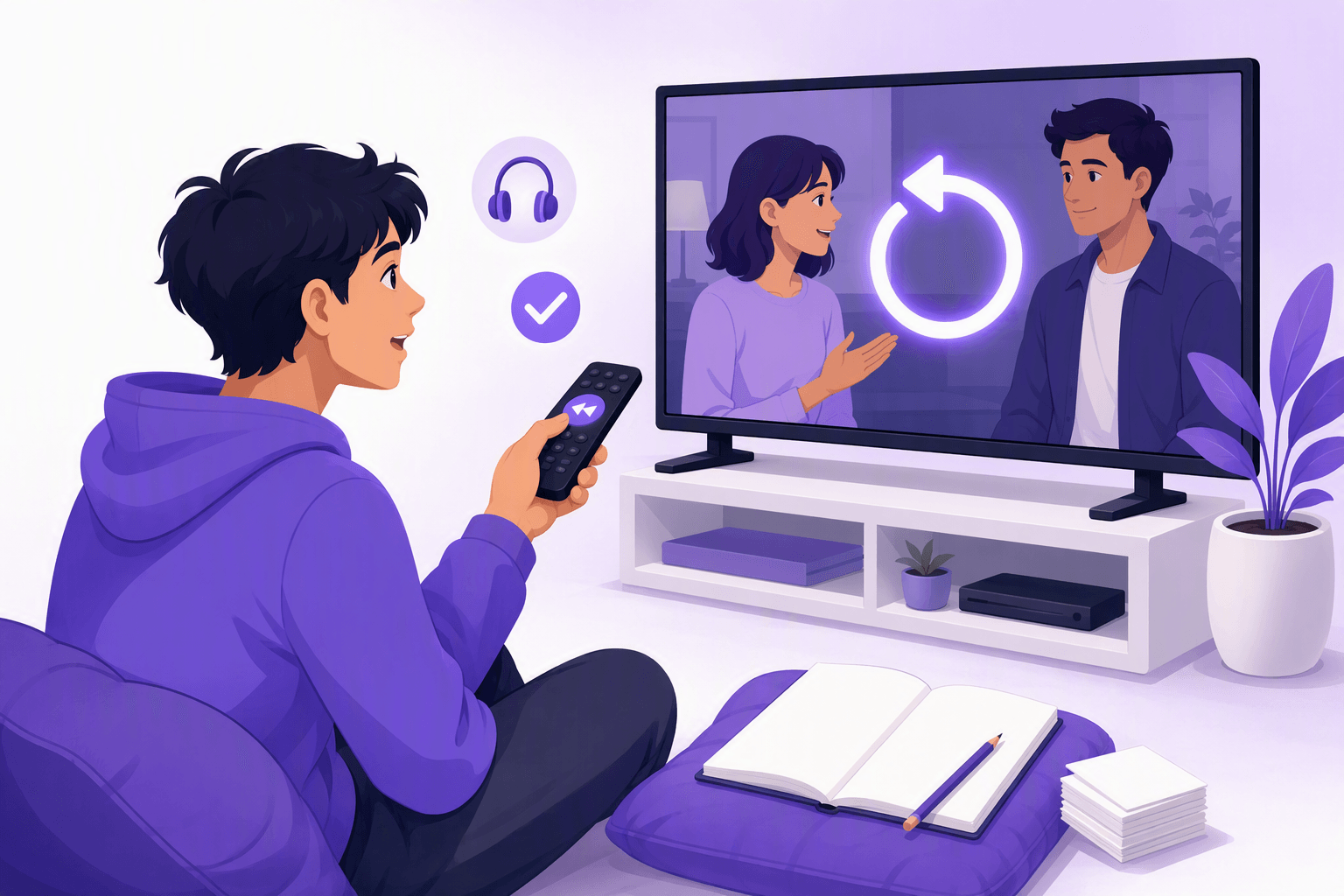
Steps 3 and 4 are exactly what Wordy automates: it teaches with short clips from real movies and shows, so every scene is small enough to genuinely rewatch, and the words you meet go straight into a spaced-repetition review deck. If you prefer to run the system manually, our guide to learning a language with movies walks through the DIY version.
How long does it take? Honest ranges
No study hands out a TV-hours-to-fluency table, so here are defensible anchors instead of invented precision. The US Foreign Service Institute plans roughly 600-750 classroom hours for English speakers learning related languages (Spanish, French, Italian) and about 2,200 hours for distant ones (Japanese, Korean, Mandarin, Arabic) — read those as orders of magnitude for total engaged time, whatever the input source. Within a TV-heavy approach, experience clusters around a few milestones:
- 2-3 months of daily active watching (30-60 minutes): a noticeable comprehension jump — you follow whole scenes, catch words in the wild.
- 6-12 months: everyday dialogue in a related language becomes broadly followable with target-language subtitles, and familiar shows work without them.
- Beyond a year: native-speed comprehension across genres, with distant languages taking proportionally longer at every step.
Distribution beats volume: an hour daily outperforms a weekend binge of seven, because regular exposure keeps vocabulary from decaying between meetings. And every figure above assumes active watching — the passive version multiplies all timelines by a large and demoralizing factor.
Best show types for every level
| Level | What works | Why |
|---|---|---|
| A1-A2 | Shows made for learners, children's animation, short repeated clips | Controlled vocabulary and visual support keep comprehension above the threshold where learning happens |
| B1 | Sitcoms, teen dramas, one series watched deeply | Everyday settings recycle high-frequency language; narrow viewing multiplies repetition |
| B2 | Crime, drama, thrillers with target-language subtitles | Native speed and slang, with plot momentum doing the motivational work |
| C1+ | Talk shows, variety, news, films — subtitles off | Overlapping speech, regional accents, and no scaffolding: the last frontier |
Genre matters as much as difficulty: slice-of-life content is packed with transferable daily language, while fantasy and period pieces spend their dialogue budget on vocabulary you may never use. For concrete ranked lists, see our picks of the best movies and shows to learn Spanish, the best movies and shows to learn French, and the best anime series for learning Japanese.
Common myths, quickly
"Background TV counts." It does not. Acquisition requires attention to meaning; ambient audio is decoration. Even infants, the most gifted language learners alive, fail to learn from unattended screens.
"Kids' shows are always the easiest start." Often, but not automatically — animated worlds run on songs, fantasy vocabulary, and wordplay. A calm slice-of-life show can be easier than a frenetic cartoon.
"Subtitles are cheating." The research says nearly the opposite: target-language subtitles measurably improve speech perception and vocabulary pickup. The cheat, if any, is permanent own-language subtitles, which quietly convert listening practice into reading your native language.
"You need to understand every word." The working target is roughly 95% coverage, not 100%. The remaining stretch — new words decoded from context — is not an obstacle to learning; it is the learning.
"My friend got fluent purely from watching Friends." Ask two questions: how is their speaking, and what else were they doing? Almost always the answer involves school English, games, music, and online chat — with TV as the input engine of a larger system. That system is the realistic promise: television can carry the biggest single share of your learning, as long as it does not have to carry all of it.
Watching TV in your target language is not a shortcut around the work of language learning — it is a way of making a large part of that work genuinely enjoyable, which is why it is one of the few methods people sustain for the years the task actually takes. Pick a show at your level, put the subtitles in the right language, rewatch what you love, and say the good lines out loud. The research supports every part of that sentence.
Frequently Asked Questions
Can you become fluent just by watching TV?
Is it better to watch with or without subtitles?
How many hours of TV does it take to learn a language?
Can you learn a language by playing TV in the background?
What should beginners watch to learn a language?
Why do countries that subtitle TV speak better English?
Sources & References
- Webb, S. & Rodgers, M.P.H., 'The Vocabulary Demands of Television Programs', Language Learning 59(2), 2009
- Webb, S. & Rodgers, M.P.H., 'The Lexical Coverage of Movies', Applied Linguistics 30(3), 2009
- d'Ydewalle, G. & Van de Poel, M., 'Incidental Foreign-Language Acquisition by Children Watching Subtitled Television Programs', Journal of Psycholinguistic Research 28, 1999
- Vanderplank, R., 'The Value of Teletext Sub-titles in Language Learning', ELT Journal 42(4), 1988
- Mitterer, H. & McQueen, J.M., 'Foreign Subtitles Help but Native-Language Subtitles Harm Foreign Speech Perception', PLoS ONE 4(11), 2009
- Birulés-Muntané, J. & Soto-Faraco, S., 'Watching Subtitled Films Can Help Learning Foreign Languages', PLoS ONE 11(6), 2016
- Krashen, S., Principles and Practice in Second Language Acquisition, Pergamon Press, 1982
Start learning with Wordy
Watch real movie clips and build your vocabulary as you go. Free to download.


