What Is Comprehensible Input? The Complete Guide to i+1 and Input-Based Learning
Quick Answer
Comprehensible input is language slightly above your current level that you can still understand from context, the idea Stephen Krashen labeled i+1. According to his input hypothesis, understanding messages, not memorizing rules, is what drives language acquisition. This guide covers the theory, concrete examples like graded readers and TV with subtitles, how to find your own i+1 level, and honest estimates of how many hours of input you need.
Comprehensible input is language that sits slightly above your current level but that you can still understand from context: you follow the message even though you do not know every word or structure in it. The term comes from linguist Stephen Krashen, who called this sweet spot i+1, your current level (i) plus one manageable step. His input hypothesis claims that understanding messages is how humans acquire languages, and that grammar rules and drills play a much smaller role than most classrooms assume.
That single idea sits underneath almost every modern approach to language learning: extensive reading, learner podcasts, watching TV with subtitles, the immersion method, and story-based teaching. This guide explains where the theory comes from, what actually counts as comprehensible input, how to find your own i+1 level, and how much input you realistically need, without the fake precision you often see attached to those questions.

The theory: Krashen's input hypothesis, i+1, and the affective filter
Stephen Krashen laid out his model of second language acquisition in Principles and Practice in Second Language Acquisition (Pergamon Press, 1982), building on work from the late 1970s. The model is a set of five hypotheses, and three of them matter most for everyday learners.
Acquisition vs. learning
Krashen draws a hard line between acquisition, the subconscious process of picking up a language through understanding it, and learning, the conscious study of rules. In his model, acquisition is what produces fluent, automatic language use. Learned rules act only as a "monitor", a mental editor you can apply when you have time to think, such as when writing. Children acquire their first language entirely through the first process; Krashen's claim is that adults still have access to it.
The input hypothesis and i+1
The input hypothesis is the engine of the model: we acquire language when we understand messages that contain structures slightly beyond our current competence. Krashen abbreviated this as i+1. Not i+0, which is comfortable but teaches nothing new, and not i+10, which is noise. The stretch has to be small enough that context carries you across the gap.
The practical consequence is radical: in this view you do not need to study a structure to acquire it. You need to meet it many times inside messages you understand.
"The best methods are therefore those that supply 'comprehensible input' in low anxiety situations, containing messages that students really want to hear." — Stephen Krashen, Principles and Practice in Second Language Acquisition (1982)
The affective filter
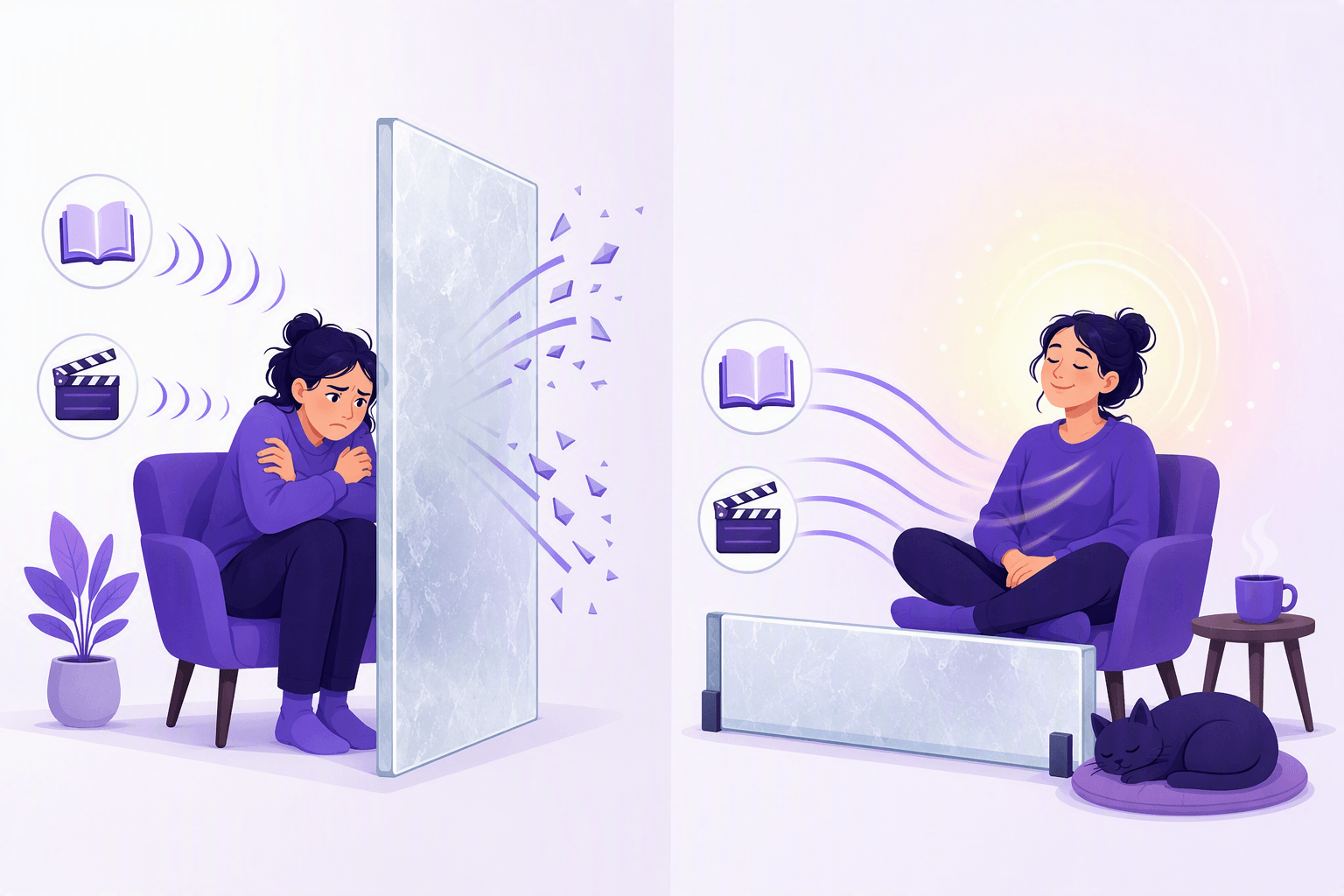
The quote above points at the third piece: the affective filter hypothesis. Anxiety, boredom, and low confidence act like a filter that blocks input from being processed, even when you understand it. A stressed learner in a classroom can hear plenty of comprehensible language and acquire little. This is one reason input you genuinely enjoy, a show you would watch anyway, a story you want to finish, tends to outperform worthy-but-dull textbook audio.
What critics say (and why it still matters)
Honest picture: the input hypothesis is enormously influential but not uncontested. Researchers have pointed out that i+1 is hard to define precisely enough to test, and that comprehension-only learners often develop strong listening while their speaking accuracy lags, which led Merrill Swain to argue that producing language ("output") plays its own role. Surveys of the field such as Lightbown and Spada's How Languages Are Learned (Oxford University Press) land on a moderate consensus: massive comprehensible input is necessary for acquisition, and interaction, output, and some explicit instruction make it work better, especially for adults.
For you as a learner, the takeaway survives the academic debate intact: the bulk of your time should go to understanding messages in the language, and everything else is a supplement.
What counts as comprehensible input: concrete examples
Three conditions make something comprehensible input for you specifically:
- You understand the message. Not every word, but what is actually being communicated.
- There is a small stretch. Some words or structures are new, and context lets you guess them.
- You are paying attention to meaning. You are following a story or a conversation, not analyzing sentences.
The same podcast can be perfect input for one learner, noise for a beginner, and pure comfort listening for an advanced learner. With that in mind, here are the standard sources and where they fit:
| Input source | Best for | Why it works | Watch out for |
|---|---|---|---|
| Graded readers | Beginner to intermediate (A1-B1) | Vocabulary is controlled to a set level, so you stay near 98% comprehension | Can feel bland; move up a level once it feels easy |
| Learner podcasts | Beginner to intermediate (A1-B2) | Slow, clear speech about everyday topics, often with transcripts | Staying too long at slow speeds delays real-speech listening |
| Kids' shows | High beginner (A2-B1) | Simple sentences, visual support, lots of repetition | Fantasy vocabulary and songs; not always as simple as they look |
| TV series with target-language subtitles | Intermediate (B1-B2) | Real dialogue plus a text safety net that keeps it comprehensible | Native-language subtitles turn listening practice into reading |
| Short movie/TV clips with replay | High beginner to advanced (A2-C1) | Short scenes can be repeated until real-speed speech becomes clear | One viewing is rarely enough; the replay is the method |
| Conversation with a patient speaker | All levels | The speaker adjusts to you in real time, the original comprehensible input | Hard to schedule enough hours of it |
Two research findings put numbers on the "you understand the message" condition. For reading, Hu and Nation found that learners needed to know about 98% of the words in a fiction text for most of them to read it comfortably without help; at 80% coverage, almost no one could follow it (Reading in a Foreign Language, 2000). For video, Webb and Rodgers analyzed hundreds of movies and found that reaching roughly 95% coverage of movie dialogue requires knowing about the 3,000 most frequent word families, plus proper nouns ('The Lexical Coverage of Movies', Applied Linguistics, 2009).
That is why "just watch native TV" fails for beginners: below a large core vocabulary, native media is i+10, not i+1. The fix is not to abandon media but to add support, easier material, subtitles, shorter segments, repetition, until it becomes comprehensible.

Comprehensible input vs. traditional grammar study
The two approaches are usually presented as rivals. A fairer comparison looks like this:
| Comprehensible input | Traditional grammar study | |
|---|---|---|
| What it builds | Listening, reading, vocabulary in context, a feel for what sounds natural | Explicit knowledge of rules, error awareness, test performance |
| Feels like | Watching, reading, listening to things you enjoy | Studying: exercises, tables, explanations |
| Weakness | Slow to produce accurate speaking on its own; progress is hard to see week to week | Knowing a rule does not mean you can apply it at conversation speed |
| Fails when | Input is too hard or attention drifts | It becomes the whole method instead of a supplement |
The evidence-based position is not "grammar is useless". Explicit instruction measurably helps, particularly for adults, because it speeds up noticing: once a pattern has been pointed out, you start registering it in your input, and each encounter then counts for more. What the input research undermines is the inverted classroom diet, 90% rule study and 10% actual language, which produces learners who can conjugate on paper but cannot order coffee.
A ratio that serves most self-learners well: spend most of your time with input you enjoy, keep a grammar reference for when a pattern keeps bothering you, and use spaced repetition to retain the vocabulary your input keeps serving you.
How to find your i+1 level
Nobody can compute i+1 for you, which is the standard academic complaint about the concept. But you can find it empirically in about two minutes.
The quick self-test
Take a page of text or a two-minute stretch of audio and check:
- Can you say what happened in your own words? If not, it is too hard, full stop.
- Roughly how many unknown words per minute or per page? A handful you can guess from context is ideal. If you would need a dictionary in every sentence, step down.
- Are you still following the story after five minutes, or has it dissolved into sound? Comprehension that collapses over time means the level is slightly too high or the support (subtitles, transcript) is too thin.
As a rough anchor from the coverage research: aim for material where you understand somewhere around 90-98% of the words. Below that band you are decoding, not acquiring.
Mapping input to CEFR levels
If you know your CEFR level, you can shortcut the search:
- A1-A2: graded readers at your level, beginner learner podcasts, teacher-talk videos with visuals, very short clips watched several times.
- B1: kids' and teen shows, intermediate learner podcasts at natural speed, sitcoms with target-language subtitles, easy novels you already know in translation.
- B2: contemporary series and films with target-language subtitles, native podcasts on familiar topics, regular novels in genres you like.
- C1 and up: anything, with subtitles off; the job now is volume and range (news, debate, regional accents, older films).
The single most useful habit is re-testing every few weeks. Learners routinely keep training wheels on long after they need them, slow podcasts at B2, native-language subtitles at B1, and that comfort quietly caps progress.

Comprehensible input with TV and movies
Film and television are, on paper, the best free source of real language: unlimited hours of native speakers talking to each other with emotion, context, and a plot that makes you want to keep understanding. The catch, per the coverage numbers above, is that raw native media is too hard for most learners below B1. Three levers close that gap:
- Subtitles in the target language. They anchor fast speech to spelling, so words you half-hear become words you recognize. They are a scaffold: the goal is to need them less over time, not to read them forever.
- Short segments instead of full episodes. A 3-minute scene you understand well beats 40 minutes of fog. Short segments also make the third lever possible.
- Repetition. The second and third pass over the same scene is where the magic is: the audio has not changed, but your perception has. Lines that were mush become words.
This combination, authentic clips, subtitles, and built-in replay, is exactly how Wordy is designed: it teaches with short clips from real movies and shows, so every clip is small enough to genuinely understand and rewatch, and the words you meet go into your review deck. If you would rather build the system yourself, our guide to learning a language with movies walks through the manual version, and the best movies to learn Spanish list is a good first shelf to pick from.
💡 The one-scene rule
If you take one thing from this section: stop measuring TV time in episodes. Pick one scene per day, watch it with target-language subtitles, rewatch it without, and say two or three of its lines out loud. Twenty minutes of that is more comprehensible input, in the technical sense, than two hours of half-understood background streaming.
Common mistakes with comprehensible input
Input that is not actually comprehensible. The number one failure mode. Podcasts for natives at A2, unsubtitled dramas at B1. If you cannot summarize what you just heard, it is not input, it is ambience. Step down without shame; easy volume beats hard confusion.
Passive exposure. Playing the language in the background while you work does almost nothing, because acquisition requires attention to meaning. Ten focused minutes outperform three distracted hours.
Native-language subtitles forever. They are fine for a first watch of something you would otherwise not follow at all, but they convert listening practice into reading your own language. Switch to target-language subtitles as early as you can survive it.
Endless novelty. A new video every day feels productive, but new content maximizes unknown words. Repetition of familiar material is what pushes vocabulary from "seen once" to "known". Keep one home-base show and revisit it.
Zero output for years. Some input-purist communities recommend long silent periods. A short one is harmless, but comprehension and speaking are partly separate skills, and speaking needs its own reps. Small, regular output, shadowing lines, voice messages, one conversation a week, keeps the gap from growing.
Grinding through anxiety. If a source stresses or bores you, the affective filter argument says you are getting less from it than the hours suggest. Enjoyment is not a luxury in this method; it is load-bearing.
How much input do you need?
Honest answer: a lot, nobody knows exactly how much, and it depends heavily on the language pair. Three real anchors, instead of an invented number:
- Cambridge English estimates roughly 180-200 guided learning hours per CEFR level, which puts a beginner-to-B2 journey around 500-600 guided hours, with self-study on top.
- The US Foreign Service Institute plans about 600-750 classroom hours for English speakers learning closely related languages (Spanish, French, Italian) and roughly 2,200 hours for distant ones (Japanese, Korean, Arabic, Mandarin). Those are intensive classroom hours; independent learners should read them as a floor for total engaged time, not a ceiling.
- Input-heavy self-learners commonly report reaching comfortable B2-ish comprehension of an easier language after on the order of 1,000-1,500 hours of engaged listening and reading. Treat that as community experience, not research.
Three caveats stop these numbers from misleading you. Hours of comprehensible input are what count, so a beginner's hour with a graded reader is worth more than an hour of incomprehensible news radio. Comprehension arrives before speaking, so "B2 understanding" and "B2 conversation" are different milestones. And distribution matters: an hour a day for two years beats occasional weekend binges, because regular exposure keeps words from decaying between meetings.
The encouraging arithmetic: one focused hour a day is about 365 hours a year. For a related language, that puts genuinely comfortable comprehension of shows and books two to three years out, and noticeable milestones, following a whole scene, reading a chapter without pain, arrive much earlier. Slow is fine. Incomprehensible is the only real failure state.
Where to start this week
Comprehensible input is not a product you buy, it is a filter you apply: is this mostly understandable, slightly stretching, and interesting enough that I will come back tomorrow? Start with three moves:
- Run the two-minute self-test on whatever you are currently using, and step down a level if you failed it.
- Pick one home-base show or reader and schedule 30-60 minutes of daily input around it.
- Add one weekly output habit, however small, so speaking grows alongside comprehension.
Then protect the habit for a few months. The theory has been argued over for four decades, but its core prediction is the most replicated experience in language learning: understand enough messages, and the language starts to stick.
Frequently Asked Questions
What is comprehensible input in simple terms?
What is i+1?
Is comprehensible input enough on its own?
Is watching TV comprehensible input?
How many hours of input do I need to reach B2?
Does comprehensible input work for complete beginners?
Sources & References
- Krashen, S., *Principles and Practice in Second Language Acquisition*, Pergamon Press, 1982
- Webb, S. & Rodgers, M.P.H., 'The Lexical Coverage of Movies', Applied Linguistics, 2009
- Hu, M. & Nation, P., 'Unknown Vocabulary Density and Reading Comprehension', Reading in a Foreign Language, 2000
- Lightbown, P. & Spada, N., *How Languages Are Learned*, Oxford University Press
- U.S. Department of State, Foreign Service Institute, foreign language training categories
- Cambridge English, guided learning hours and CEFR level guidance
Start learning with Wordy
Watch real movie clips and build your vocabulary as you go. Free to download.


