Immersion Method Language Learning: A Realistic Guide to Getting Fluent Faster
Quick Answer
The immersion method is learning a language by spending lots of time with real input, movies, TV, podcasts, conversations, and reading, so your brain learns patterns the way native speakers use them. It works best when you combine high-volume listening with subtitles you can control, repeatable scenes, and a small daily speaking habit, instead of relying on passive background exposure.
The immersion method for language learning works by flooding your day with real, meaningful input, movies, TV, podcasts, reading, and conversation, then using repetition and small feedback loops so your brain starts predicting the language automatically. Done well, immersion is not “just watch Netflix”, it is high-volume exposure plus deliberate noticing, replay, and gradual removal of support like subtitles.
Immersion is especially popular for English because it is everywhere. Ethnologue estimates roughly 1.5 billion English speakers worldwide (including L2 speakers), and English has official or de facto institutional roles in dozens of countries (Ethnologue, 27th edition, 2024). That global footprint means you can build an immersion environment almost anywhere.
If you want a media-first path, start with our picks for the best movies to learn English, then use the method below to turn entertainment into repeatable listening practice.
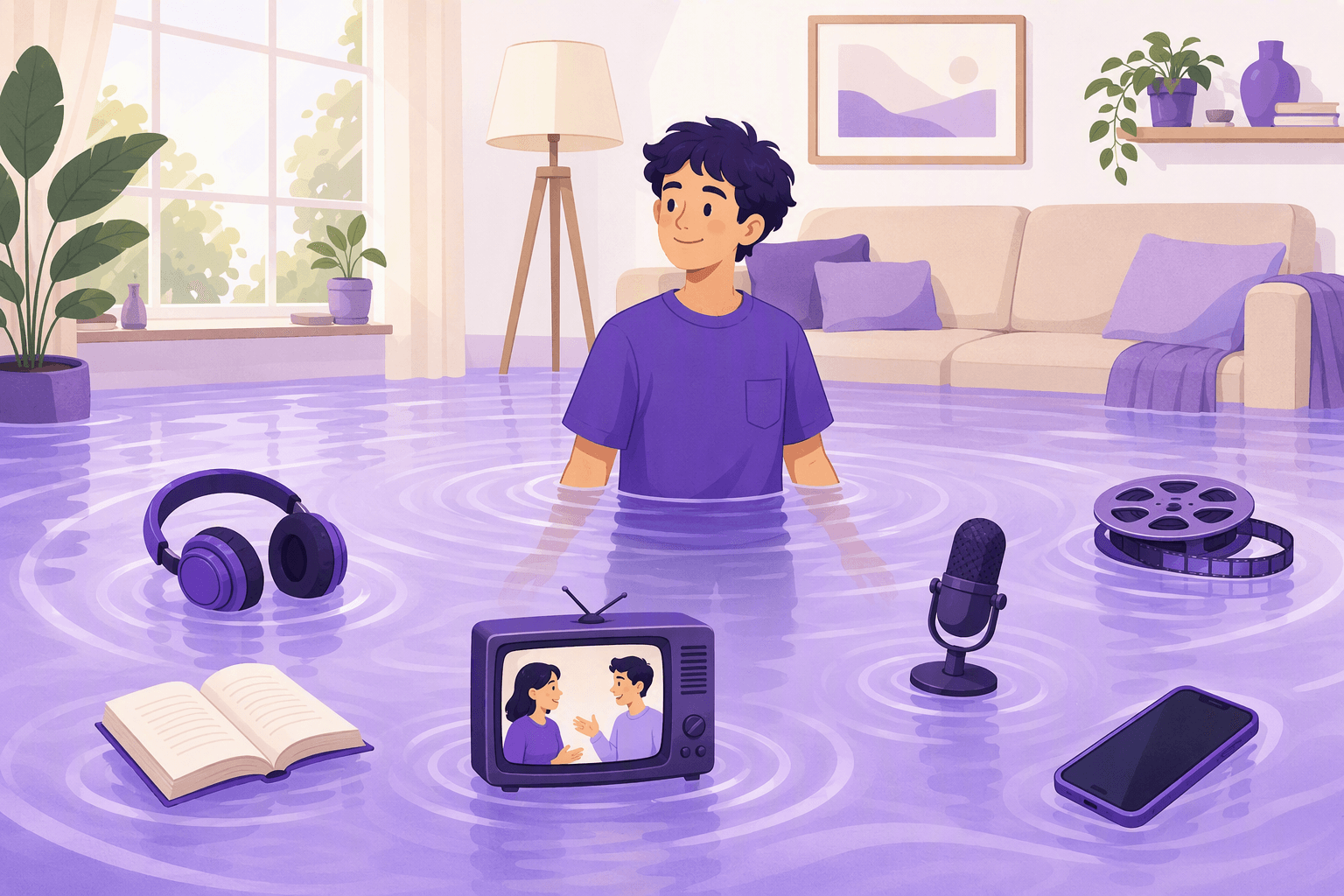
What the immersion method actually is (and what it is not)
Immersion means spending a large amount of time with the language as it is used by native speakers and fluent speakers, in context, with real goals like understanding a scene, following a story, or replying in a chat. The “method” part is how you choose content, how you repeat it, and how you track what you are learning.
It is not passive background noise. If the language is always on but you never try to understand, your brain has little reason to build strong sound-meaning links.
It is also not “no study allowed”. Many successful immersion learners use targeted study as support, especially early on, to make input more understandable.
Why immersion works (the science in plain English)
Stephen Krashen’s work on comprehensible input argues that acquisition happens when learners understand messages in the target language, with a small stretch beyond their current level (Krashen, The Input Hypothesis: Issues and Implications, Longman). In practice, that means you need input you can mostly follow, not input that is pure noise.
Immersion also aligns with what psycholinguists call frequency effects: the more often you meet a word or pattern, the faster it becomes automatic. You do not memorize “rules” so much as you build expectations.
A third piece is phonological tuning: your brain gets better at hearing sound categories and word boundaries. This is why repeated listening to the same scene can feel like magic, the audio did not change, your perception did.
The biggest myth: “Move abroad and you will become fluent”
Living in-country can help, but it is not a guarantee. Many people live abroad and still spend most of their day in their native language, especially if they work in an international office or socialize with expats.
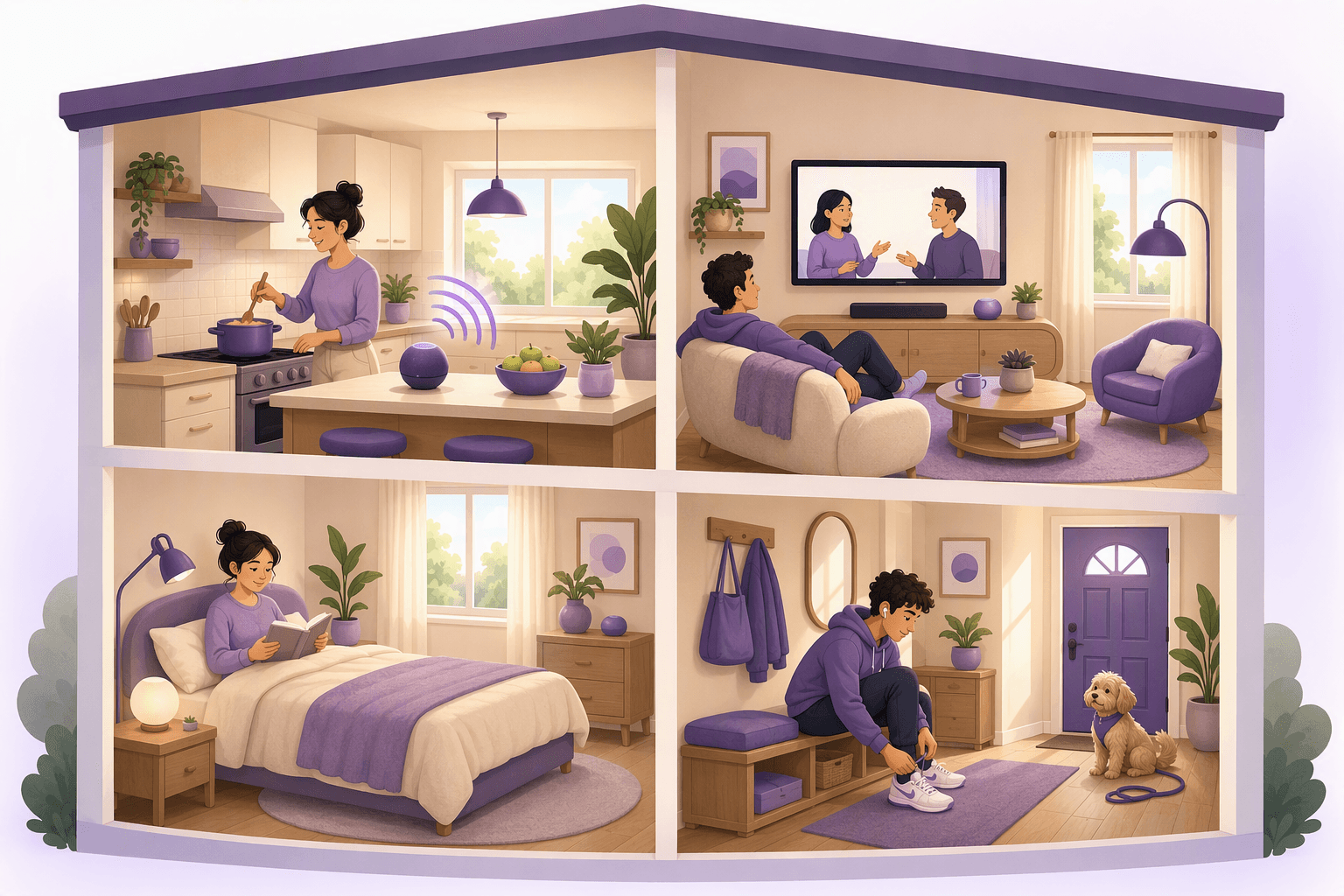
Immersion is about hours of meaningful contact, not geography. You can create “micro-immersion” at home by controlling your media, your phone, your reading, and your speaking schedule.
🌍 Why English immersion is unusually accessible
English is a global default in entertainment, tech, and education, which makes at-home immersion easier than for many languages. The British Council has documented English’s role as a dominant international language in education and opportunity, which is why English media and online communities are so easy to find (British Council, 'The English Effect' report, accessed 2026).
How much immersion do you need to see results?
Most learners notice measurable listening gains with 5 to 10 focused hours per week, especially if they repeat content. If you can do 60 to 90 minutes a day, you can build momentum without burning out.
The key variable is not just time, it is how understandable the input is. Two hours of content where you understand 80% will usually beat five hours where you understand 10%.
A practical “understandability” test
Use a 5-minute clip and ask:
- Can you summarize what happened in your own words?
- Can you catch the main verbs and who did what?
- Do you recognize at least some repeated phrases?
If the answer is “no” to all three, the clip is too hard right now. Switch to easier content, or add support like target-language subtitles and a transcript.
Choosing the right immersion materials (movies, TV, podcasts, reading)
Not all “native content” is equal for learning. You want language that is frequent, clear enough, and relevant to your life.
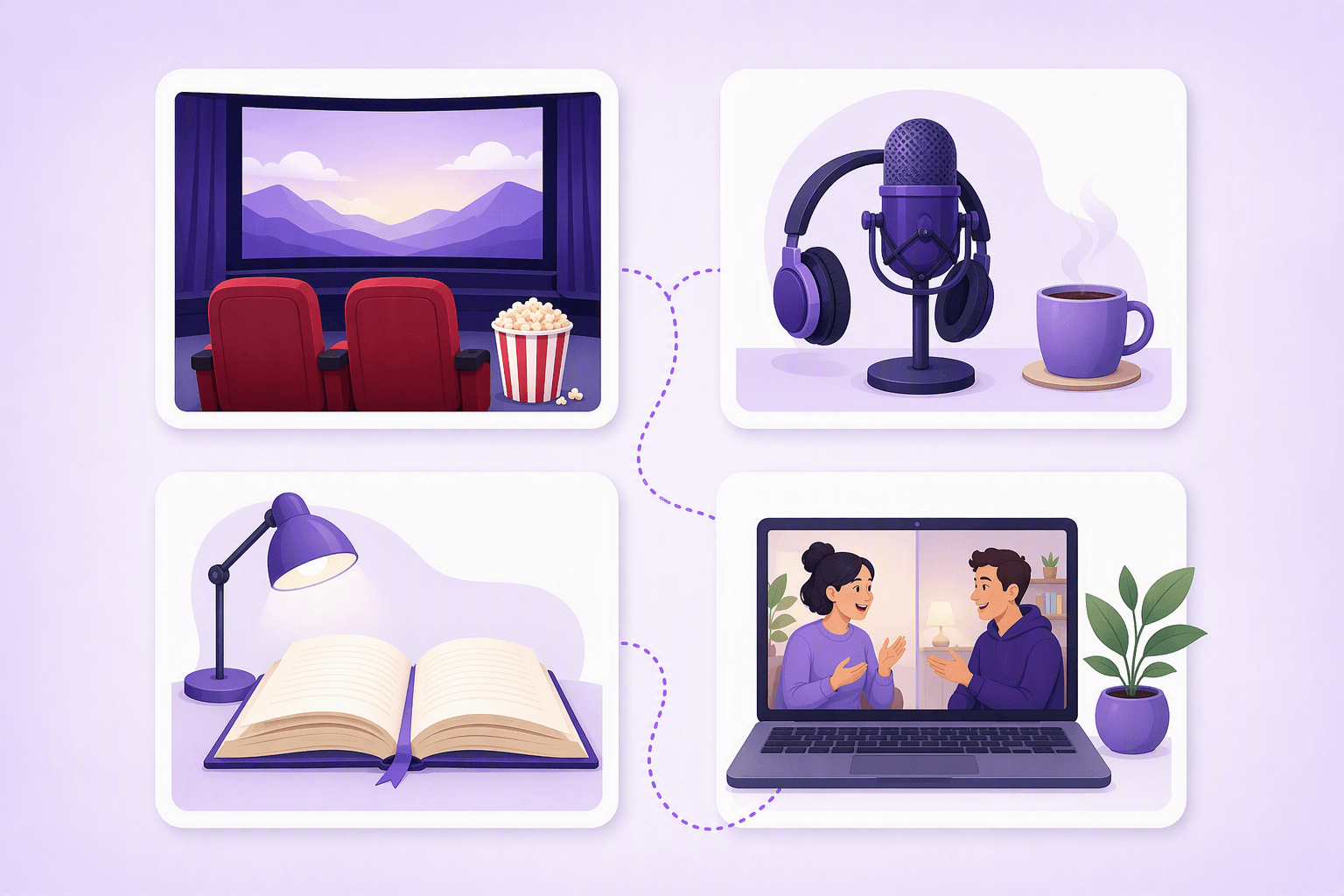
Movies and TV: best for repeatable, emotional memory
Movies are dense with everyday vocabulary, but they vary by genre. Research on lexical coverage suggests that films can provide rich exposure, yet learners still need high coverage to follow comfortably, which is why replay and support matter (Webb & Rodgers, “The Lexical Coverage of Movies”, Applied Linguistics).
Pick content with:
- Lots of dialogue, not constant action
- Contemporary settings (more everyday speech)
- Characters who speak clearly, at least at first
If you need a starting point, use the best movies to learn English list, then commit to repeating the same 10 to 20 minutes for a week.
Podcasts and YouTube: best for volume and routines
Podcasts are easier to fit into daily life. The downside is that they can become background noise.
Make them “active” by:
- Listening to the same episode twice
- Taking 5 phrases and saying them out loud
- Writing a 3-sentence summary
Reading: the fastest way to grow vocabulary breadth
Reading gives you more unique words per hour than most listening. It also shows spelling, which helps you search and review.
Start with graded readers or simple news, then move to novels, scripts, and long-form articles. If you already watch shows, reading episode recaps can bridge listening and reading.
Social immersion: where fluency becomes real
Immersion without interaction can build strong comprehension but weak speaking confidence. Add low-pressure interaction early:
- Voice notes with a language partner
- Short tutoring sessions
- Online communities around a hobby
If you are learning English, you will quickly run into informal language. Pair your immersion with a guide to English slang so you do not misread tone.
The “three-layer” immersion system (Input, Replay, Output)
Most immersion plans fail because they only do Layer 1.
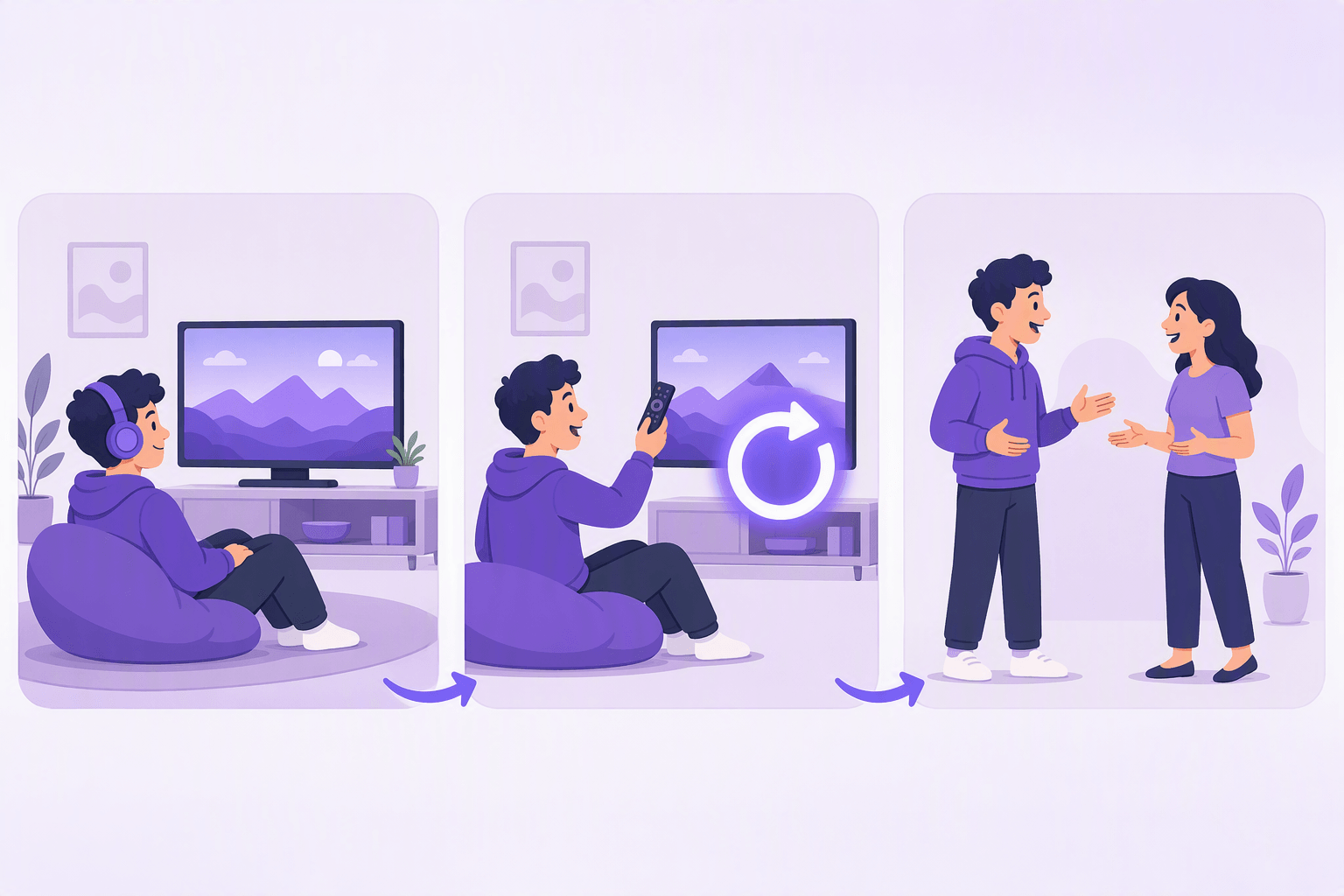
Layer 1: Input (new content)
This is your main exposure. Choose content you enjoy enough to stick with.
Aim for:
- 30 to 60 minutes per day
- Mostly understandable, with support if needed
Layer 2: Replay (the secret weapon)
Replay is where your brain stops guessing and starts hearing.
A simple replay loop:
- Watch a 2 to 4 minute scene with target subtitles.
- Watch again, pausing to repeat lines.
- Watch again without subtitles.
- The next day, do one more replay.
This is also where you build pronunciation. You are not trying to sound perfect, you are training timing, stress, and linking.
Layer 3: Output (small, frequent speaking)
Output does not need to be long. It needs to be consistent.
Try:
- 2 minutes of shadowing (repeat right after the actor)
- 5 sentences about your day
- One short conversation per week
Merrill Swain’s work on the output hypothesis is often discussed in language education because producing language can push you to notice gaps in what you can say versus what you can understand. You do not need to “speak from day one” aggressively, but you do need some output to become conversational.
Subtitles: the right way to use them
Subtitles can either support listening or replace it.
Target-language subtitles (English subtitles for English learning)
These help you connect sound to spelling, which is essential in English because spelling is not fully phonetic. They are also useful for fast speech where word boundaries are hard to hear.
A strong pattern is “subtitles first, then remove”.
Native-language subtitles (your language)
These often reduce listening effort. If you use them, use them only on the first watch to understand the plot, then switch to target subtitles for rewatching.
💡 A simple subtitle rule
If you are reading more than you are listening, subtitles are too strong. Reduce support by switching to target subtitles, then rewatching short scenes without any subtitles.
What to do when immersion feels like you are not learning
This is the most common experience in weeks 1 to 3. Your brain is adapting, but progress is hidden.
Use three measurable signals:
- You understand more on the second listen than the first
- You recognize recurring phrases across different scenes
- You can predict the next word sometimes
If you have none of these, your input is likely too hard, or you are not replaying.
A 30-day immersion plan you can actually follow
This plan assumes you are learning English, but the structure works for any language.
Week 1: Build the habit and pick “your show”
- Choose one series or movie you can tolerate repeating.
- Do 30 minutes of input daily.
- Do 10 minutes of replay on a 2 to 4 minute scene.
Your goal is not variety. Your goal is familiarity.
Week 2: Start collecting “high-frequency lines”
Pick 5 lines you hear often and make them yours. Examples:
- “Are you serious?”
- “I’m not sure.”
- “That makes sense.”
Say them out loud, copy the stress, and use them in a message.
If numbers trip you up in fast speech, add a focused review of English numbers and then listen for them in the wild (prices, times, dates).
Week 3: Add one social commitment
Choose one:
- 30-minute tutoring session
- 30-minute language exchange
- 10 voice notes across the week
Keep it small. Consistency beats intensity.
Week 4: Reduce support and increase speed
- Rewatch scenes without subtitles.
- Increase replay difficulty by choosing a faster scene.
- Do 5 minutes of “shadowing while walking” to train rhythm.
At the end of 30 days, you should have:
- One show you can understand far better than day 1
- A set of phrases you can say automatically
- A clearer ear for stress and linking
How immersion changes what “correct English” means
Immersion teaches you register, not just grammar. You start hearing that “correct” depends on context.
In English, you will hear:
- Formal workplace English
- Casual friend English
- Internet English
- Regional accents and slang
This matters because some phrases are socially risky. If your immersion includes edgy comedy or aggressive characters, you will pick up language that can backfire.
If you are curious, read our guide to English swear words, not to use them more, but to recognize them and understand severity and context.
🌍 A real cultural trap: copying the 'cool' character
Many learners imitate the most charismatic character in a show. In English-language media, that character is often sarcastic, blunt, or profane. Native speakers can tell when a non-native speaker uses those styles without the softeners that usually come with them, like tone, timing, or relationship history. Build a neutral baseline first, then add style.
Common immersion mistakes (and the fixes)
Mistake 1: Too hard, too soon
If you start with fast, slang-heavy shows, you will stall.
Fix: choose clearer dialogue, use target subtitles, and replay short scenes. Add harder content later.
Mistake 2: Endless novelty
New content feels productive, but it prevents deep learning.
Fix: keep one “home base” show for repetition, and one “fun” show for variety.
Mistake 3: No feedback loop
If you never check what you misheard, errors fossilize.
Fix: use transcripts, subtitle rewind, or a tutor to confirm what was said.
Mistake 4: Ignoring pronunciation and rhythm
English clarity depends heavily on stress and reductions, not just individual sounds. David Abercrombie’s classic work in phonetics is often cited for emphasizing rhythm and stress as central to English speech perception.
Fix: shadow short lines, focus on stressed words, and accept reductions like “gonna” in casual speech.
How to make immersion work with a language learning app
Apps help when they reduce friction: quick review, spaced repetition, and easy replay.
A practical combo is:
- Immersion for listening and intuition
- A small daily review system for vocabulary you actually heard
- Occasional grammar reference when a pattern keeps showing up
If you want a broader view of tools, compare approaches in 10 best language learning apps in 2026. If you are already using AI for practice, see ChatGPT for language learning for what it is good at and where it can mislead you.
A simple way to track progress without over-testing
Testing can kill motivation. Tracking can support it.
Use a weekly check-in:
- Pick one 2-minute scene.
- Listen without subtitles.
- Write what you understood.
- Compare to the transcript.
Your score is not “percent perfect”. Your score is “did I understand more than last week?”
Final take: the immersion method is volume plus intention
Immersion works when you make input understandable, repeat it enough to hear details, and add small output so you can use what you learn. You do not need to live abroad, and you do not need to study eight hours a day, but you do need a system that turns entertainment into practice.
If you want an easy place to start, choose one title from the best movies to learn English list, then commit to 30 days of replay-based immersion and one weekly conversation.
Frequently Asked Questions
Does the immersion method work for adults?
How many hours of immersion do I need per day?
Is watching TV with subtitles real immersion?
What is the difference between immersion and studying grammar?
Can I do immersion if I live outside the country?
Sources & References
- Krashen, S., *The Input Hypothesis: Issues and Implications*, Longman
- Webb, S. & Rodgers, M.P.H., 'The Lexical Coverage of Movies', Applied Linguistics
- Ethnologue, 27th edition, 2024
- British Council, 'The English Effect' report, accessed 2026
- OECD, Education at a Glance, accessed 2026
Start learning with Wordy
Watch real movie clips and build your vocabulary as you go. Free to download.


