Quick Answer
The single most useful Korean travel phrase is '이거 주세요' (igeo juseyo): 'This one, please.' Point at anything and say it. Beyond that, '감사합니다' (gamsahamnida, thank you), '실례합니다' (sillyehamnida, excuse me), and '카드 돼요?' (kadeu dwaeyo?, can I pay by card?) will get you through 90% of daily travel situations in South Korea.
Why Learn Korean Travel Phrases?
The single most useful Korean travel phrase is 이거 주세요 (igeo juseyo): "This one, please." Point at a menu, a market stall item, or a store display, say those four syllables, and you are covered. But a handful of additional phrases will transform your trip from tourist-functional to genuinely immersive.
South Korea welcomed over 17.5 million international visitors in 2024, according to the Korea Tourism Organization (KTO), making it one of Asia's fastest-growing travel destinations. Korean is spoken by approximately 77 million people worldwide, and the Hallyu wave (K-dramas, K-pop, Korean cinema) has turned Seoul, Busan, and Jeju into bucket-list destinations for millions. Yet despite Korea's global cultural reach, surprisingly few travel guides teach visitors the practical phrases that actually matter on the ground.
"Language is not simply a tool for communication; it is the key to understanding a culture's values, social hierarchies, and daily rituals. In Korea, even a tourist's attempt at the local language signals respect for those deeply held values."
(Claire Kramsch, Language and Culture, Oxford University Press, 1998)
This guide covers 50+ essential Korean travel phrases organized by real travel situations: getting around, hotels, restaurants, shopping, and emergencies. Every phrase includes Hangul, romanization, pronunciation, and cultural context so you know not just what to say, but when and how.
All phrases in this guide use polite speech (존댓말, jondaenmal) with the -요 (yo) ending, the safe default for every interaction with strangers in Korea. For a deeper dive into Korean greetings or polite expressions, check our dedicated guides.
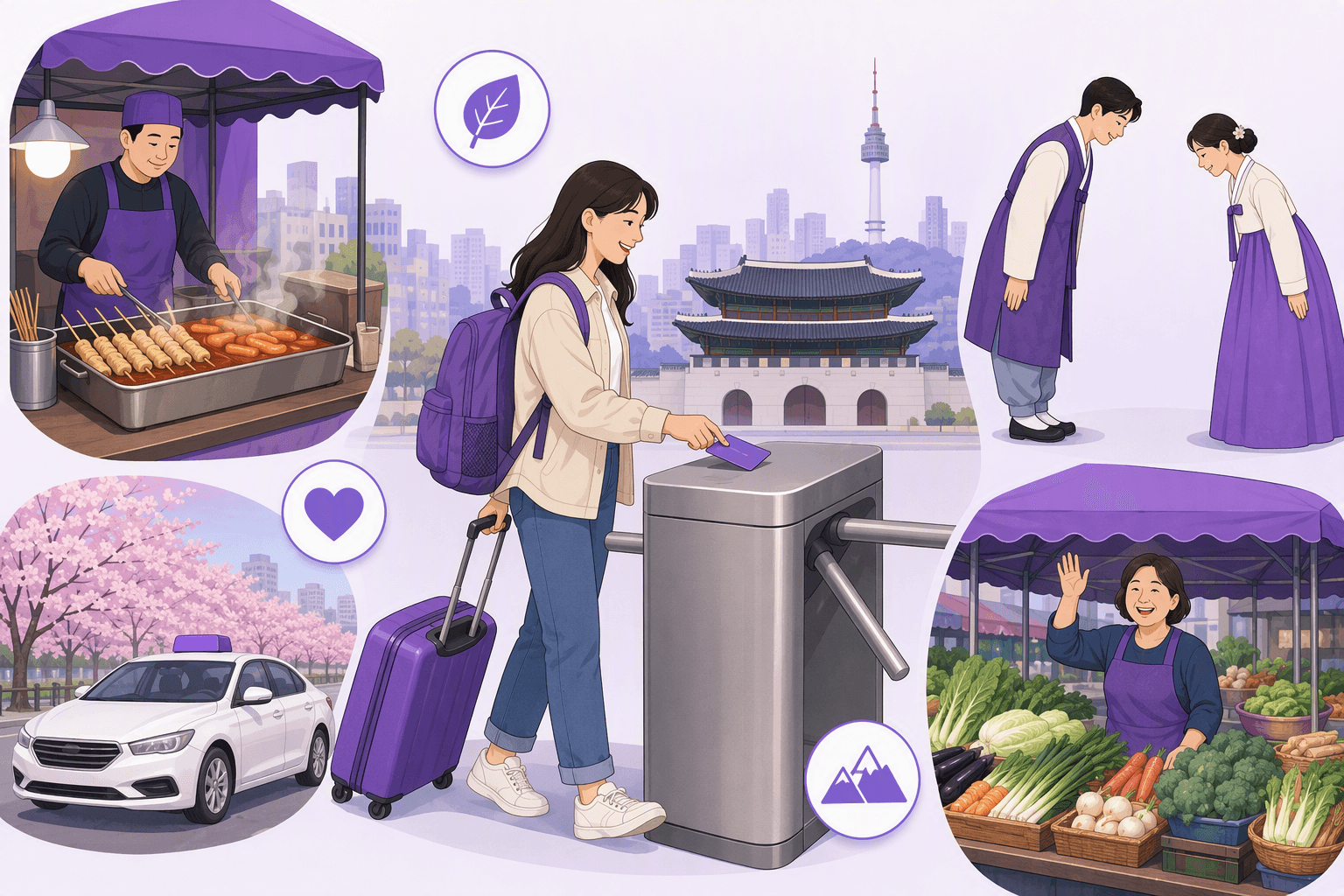
Quick Reference: Top 10 Korean Travel Phrases
| English | Korean | Pronunciation | Formality |
|---|---|---|---|
| Thank you | 감사합니다 | Gam-sa-ham-ni-da | formal |
| Excuse me | 실례합니다 | Shil-lye-ham-ni-da | formal |
| This one, please | 이거 주세요 | I-geo ju-se-yo | polite |
| How much is this? | 이거 얼마예요? | I-geo eol-ma-ye-yo | polite |
| Where is the bathroom? | 화장실 어디예요? | Hwa-jang-shil eo-di-ye-yo | polite |
| Can I pay by card? | 카드 돼요? | Ka-deu dwae-yo | polite |
| Hello | 안녕하세요 | An-nyeong-ha-se-yo | polite |
| Please help me | 도와주세요 | Do-wa-ju-se-yo | polite |
| I'm sorry | 죄송합니다 | Jwe-song-ham-ni-da | formal |
| It's delicious | 맛있어요 | Ma-shi-sseo-yo | polite |
Getting Around
Navigating Seoul's world-class subway system, taking taxis, and asking for directions are among the first things you will do. These phrases cover your transportation essentials.
실례합니다
/Shil-lye-ham-ni-da/
Literal meaning: I am being rude (please excuse me)
“실례합니다, 명동역이 어디예요?”
Excuse me, where is Myeongdong Station?
The go-to phrase for getting a stranger's attention. More formal than '저기요' (jeogiyo) and always safe to use with anyone, taxi drivers, subway workers, passersby.
This is your conversation starter in Korea. Before asking any question, directions, the time, help with anything, lead with 실례합니다. It signals politeness and gives the other person a moment to focus their attention on you. Pair it with a slight bow of the head. A more casual alternative is "저기요" (jeogiyo, literally "over there"), which you will hear Koreans use to get a waiter's attention, but 실례합니다 is always the safer choice with strangers.
여기가 어디예요?
/Yeo-gi-ga eo-di-ye-yo/
Literal meaning: Where is this place?
“실례합니다, 여기가 어디예요? 길을 잃었어요.”
Excuse me, where is this place? I'm lost.
Show your map or phone screen while asking. Koreans are remarkably helpful, many will walk you to your destination rather than just point.
When you are lost, hold up your phone showing the map and say this phrase. According to the Lonely Planet Korean Phrasebook, pairing a question with a visual reference is the most effective communication strategy for tourists with limited Korean.
표가 얼마예요?
/Pyo-ga eol-ma-ye-yo/
Literal meaning: How much is the ticket?
“서울역까지 표가 얼마예요?”
How much is a ticket to Seoul Station?
Used at subway ticket machines, bus terminals, and train stations. For the KTX (high-speed rail), buying online in advance is usually cheaper.
In practice, most Seoul subway stations have English-language touch screens, but smaller cities and intercity bus terminals often do not. This phrase is especially useful at local bus stops and regional train stations outside of Seoul. The KTX (Korea Train Express) connects Seoul to Busan in just 2.5 hours (for booking, "서울에서 부산까지 주세요" (Seoul-eseo Busan-kkaji juseyo) Seoul to Busan, please) is all you need at the counter.
💡 Get a T-money Card Immediately
Your first purchase in Korea should be a T-money card (₩2,500-4,000 at any convenience store or subway station). It works on all buses, subways, and most taxis across the country. You save ₩100 per ride compared to cash, transfers between bus and subway are discounted, and you never need exact change. Recharge it at any convenience store by saying "충전해 주세요" (chungjeonhae juseyo, please recharge this).
여기에서 세워 주세요
/Yeo-gi-e-seo se-wo ju-se-yo/
Literal meaning: Please stop here
“기사님, 여기에서 세워 주세요.”
Driver, please stop here.
Essential for taxis. Korean taxis use meters, so no need to negotiate. Address the driver as '기사님' (gisanim, honorable driver) for extra politeness.
Korean taxis are safe, metered, and relatively affordable. Most accept T-money cards and credit cards. When you need to stop, point to the spot and say this phrase. The driver will pull over at the nearest safe location. Tip: if your destination is hard to explain verbally, show the address on your phone, many tourists use Naver Map or KakaoMap, which are far more accurate in Korea than Google Maps.
At the Hotel
From check-in to requesting amenities, these phrases keep your accommodation experience smooth.
예약했어요
/Ye-yak-hae-sseo-yo/
Literal meaning: I made a reservation
“안녕하세요, 예약했어요. 이름은 [your name]이에요.”
Hello, I have a reservation. My name is [your name].
Most hotel staff in Seoul speak basic English, but at guesthouses (게스트하우스), hanok stays (한옥), and rural accommodations, Korean is often essential.
Show your booking confirmation on your phone as backup. Korean accommodation ranges from international hotel chains to traditional hanok guesthouses and the uniquely Korean jimjilbang (찜질방, Korean bathhouse-spa), each offering a very different cultural experience. Another useful check-in phrase: "와이파이 비밀번호가 뭐예요?" (waipai bimilbeonhoga mwoyeyo?, what is the Wi-Fi password?), essential for staying connected.
방 있어요?
/Bang i-sseo-yo/
Literal meaning: Is there a room?
“오늘 밤에 방 있어요?”
Do you have a room for tonight?
Useful for walk-in stays, especially at motels (모텔) and guesthouses. Korea has a vast network of budget motels with surprisingly high quality, often bookable same-day.
Walk-in availability is common at Korean motels and guesthouses, particularly outside peak seasons (cherry blossom season in April and autumn foliage in October-November).
열쇠 주세요
/Yeol-soe ju-se-yo/
Literal meaning: Please give me the key
“열쇠를 방에 놓고 왔어요. 열쇠 주세요.”
I left the key in the room. Please give me the key.
Many modern Korean hotels use digital keypad locks or card keys. But guesthouses and traditional stays often still use physical keys.
If your accommodation uses a keypad, the front desk will give you a code. Ask "비밀번호가 뭐예요?" (bimilbeonhoga mwoyeyo?, what is the passcode?) if you need it repeated.
Ordering Food
Korean cuisine is one of the top reasons people visit. These phrases will help you navigate everything from street food stalls to BBQ restaurants.
이거 주세요
/I-geo ju-se-yo/
Literal meaning: This one, please give me
“저기요, 이거 주세요. 두 개요.”
Excuse me, this one please. Two of them.
The most versatile travel phrase in Korean. Point at anything (a menu item, a food display, a market sample) and say it. Works in every food situation from Michelin-starred restaurants to pojangmacha (포장마차, street food tents).
This is the phrase that will feed you across Korea. Many Korean restaurants have picture menus, food displays in the window, or tablet ordering systems. Point and say 이거 주세요, mission accomplished. To specify quantity, add the number with the Korean counter: "두 개요" (du gaeyo, two, please) or "세 개요" (se gaeyo, three, please). For drinks, use "잔" (jan): "맥주 두 잔 주세요" (maekju du jan juseyo, two beers, please).
추천해 주세요
/Chu-cheon-hae ju-se-yo/
Literal meaning: Please recommend (for me)
“여기 뭐가 맛있어요? 추천해 주세요.”
What's good here? Please recommend something.
Koreans love recommending their favorites. Restaurant owners take genuine pride in their signature dishes. This phrase often gets you the best item on the menu, and sometimes a personal story about why it is special.
Asking for a recommendation at a Korean restaurant is a sign of respect for the owner's expertise. Do not be surprised if the response comes with extra banchan (반찬, side dishes) or a larger portion.
계산해 주세요
/Gye-san-hae ju-se-yo/
Literal meaning: Please calculate (the bill)
“다 먹었어요. 계산해 주세요.”
We've finished eating. The check, please.
In Korea, you typically pay at the counter near the exit, not at your table. Tipping is NOT customary and can even cause confusion. The price on the menu is the final price.
One of the biggest cultural differences for Western travelers: Korea has no tipping culture. The National Institute of Korean Language notes that the concept of a separate tip is foreign to Korean service norms, good service is simply considered part of the job. Leaving money on the table may result in staff chasing you down to return it.
알레르기가 있어요
/Al-le-reu-gi-ga i-sseo-yo/
Literal meaning: I have an allergy
“견과류 알레르기가 있어요.”
I have a nut allergy.
Critical for travelers with food allergies. Common allergens to know: 견과류 (gyeongwaryu, nuts), 해산물 (haesanmul, seafood), 우유 (uyu, milk), 밀가루 (milgaru, wheat/gluten).
Korean cuisine relies heavily on soy sauce, sesame, shellfish-based broths, and fermented pastes. If you have allergies, consider carrying a written card in Korean listing your specific allergens, many travelers report this as the single most useful travel preparation. For vegetarian or vegan travelers, "고기 빼 주세요" (gogi ppae juseyo, please remove the meat) and "채식주의자예요" (chaesikjuuijayeyo. I'm vegetarian) are essential, as many Korean dishes include meat or seafood by default.
맛있어요!
/Ma-shi-sseo-yo/
Literal meaning: It is delicious!
“이 김치찌개 정말 맛있어요!”
This kimchi jjigae is really delicious!
Say this after your meal and watch the restaurant owner's face light up. It is the single fastest way to earn goodwill, and sometimes free dessert or extra banchan on your next visit.
This is your magic word at every Korean meal. Complimenting the food is deeply meaningful in a culture where cooking is considered an expression of care. The King Sejong Institute Foundation lists 맛있어요 among the top five phrases international students learn first, for good reason.
🌍 Korean BBQ Etiquette
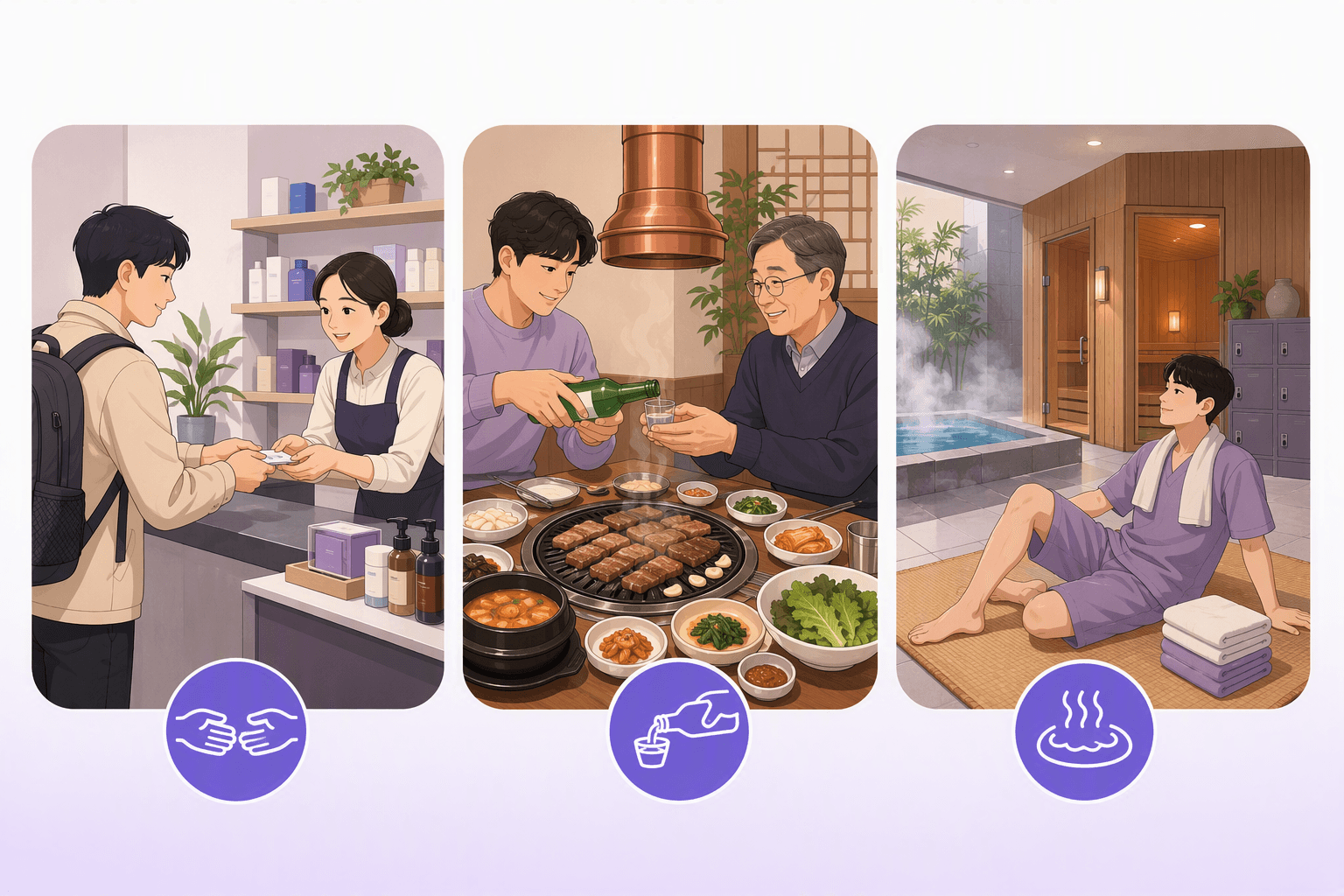
At Korean BBQ restaurants, never pour your own drink. The youngest person at the table pours for elders, holding the bottle with two hands or with the left hand supporting the right forearm. When an elder pours for you, receive the glass with two hands. These small gestures matter deeply in Korean dining culture.
Shopping
From Myeongdong to Namdaemun Market to Gangnam boutiques, these phrases cover your retail needs.
이거 얼마예요?
/I-geo eol-ma-ye-yo/
Literal meaning: How much is this?
“실례합니다, 이거 얼마예요?”
Excuse me, how much is this?
The essential shopping phrase. At traditional markets like Namdaemun and Dongdaemun, prices are often not displayed. At department stores and chain shops, prices are fixed and clearly tagged.
At traditional markets, bargaining is acceptable but not aggressive, a polite "좀 깎아 주세요" (jom kkakka juseyo, please give me a little discount) is the standard approach. At department stores and modern retailers, prices are non-negotiable. For tax-free shopping (applicable to purchases over ₩30,000 at participating stores), ask "세금 환급 돼요?" (segeum hwangeum dwaeyo?, can I get a tax refund?).
더 싼 거 있어요?
/Deo ssan geo i-sseo-yo/
Literal meaning: Is there something cheaper?
“이거 좋은데, 더 싼 거 있어요?”
This is nice, but is there something cheaper?
Perfectly acceptable at traditional markets and small shops. Not appropriate at department stores or convenience stores. Korean market vendors often have multiple price tiers and will happily show alternatives.
Korean markets operate on relationships. If you visit the same stall more than once, vendors remember you and often offer better prices or throw in extras. The Lonely Planet Korean Phrasebook notes that repeat visits are the best "bargaining strategy" in Korean markets.
카드 돼요?
/Ka-deu dwae-yo/
Literal meaning: Card, is it okay?
“카드 돼요? 비자카드요.”
Can I pay by card? It's a Visa.
South Korea has the highest credit card usage rate in the world, over 70% of all transactions are cashless. Most places accept international Visa and Mastercard. Even many street food vendors have card terminals.
Korea's cashless infrastructure is among the most advanced globally. According to the Bank of Korea, credit card transactions exceeded 70% of total consumer spending in 2024. Still, a few traditional market vendors and very small local restaurants are cash-only, so carrying ₩20,000-50,000 as backup is wise.
Emergencies
Hopefully you will never need these, but having them ready provides peace of mind.
살려 주세요!
/Sal-lyeo ju-se-yo/
Literal meaning: Please save me!
“살려 주세요! 도와주세요!”
Help me! Please help!
Use only in genuine emergencies. For less urgent help, use '도와주세요' (dowajuseyo, please help me). Korea's emergency number is 119 (fire/ambulance) and 112 (police).
Korea is one of the safest countries in Asia for tourists, but knowing emergency phrases provides essential security. The 1330 Korea Travel Hotline offers 24/7 multilingual tourist assistance, including English, Chinese, and Japanese.
의사가 필요해요
/Ui-sa-ga pi-ryo-hae-yo/
Literal meaning: I need a doctor
“아파요. 의사가 필요해요.”
I'm sick. I need a doctor.
Major hospitals in Seoul (Severance, Samsung Medical Center, Asan) have international clinics with English-speaking staff. For minor issues, pharmacies (약국, yakguk) are everywhere and pharmacists can recommend over-the-counter medication.
Korean pharmacies are well-stocked and pharmacists are trained medical professionals who can assess symptoms and recommend treatment. For common travel ailments (stomach issues, colds, headaches) a pharmacy visit is often faster and more practical than a hospital.
경찰을 불러 주세요
/Gyeong-chal-eul bul-leo ju-se-yo/
Literal meaning: Please call the police
“도둑이야! 경찰을 불러 주세요!”
Thief! Please call the police!
Dial 112 for police. Korean police are generally helpful with tourists, and many stations in tourist areas have officers who speak basic English. Tourist Police (관광경찰) patrol popular areas like Myeongdong and Itaewon.
South Korea has a dedicated Tourist Police force (관광경찰) stationed in major tourist districts. They wear distinctive uniforms, speak multiple languages, and specialize in helping foreign visitors with everything from lost items to navigation assistance. Save these numbers in your phone before traveling: 112 (police), 119 (fire/ambulance), and 1330 (24-hour Korea Travel Hotline with English support).
Useful Everyday Phrases
A few extra phrases that come up constantly during travel.
화장실 어디예요?
/Hwa-jang-shil eo-di-ye-yo/
Literal meaning: Where is the bathroom?
“실례합니다, 화장실 어디예요?”
Excuse me, where is the bathroom?
Korean public restrooms are clean, free, and abundant, subway stations, parks, convenience stores. Many have heated seats and bidets. Look for the signs 남 (nam, men) and 여 (yeo, women).
Korea's public restrooms are consistently ranked among the cleanest in Asia. Most subway stations have well-maintained facilities, and convenience stores (편의점) almost always have customer restrooms available.
네 / 아니요
/Ne / A-ni-yo/
Literal meaning: Yes / No
“물 더 드릴까요? (네, 감사합니다.”
Would you like more water?) Yes, thank you.
네 (ne) is polite 'yes,' while 예 (ye) is slightly more formal. Both work in all travel situations. 아니요 (aniyo) is polite 'no.' In very casual situations, Koreans shorten 아니요 to 아뇨 (anyo).
A key nuance: 네 in Korean also functions as a filler word meaning "I'm listening" or "I understand." Koreans say 네 repeatedly during phone calls, it does not always mean "yes" in the affirmative sense. Context matters. Two other everyday phrases worth memorizing: "괜찮아요" (gwaenchanhayo, it's okay / I'm fine) and "몰라요" (mollayo. I don't know). Both come up constantly in travel situations, whether declining a street vendor or admitting you are lost.
🌍 The Two-Handed Rule
Always give and receive things (money, credit cards, business cards, gifts) with two hands, or with your right hand supported by your left hand on the forearm. This applies to every exchange: paying at a store, receiving change, handing your passport to hotel staff. It is considered one of the most fundamental gestures of respect in Korean culture, and doing it correctly immediately signals cultural awareness.
Cultural Tips for Korea
🌍 Jimjilbang (찜질방). Korean Bathhouse Culture
A jimjilbang is a Korean public bathhouse and sauna, open 24 hours, and one of the most uniquely Korean travel experiences. Entry costs ₩10,000-15,000 and includes a locker, pajama-like clothes, and access to saunas, hot/cold pools, and sleeping areas. The bathing area is gender-separated and fully nude, no swimsuits allowed. It is a deeply normal part of Korean daily life, not a tourist novelty. Useful phrase: "수건 주세요" (sugeon juseyo, towel, please).
💡 Hallyu Travel. K-Drama Filming Locations
Many tourists visit Korea specifically for K-drama and K-pop locations. Bukchon Hanok Village, Namsan Tower, and Gangnam's COEX Mall are among the most-visited filming spots. The Korea Tourism Organization maintains an official K-drama filming location map. Useful phrase: "여기서 [drama name] 촬영했어요?" (yeogiseo [drama name] chwaryeonghaesseoyo?, Did they film [drama name] here?).
Learn Korean Through Movies and TV
One of the fastest ways to internalize these travel phrases is by hearing them in natural Korean conversation. K-dramas and Korean films are ideal for this you hear real pronunciation, natural speed, and authentic cultural context that textbooks cannot replicate.
Check out our guide to the best movies and TV shows for learning Korean for curated recommendations organized by difficulty level. For structured vocabulary practice beyond travel phrases, explore Korean learning resources on Wordy.
For more Korean phrases, see our guides on how to say thank you in Korean and how to say hello in Korean. Browse all our language learning articles for guides covering greetings, cultural phrases, and vocabulary across six languages.
Frequently Asked Questions
What Korean phrases do I absolutely need for travel?
Do I need to speak Korean to travel in South Korea?
Should I use formal or casual Korean as a tourist?
Is South Korea a cash or card country?
What is a T-money card and do I need one?
How do Koreans react when tourists try to speak Korean?
Sources & References
- King Sejong Institute Foundation, Korean Language Education Guidelines (2024)
- Lonely Planet, Korean Phrasebook & Dictionary, 7th edition
- Korea Tourism Organization (KTO), 2024 International Visitor Statistics
- National Institute of Korean Language (국립국어원, NIKL), Standard Korean Dictionary
- Kramsch, C., Language and Culture (Oxford University Press, 1998)
Start learning with Wordy
Watch real movie clips and build your vocabulary as you go. Free to download.


