Quick Answer
Japanese jokes often rely on sound-based puns called dajare, quick double-meaning wordplay, exaggerated reactions, and the two-person manzai comedy format. Learning a few safe examples helps you understand anime, TV variety shows, and everyday playful conversation without forcing humor that does not fit the moment.
Japanese jokes are often built around sound-alike puns called ダジャレ /dadʑaɾe/, exaggerated misunderstandings, and the fast two-person style called 漫才 /maɴdza.i/. To understand jokes in Japanese, listen for repeated sounds, expect deliberately corny punchlines, and learn that a groan or an awkward pause can be the intended reaction, not a failure.
Japanese is spoken by roughly 123 million first-language speakers, according to Ethnologue’s 27th edition. That large speech community shares national media, regional comedy traditions, anime conventions, and internet culture, but humor still changes sharply by age, region, relationship, and setting.
A joke that works in an Osaka comedy theater may sound overly loud in a Tokyo office. A pun in an anime may be impossible to translate because it depends on kanji readings or two identical Japanese sounds. If you are learning through clips, this is exactly why context matters as much as vocabulary.
For core everyday expressions before tackling comedy, start with Japanese greetings. Humor lands better when you already recognize politeness level, relationship cues, and what counts as unexpectedly casual.
| English | Japanese | Pronunciation | Note |
|---|---|---|---|
| joke, kidding | 冗談 | joh-DAHN | A general word for a joke or unserious remark. |
| pun, corny pun | ダジャレ | dah-jah-reh | Sound-based wordplay, often intentionally cheesy. |
| comedy sketch or gag | ギャグ | GYAH-goo | Used for a comic bit, especially in media. |
| comedy duo act | 漫才 | mahn-ZYE | A rapid back-and-forth comedy format. |
| the silly performer | ボケ | BOH-keh | The performer who makes absurd mistakes in manzai. |
| the straight person | ツッコミ | tsoo-KOH-mee | The performer who calls out the absurdity. |
Why Japanese humor can feel hard to translate
A translated punchline can preserve the plot but lose the laugh. Japanese humor often works through sound, word order, shared media references, levels of politeness, and the audience’s expectation that a speaker will suddenly violate a familiar pattern.
Masayoshi Shibatani’s The Languages of Japan describes Japanese as a language with distinctive sound, grammar, and writing-system patterns. Those patterns create possibilities for wordplay that English translations cannot always reproduce.
For example, Japanese has many homophones: words that sound alike but have different meanings. Kanji can make the meanings visible on a page, while spoken dialogue leaves listeners to infer the intended interpretation from context.
Japanese also leaves subjects unstated when they are obvious. A joke can exploit that ambiguity, making the listener assume one person or meaning before revealing another. In subtitles, the translator may need to replace the original pun with a different joke or add a brief explanation.
💡 Watch the reaction, not only the subtitle
When a character repeats a word, pauses after a strange phrase, or receives an exaggerated stare, you may be hearing wordplay. Replay the line, read the Japanese subtitle if available, and identify the sounds that repeat.
ダジャレ
ダジャレ /dadʑaɾe/ is the classic Japanese pun. The word itself combines 駄 /da/, meaning inferior or trivial, with 洒落 /ɕaɾe/, meaning wit or stylish wordplay. The label carries a self-aware sense that the joke may be silly.
A dajare often appears when someone says a normal phrase, then twists it through a similar sound. The humor can be intentionally low-stakes and low-status. Telling a truly terrible pun can invite a theatrical groan, which confirms that everyone understood it.
布団が吹っ飛んだ
布団が吹っ飛んだ /ɸɯtoɴ ɡa ɸɯttoɴda/ means that the futon blew away. The joke relies on the similar sounds of 布団 /ɸɯtoɴ/, futon, and 吹っ飛んだ /ɸɯttoɴda/, blew away violently.
The word 吹っ飛んだ has a small っ /Q/, which creates a doubled consonant and adds punch to the line. Say it in clear beats: /ɸɯ.toɴ ɡa ɸɯt.toɴ.da/.
This is a classic example, closer to a dad joke than sharp satire. Use it only when the mood is already playful, perhaps when wind blows a napkin or cushion away.
アルミ缶の上にあるみかん
アルミ缶の上にあるみかん /aɾɯmi kaɴ no ɯe ni aɾɯ mikaɴ/ means there is a mandarin orange on top of an aluminum can. The core sound overlap is between ある /aɾɯ/, there is, and アルミ /aɾɯmi/, aluminum.
The phrase is funny because it makes an elaborate sentence from near-repetition. It is a spoken sound joke, so reading it silently gives less of the effect.
Do not worry if it feels childish. That is the point. Japanese television hosts, parents, teachers, and comedians may use this kind of dajare precisely because its cheesiness is recognizable.
猫が寝込んだ
猫が寝込んだ /neko ɡa nekoɴda/ means the cat became ill and stayed in bed. The pun pairs 猫 /neko/, cat, with 寝込んだ /nekoɴda/, became bedridden.
This works because the first two morae of 寝込んだ echo the word for cat. The tiny semantic story is absurdly serious for such a short sound coincidence, which gives the joke its familiar pun-like shape.
漫才
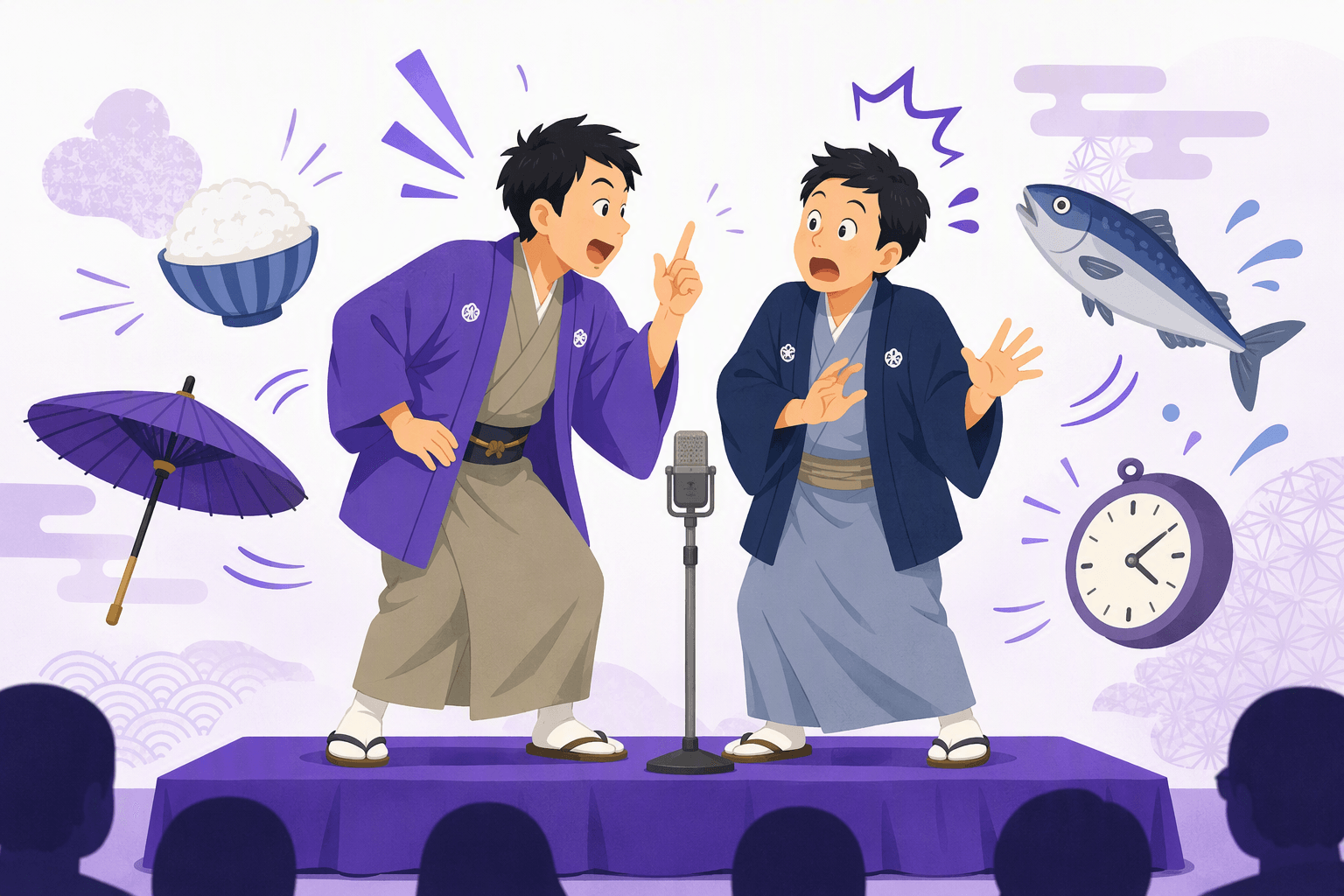
漫才 /maɴdza.i/ is one of Japan’s best-known live comedy traditions. It is particularly associated with the Kansai region, especially Osaka, and commonly features two performers speaking at high speed.
One role is the ボケ /boke/, the person who says something naive, absurd, mistaken, or wildly inappropriate for the situation. The other is the ツッコミ /tsɯkkomi/, who immediately points out the error, often with a sharp verbal correction.
The roles are not simply foolish person and intelligent person. A strong boke sets up a deliberate deviation from common sense, while a strong tsukkomi identifies exactly what makes it wrong. The timing of that correction is a major part of the laugh.
| Role | Japanese | What the performer does |
|---|---|---|
| Silly setup | ボケ /boke/ | Makes an odd claim, misunderstanding, or non sequitur |
| Quick correction | ツッコミ /tsɯkkomi/ | Interrupts, challenges, or reframes the absurd statement |
| Shared payoff | オチ /otɕi/ | Delivers the ending or punchline that resolves the bit |
The word オチ /otɕi/ comes from 落ち /otɕi/, an ending or drop. In comedy, it is the payoff that makes the preceding setup click into place.
A basic fictional exchange might work like this:
- A: 明日、月に行く。 /aɕita tsɯki ni ikɯ/ , I am going to the moon tomorrow.
- B: どこからそんな金が出るねん! /doko kaɾa soɴna kane ɡa deɾɯ neɴ/ , Where would you get that kind of money?
The second line uses a Kansai-flavored ending, ねん /neɴ/, which can sound strongly associated with the region in popular media. The joke is not merely that the plan is impossible. It is that the tsukkomi ignores the physical impossibility and focuses on the mundane problem of paying for it.
🌍 Osaka is not a comedy costume
Kansai speech is prominent in Japanese comedy, but learners should not imitate it automatically to sound funny. Regional dialect carries identity and social meaning. Use the standard forms you know unless you have meaningful exposure to a specific region and community.
The importance of timing and reactions
In many English-language joke formats, speakers visibly signal a punchline. Japanese comedy can also use a pause, a flat delivery, a delayed reaction, or the sudden use of a formal phrase in a casual scene.
The reaction word えっ /eQ/ can mean what, really, or wait, depending on intonation. A long silence after a dajare can be staged as a joke in itself. You may hear someone say 寒い /samɯi/, literally cold, after a weak pun because the joke has made the atmosphere feel comically chilly.
That does not mean the speaker is genuinely offended. The response may be affectionate teasing. Still, learners should not assume every negative-looking reaction is playful. Watch facial expression, tone, and whether others join the laughter.
Laura Miller’s work on contemporary Japanese aesthetics shows how performance, persona, and social presentation carry cultural weight. In humor too, how a line is delivered can be more meaningful than the dictionary definition of its words.
Anime jokes versus everyday jokes
Anime frequently exaggerates comic timing. A character may fall over, receive a dramatic reaction, or use a catchphrase that would feel theatrical in ordinary conversation.
Anime also uses stock character voices. An older-man character may deliver repeated dajare, while a deadpan character may respond with silence. These are genre signals, not instructions for how all Japanese people speak.
If you learn through animated shows, pair them with more natural material such as interviews, travel programs, or casual dramas. Our Japanese anime learning guide explains how to use scripted entertainment without copying every fictional speech pattern.
Pay close attention to sentence endings. A punchline may turn on です /desɯ/ being unexpectedly polite, or on a casual ending such as じゃん /dʑaɴ/ that changes the character’s stance. Japanese humor is often social grammar in miniature.
How to respond when you do not understand
You do not need to fake a laugh. A simple response can keep the conversation warm while showing that you missed the wordplay.
Try one of these:
- どういう意味? /doː iɯ imi/ , What does that mean?
- 今の、ダジャレ? /ima no dadʑaɾe/ , Was that a pun just now?
- もう一回言って。 /moː ikkai iQte/ , Say it one more time.
- ああ、分かった。 /aː wakaQta/ , Ah, I get it.
The phrase もう一回 /moː ikkai/ has a long vowel in もう and a doubled consonant in 一回. Keeping those beats distinct makes your request clearer.
Asking about a joke is often an excellent learning moment. It reveals homophones, cultural references, and word boundaries that a textbook example may never show.
Humor boundaries for learners
The safest Japanese jokes are self-directed, situational, or language-based. Comment on a harmless coincidence, a pun, or your own small mistake rather than making another person the target.
Avoid jokes involving a person’s name, rank, age, physical appearance, nationality, illness, or a public tragedy. Japanese communication can be highly sensitive to group harmony, especially in workplaces and new social circles.
Research and teaching resources from the Japan Foundation emphasize that communicative ability includes knowing what language fits a setting. A grammatically correct joke can still feel intrusive if the relationship is too new or the context is formal.
⚠️ Do not copy aggressive comedy lines
Some television comedy uses insults, physical slapstick, stereotypes, or harsh language. Those routines depend on performer roles, consent, audience expectations, and established relationships. Do not repeat a line just because subtitles make it look funny.
For potentially rude language you may hear in media, read our Japanese swear words guide as recognition practice, not as a script for conversation.
A practical way to learn Japanese humor from clips
Choose a short clip with Japanese subtitles. First, watch it once for the scene. Who has more social power, who is speaking casually, and when do other people react?
Watch a second time and mark repeated sounds. If there is a visible subtitle, check whether the repeated sound uses different kanji or different spellings. That is often the key to a dajare.
Then say the line aloud in mora-sized beats. Japanese rhythm is not built on English-style stressed syllables. A short word and a long vowel do not take the same timing, so pronunciation can make or break a pun.
Finally, save only jokes you could actually understand and explain. Memorizing a line without the setup tends to produce awkward results. Memorizing the sound pattern and situation gives you something you can recognize again.
A good next step is comparing humorous speech with ordinary farewells and affectionate language. See how to say goodbye in Japanese and how to say I love you in Japanese to notice how strongly relationship and context shape what sounds natural.
The real goal: recognition, not performance
You do not need to become a stand-up comedian to understand jokes in Japanese. Recognizing a dajare, noticing the boke and tsukkomi pattern, and responding honestly when you miss the point will already make Japanese shows and conversations more accessible.
Start with one classic pun. Learn why it works, listen for its rhythm, and accept the groan as part of the lesson. In Japanese humor, a bad joke delivered at the right moment can be more socially successful than a perfect joke delivered without context.
Frequently Asked Questions
What is the Japanese word for joke?
Why do Japanese jokes use so many puns?
What does manzai mean in Japanese comedy?
Are Japanese puns funny to Japanese people?
Can learners tell jokes in Japanese?
Sources & References
- National Institute for Japanese Language and Linguistics, Japanese Language Research Resources, accessed 2026
- The Japan Foundation, Japanese-Language Education Resources, accessed 2026
- Ethnologue, Japanese, 27th edition, 2024
- Shibatani, Masayoshi, The Languages of Japan, Cambridge University Press
- Miller, Laura, Beauty Up: Exploring Contemporary Japanese Body Aesthetics, University of California Press
Start learning with Wordy
Watch real movie clips and build your vocabulary as you go. Free to download.


