Quick Answer
Japanese stroke order follows a small set of reliable patterns: top to bottom, left to right, horizontal before vertical, and outside before inside. Learning it helps you write kana and kanji more clearly, recognize characters faster, and use handwriting input with fewer errors.
Japanese stroke order is the standard sequence used to write each Japanese character: generally left to right, top to bottom, horizontal before vertical, and outside before inside. You do not need perfect handwriting to communicate, but learning the order makes hiragana /çiɾaɡana/, katakana /katakana/, and kanji /kaɲdʑi/ easier to remember, write clearly, and recognize in real life.
Japanese is spoken by roughly 123 million people, primarily in Japan. Its writing system combines two phonetic scripts with Chinese-origin characters, so writing is not just a visual skill. It is part of reading, vocabulary recognition, and noticing how words are built. If you are learning everyday expressions such as those in our guide to how to say hello in Japanese, correct character shapes will help you identify the phrases in subtitles, menus, messages, and handwriting.
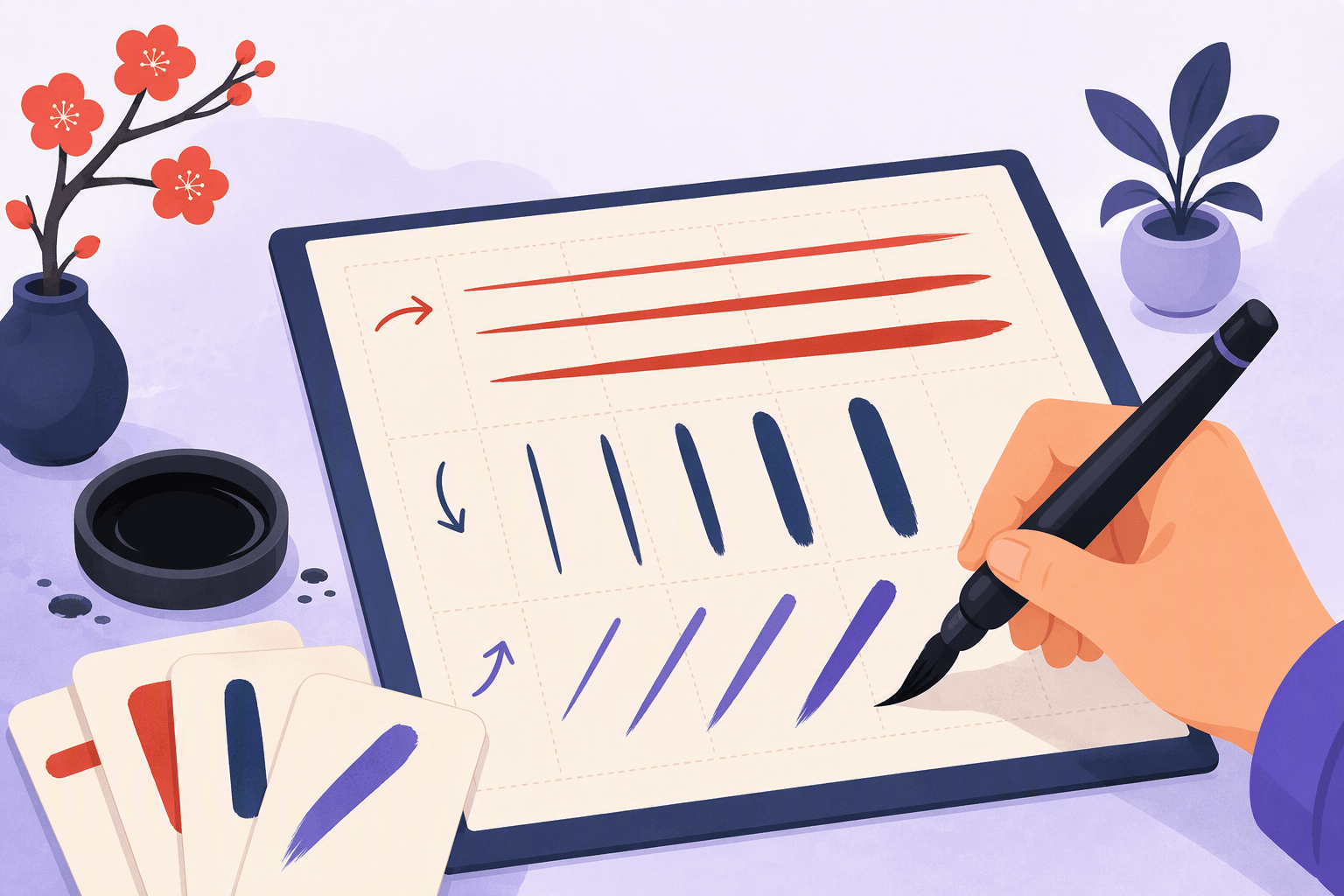
Why Japanese stroke order matters
Stroke order is not a decorative rule invented to make writing harder. It reflects how characters were historically written with brush and ink, and it gives each character a stable internal structure.
When you write in the expected sequence, your hand moves efficiently. The result usually has better balance: lines meet where they should, enclosures close naturally, and small marks land in the right place.
It improves character recognition
Many Japanese characters differ by only one line, position, or direction. Consider 人 /çi.to/ and 入 /çiɾu/. Both use two strokes, but the direction and placement of the strokes create different shapes and different meanings.
Writing a character correctly makes you notice these details. This is valuable when reading fast handwriting, stylized fonts, or subtitles where a character appears for only a moment.
It supports memory
Handwriting alone does not guarantee learning. Copying a character fifty times while thinking about something else has limited value.
But stroke order can give a character a memorable motor pattern. Florian Coulmas, in Writing Systems: An Introduction to Their Linguistic Analysis, explains that writing systems are more than code for speech: they are visual systems with conventions readers learn to recognize. Stroke order helps learners build those conventions into their own writing.
It helps with handwriting input
Many phones and tablets offer Japanese handwriting input. These systems can often identify an imperfect character, but their accuracy improves when the character has the expected proportions and component order.
This matters for learners who cannot yet type confidently in Japanese. It also gives you a practical way to check whether the character you wrote resembles the intended one.
It connects you to school literacy in Japan
Japanese children learn a formally sequenced set of characters in elementary school. Japan's Ministry of Education assigns 1,006 kanji /kaɲdʑi/ to elementary education, while the official Jōyō Kanji /dʑoːjoː kaɲdʑi/ list contains 2,136 characters used as a general reference for everyday written Japanese.
Adults do not judge every handwritten character like a school worksheet. Still, conventional stroke order is part of basic literacy culture, especially in classrooms, calligraphy, forms, and careful written communication.
The core Japanese stroke order rules
You do not need to memorize a separate rule for every character. Start with these patterns, then check a reliable dictionary or character resource when a kanji seems unusual.
| Rule | What it means | Example |
|---|---|---|
| Left to right | Write the left-side element before the right-side element | 川 /ka.wa/ |
| Top to bottom | Write upper strokes before lower strokes | 三 /saɴ/ |
| Horizontal before vertical | A crossbar usually comes before the line crossing it | 十 /dʑuː/ |
| Outside before inside | Begin a frame before writing its contents | 同 /doː/ |
| Close the frame last | The final lower or enclosing stroke often finishes the character | 国 /koku/ |
| Center before sides | A central vertical line may come before matching side strokes | 小 /ɕoː/ |
| Dots last | Small dots and short finishing marks are often added after the main shape | 玉 /tama/ |
These are tendencies, not a license to guess every order. Japanese has standard forms, and some characters have historical patterns that are not obvious from their final shape.
Left to right
The character 川 /ka.wa/, meaning river, has three vertical strokes. Write the left stroke first, then the middle, then the right.
The same principle appears in complex kanji with left and right components. In 明 /mei/, the left component 日 /çi/ comes before the right component 月 /tsɯki/.
Top to bottom
The character 二 /ni/ is written with the upper horizontal line first, then the lower one. In 三 /saɴ/, write from the top line down.
This looks obvious, but it matters when a character contains several stacked elements. For example, in 学 /ɡakɯ/, upper elements are formed before the lower child component 子 /ko/.
Horizontal before vertical
For 十 /dʑuː/, write the horizontal stroke first, then the vertical stroke. The same pattern appears in 木 /ki/, where the horizontal line comes before the central vertical line.
A useful beginner habit is to identify the skeleton of the character. If a long vertical line crosses a horizontal bar, the horizontal stroke often establishes the width before the vertical stroke anchors the center.
Outside before inside, then close last
This rule is crucial for box-like kanji. In 口 /kɯʦi/, write the top and left side as one stroke, then the right side, then the bottom closing stroke.
In 国 /koku/, form the outer enclosure, write the inside component, then complete the enclosing lower stroke. Closing too early traps the interior and makes the movement awkward.
💡 Think of a character as a route
Do not think only about where each line ends. Think about the route your pen takes through the character. Standard stroke order is usually the shortest, most stable route for producing a recognizable shape.
Stroke order for hiragana and katakana
Hiragana /çiɾaɡana/ and katakana /katakana/ are often introduced as alphabets, but they are syllabaries. Each symbol generally represents a mora /moɾa/, a rhythmic unit in Japanese.
For example, こんにちは /koɴ.ni.tɕi.wa/ has five morae: こ /ko/, ん /ɴ/, に /ni/, ち /tɕi/, は /wa/. Its standard pronunciation approximation is kohn-NEE-chee-wah.
The scripts contain 46 basic symbols each, plus modified sounds and combinations. Their forms are simpler than kanji, so they are the best place to build reliable writing habits.
Hiragana: prioritize smoothness and proportion
Hiragana developed from cursive forms of Chinese characters. That history explains its flowing, curved look.
Characters such as あ /a/, ぬ /nɯ/, め /me/, and ね /ne/ can become confusing when their loops, hooks, and crossings are rushed. Stroke order tells you which curve belongs to the main body and which is a final finishing stroke.
| Character | Sound | IPA | Key writing point |
|---|---|---|---|
| あ | a | /a/ | Keep the left component separate from the larger right curve |
| き | ki | /ki/ | Write the horizontal structure before the final lower stroke |
| さ | sa | /sa/ | Keep the final stroke distinct rather than joining everything |
| ぬ | nu | /nɯ/ | Build the main loop before adding the final movement |
| れ | re | /ɾe/ | Keep the left element narrow and the right curve open |
A common beginner error is making every stroke identical in length and pressure. Japanese handwriting is not mechanical. Some lines are light, some finish with a small sweep, and some stop firmly.
Katakana: do not turn it into English capitals
Katakana /katakana/ is often more angular. Learners sometimes make it look like improvised Roman capital letters because they focus on the overall silhouette rather than individual strokes.
Compare シ /ɕi/ and ツ /tsɯ/. They contain similar marks, but the direction and placement of the short strokes differ. Correct stroke order helps preserve the intended angle.
| Character | Sound | IPA | Common confusion |
|---|---|---|---|
| シ | shi | /ɕi/ | Often confused with ツ /tsɯ/ |
| ツ | tsu | /tsɯ/ | Often confused with シ /ɕi/ |
| ソ | so | /so/ | Often confused with ン /ɴ/ |
| ン | n | /ɴ/ | Often confused with ソ /so/ |
| メ | me | /me/ | Keep the crossing strokes clearly separated |
If you are still building basic literacy, pair writing with reading. Our Japanese alphabet guide explains how hiragana, katakana, and kanji work together in real Japanese text.
Kanji stroke order: learn components, not isolated drawings
Kanji /kaɲdʑi/ are not random pictures. Most are built from recurring components, often called radicals. Recognizing these components reduces the amount you need to memorize.
For instance, the left-side water component 氵 /saɴzɯi/ appears in 海 /ɯmi/, meaning sea, and 酒 /sake/, meaning alcohol. Its three short strokes have a standard order, so every new character using it becomes easier to write.
Hadamitzky and Spahn's Kanji and Kana organizes character learning around forms, readings, and practical use. That approach is useful because stroke order becomes much less intimidating when you see recurring parts instead of several thousand unrelated symbols.
Learn high-frequency building blocks
Start with components that appear constantly in beginner materials:
| Component | IPA | General association | Example kanji |
|---|---|---|---|
| 亻 | /nito.beɴ/ | person | 休 /jasɯmɯ/ |
| 氵 | /saɴzɯi/ | water | 海 /ɯmi/ |
| 木 | /ki/ | tree, wood | 林 /çajaɕi/ |
| 口 | /kɯʦi/ | mouth, opening | 名 /na/ |
| 日 | /çi/ | sun, day | 時 /toki/ |
| 女 | /oɴna/ | woman | 好 /sɯki/ |
The component label is not always the character's meaning. It is a memory tool and structural clue. Focus first on how the parts are placed: left-right, top-bottom, surrounding, or stacked.
Watch for stroke direction
A line that looks vertical may be a downward-left sweep, a downward-right sweep, or a hook. Japanese calligraphy distinguishes these movements because they affect the final shape.
For example, 人 /çi.to/ begins with a left-falling stroke, then a right-falling stroke. Reversing them can make the character stiff and poorly balanced.
Do not obsess over brush-calligraphy precision on day one. A pencil or pen is enough. The goal is to see direction, starting point, and finishing point.
🌍 Why stroke order is visible even in casual writing
Japanese handwriting varies widely, just as handwriting does in English. Yet character balance still reveals whether someone understands the underlying structure. A person may write quickly, simplify a curve, or use a personal style, but the standard stroke route remains the shared foundation learned in school.
Common Japanese stroke order mistakes
Writing the character as a single drawing
Many beginners look at a kanji and trace its outer shape as if it were a logo. This creates a character that may look acceptable in isolation but becomes hard to reproduce consistently.
Instead, divide it into components and strokes. Ask where the pen starts, what establishes the main structure, and which marks finish the character.
Closing boxes too early
Characters with enclosures are frequent trouble spots. If you close a box before writing what is inside, your pen movement becomes unnatural.
Practice 口 /kɯʦi/, 日 /çi/, 目 /me/, and 国 /koku/ slowly. Say the sequence aloud: top-left, right, inside if needed, bottom close.
Confusing visual similarity with identical structure
Characters can look alike but have different stroke paths. The kana ソ /so/ and ン /ɴ/ are a classic example. So are 未 /mi/ and 末 /matsɯ/, where the position of a horizontal line changes the meaning.
Do not rely only on flashcards that show a finished character. Use animated stroke-order diagrams or write from a model that shows numbered strokes.
Practicing too fast
Speed hides mistakes. If you always write at full speed, you may memorize a distorted version of the character.
Use a two-stage method: write slowly with attention to order, then write at normal speed while keeping the same structure. Accuracy first, automaticity second.
⚠️ Do not confuse font shapes with handwriting models
Printed Japanese fonts can make a character look different from handwritten forms. This is especially noticeable with kanji components such as 糸 /ito/ and 食 /ta.beɾɯ/. Use a learner dictionary, school-style model, or reliable stroke-order resource when checking what to write by hand.
A practical 10-minute stroke order routine
A short routine works better than occasional marathon sessions. Use it alongside vocabulary study, listening, and reading.
Minutes 1 to 2: review old characters
Choose five characters you studied earlier. Cover the model and write each from memory.
Then compare your version with the reference. Do not only mark it right or wrong. Identify the exact problem: wrong order, uneven spacing, missing hook, or misplaced dot.
Minutes 3 to 6: learn two new characters
For each new character, look at the meaning, reading, components, and stroke count. Trace the order in the air once, then write it three times slowly.
For example, when learning 愛 /ai/, commonly associated with love, connect it with phrases from our guide to how to say I love you in Japanese. The phrase 愛してる /ai.ɕi.te.ɾɯ/ is pronounced AH-ee-shee-teh-roo, with each mora clearly present.
Minutes 7 to 8: write a real word
Put the new character into a word or short phrase. This prevents stroke practice from becoming disconnected from language.
Write こんにちは /koɴ.ni.tɕi.wa/ for a greeting, or さようなら /sa.joː.na.ɾa/ for goodbye. For natural alternatives and context, see how to say goodbye in Japanese.
Minutes 9 to 10: test without looking
Write the characters once more from memory. If you forget a stroke, check the model immediately and rewrite it correctly once.
This is retrieval practice. James W. Heisig's Remembering the Kanji is well known for emphasizing memorable character components, but stroke order adds an important physical layer: you are not only recalling a story or meaning, you are reconstructing the written form.
When stroke order matters less
You do not need to delay reading Japanese until your handwriting is beautiful. Modern learners often type more than they write, and Japanese input methods convert phonetic typing into kanji candidates.
Stroke order is also less important for recognizing a familiar word in a subtitle. If you see ありがとう /a.ɾi.ɡa.toː/, your ability to understand it depends more on vocabulary and listening than on whether you can handwrite every kana perfectly. The canonical pronunciation approximation is ah-ree-GAH-toh.
Still, writing supports the rest of your learning. It makes unfamiliar characters less visually overwhelming and helps you distinguish forms that look nearly identical on screen.
The best goal for beginners
Your goal is not to produce museum-quality calligraphy. It is to write recognizable Japanese characters with standard structure, know the major stroke-order rules, and check unfamiliar kanji rather than inventing an order.
Start with hiragana /çiɾaɡana/, add katakana /katakana/, then learn kanji /kaɲdʑi/ through useful words and real sentences. Combine handwriting with input from movies, shows, conversations, and subtitles so every character belongs to something you can understand.
For a broader foundation, pair this routine with our guide to learning hiragana and beginner kanji guide. Consistent, careful practice will make Japanese writing feel less like copying symbols and more like reading a system you can use.
Frequently Asked Questions
Do I need to learn Japanese stroke order to read Japanese?
Is Japanese stroke order always the same?
What are the most important Japanese stroke order rules?
Does bad stroke order make Japanese handwriting unreadable?
How long should I practice stroke order each day?
Sources & References
- Agency for Cultural Affairs, 常用漢字表, accessed 2026
- Ministry of Education, Culture, Sports, Science and Technology, Elementary School Course of Study, accessed 2026
- The Japan Foundation, Japanese-Language Education Resources, accessed 2026
- Hadamitzky and Spahn, Kanji and Kana, Tuttle Publishing
- Florian Coulmas, Writing Systems: An Introduction to Their Linguistic Analysis, Cambridge University Press
Start learning with Wordy
Watch real movie clips and build your vocabulary as you go. Free to download.


