Quick Answer
To start learning kanji as a beginner, focus on high-frequency characters, learn them in real words (not in isolation), and build a daily routine that combines reading practice with spaced repetition. A practical path is: master hiragana and katakana, learn 20 to 30 core radicals, then study beginner kanji through common vocabulary you will actually see in signs, menus, and subtitles.
To start learning kanji as a beginner, you should learn high-frequency characters through real words you will actually read, understand how on'yomi (OHN-yoh-mee) and kun'yomi (koon-YOH-mee) work, and build a small daily routine that mixes reading with spaced repetition. If you do that consistently, kanji stops feeling like 2,000 separate puzzles and starts feeling like a system you can decode.
| English | Japanese | Pronunciation | Formality |
|---|---|---|---|
| Kanji | 漢字 | KAHN-jee | casual |
| Radical | 部首 | BOO-shoo | casual |
| On reading | 音読み | OHN-yoh-mee | casual |
| Kun reading | 訓読み | koon-YOH-mee | casual |
| Stroke order | 筆順 | HIT-soon | casual |
| Common-use kanji | 常用漢字 | JOH-yoh KAHN-jee | formal |
What kanji are, and why beginners should care
Kanji (漢字, KAHN-jee) are Chinese characters used in written Japanese alongside hiragana and katakana. They carry meaning and often hint at pronunciation, which is why they are so useful once you get past the initial shock.
Japanese is spoken by about 123 million people worldwide (Ethnologue 2024). Most of those speakers read a writing system that mixes three scripts, so if your goal is real-world Japanese, kanji is not optional.
Kanji vs hiragana vs katakana (the beginner mental model)
Hiragana is for grammar and native words, katakana is for loanwords and emphasis, and kanji is for content words. In real Japanese, you will see all three in the same sentence, including in subtitles.
If you have not locked down kana yet, do that first. A kanji routine works best when you can read hiragana and katakana smoothly, because kanji study relies on seeing words in context.
For a quick motivation boost, compare how much you can understand with and without kanji in common greetings like in our hello in Japanese guide. Kanji is often the difference between "I can sound it out" and "I can read it instantly."
The numbers: how many kanji exist, and how many you actually need
There are tens of thousands of kanji historically, but modern literacy targets are much smaller. Japan’s Agency for Cultural Affairs defines the Joyo Kanji (常用漢字, JOH-yoh KAHN-jee) list of 2,136 characters as the standard set for general use (文化庁, 2010).
You do not need 2,136 to start enjoying Japanese media. For many learners, the first 300 to 600 high-frequency kanji unlock a surprising amount of signage, menus, and subtitles, because common characters repeat constantly.
JLPT as a practical benchmark (even if you never take it)
The JLPT is not the only path, but its levels are a useful pacing tool. Beginners often aim for N5 and N4 first, which pushes you toward everyday vocabulary and basic literacy.
The key is not the test itself. The key is using a curated set of beginner kanji and words so you are not guessing what matters.
How kanji readings work (without the confusion)
Most kanji have more than one reading, and that is normal. Japanese borrowed characters over centuries, and readings reflect different layers of borrowing and native usage.
Here is the beginner rule that stays true in most everyday cases:
- On'yomi (音読み, OHN-yoh-mee): common in compounds like 学生 (がくせい, gah-KAY, "student").
- Kun'yomi (訓読み, koon-YOH-mee): common when a kanji is used with okurigana, like 食べる (たべる, tah-BEH-roo, "to eat").
音読み
On'yomi (音読み, OHN-yoh-mee) often feels shorter and more "compressed." You will hear it in words that sound like they belong together as a unit.
Examples you will meet early:
- 学生 (がくせい, gah-KAY)
- 日本 (にほん, nee-HOHN) or (にっぽん, nip-POHN)
訓読み
Kun'yomi (訓読み, koon-YOH-mee) often maps to a native Japanese word. It is frequently paired with hiragana endings called okurigana.
Examples:
- 食べる (たべる, tah-BEH-roo)
- 大きい (おおきい, oh-KEE)
- 小さい (ちいさい, koh-SAH-ee)
💡 Beginner shortcut that works
Do not memorize a kanji plus ten readings as a list. Memorize words. Learn 学 as part of 学生 (がくせい, gah-KAY) and 学ぶ (まなぶ, mah-NAH-boo). Your brain stores readings more reliably when they are attached to meaning and context.
Radicals: the fastest way to stop kanji from looking random
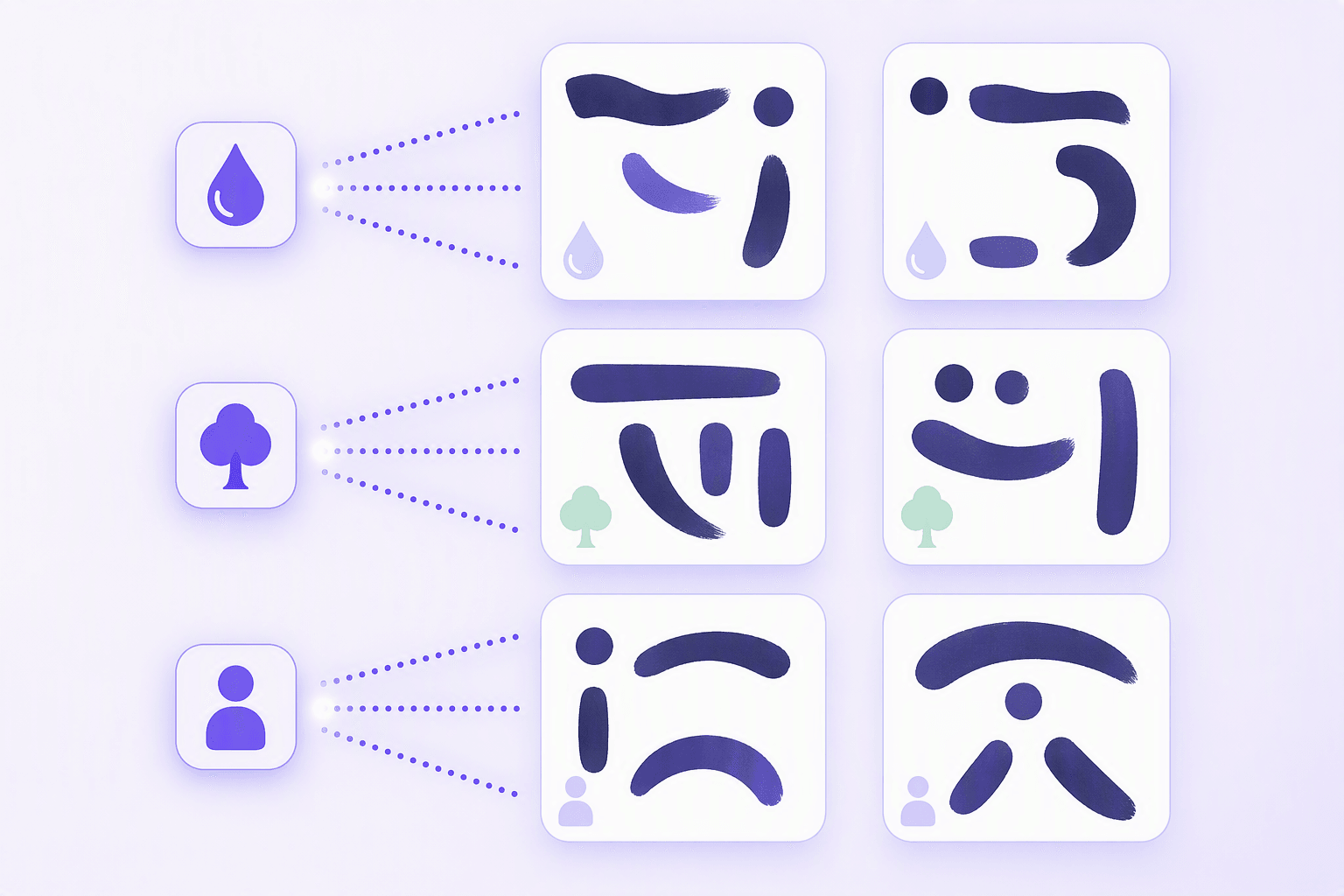
Radicals are called bushu (部首, BOO-shoo). They are components used to classify kanji and often hint at meaning, like 氵 (water) appearing in many water-related characters.
You do not need to memorize 200 radicals on day one. Learning 20 to 30 high-utility components gives you immediate benefits:
- Better guessing of meaning
- Better memory hooks
- Faster dictionary lookup
A few radicals you will see everywhere
Here are some beginner-friendly ones to notice:
- 氵: water-related ideas (river, wash, drink)
- 亻: person-related ideas
- 木: tree or wood-related ideas
- 女: woman-related ideas
- 言: speech or language-related ideas
When you watch Japanese shows, you will spot these patterns in subtitles. That is one reason movie-based learning sticks, your brain sees the same shapes repeatedly in meaningful scenes.
Learn kanji through words you will actually read (starter set)
A beginner kanji plan should be vocabulary-driven. That means you learn characters inside common words, with pronunciation, not as isolated flashcards.
| English | Japanese | Pronunciation | Note |
|---|---|---|---|
| Japan | 日本 | nee-HOHN / nip-POHN | Two common pronunciations depending on context. |
| Person | 人 | HEE-toh / jeen | Kun: hito, On: jin or nin in compounds. |
| Student | 学生 | gah-KAY | A very common compound: 学 (study) + 生 (life). |
| To eat | 食べる | tah-BEH-roo | Kanji plus okurigana (the hiragana ending). |
| To drink | 飲む | NOH-moo | Often seen on menus and vending machines. |
| Big | 大きい | oh-KEE | Adjective with okurigana. |
| Small | 小さい | koh-SAH-ee | Pairs naturally with 大きい. |
| This | これ | koh-REH | Hiragana only, included to show mixed scripts in real Japanese. |
Why vocabulary-first beats character-first
Kanji are not just symbols, they are part of a writing system that encodes words. Research on second-language reading consistently shows that fluent reading depends on building automatic word recognition, not just decoding letters or characters one by one (Koda, 2005).
That is why "I know this kanji" is not a useful end goal. "I can read this word instantly in a sentence" is the goal.
"Reading is not the simple decoding of print to sound. Skilled reading depends on rapid, automatic word recognition that frees attention for comprehension."
K. Koda, linguist and reading researcher (Insights into Second Language Reading, 2005)

A simple daily kanji routine (20 minutes, realistic)
Consistency beats intensity. A short routine you can repeat daily will outperform weekend cramming.
Step 1: 5 minutes, review with spaced repetition
Use an SRS deck, but keep it tight. Review only what you have learned recently plus a small backlog.
If you use Wordy, you can tie reviews to what you actually heard in clips, which reduces "flashcard amnesia." If you are curious about learning through real dialogue, start at Japanese learning on Wordy.
Step 2: 10 minutes, learn 3 to 5 new words
Pick words that show up in:
- Signs and stations
- Menus and convenience stores
- Subtitles and common dialogue
Aim for 3 to 5 new words per day, not 20. At 5 words per day, you learn 150 words in a month, which is a meaningful jump in comprehension.
Step 3: 5 minutes, read something short
Read one short thing daily:
- A subtitle line you paused on
- A simple graded reader excerpt
- A menu photo
- A short social post
The point is exposure. NINJAL’s corpus-based work highlights how frequency and real usage drive what you encounter most, so your reading practice should mirror real language, not textbook-only sentences (NINJAL resources, ongoing).
⚠️ The trap that slows beginners
Avoid spending all your time perfecting stroke order for every new kanji. Stroke order (筆順, HIT-soon) matters, but recognition and vocabulary give you faster returns for reading and listening. Add writing selectively for characters that refuse to stick.
Stroke order: when it matters and when it does not
Stroke order is useful for:
- Handwriting legibility
- Remembering complex characters
- Looking up kanji by handwriting input
It matters less for:
- Reading subtitles
- Typing on a phone
- Recognizing words quickly
If you do practice writing, follow one rule: write from memory after seeing the character, not while copying it mindlessly. Copying can feel productive while building weak recall.
How to use kanji in real life: signs, menus, and subtitles
Kanji study becomes easier when you connect it to places where Japanese is actually written.
Train stations and city navigation
Stations are a kanji goldmine because names repeat on maps, tickets, and announcements. You will see common location characters like:
- 駅 (えき, EH-kee, station)
- 口 (ぐち, goo-chee, exit, often as 出口)
Even if you cannot read the whole station name, recognizing the "type" of word reduces stress and speeds up navigation.
Restaurants and convenience stores
Menus repeat the same categories:
- 水 (みず, MEE-zoo, water)
- 茶 (ちゃ, CHAH, tea)
- 肉 (にく, nee-KOO, meat)
You do not need to read everything. You need enough to make good guesses quickly.
Subtitles and the "furigana gap"
Many learner materials include furigana, small kana readings above kanji. Real subtitles usually do not.
That gap is why beginners feel a sudden difficulty spike when they switch from learning resources to native media. The fix is gradual exposure: start with short clips, pause often, and reuse the same scenes until the kanji becomes familiar.
If you want phrases that show up constantly in dialogue, pair this with our guides to saying goodbye in Japanese and saying "I love you" in Japanese. Those articles give you high-frequency words you will see written too.
Kanji memory that actually works (and why mnemonics are optional)
Mnemonics can help, but they are not the core skill. The core skill is building a network: shape, meaning, and common words.
Use this checklist when a kanji will not stick:
- Can you recognize its radical or main component?
- Do you know at least two common words that use it?
- Have you seen it in a sentence you understand?
- Can you type it from kana input?
Typing is underrated. If you can type たべる and choose 食べる correctly, you are reinforcing recognition and meaning in a practical way.
A note on "keyword" meanings
Some methods teach a single English keyword per kanji. That can be a helpful starting hook, but it becomes misleading if you treat it as the full meaning.
Kanji meaning is shaped by the word it appears in. Learn meanings at the word level, and let the kanji meaning become more precise over time.
Cultural insight: why kanji feels "polite" and kana feels "casual"
In many contexts, kanji-heavy writing looks more formal, while kana-only writing can look softer, friendlier, or more childlike. You will see this in:
- Shop signs choosing kanji to look traditional
- Brands choosing hiragana to feel cute or approachable
- Social posts using katakana for emphasis
This is not a strict rule, but it is a real design choice in Japanese public text. Once you notice it, kanji stops being just "hard characters" and starts being part of style.
🌍 Kanji choice is sometimes a style choice
Japanese writers can often choose between kanji and kana for the same word. For example, some words are commonly written in kana in casual contexts. When you see kana where you expected kanji, it is not always because the writer 'does not know' the kanji, it can be a tone decision.
Common beginner mistakes (and how to fix them)
Mistake 1: Learning rare kanji too early
If you are learning kanji from random lists, you will waste time on characters you will not see for months. Use frequency and relevance as your filter.
A practical heuristic: if you have not seen it in subtitles, a sign, or a beginner reader, it can wait.
Mistake 2: Treating readings like a test
Beginners often ask, "What is the reading of this kanji?" The better question is, "What is this word, and how is it read here?"
Kanji do not have one pronunciation. Words do.
Mistake 3: Ignoring pitch and sound while focusing on writing
Kanji study can accidentally become silent study. But Japanese is a spoken language, and reading supports listening.
When you learn a new word like 学生 (がくせい, gah-KAY), say it out loud. Better yet, hear it in a clip and repeat it.
Mistake 4: Using edgy vocabulary without context
Some kanji appear in insults and taboo language, and learners sometimes pick them up from media without understanding the social weight. If you are curious, keep it educational and context-focused, and read our guide to Japanese swear words with the cultural notes.
A beginner-friendly progression plan (first 8 weeks)
This is a realistic schedule that fits busy adults.
Weeks 1-2: Build the base
- Kana fluency (hiragana and katakana)
- 20 core radicals (部首, BOO-shoo)
- 30 to 50 kanji through basic nouns and verbs
Weeks 3-5: Expand through daily-life vocabulary
- 100 to 150 additional kanji, but always through words
- Start reading short native snippets daily
- Begin typing practice for every new word
Weeks 6-8: Start reading for meaning, not decoding
- Rewatch the same scenes with subtitles
- Track recurring kanji and words
- Add writing practice only for your "top 20 stubborn kanji"
If you want a structured way to keep this fun, browse the Wordy blog for Japanese learning topics you can stack together, like greetings and travel phrases.
How Wordy helps you learn kanji from real scenes
Kanji becomes easier when it is attached to a moment you remember. A character on screen points at a sign, a subtitle flashes a word, and your brain stores it with context.
Wordy is built around that idea: short movie and TV clips, interactive subtitles, and review tools that bring back the exact words you met in dialogue. If your goal is to read and understand what you hear, start with learning Japanese with Wordy and keep your kanji list tied to the scenes you actually watched.
Near the end of your first month, revisit your favorite greeting scenes and compare what you can read now. Even small progress feels big when it shows up in real subtitles.
Final checklist: what to do next
- Learn kanji through words, not isolated characters.
- Use radicals (部首, BOO-shoo) as pattern recognition, not as another memorization mountain.
- Keep a daily routine: SRS review, a few new words, a little reading.
- Read real Japanese every day, even one subtitle line.
For more everyday phrases that appear constantly in writing, continue with hello in Japanese and goodbye in Japanese.
Frequently Asked Questions
How many kanji should a beginner learn first?
What is the difference between onyomi and kunyomi?
Should I learn kanji by writing them or by reading them?
Do Japanese people memorize kanji using radicals?
Is it realistic to learn all Joyo kanji?
Sources & References
- Agency for Cultural Affairs (Japan), Joyo Kanji Hyō (常用漢字表), 2010 (with later updates)
- National Institute for Japanese Language and Linguistics (NINJAL), Corpus-based Japanese language research resources, ongoing
- Ethnologue, Languages of the World (27th edition), 2024
- The Japan Foundation, Japanese-Language Education resources and JLPT information, ongoing
- Koda, K. (2005). Insights into Second Language Reading. Cambridge University Press
Start learning with Wordy
Watch real movie clips and build your vocabulary as you go. Free to download.


