Japanese Quotes and Proverbs: 25 Sayings With Meaning, Pronunciation, and When to Use Them
Quick Answer
Japanese quotes and proverbs are short, memorable sayings that people use to give advice, encourage someone, or sum up a situation. The most practical ones are everyday yojijukugo (four-character idioms) and classic kotowaza (proverbs) like 七転び八起き and 猿も木から落ちる, which show up in conversation, TV, and books when you want to sound thoughtful without overexplaining.
Japanese quotes and proverbs are best learned as ready-to-use lines for real moments: encouragement, warnings, and quick summaries of a situation. In practice, you will sound most natural if you focus on a small set of famous kotowaza (koh-toh-WAH-zah, proverbs) and yojijukugo (yoh-jee-joo-koo-goh, four-character idioms) that Japanese speakers instantly recognize.
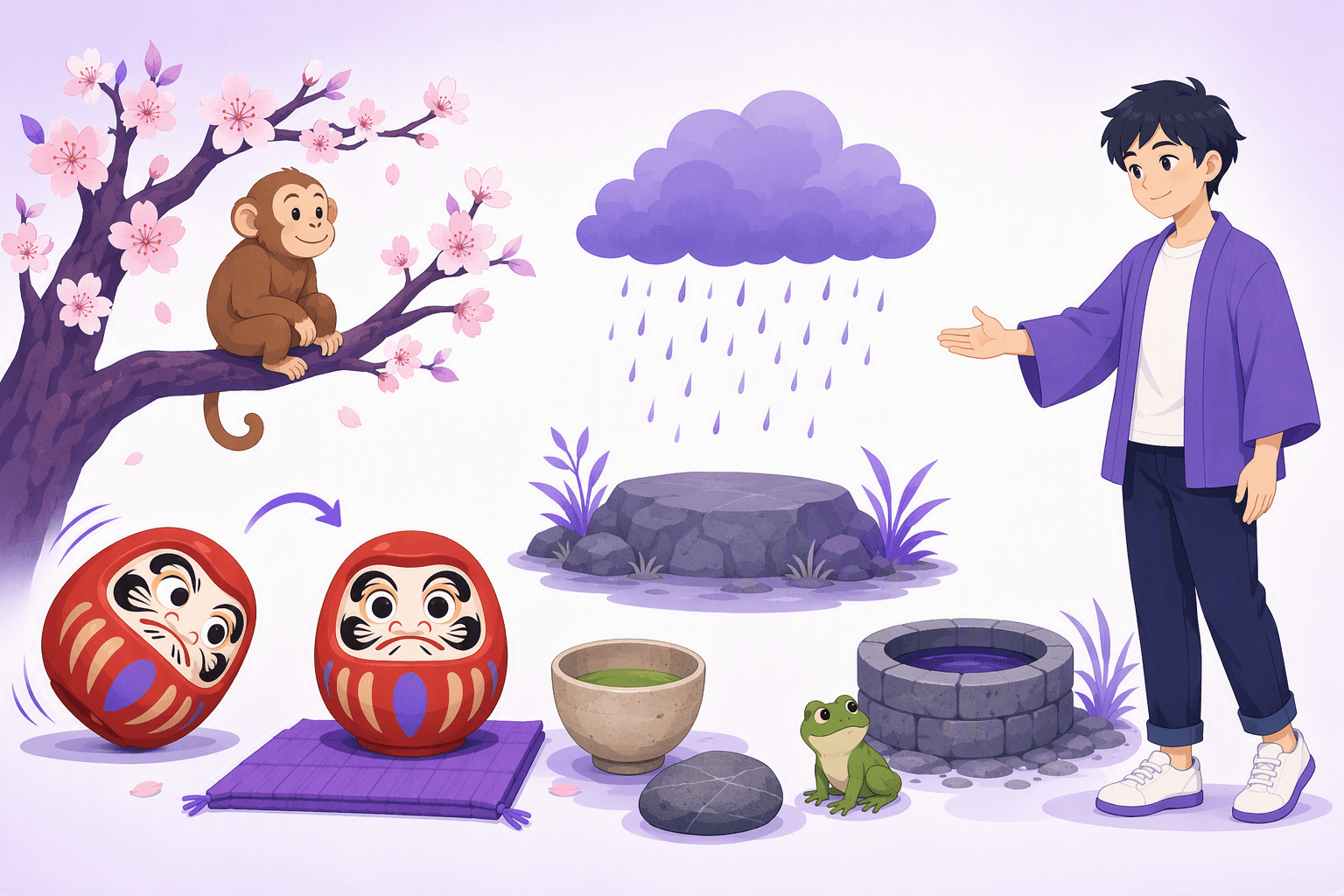
| English | Japanese | Pronunciation | Formality |
|---|---|---|---|
| Resilience: fall seven times, get up eight | 七転び八起き | nah-nah-koh-roh-bee yah-oh-kee | polite |
| Even monkeys fall from trees | 猿も木から落ちる | sah-roo moh kee kah-rah oh-cheh-roo | casual |
| After rain, the ground hardens | 雨降って地固まる | ah-meh foot-teh chee kah-tah-mah-roo | polite |
| Haste makes waste | 急がば回れ | ee-soh-gah-bah mah-wah-reh | polite |
| One time, one meeting | 一期一会 | ee-chee-goh ee-chee-eh | formal |
| If you do it, it will work out | なんとかなる | nahn-toh-kah nah-roo | casual |
Why Japanese proverbs feel powerful (and when they backfire)
Japanese is spoken by roughly 123 million people worldwide, and Japan is the main country where it is an official national language, which means shared cultural references travel fast through school, TV, and workplace life (Ethnologue, 2024). That is why a short proverb can do a lot of social work: it compresses advice into something familiar, and it signals you understand the “common sense” behind the situation.
At the same time, proverbs can sound preachy if you use them like a verdict. The safest pattern is: describe the situation first, then add the proverb as a gentle summary.
"Politeness is not just about being 'nice', it is a system for managing social distance and avoiding imposing on others."
Professor Anna Wierzbicka, Cross-Cultural Pragmatics (2003)
That “avoid imposing” idea is exactly why many Japanese sayings work best as soft encouragement, not as a lecture.
💡 A natural delivery pattern
Say your point in plain Japanese first, then add: まさに (mah-sah-nee, "exactly") + proverb.
Example: 大変だったね。まさに雨降って地固まるだね。
Keep your voice light, like you are empathizing, not judging.
Kotowaza vs yojijukugo vs “quotes”
In English, “quotes” can mean anything from a movie line to a philosopher’s sentence. In Japanese, you will see a few different buckets.
ことわざ
Kotowaza (koh-toh-WAH-zah) are proverbs, often sentence-like and easy to drop into conversation. Many are taught in school and used in TV variety shows, so they are widely recognized.
Pronunciation note: ことわざ is usually said smoothly, koh-toh-WAH-zah, with a clear “wah.”
四字熟語
Yojijukugo (yoh-jee-joo-koo-goh) are compact four-kanji idioms. They are common in writing, mottos, speeches, and headlines, and they often feel “wise” or formal.
If you like learning through media, you will spot them in anime episode titles, sports slogans, and company mission statements. For more everyday openings and closings around these sayings, pair them with greetings from our guides to how to say hello in Japanese and how to say goodbye in Japanese.
名言
Meigen (may-gehn) are famous quotes, often attributed to a historical figure, author, or celebrity. These are more “quote-like” than proverb-like, and they are used in speeches, essays, and social media captions.
25 Japanese sayings you can actually use (with pronunciation)
Below are practical, high-recognition sayings. For each one, you get a pronunciation approximation in English letters, plus the social “vibe” so you know when it fits.
七転び八起き
Reading: ななころびやおき (nah-nah-koh-roh-bee yah-oh-kee)
Meaning: Resilience, keep getting back up.
When to use: After a setback, exam failure, job rejection, injury, or a tough season. It is common in sports and school pep talks.
Natural add-on lines:
- 七転び八起きだよ。 (…dah yoh, casual reassurance)
- 七転び八起きの精神でいきましょう。 (…seh-ee-sheen deh ee-kee-mah-shoh, polite “let’s do this”)
猿も木から落ちる
Reading: さるもきからおちる (sah-roo moh kee kah-rah oh-cheh-roo)
Meaning: Even experts make mistakes.
When to use: When someone competent messes up and feels embarrassed. It can be comforting, but do not use it to tease someone who is truly upset.
Cultural nuance: The “monkey” is not an insult here, it is a familiar image.
雨降って地固まる
Reading: あめふってじかたまる (ah-meh foot-teh jee kah-tah-mah-roo)
Meaning: After trouble, things become stronger.
When to use: After an argument that leads to better understanding, or after a crisis that improves teamwork.
Where you hear it: Workplace reflections, relationship talk, and TV narration.
急がば回れ
Reading: いそがばまわれ (ee-soh-gah-bah mah-wah-reh)
Meaning: Haste makes waste, take the safer route.
When to use: Planning, studying, coding, driving, any situation where rushing creates errors.
Learner tip: This one is easy to sound natural with: 急がば回れだね。 (…dah neh)
石の上にも三年
Reading: いしのうえにもさんねん (ee-shee noh oo-eh moh sahn-nehn)
Meaning: Persevere, even a cold stone warms after three years.
When to use: Long-term study, apprenticeships, learning Japanese itself. It can feel old-school, but it is still widely understood.
Cultural note: The “three years” reflects a traditional patience ethic in training environments.
継続は力なり
Reading: けいぞくはちからなり (kay-zoh-koo wah chee-kah-rah nah-ree)
Meaning: Consistency becomes strength.
When to use: Fitness, language learning, daily habits. This is a common motto on school walls and sports clubs.
If you want a modern, casual version, Japanese speakers often say: コツコツが大事 (koh-tsoo-koh-tsoo gah dah-ee-jee, “steady effort matters”).
井の中の蛙大海を知らず
Reading: いのなかのかわずたいかいをしらず (ee-noh nah-kah noh kah-wah-zoo tie-kai oh shee-rah-zoo)
Meaning: A frog in a well does not know the ocean, limited perspective.
When to use: Carefully. It can sound like you are calling someone narrow-minded. It is safer as self-reflection: 自分も井の中の蛙かも。 (…kah moh, “maybe I am the frog.”)
出る杭は打たれる
Reading: でるくいはうたれる (deh-roo koo-ee wah oo-tah-reh-roo)
Meaning: The nail that sticks out gets hammered down.
When to use: Talking about conformity pressure at school or work. It is descriptive, not necessarily approving.
Unique cultural insight: This saying is often cited by people who feel tension between standing out (individual achievement) and group harmony (wa, わ). It is a useful line for discussing workplace culture without blaming a specific person.
花より団子
Reading: はなよりだんご (hah-nah yoh-ree dahn-goh)
Meaning: Dumplings over flowers, practical over aesthetic.
When to use: Choosing substance over style, especially around events like cherry blossom viewing. It is playful and friendly.
二兎を追う者は一兎をも得ず
Reading: にとをおうものはいっとをもえず (nee-toh oh oh-oh moh-noh wah eet-toh oh moh eh-zoo)
Meaning: Chase two rabbits, catch none.
When to use: Prioritization, focus, not overcommitting.
口は災いの元
Reading: くちはわざわいのもと (koo-chee hah wah-zah-wah-ee noh moh-toh)
Meaning: The mouth is the source of trouble, words can cause disasters.
When to use: After a slip of the tongue, gossip, or oversharing. It is a good “lesson learned” line.
覆水盆に返らず
Reading: ふくすいぼんにかえらず (foo-koo-swee bohn nee kah-eh-rah-zoo)
Meaning: Spilled water does not return to the tray, what is done is done.
When to use: Formal writing, speeches, or reflective moments. It is more literary than everyday chat.
一期一会
Reading: いちごいちえ (ee-chee-goh ee-chee-eh)
Meaning: One time, one meeting, treasure each encounter.
When to use: Travel, meeting someone important, weddings, tea ceremony contexts. It is a classic yojijukugo that feels elegant.
Cultural context: It is strongly associated with 茶道 (sah-doh, tea ceremony) and the idea that each gathering is unrepeatable.
温故知新
Reading: おんこちしん (ohn-koh chee-sheen)
Meaning: Learn new things by revisiting the old.
When to use: Study, history, craft traditions, and even rewatching old films to catch new details.
This pairs well with learning through clips. If you are building listening skill, you will often “learn new” from a scene you already understand.
有言実行
Reading: ゆうげんじっこう (yoo-gehn jeek-koh)
Meaning: Say it and do it, follow through.
When to use: Goal-setting, team commitments, sports. It is motivational and common in slogans.
十人十色
Reading: じゅうにんといろ (joo-neen toh ee-roh)
Meaning: Ten people, ten colors, everyone is different.
When to use: When tastes differ, when a debate has no single correct answer. It is friendly and non-confrontational.
因果応報
Reading: いんがおうほう (een-gah oh-hoh)
Meaning: Cause and effect, karma-like consequences.
When to use: Carefully. It can sound moralizing. It is common in dramas and commentary when someone “gets what they deserve.”
If you want a gentler version, say: そういうこともあるよね (soh-yoo koh-toh moh ah-roo yoh neh, “that happens”).
自業自得
Reading: じごうじとく (jee-goh jee-toh-koo)
Meaning: You brought it on yourself.
When to use: Mostly as self-criticism, not aimed at others. Said to others, it can be harsh.
For strong language, Japanese has plenty, but keep that separate from proverb use. If you are curious about what not to say, see our guide to Japanese swear words.
以心伝心
Reading: いしんでんしん (ee-sheen dehn-sheen)
Meaning: Communicating heart-to-heart without words.
When to use: Close relationships, teamwork, “we just get each other.” It is common in romantic and friendship contexts.
If you are looking for affectionate lines that match this vibe, our guide on how to say I love you in Japanese covers what sounds natural vs what sounds like a translation.
千里の道も一歩から
Reading: せんりのみちもいっぽから (sehn-ree noh mee-chee moh eep-poh kah-rah)
Meaning: A journey of a thousand miles begins with one step.
When to use: Starting a long project, beginner encouragement. This is a shared proverb across cultures, but the Japanese phrasing is common and recognizable.
失敗は成功のもと
Reading: しっぱいはせいこうのもと (sheep-pie hah say-koh noh moh-toh)
Meaning: Failure is the foundation of success.
When to use: Mentoring, coaching, learning contexts. It is supportive and safe.
早起きは三文の徳
Reading: はやおきはさんもんのとく (hah-yah-oh-kee hah sahn-mohn noh toh-koo)
Meaning: Waking up early brings small benefits.
When to use: Light jokes about morning routines, productivity, or travel days.
Unique cultural insight: 三文 (sahn-mohn) is an old low-value coin reference, so the proverb implies “small but real” benefits, not instant success.
旅は道連れ世は情け
Reading: たびはみちづれよはなさけ (tah-bee hah mee-chee-zoo-reh yoh hah nah-sah-keh)
Meaning: On a journey you need companions, in life you need kindness.
When to use: Thanking someone for help, travel bonding, reflecting on community support. It feels warm and slightly old-fashioned.
笑う門には福来たる
Reading: わらうかどにはふくきたる (wah-rah-oo kah-doh nee-wah foo-koo kee-tah-roo)
Meaning: Good fortune comes to a smiling home.
When to use: Encouragement during stressful times, family contexts, seasonal greetings.
なんとかなる
Reading: なんとかなる (nahn-toh-kah nah-roo)
Meaning: It will work out somehow.
When to use: Casual reassurance. This is not a proverb in the classical sense, but it functions like a “quote” people actually say.
Tone control: It can sound dismissive if someone wants concrete help. Pair it with action: なんとかなるよ。一緒に考えよう。 (…ee-shoh nee kahn-gah-eh-yoh, “let’s think together.”)
How to choose the right saying: formality, age, and setting
Japanese has strong expectations around register, especially in workplaces and when speaking to seniors. The Agency for Cultural Affairs (文化庁) regularly emphasizes appropriate language use and communication norms in Japanese language policy and education materials, reflecting how socially meaningful register is in Japan.
Use this quick decision guide:
| Situation | Best choice | Avoid |
|---|---|---|
| Friend is discouraged | 七転び八起き, なんとかなる | 自業自得 (too harsh) |
| Coworker made a mistake | 猿も木から落ちる (gentle), 急がば回れ | 井の中の蛙 (judgmental) |
| Team conflict resolved | 雨降って地固まる | 因果応報 (moralizing) |
| Speech, essay, motto | 一期一会, 温故知新, 有言実行 | Very casual lines like なんとかなる |
| Travel and meeting people | 一期一会, 旅は道連れ世は情け | 出る杭は打たれる (wrong vibe) |
⚠️ A common learner mistake
Do not drop a proverb as a direct criticism, especially upward (to a boss, teacher, or older person). Even “true” sayings can feel like you are correcting them. If you want to reference a lesson, frame it as your own takeaway: 勉強になりました。急がば回れですね。

Where you will hear these in movies and TV (and why it matters)
Proverbs show up in Japanese media because they are efficient characterization. A strict coach uses 継続は力なり, a grandmother says 笑う門には福来たる, and a narrator drops 雨降って地固まる to wrap a storyline.
This is exactly why learning them through clips works: you learn the “scene” that matches the saying. When you later reuse it, you are not translating from English, you are recalling a context.
If you are building a broader base of everyday Japanese, start with greetings and closings, then add proverbs as “seasoning.” Our Japanese language overview is a good roadmap for what to learn first and why.
Mini practice: make them sound natural in Japanese
Try these templates and swap in a proverb.
-
Empathy first, proverb second
大変だったね。まさに「雨降って地固まる」だね。
(tie-hehn daht-tah neh. mah-sah-nee “ah-meh foot-teh…” dah neh.) -
Self-reflection
今回の失敗は自業自得だな。次は急がば回れでいく。
(kohn-kai noh shee-pie wah jee-goh jee-toh-koo dah nah. tsoh-gee wah…) -
Encouragement with a plan
七転び八起きだよ。今日は一歩だけやろう。
(…kyoh wah eep-poh dah-keh yah-roh.)
🌍 Why proverbs are often 'short endings' in Japanese
In Japanese conversation, it is common to imply rather than spell everything out. A proverb works like a socially accepted “ending,” letting you stop without sounding abrupt. This matches broader pragmatic patterns described in cross-cultural pragmatics research (Wierzbicka, 2003).
A note on kanji, readings, and dictionaries
Many sayings have multiple readings or slight variants, and some are easier to say in kana than in kanji. When in doubt, check a reputable dictionary source such as Kenkyusha for standard forms and readings (Kenkyusha, 2003).
If kanji is your bottleneck, build it gradually. You can also learn to recognize yojijukugo as “chunks” rather than four separate characters.
For a structured way to learn kanji used in real media, see our kanji guide for beginners.
How to learn these fast with movie and TV clips
Pick 5 sayings from this article and commit to hearing them in context. In Wordy, you can save a clip, replay it, and quiz the exact line until it becomes automatic.
A practical weekly plan:
- Day 1: Learn pronunciation and meaning for 1 saying.
- Days 2-4: Find or rewatch a clip where the vibe matches.
- Day 5: Say it out loud in your own sentence.
- Weekend: Review all 5, then add one yojijukugo for “formal” flavor.
If you want more Japanese learning paths, browse the Wordy blog or start practicing on the Japanese learning page.
Frequently Asked Questions
What is the difference between kotowaza and yojijukugo?
Do Japanese people actually use proverbs in daily conversation?
What is the most famous Japanese proverb?
How can I use Japanese proverbs without sounding awkward?
Are there Japanese proverbs that can sound rude or preachy?
Sources & References
- Agency for Cultural Affairs (文化庁), Japanese Language Education and Policy Materials, 2020s
- Japan Foundation (国際交流基金), Japanese-Language Education Resources and Reports, 2020s
- Ethnologue, Ethnologue: Languages of the World (27th ed.), 2024
- Kenkyusha, Kenkyusha's New Japanese-English Dictionary (5th ed.), 2003
- Wierzbicka, A., Cross-Cultural Pragmatics (2nd ed.), 2003
Start learning with Wordy
Watch real movie clips and build your vocabulary as you go. Free to download.


