Quick Answer
Japanese doesn’t have a single dedicated present tense like English. Instead, the non-past form (辞書形 or ます形) covers present, habitual, and future meaning depending on context. This guide shows how to form polite and plain non-past, make negatives, and choose the right level for real conversations.
Japanese “present tense” is best understood as the non-past form: it describes what happens now, what usually happens, and what will happen, and you choose polite (ます形) or plain (辞書形) based on the relationship, not the clock.
Japanese (Nihongo) has about 123 million L1 and L2 speakers worldwide (Ethnologue, 27th edition, 2024), and it is used as a national language in Japan and as a community language across many diaspora communities. That means you will hear the same grammar in very different settings, from convenience stores to anime, but the social level you pick matters every time.
If you already know greetings like こんにちは (kohn-NEE-chee-wah) from our hello in Japanese guide or さようなら (sah-yoh-NAH-rah) from goodbye in Japanese, this article explains the verb and sentence forms that make those lines work in real dialogue.
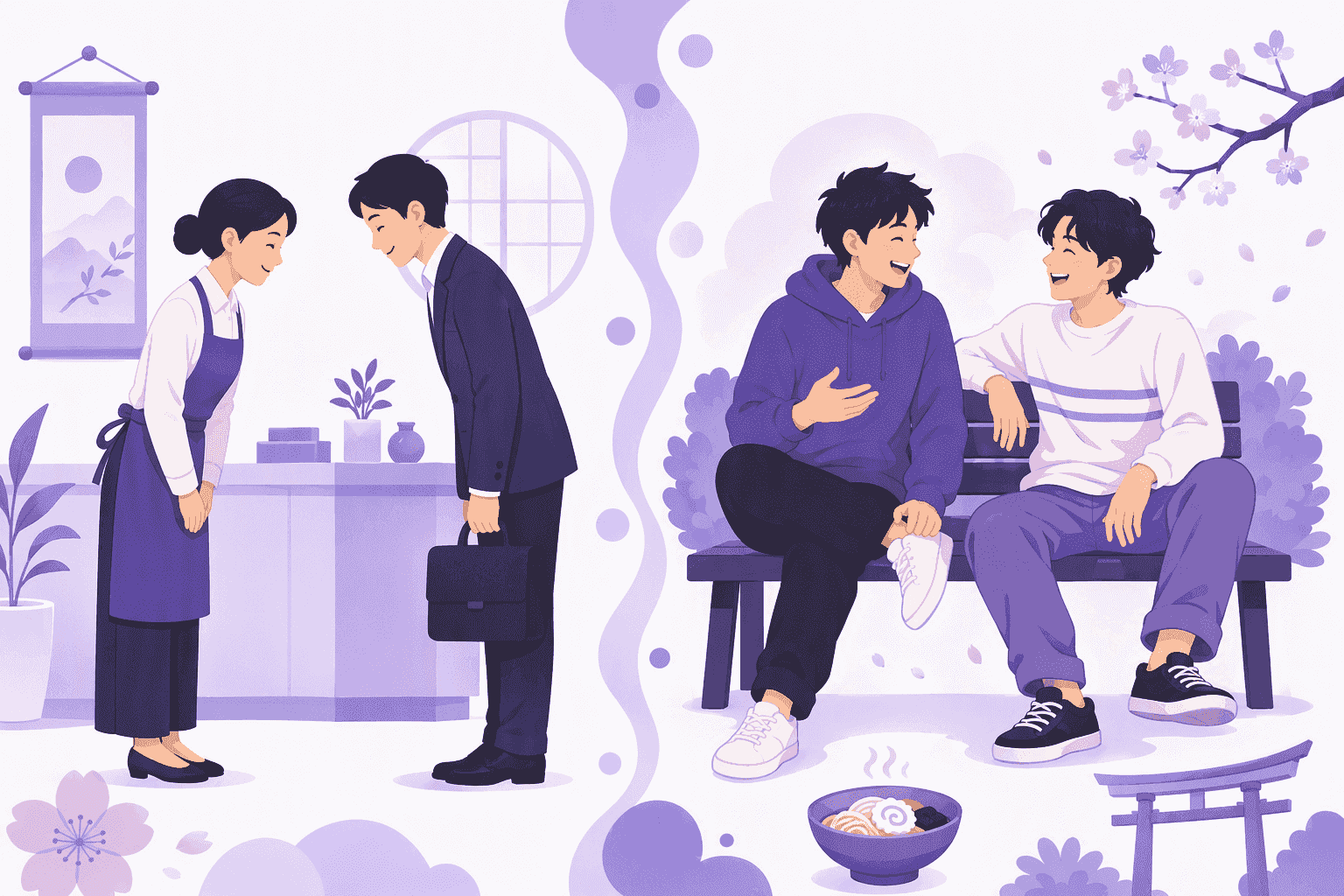
What “present tense” means in Japanese
Japanese grammar is often taught with “present vs past,” but the more accurate framing is non-past vs past. The non-past form covers present and future, and context does the rest.
Linguist Haruo Shirane, in his work on classical and modern Japanese, highlights that tense in Japanese is tightly linked to discourse context rather than a strict time grid. In practical terms, you learn one form and then learn the cues that make it “now,” “usually,” or “later.”
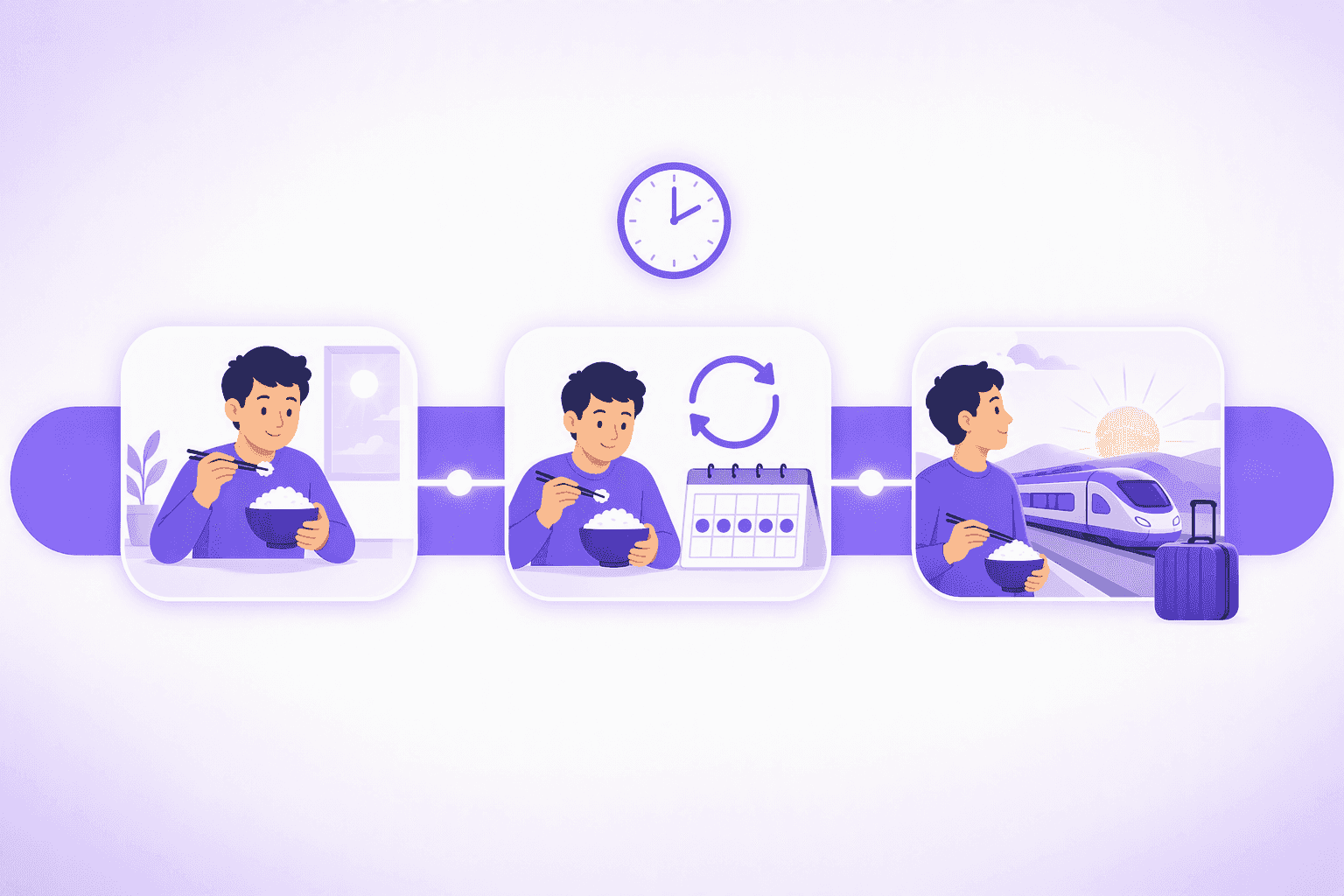
Non-past = present, habitual, or future
These three English ideas often map to the same Japanese form:
- Present (right now): 今、食べます。
- Habitual: 毎日、食べます。
- Future: 明日、食べます。
The verb ending does not change. The time word (今, 毎日, 明日) and the situation do the heavy lifting.
Why this matters for learners
If you try to force English tense logic onto Japanese, you end up overusing ている or adding extra words that sound stiff. A lot of “textbook Japanese” feels unnatural for this reason.
💡 A useful mental model
Treat the non-past as “not finished time.” It can be now, it can be a general truth, or it can be later. Then add time words only when you need to be specific.
The two core non-past styles: ます形 vs 辞書形
Japanese gives you two main ways to say the same content, with different social tone.
- ます形 (masu-form): polite, safe default with strangers
- 辞書形 (jisho-form): plain, used with in-groups and in casual narration
Tae Kim’s grammar guide is especially clear on this point: politeness is not “extra politeness,” it is a core grammatical choice that changes the sentence ending.
ます形: polite non-past
You use ます形 in customer service, classrooms, first meetings, and many workplaces.
Examples:
- 行きます (ee-KEE-mahss): go, will go
- 食べます (tah-BEH-mahss): eat, will eat
- 見ます (MEE-mahss): see, watch
A common beginner mistake is thinking ます means “present” and 辞書形 means “future.” They are both non-past. The difference is social.
辞書形: plain non-past
辞書形 is what you see in dictionaries and what you hear constantly in casual speech.
Examples:
- 行く (ee-KOO): go, will go
- 食べる (tah-BEH-roo): eat, will eat
- 見る (MEE-roo): see, watch
In real TV dialogue, 辞書形 is also the base for many other forms: ない, ている, た, と思う, から, けど, and more.
🌍 Why casual Japanese often sounds 'unfinished'
In everyday conversation, Japanese frequently drops what is obvious from context, including subjects and even copulas. Plain forms fit that style. If you speak only in です/ます all the time, you can sound distant, even if you are being polite.
How to conjugate verbs into non-past (polite and plain)
Japanese verbs fall into three groups. You do not need perfect labels to speak, but you do need the patterns.
Group 1: う-verbs (Godan)
These often end in: う, く, ぐ, す, つ, ぬ, ぶ, む, る (some る verbs are here too).
Polite non-past: change the final sound to the i-row and add ます.
| Dictionary (plain) | Polite non-past | Pronunciation | Meaning |
|---|---|---|---|
| 行く | 行きます | ee-KEE-mahss | go |
| 話す | 話します | hah-NAH-shee-mahss | speak |
| 飲む | 飲みます | noh-MEE-mahss | drink |
| 待つ | 待ちます | MAH-chee-mahss | wait |
Notice the mora timing: まちます is MAH-chee-mahss, not “match-mas.”
Group 2: る-verbs (Ichidan)
These usually end in る after an i or e sound (but there are exceptions).
Polite non-past: drop る and add ます.
| Dictionary (plain) | Polite non-past | Pronunciation | Meaning |
|---|---|---|---|
| 食べる | 食べます | tah-BEH-mahss | eat |
| 見る | 見ます | MEE-mahss | see/watch |
| 起きる | 起きます | oh-KEE-mahss | wake up |
Group 3: irregular verbs
There are two main irregulars:
| Dictionary (plain) | Polite non-past | Pronunciation | Meaning |
|---|---|---|---|
| する | します | shee-MAHSS | do |
| 来る | 来ます | KEE-mahss | come |
Present negative: ません and ない
Negatives are also non-past. They can mean “don’t” (habit) or “won’t” (future).
Polite negative: ません
- 行きません (ee-KEE-mah-SEN): don’t go, won’t go
- 食べません (tah-BEH-mah-SEN): don’t eat, won’t eat
This is the form you will hear in service interactions and formal settings.
Plain negative: ない
Plain negative is built differently for う-verbs vs る-verbs.
る-verbs: drop る, add ない
- 食べない (tah-BEH-nah-ee)
う-verbs: change final sound to the a-row and add ない
- 行かない (ee-KAH-nah-ee)
- 飲まない (noh-MAH-nah-ee)
Exception: ある becomes ない in the negative (a special case you meet early).
⚠️ The 'ない' pronunciation trap
ない is two morae: nah-ee. Do not compress it into “nay.” Clear mora timing is one of the fastest ways to sound more natural in Japanese.
The copula in the non-past: です, だ, and zero
Verbs are only half the story. Japanese also needs a way to say “is/are” for nouns and na-adjectives.
です: polite “is”
- 学生です (gah-KAY SEHSS): I’m a student.
- 静かです (shee-ZOO-kah DEHSS): It’s quiet.
In fast speech, です often sounds closer to “dess,” but keep the mora count in your head.
だ: plain “is” (often dropped)
- 学生だ (gah-KAY dah)
- 静かだ (shee-ZOO-kah dah)
In casual conversation, だ is frequently softened or omitted depending on sentence type and gendered speech style. Many learners overuse だ because it feels like English “is,” but Japanese often does not need it.
i-adjectives do not need だ
- いい (EE-ee): good
- 忙しい (ee-soh-GAH-shee): busy
You can be polite by adding です after an i-adjective, but the adjective itself already carries predicate function:
- 忙しいです (ee-soh-GAH-shee DEHSS): I’m busy.
The form learners call “present continuous”: ている
If you want “I am doing,” you often use ている, but its meaning depends on the verb type. Cure Dolly’s explanations are helpful here because they push learners to stop translating word-for-word and start thinking in Japanese structures.
With activity verbs: ongoing action
- 読んでいる (yohn-DEH ee-roo): is reading
- 食べている (tah-BEH-teh ee-roo): is eating
Polite: 読んでいます (yohn-DEH ee-mahss)
With change-of-state verbs: resulting state
This is where English mapping breaks.
- 結婚している (kehk-KOHN shee-TEH ee-roo): is married (state), not “is marrying”
- 座っている (suh-WAH-tteh ee-roo): is sitting (state)
That small っ in 座って is a full mora: suh-WAH-tteh.
Common real-life use: “currently” vs “usually”
Japanese often uses adverbs to clarify:
- 今、働いています。 (now, currently working)
- 普段は働いています。 (usually work)
How Japanese uses non-past for the future
Because non-past covers future, Japanese leans on time words and plans.
Time words that make future meaning obvious
- 明日 (ah-SHEE-tah): tomorrow
- 来週 (ryah-ee-SHOO): next week (two morae in しゅう: SHOO)
- これから (koh-reh-kah-rah): from now, soon
Example:
- 明日、行きます。 (Tomorrow, I’ll go.)
“Going to” nuance: つもり
If you want a stronger “I intend to,” use つもり:
- 行くつもりです。 (ee-KOO tsoo-MOH-ree DEHSS): I plan to go.
This is a common way to avoid sounding like you are making a promise.
Questions in the non-past: か and rising intonation
Questions are usually formed by:
- adding か in polite speech
- using rising intonation in casual speech
Examples:
- 行きますか。 (ee-KEE-mahss kah): Are you going?
- 行く? (ee-KOO): You going?
If you want more on natural question building, pair this with our broader Japanese verb conjugation guide, since question forms interact with many endings.
Real conversation patterns: dropping subjects and using particles lightly
A lot of present-tense confusion is not tense at all. It is that Japanese often omits the subject.
English: “I go to work.”
Japanese: 仕事行く。 (shee-GOH-toh ee-KOO)
The tense is clear from context. The subject is clear from the situation.
This is also why learning through dialogue helps. When you hear the same non-past form used across contexts, your brain stops demanding an explicit tense marker.
If you are building listening skill through native clips, our guide on learning Japanese with anime explains how to pick scenes where the grammar is clear and repeatable.
Politeness choices you actually need (and the ones you can skip)
You do not need to master every speech level to use non-past correctly, but you do need to avoid mismatches.
Safe defaults
- Use です/ます with strangers, service staff, teachers, older people.
- Use plain forms with friends your age once the relationship is clearly casual.
Common mismatch: polite verb with casual sentence-ending particles
Mixing levels can sound odd:
- 行きますよね is not “wrong,” but it is a specific tone (polite but seeking agreement).
- 行くです is wrong.
If you want to hear how politeness shifts in real speech, compare a polite greeting scene in how to say hello in Japanese with a casual goodbye scene in how to say goodbye in Japanese. The verb endings and sentence-final particles change together.
🌍 A practical workplace insight
In many Japanese workplaces, juniors use です/ます upward, but colleagues at the same rank may switch to plain forms in side conversations. The switch is not about grammar difficulty, it is about social distance and who can overhear.
Mini “present tense” templates you can reuse
These are patterns you can plug vocabulary into immediately.
Polite: daily routine
- 毎日、Xします。 (myah-ee-NEE-chee, eks shee-MAHSS): I do X every day.
- 週末はXします。 (shoo-MAH-tsu wah eks shee-MAHSS): On weekends, I do X.
Casual: plans
- 明日、Xする。 (ah-SHEE-tah, eks soo-ROO): I’ll do X tomorrow.
- これからXする。 (koh-reh-kah-rah eks soo-ROO): I’m going to do X now.
Describing states
- Xです。 (eks DEHSS): It is X. (polite)
- Xだ。 (eks dah): It is X. (plain)
- Xい。 (eks-ee): It’s X (i-adjective)
Common mistakes (and how to fix them fast)
Mistake 1: treating ます as “present” and 辞書形 as “future”
Fix: label both as non-past, then attach time meaning with adverbs.
Mistake 2: overusing ている for “now”
Fix: use simple non-past with 今 when the action is obvious, and reserve ている for ongoing or resulting-state meaning.
Mistake 3: pronouncing long sounds as one beat
Fix: keep mora timing. For example, しゅう (SHOO) is long, and ない is nah-ee. If you collapse beats, your Japanese becomes harder to parse.
Mistake 4: trying to translate “I” in every sentence
Fix: practice dropping the subject. Japanese listeners expect it.
How to practice non-past with real clips (without getting overwhelmed)
A good practice loop is short and repeatable:
- Pick a 5 to 10 second clip with one clear non-past sentence.
- Write the sentence in both polite and plain forms.
- Swap one noun or time word and keep the grammar identical.
This is where movie and TV dialogue is useful: you hear the same structures in different emotional contexts, including soft casual lines like 愛してる (AH-ee-shee-teh-roo) that you might recognize from how to say I love you in Japanese. Even that phrase is non-past, and its meaning is contextual, not “present continuous.”
If you want a contrast in tone, you can also notice how grammar and politeness shift in aggressive speech. Our Japanese swear words guide is useful for recognition, even if you never plan to say those lines.
A quick checklist to choose the right “present tense” form
- Do I need polite distance? Use ます/です.
- Am I speaking inside my in-group? Use plain forms.
- Is it happening right now? Use non-past, add 今 if needed, or use ている if truly ongoing.
- Is it a plan? Use non-past, add a time word, or use つもり for intention.
- Is it a state after a change? Consider ている as a resulting state.
Keep going: build the rest of your verb system
Once non-past feels automatic, past tense and combinations become much easier because Japanese stacks endings in predictable ways. For the next step, use our Japanese verb conjugation guide alongside listening practice so you see the forms in real speech, not just tables.
If you want structured listening built around native dialogue, Wordy’s clip-based practice is designed for exactly this kind of repetition: short scenes where you can hear non-past forms used naturally, then review them until they stick.
Frequently Asked Questions
Does Japanese have a present tense?
What is the difference between 辞書形 and ます形?
Is ている the present tense in Japanese?
How do you make the Japanese present negative?
When should I use です in the present tense?
Sources & References
- National Institute for Japanese Language and Linguistics (NINJAL), corpora and Japanese language resources, accessed 2026
- Agency for Cultural Affairs (文化庁), Japanese language education resources, accessed 2026
- Ethnologue, 27th edition, 2024
- Cure Dolly, Japanese grammar explanations (online), accessed 2026
- Tae Kim, Guide to Japanese Grammar (online), accessed 2026
Start learning with Wordy
Watch real movie clips and build your vocabulary as you go. Free to download.


