Quick Answer
Kanji radicals are recurring character parts that help organize, recognize, and remember Japanese kanji. Learn the most useful radicals first, identify their common positions, and use them as meaning clues rather than as fixed translations.
Japanese kanji radicals are recurring building blocks used to classify characters and often hint at their general meaning. You do not need to learn all 214 traditional radicals before reading Japanese. Start by recognizing common shapes such as 人 /ひと/, 氵 /さんずい/, and 言 /ごんべん/, then use them to break unfamiliar kanji into memorable parts.
Radicals make kanji feel less like thousands of unrelated pictures. They help you spot visual families, use paper dictionaries and radical search tools, and make educated guesses about a new character’s semantic area.
Japanese is spoken by roughly 123 million people, primarily in Japan, according to Ethnologue data. Modern literacy involves a large character inventory: Japan’s Agency for Cultural Affairs lists 2,136 常用漢字 /じょうようかんじ/ as characters for general daily use. Radicals are not a shortcut around that work, but they are one of the most practical systems for handling it.
If you are still building reading foundations, begin with hiragana first, then return to radicals as soon as you meet your first everyday kanji.
| Radical type | Japanese | Pronunciation | Note |
|---|---|---|---|
| person radical | 人 / 亻 | HEE-toh / nee-NYOH | Often appears on the left side of kanji about people or actions. |
| water radical | 水 / 氵 | mee-ZOO / sahn-ZOO-ee | The three-stroke form 氵 commonly appears on the left. |
| speech radical | 言 / 訁 | KOH-toh / gohn-BEHN | Often relates to speaking, language, or communication. |
| heart radical | 心 / 忄 | koh-koh-ROH / ree-SHIN-ben | Common in characters involving feelings, thoughts, and attitudes. |
| hand radical | 手 / 扌 | TEH / teh-HEN | Usually suggests an action performed by hand. |
| wood radical | 木 | KEE | Appears in tree, plant, material, and object-related kanji. |
| fire radical | 火 / 灬 | HEE / rehk-KAH | The four-dot form 灬 often appears at the bottom. |
| roof radical | 宀 | oo-KAHN-moo-ree | Often appears above characters connected with homes or enclosed spaces. |
| mouth radical | 口 | koo-CHIH | Can indicate mouths, openings, speech, or a box-like shape. |
| woman radical | 女 | oh-NNA | Appears in many characters historically associated with women or family. |
| sun radical | 日 | HEE | Often relates to the sun, day, time, brightness, or warmth. |
| thread radical | 糸 / 纟 | ee-TOH / ee-TOH-hen | The left-side form 糸 is common in Japanese kanji. |
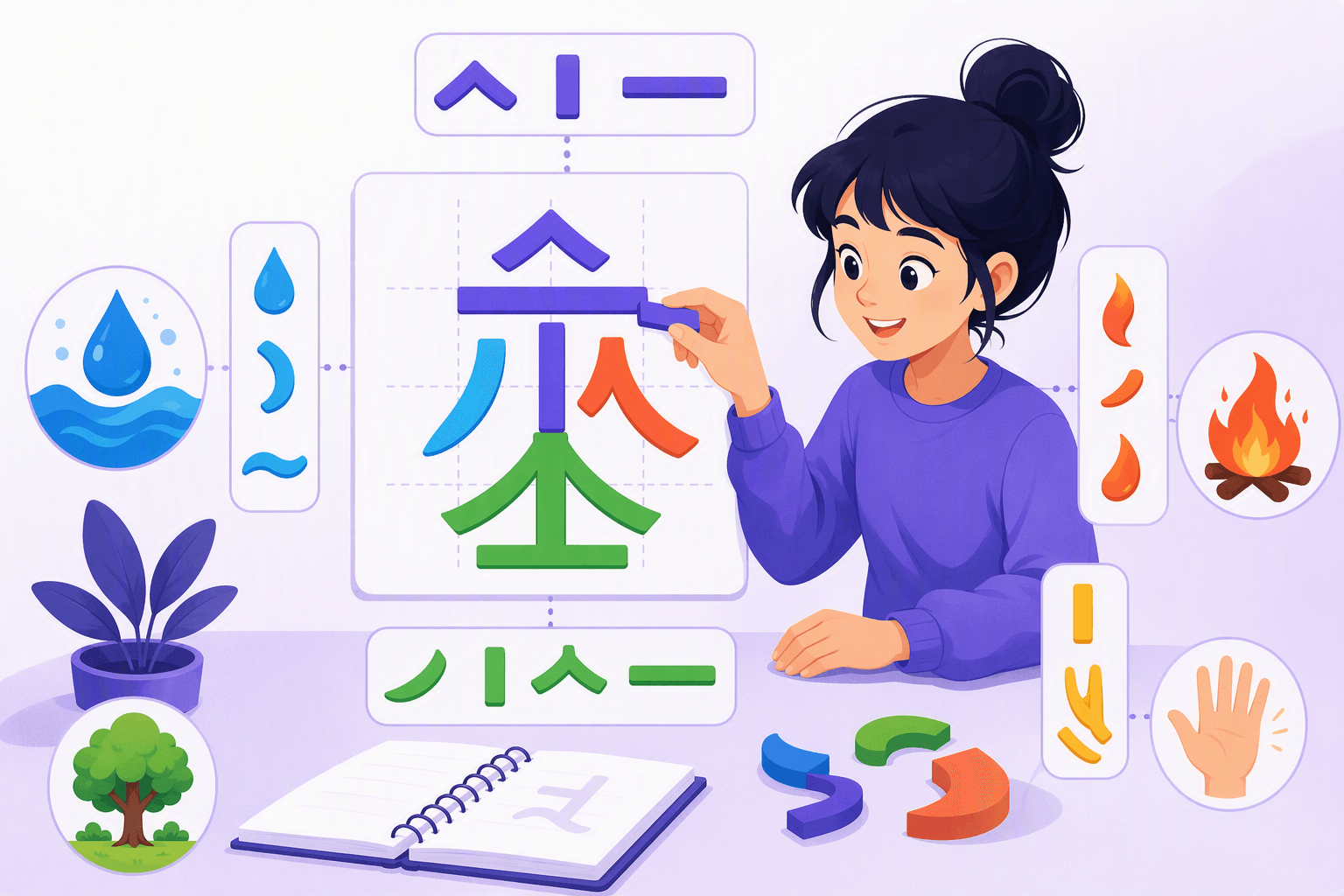
What a kanji radical actually is
A radical is called 部首 /ぶしゅ/ in Japanese, pronounced /bɯ.ɕɯ/. The word literally refers to the section or heading under which a character is classified. In traditional character dictionaries, each kanji is assigned one primary radical.
That definition matters because learners often use radical, component, and element as if they mean exactly the same thing. In practice, they overlap, but they are not identical.
A kanji may contain several recognizable parts. For example, 語 /ご/ contains 言 /げん/ and 吾 /われ/. Its official radical is 言 /げん/, because dictionaries traditionally file it under the speech component.
A component can be anything you can identify within a character. A radical is the component selected for organization. Think of the radical as the dictionary label, not necessarily the only meaningful piece.
Andrew N. Nelson’s The Modern Reader’s Japanese-English Character Dictionary reflects this traditional lookup logic. Jack Halpern’s The Kodansha Kanji Learner’s Dictionary is especially useful for learners because it also emphasizes recognizable patterns, meanings, readings, and practical indexing.
Why radicals help you learn kanji
Radicals support three distinct skills: visual recognition, meaning association, and lookup. Each skill helps, but none works perfectly in every character.
They reduce visual overload
The kanji 銀 /ぎん/ may look dense at first. Once you recognize 金 /かね/ as the metal radical on the left and 艮 /こん/ as the remaining component, it becomes a structure rather than a single complicated drawing.
This is how experienced readers process many characters. They do not consciously count every stroke. They recognize chunks and patterns.
Learning to see chunks is particularly helpful when watching Japanese shows with subtitles. You may not know a word yet, but seeing the same left-side component repeatedly begins to create a visual category. Pair this with Japanese listening practice so that characters, words, and sounds develop together.
They offer broad meaning clues
The water radical 氵 /さんずい/ appears in 海 /うみ/, meaning sea; 洗 /あらう/, meaning to wash; and 泳 /およぐ/, meaning to swim. That does not mean every character with 氵 /さんずい/ is literally about water, but it gives you a useful semantic neighborhood.
Similarly, the hand radical 扌 /てへん/ appears in 持 /もつ/, to hold; 打 /うつ/, to strike; and 指 /ゆび/, finger or point. The repeated link to hands and action is strong enough to help memory.
A radical should be treated as a clue, not a translation. A clue points you in a direction. It does not settle the meaning by itself.
They make dictionary searches easier
Most digital dictionaries let you search by handwriting, keyboard input, or radical. Radical search becomes valuable when you see a kanji on a sign, menu, manga panel, or subtitle but do not know its reading.
First identify the likely radical, then count the remaining strokes. Dictionary systems vary, and stroke counts can be frustrating at first, but the method remains useful when handwriting recognition fails.
The National Institute for Japanese Language and Linguistics, NINJAL, maintains major Japanese-language resources that show how seriously character data and lexical classification matter in Japanese research. Radicals are not merely a classroom tradition, they are part of the infrastructure used to organize written language.
The most useful radicals to learn first
Do not begin with an alphabetical-looking list of 214 forms. Start with radicals that appear frequently in common daily kanji.
人
人 /ひと/, pronounced /çi.to/, means person. Its left-side form is 亻 /にんべん/, pronounced /niɴ.beɴ/.
You will see it in 休 /やすむ/, to rest, which combines person with 木 /き/, tree. The traditional visual story is a person resting against a tree. You will also meet it in 何 /なに/, what, and 住 /すむ/, to live.
The meaning connection is sometimes transparent and sometimes historical. Use stories as memory aids, not as proof of a character’s exact origin.
氵
氵 /さんずい/, pronounced /saɴ.zɯi/, is the compressed form of 水 /みず/, water. It sits on the left in many water-related characters.
Look at 河 /かわ/, river; 酒 /さけ/, alcohol; and 温 /あたたかい/, warm. Not every word stays close to literal water, but the radical provides a useful category signal.
Be careful not to confuse 氵 /さんずい/ with the left-side form of ice, 冫 /にすい/, pronounced /ni.sɯi/. Ice has two strokes, water has three.
言
言 /こと/, pronounced /ko.to/, becomes 訁 /ごんべん/ on the left side. It often points to language, speech, information, or thought expressed through language.
Examples include 話 /はなす/, to speak; 読 /よむ/, to read; 説 /せつ/, explanation or theory; and 語 /ご/, language or word. This is one of the highest-value radicals for beginners because it appears throughout classroom and daily vocabulary.
When you learn greetings such as こんにちは /こんにちは/ and さようなら /さようなら/, the written forms are usually kana. But kanji become central as soon as you move into vocabulary like 言葉 /ことば/, words, and 会話 /かいわ/, conversation. See how Japanese hello expressions work for the spoken side of that transition.
忄
忄 /りっしんべん/, pronounced /ɾiɕ.ɕiɴ.beɴ/, comes from 心 /こころ/, heart or mind. It often occurs in kanji relating to emotion, mental states, evaluation, or inner experience.
Examples include 急 /いそぐ/, to hurry; 性 /せい/, nature or characteristic; and 情 /じょう/, feeling, circumstance, or emotion. The semantic range is broad because 心 /こころ/ in Japanese covers both heart and mind more readily than the English word heart does.
This radical also reveals why direct one-word translations can mislead. Japanese cultural concepts frequently bundle emotion, social awareness, and intention into vocabulary that English divides into separate terms.
扌
扌 /てへん/, pronounced /te.heɴ/, is a reduced form of 手 /て/, hand. It regularly appears in action verbs and physical interactions.
Find it in 押 /おす/, push; 投 /なげる/, throw; and 拾 /ひろう/, pick up. When a new kanji has 扌 /てへん/, ask yourself whether its meaning might involve handling, moving, touching, or doing.
This question will not always give you the answer, but it creates a retrieval hook. Retrieval hooks are more useful than isolated flashcard definitions because they give your memory more than one route back to the word.
宀
宀 /うかんむり/, pronounced /ɯ.kaɴ.mɯ.ɾi/, is the roof radical. You will usually find it at the top of a character.
It appears in 家 /いえ/, house; 室 /しつ/, room; and 安 /やすい/, cheap or safe. The original associations often relate to a roofed or enclosed space, although modern meanings may have moved far from the original image.
Japanese homes, family names, and address systems all create frequent exposure to house-related kanji. Familiarity with 宀 /うかんむり/ makes signs and labels feel more readable sooner.
Radical positions and changing shapes
A radical often changes shape depending on where it appears. The character is still related to the same underlying component.
| Position | Japanese term | Example | What to notice |
|---|---|---|---|
| Left side | へん /へん/ | 氵 in 海 /うみ/ | Left-side radicals often become narrow |
| Right side | つくり /つくり/ | 刂 in 別 /べつ/ | The right side may carry a sound clue |
| Top | かんむり /かんむり/ | 宀 in 家 /いえ/ | Often spread horizontally across the character |
| Bottom | あし /あし/ | 灬 in 熱 /ねつ/ | Often compressed into dots or short strokes |
| Surrounding | かまえ /かまえ/ | 門 in 間 /あいだ/ | Creates an enclosure around another part |
The labels in this table describe position, not meaning. A radical can be a へん /へん/ in one kanji and appear elsewhere in another.
This is why copying a radical chart without seeing real characters produces limited results. You need repeated examples to learn the shape changes naturally.
Meaning radicals and sound components
Many common kanji are 形声文字 /けいせいもじ/, pronounced /keː.seː.mo.dʑi/, meaning characters built from a semantic component and a phonetic component. This is a major reason radicals are useful, but also why they cannot do everything.
For example, the water radical 氵 /さんずい/ in 清 /せい/ gives a meaning connection to liquid, purity, or clarity. The component 青 /せい/ contributes a historical sound clue.
The system is not fully predictable in modern Japanese. Kanji may have 音読み /おんよみ/, pronounced /oɴ.jo.mi/, readings based on historical Chinese pronunciations, and 訓読み /くんよみ/, pronounced /kɯɴ.jo.mi/, readings linked to native Japanese words.
A character’s sound can also differ across compounds. 生 /せい/ has many readings, including /seː/, /ɕoː/, /i.ki.ɾɯ/, and /u.mɯ/. Radicals will help you recognize its written structure, but vocabulary and context must teach you the reading.
💡 Use radicals as clues, not quizzes
When you meet an unfamiliar kanji, identify the radical first, then look for a possible meaning area. Next, check the word in context and learn its actual reading. This sequence builds pattern recognition without encouraging unreliable guesses.
A practical way to study radicals
Study radicals alongside words you are already learning. Five minutes of focused noticing is more effective than trying to memorize a giant chart in one sitting.
Build a small core set
Start with ten to fifteen high-frequency forms: 人 /ひと/, 口 /くち/, 日 /ひ/, 月 /つき/, 木 /き/, 女 /おんな/, 子 /こ/, 手 /て/, 心 /こころ/, 言 /こと/, and 氵 /さんずい/.
Write each one once or twice, then attach it to three familiar kanji. For 木 /き/, you might use 林 /はやし/, forest grove; 森 /もり/, forest; and 校 /こう/, school.
Learn whole words, not character labels alone
Knowing that 愛 /あい/ has a particular radical does not mean you can read or use the word automatically. Learn 愛 /あい/ through expressions such as 愛してる /あいしてる/, pronounced /a.i.ɕi.te.ɾɯ/, and 愛情 /あいじょう/, pronounced /a.i.dʑoː/.
Real expressions add grammar, tone, and social context. For relationship language, compare the nuance in ways to say I love you in Japanese, where the naturalness of a phrase matters as much as the kanji.
Use handwriting strategically
You do not need to hand-copy every kanji fifty times. Write new characters slowly enough to notice their parts and stroke order, then return to them through reading.
The Japan Foundation’s proficiency resources reflect a practical principle: language ability is about what you can understand and do. Radical knowledge matters when it improves reading, recall, and communication, not when it becomes a disconnected test score.
Notice radicals in subtitles and signs
Choose a short scene, pause on a subtitle, and identify one component you recognize. Do not try to decode every character immediately.
For example, if you notice 言 /こと/ in a subtitle, check whether the word relates to saying, explaining, reading, or a word itself. This turns entertainment into a focused recognition exercise. For more structured viewing methods, use learning Japanese with anime.
🌍 Why radicals still matter in a phone-first world
Most Japanese readers now search by keyboard, predictive text, or handwriting recognition, so radical lookup is not an everyday necessity for everyone. Yet radicals remain essential in school materials, character dictionaries, calligraphy, kanji tests, and the visual literacy needed to recognize unfamiliar writing quickly.
Common mistakes to avoid
The first mistake is expecting every radical to reveal a character’s exact meaning. 氵 /さんずい/ provides a semantic direction, not a full definition. The kanji 法 /ほう/, law or method, has the water radical, but its modern meaning is not about water.
The second mistake is treating mnemonic stories as historical facts. A story can help you remember 休 /やすむ/ as person plus tree, but it should not replace a real understanding of the word’s readings and usage.
The third mistake is learning radicals before you can read basic kana. Kana gives you access to pronunciation, grammar, subtitles, and beginner dictionaries. Use the Japanese writing systems overview to see how kanji, hiragana, and katakana divide their jobs.
Finally, avoid assuming that a familiar radical guarantees a familiar reading. Japanese writing connects form, history, sound, and meaning, but not in a one-to-one system. That complexity is normal, and repeated encounters are how it becomes manageable.
The best next step
Choose ten radicals from the table, find three common kanji for each, and learn at least one real word containing each character. Review them while reading subtitles, song lyrics, menus, or graded material.
Radicals will not make every kanji transparent. They will make the script more organized, more memorable, and far less intimidating. Once you can see the repeated parts, every new character has somewhere to begin.
Frequently Asked Questions
How many kanji radicals are there?
Are radicals the same as kanji components?
Do radicals tell you how to pronounce a kanji?
What is the best way to memorize Japanese radicals?
Should beginners learn radicals before hiragana and katakana?
Sources & References
- National Institute for Japanese Language and Linguistics, Japanese Language Resources
- Agency for Cultural Affairs, List of Joyo Kanji
- The Japan Foundation, Japanese-Language Proficiency Test Can-do Resources
- Andrew N. Nelson, The Modern Reader's Japanese-English Character Dictionary, Tuttle Publishing
- Jack Halpern, The Kodansha Kanji Learner's Dictionary, Kodansha
Start learning with Wordy
Watch real movie clips and build your vocabulary as you go. Free to download.


