Quick Answer
Golden Week is Japan's late-April and early-May holiday period, built around four national holidays. In 2026, the main break falls from May 2 to May 6 for many workers, bringing heavy travel, crowded attractions, family visits, and a distinct holiday atmosphere across Japan.
Golden Week is one of Japan's busiest holiday periods: a run of national holidays from late April to early May when many people take time off, travel, see family, and visit seasonal events. In 2026, the main practical break is May 2 to May 6, although April 29 is also a national holiday. If you are visiting Japan, expect crowded trains and higher demand for hotels, but also lively parks, festivals, and a strong sense of shared holiday time.
The Japanese name for Golden Week is ゴールデンウィーク /ɡoːɾɯdeɰ̃ wiːkɯ/. The English-style name was popularized by Japan's film industry in the 1950s, after cinemas noticed exceptionally high ticket sales during the spring holiday cluster.
For Japanese learners, Golden Week is also a useful window into how holidays work in daily life. You will hear colleagues discuss travel plans, families talk about homecoming, and broadcasters report on traffic congestion, airport queues, and shinkansen reservations. Start with essential everyday language in our Japanese hello guide, then use this guide to understand the social context behind the holiday season.
| English | Japanese | Pronunciation | Note |
|---|---|---|---|
| Are you busy or crowded? | 混んでいますか? | KON-deh ee-MAHSS-kah | IPA: /koɰ̃.de i.ma.sɯ ka/. Useful for trains, restaurants, and attractions. |
| It is very crowded. | とても混んでいます。 | toh-TEH-moh KON-deh ee-MAHSS | IPA: /totemo koɰ̃de imasɯ/. |
| Enjoy your holiday. | お休みを楽しんでください。 | oh-yah-SOO-mee oh tah-noh-SHEEN-deh koo-dah-SYE | IPA: /o jasɯmi o tanoɕĩnde kɯdasai/. Polite and warm. |
| What are you doing during the long weekend? | 連休は何をしますか? | REHN-kyoo wah NAH-nee oh shee-MAHSS-kah | IPA: /ɾeɰ̃kʲɯː wa nani o ɕimasɯ ka/. Appropriate with colleagues or acquaintances. |
| I am going back to my hometown. | 実家に帰ります。 | JIK-kah nee kah-eh-ree-MAHSS | IPA: /d͡ʑikka ni kaeɾimasɯ/. Common when visiting one's family home. |
| Have a safe trip. | 気をつけて行ってください。 | kee oh tsoo-KEH-teh eet-TEH koo-dah-SYE | IPA: /ki o tsɯkete itte kɯdasai/. A polite send-off. |
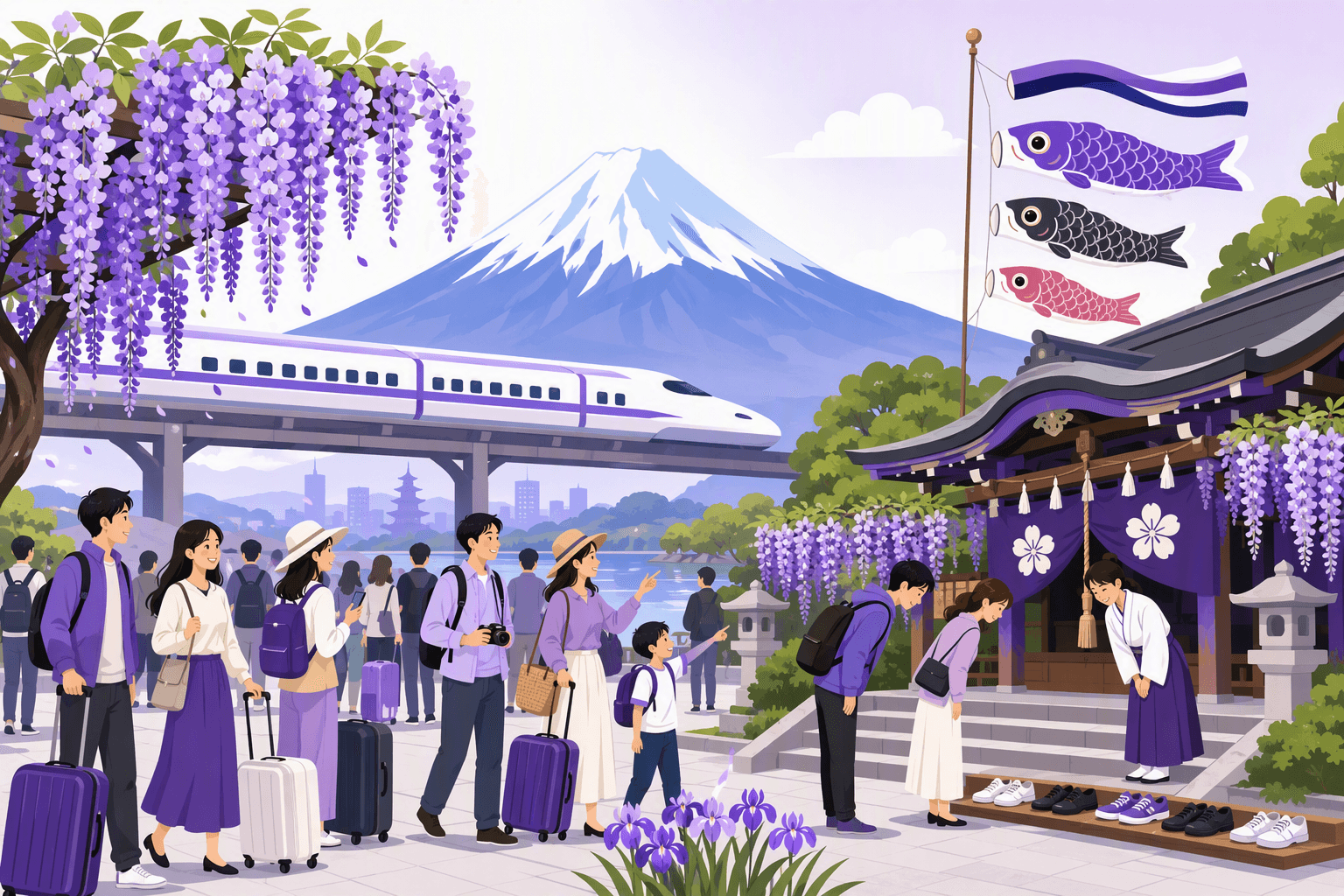
What holidays make up Golden Week?
Golden Week is not one official holiday. It is a popular label for four national holidays that occur close together. Japan's Act on National Holidays establishes the dates, while rules on substitute holidays can create an even longer break.
In 2026, the official dates are separated into two blocks. April 29 falls on a Wednesday, then the May holidays create a five-day stretch for many people from Saturday, May 2 through Wednesday, May 6.
| Date in 2026 | Holiday | Japanese name | What it recognizes |
|---|---|---|---|
| April 29 | Shōwa Day | 昭和の日 | The Shōwa era and reflection on Japan's modern history |
| May 3 | Constitution Memorial Day | 憲法記念日 | The postwar Constitution of Japan |
| May 4 | Greenery Day | みどりの日 | Nature and environmental appreciation |
| May 5 | Children's Day | こどもの日 | Children's health, happiness, and growth |
| May 6 | Substitute Holiday | 振替休日 | A replacement day because May 3 is a Sunday |
Shōwa Day
Shōwa Day is 昭和の日 /ɕoːwa no çi/. It marks the birthday of Emperor Shōwa, known internationally as Emperor Hirohito, whose reign lasted from 1926 to 1989.
The day is not primarily a celebration of the emperor as an individual. Its legal purpose is reflection on the Shōwa period, a time that included war, postwar reconstruction, rapid economic growth, and deep social change.
Constitution Memorial Day
Constitution Memorial Day is 憲法記念日 /ke̞mpoː kiɲe̞ɲbi/, held on May 3. It commemorates the date Japan's current constitution came into effect in 1947.
It can prompt television documentaries, newspaper commentary, and public discussion about democracy, peace, and constitutional law. Visitors may not notice ceremonies in the street, but the date has major civic significance.
Greenery Day
Greenery Day is みどりの日 /midoɾi no çi/, literally green day. It encourages appreciation of nature and is well suited to the season, when much of Japan is bright with new foliage.
Public gardens, hiking areas, and botanical parks are especially popular. This is also when people talk about 新緑 /ɕiɰ̃ɾʲokɯ/, the fresh green leaves of early summer, rather than the autumn colors associated with 紅葉 /koːjoː/.
Children's Day
Children's Day is こどもの日 /kodomo no çi/, on May 5. Families traditionally fly carp-shaped streamers called 鯉のぼり /ko.i noboɾi/, which symbolize strength and perseverance because carp are believed to swim upstream.
You may also see displays of warrior helmets, called 兜 /kabɯto/, and samurai dolls. These customs historically centered on boys, but the national holiday itself now celebrates the wellbeing and growth of all children and expresses gratitude toward parents.
🌍 Look for carp streamers
鯉のぼり /ko.i noboɾi/ are often flown outside houses, schools, shopping centers, and riverside parks before May 5. The largest black carp traditionally represents the father, the red or pink carp the mother, and smaller carp the children. Displays vary by household and region.
Why Golden Week changes travel across Japan
Golden Week affects Japan because many people have the same days off. Japan has about 123 million first-language Japanese speakers, and the country combines a dense rail network with a strong domestic travel culture. When schools, offices, and factories pause at once, movement concentrates sharply around a few dates.
Japan National Tourism Organization data recorded 36.87 million international visitors in 2024, a record high. During Golden Week, those visitors share major attractions with domestic holidaymakers, especially in Tokyo, Kyoto, Osaka, Hakone, Nara, and Okinawa.
The busiest travel days are often the beginning and end of the break. News reports commonly show packed platforms at Tokyo Station, long expressway queues, and airport departure boards full of domestic flights.
The shinkansen is usually reliable, but reliability does not mean empty seats. Reserved seats can sell out well in advance, while unreserved cars can involve long platform lines. If you need a specific departure, book before arriving in Japan where possible.
Travel advice for visitors in 2026
Book accommodation first, then reserve intercity transport. A flexible hotel plan is less useful if every practical train route is sold out.
Try traveling early in the morning or later in the evening. Midday departures on the first major day of the break and returns toward the end are usually the least comfortable choices.
Choose one neighborhood or region per day instead of crossing a city repeatedly. In Kyoto, for example, a short geographic plan often saves more time than trying to see every famous temple.
For a quieter experience, consider smaller cities, rural hot-spring towns, or destinations outside the most famous route between Tokyo and Osaka. They will not be empty, but the crowd pressure can be noticeably lower.
💡 Reserve seats, then leave room for spontaneity
Golden Week is a good time for a carefully planned framework: reserve long-distance trains, key hotels, and any timed museum entry. Keep meals, walks, neighborhood exploration, and small local stops flexible, because queues and weather can change a day's pace.
The social side of a long Japanese holiday
Golden Week is not simply a tourist rush. For many residents, it is a chance to return to a family home, called 実家 /d͡ʑikka/, catch up on rest, or take a short trip with friends.
Returning home is often called 帰省 /kiseː/, especially when someone travels from a large city back to their hometown. The idea resembles a homecoming more than a formal holiday obligation, although family expectations vary widely.
Joy Hendry's Understanding Japanese Society explains how relationships, seasonal rhythms, and social roles shape ordinary Japanese life. Golden Week makes that pattern visible: a national calendar creates shared time, but people use it differently according to work, family location, money, and personal preference.
Some people actively avoid travel. A phrase such as 家でゆっくりします /ie de jɯkkɯɾi ɕimasɯ/, meaning I will relax at home, is a perfectly normal Golden Week plan.
Work messages and holiday boundaries
In offices, coworkers may exchange a brief farewell before the break. お休みを楽しんでください /o jasɯmi o tanoɕĩnde kɯdasai/ means enjoy your holiday and is polite without being overly personal.
Do not expect fast replies to non-urgent work messages. Japan's work culture is diverse, but Golden Week is one of the clearest periods when many teams recognize a genuine pause.
If you are leaving someone after discussing travel plans, 気をつけて行ってください /ki o tsɯkete itte kɯdasai/ means please have a safe trip. For more natural parting options, see our guide to saying goodbye in Japanese.
Food, family, and seasonal symbols
Golden Week has no single national menu comparable to the New Year dishes of お正月 /oɕoːɡat͡sɯ/. Instead, its food traditions are most visible around Children's Day.
柏餅 /kaɕiwamot͡ɕi/ is a rice cake filled with sweet bean paste and wrapped in an oak leaf. Oak leaves do not fall until new buds appear, so they became associated with family continuity.
Another common seasonal item is ちまき /t͡ɕimaki/, a wrapped rice dumpling whose form and ingredients vary by region. In Kansai, traditions can differ notably from those in the Tokyo area.
Emiko Ohnuki-Tierney's Rice as Self: Japanese Identities Through Time examines rice as a cultural symbol as well as a staple food. That perspective helps explain why seasonal rice foods can carry family, place, and continuity meanings far beyond their ingredients.
For a broader look at seasonal celebrations, compare Golden Week with Japanese New Year customs. The two periods are very different: New Year is more strongly tied to family ritual and formal greetings, while Golden Week is often a mix of recreation, travel, and practical rest.
Golden Week etiquette for travelers
Be patient in queues. Standing in line is a normal and organized part of public life in Japan, particularly at train platforms, elevators, restaurants, and popular attractions. Cutting ahead, blocking a queue, or spreading luggage across limited space will be noticed.
Keep your voice low on public transport. A crowded train is not an invitation to speak loudly or take long phone calls. Use headphones, silence notifications, and move backpacks to the front when space is tight.
Respect reserved areas and posted rules. During major holiday periods, staff may direct visitors through one-way routes, limit entry, or separate lines for ticket holders. These systems reduce congestion, so follow them even if they feel unfamiliar.
Avoid treating every local celebration as a photo opportunity. Ask before photographing children, families, religious spaces, or people in traditional dress. A simple すみません /sɯmimasẽɰ̃/ can get attention politely, and our Japanese travel phrases guide offers more practical language for public situations.
🌍 Do not confuse Golden Week with a single festival
Golden Week is a holiday period, not one nationwide event with a fixed ceremony. A city may host parades, exhibitions, sports events, or children's activities, while another area may simply be busy with travelers. Check the local calendar for the place you are visiting.
How to experience Golden Week well
Golden Week can be enjoyable if you treat crowds as part of the season rather than as a planning failure. Pick fewer major sights, make reservations early, and use quiet morning hours for places that become packed after lunch.
It is also an excellent listening opportunity for learners. Watch a Japanese news segment about 渋滞 /d͡ʑɯːtai/, traffic congestion, or 帰省ラッシュ /kiseː ɾaɕɕɯ/, the rush of people returning home. You will hear dates, destinations, weather language, numbers, and polite announcements in a meaningful context.
Movies and television clips can make these recurring expressions easier to recognize in real speech. After learning the holiday vocabulary, explore how to learn Japanese with anime for a practical way to connect scripted dialogue with everyday cultural situations.
Golden Week shows Japan at a revealing moment: public schedules slow down, transport speeds up, families reconnect, and the entire country negotiates shared space. Learn a few phrases, plan well, and you will understand far more than the crowds.
Frequently Asked Questions
What is Golden Week in Japan?
When is Golden Week in Japan in 2026?
Is it a bad idea to visit Japan during Golden Week?
Do shops and restaurants close during Golden Week?
What should I say to someone during Golden Week?
Sources & References
- Cabinet Office, Japan's National Holidays, accessed 2026
- National Diet Library, The Act on National Holidays, accessed 2026
- Japan National Tourism Organization, Visitor Arrivals Statistics, 2024
- Joy Hendry, Understanding Japanese Society, Routledge
- Emiko Ohnuki-Tierney, Rice as Self: Japanese Identities Through Time, Princeton University Press
Start learning with Wordy
Watch real movie clips and build your vocabulary as you go. Free to download.


