Quick Answer
The days of the week in Japanese are 月曜日, 火曜日, 水曜日, 木曜日, 金曜日, 土曜日, and 日曜日. Each day combines an element, planet, or celestial body with 曜日, meaning day of the week, and Japanese calendars usually begin with Sunday.
Days of the Week in Japanese
The days of the week in Japanese are 月曜日 /ɡe.tsɯ.joː.bi/, 火曜日 /ka.joː.bi/, 水曜日 /sɯi.joː.bi/, 木曜日 /mo.kɯ.joː.bi/, 金曜日 /kiɲ.joː.bi/, 土曜日 /do.joː.bi/, and 日曜日 /ni.tɕi.joː.bi/. Learn the first character of each name first, then add 曜日 /joː.bi/, and you will be able to read Japanese calendars, make plans, and understand dates in everyday conversation.
Japanese has about 123 million first-language speakers, according to Ethnologue, and day names are among the most useful early vocabulary because they appear constantly in school schedules, work messages, shop notices, TV listings, and appointment reminders. Pair these words with Japanese numbers and dates become far easier to handle.
| English | Japanese | Pronunciation | Note |
|---|---|---|---|
| Monday | 月曜日 | get-soo-YOH-bee | Moon day |
| Tuesday | 火曜日 | kah-YOH-bee | Fire day |
| Wednesday | 水曜日 | soo-EE-YOH-bee | Water day |
| Thursday | 木曜日 | moh-KOO-YOH-bee | Wood day |
| Friday | 金曜日 | keen-YOH-bee | Gold or metal day |
| Saturday | 土曜日 | doh-YOH-bee | Earth day |
| Sunday | 日曜日 | nee-CHEE-YOH-bee | Sun day |
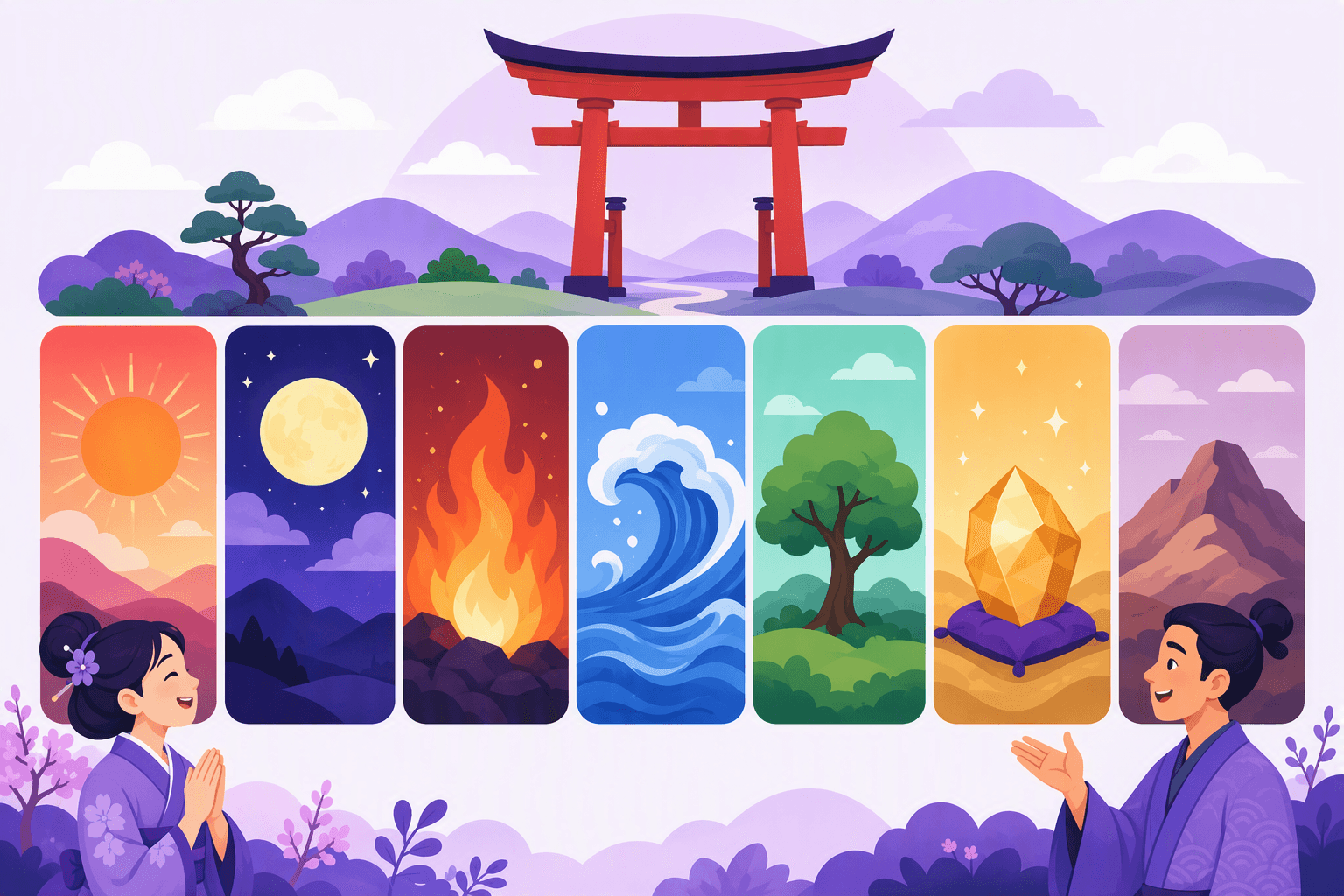
The basic pattern: 曜日
Every full Japanese day name ends in 曜日 /joː.bi/, meaning day of the week. The first kanji identifies the specific day. Once you recognize the seven first characters, you can read a timetable quickly even before you feel comfortable reading full Japanese sentences.
The character 曜 /joː/ is not common in beginner conversation outside this word. Treat 曜日 /joː.bi/ as one fixed calendar unit rather than trying to use 曜 /joː/ independently.
The seven-day sequence is built around the moon, sun, and the five classical elements: fire, water, wood, metal, and earth. This framework came to Japan through the broader East Asian calendar tradition. Masayoshi Shibatani, in The Languages of Japan, places Japanese writing and much of its learned vocabulary within this long history of cultural exchange with the continent.
The seven Japanese days, explained
月曜日
月曜日 /ɡe.tsɯ.joː.bi/ means Monday. The first character, 月 /tsɯki/ or /ɡe.tsɯ/ in compounds, means moon, so Monday is literally moon day.
The word has five morae: げ・つ・よ・う・び. The long vowel in よう /joː/ takes two mora beats, so avoid compressing it into a quick single syllable.
Example: 月曜日は仕事です。/ɡe.tsɯ.joː.bi wa ɕi.ɡo.to de.sɯ/
“I work on Monday.”
火曜日
火曜日 /ka.joː.bi/ means Tuesday. 火 /hi/ means fire by itself, but its reading changes to /ka/ in this compound.
Example: 火曜日に会議があります。/ka.joː.bi ni ka.i.ɡi ɡa a.ɾi.ma.sɯ/
“There is a meeting on Tuesday.”
Japanese uses に /ni/ after a specific day when saying that something happens on that day. You can omit it in short, informal scheduling language, but it is useful to learn early.
水曜日
水曜日 /sɯi.joː.bi/ means Wednesday. 水 /mʲi.zɯ/ means water, while the compound reading begins with /sɯi/.
This is one of the most frequently mispronounced days by English speakers. Say each mora: す・い・よ・う・び. The /sɯi/ sequence is two morae, not one blended sound.
Example: 水曜日は休みです。/sɯi.joː.bi wa ja.sɯ.mi de.sɯ/
“Wednesday is my day off.”
木曜日
木曜日 /mo.kɯ.joː.bi/ means Thursday. 木 /ki/ means tree or wood alone, but in 木曜日 /mo.kɯ.joː.bi/ it uses the reading /mo.kɯ/.
The connection is wood day, not tree day in ordinary translation. Still, remembering the visible tree character can help you distinguish Thursday from the other days on a calendar.
Example: 木曜日の夜は空いています。/mo.kɯ.joː.bi no jo.ɾɯ wa a.i.te i.ma.sɯ/
“I am free on Thursday night.”
金曜日
金曜日 /kiɲ.joː.bi/ means Friday. 金 /ka.ne/ can mean money or gold in everyday Japanese, while in this weekday name it represents metal or gold.
The sound /ɲ/ is close to the sound in the middle of “canyon.” Do not pronounce the first part as English “kin” with a hard final /n/. Let the tongue move toward the following /j/ sound.
Example: 金曜日に映画を見ます。/kiɲ.joː.bi ni eː.ɡa o mi.ma.sɯ/
“I will watch a movie on Friday.”
Friday is a useful day for film-based study routines. Try watching a short scene, replaying it with Japanese subtitles, and collecting only three useful expressions. Our guide to learning Japanese with anime explains how to turn entertainment into focused listening practice.
土曜日
土曜日 /do.joː.bi/ means Saturday. 土 /tsɯtɕi/ means earth or soil, but the weekday compound uses /do/.
Saturday is often associated with weekend plans, yet do not assume every workplace follows a Monday-to-Friday schedule. Retail staff, hospitality workers, and students with club activities may all use Saturday as a regular work or study day.
Example: 土曜日に友達と出かけます。/do.joː.bi ni to.mo.da.tɕi to de.ka.ke.ma.sɯ/
“I am going out with friends on Saturday.”
日曜日
日曜日 /ni.tɕi.joː.bi/ means Sunday. 日 /hi/ means sun or day on its own, but the weekday reading is /ni.tɕi/.
The character 日 /hi/ also appears in words for Japan, dates, and daily life, so it is worth recognizing immediately. Sunday is often printed in red on Japanese calendars, while Saturdays may appear in blue, although this is a convention rather than a language rule.
Example: 日曜日は家でゆっくりします。/ni.tɕi.joː.bi wa i.e de jɯk.kɯ.ɾi ɕi.ma.sɯ/
“I relax at home on Sunday.”
How Japanese calendars abbreviate days
A Japanese calendar often uses one character per day:
| Full day name | Calendar abbreviation | Meaning |
|---|---|---|
| 月曜日 /ɡe.tsɯ.joː.bi/ | 月 /ɡe.tsɯ/ | Monday |
| 火曜日 /ka.joː.bi/ | 火 /ka/ | Tuesday |
| 水曜日 /sɯi.joː.bi/ | 水 /sɯi/ | Wednesday |
| 木曜日 /mo.kɯ.joː.bi/ | 木 /mo.kɯ/ | Thursday |
| 金曜日 /kiɲ.joː.bi/ | 金 /kiɲ/ | Friday |
| 土曜日 /do.joː.bi/ | 土 /do/ | Saturday |
| 日曜日 /ni.tɕi.joː.bi/ | 日 /ni.tɕi/ | Sunday |
You will see these single-character forms on train posters, booking interfaces, classroom schedules, and signs showing business hours. For example, 月〜金 /ɡe.tsɯ ka.ɾa kiɲ/ means Monday through Friday, while 土日 /do.ni.tɕi/ means Saturday and Sunday.
🌍 Sunday is often the first column
Many Japanese monthly calendars place 日 /ni.tɕi/, Sunday, in the leftmost column and 土 /do/, Saturday, in the rightmost column. A Monday-first layout also exists, particularly in business and international contexts. When booking an appointment, follow the actual calendar headings rather than relying on position alone.
Useful phrases for plans and schedules
To say “on Monday,” use 月曜日に /ɡe.tsɯ.joː.bi ni/. To say “Monday’s class” or “on Monday morning,” link the day to the next noun with の /no/: 月曜日の授業 /ɡe.tsɯ.joː.bi no dʑɯ.ɡʲoː/, “Monday class.”
Here are patterns you will use repeatedly:
| Japanese pattern | Meaning | Example |
|---|---|---|
| 曜日に /joː.bi ni/ | on a day | 金曜日に行きます。/kiɲ.joː.bi ni i.ki.ma.sɯ/ |
| 曜日の + noun | a day’s noun | 火曜日の予定 /ka.joː.bi no jo.teː/, Tuesday’s plans |
| 毎週 + 曜日 | every day of that week | 毎週水曜日 /ma.i.ɕɯː sɯi.joː.bi/, every Wednesday |
| 今週の + 曜日 | this week’s day | 今週の土曜日 /koɲ.ɕɯː no do.joː.bi/, this Saturday |
| 来週の + 曜日 | next week’s day | 来週の月曜日 /ɾa.i.ɕɯː no ɡe.tsɯ.joː.bi/, next Monday |
The Japan Foundation’s learning materials emphasize fixed, practical patterns like these because they let beginners communicate before they have mastered every verb form. Start by swapping only the day name, then add the activity you need.
Weekend and weekday vocabulary
平日 /heː.dʑi.tsɯ/ means weekday, usually Monday through Friday. 週末 /ɕɯː.ma.tsɯ/ means weekend. You may also hear 週末 /ɕɯː.ma.tsɯ/ used broadly for Friday evening through Sunday, depending on the speaker’s plans.
Example: 平日は忙しいです。/heː.dʑi.tsɯ wa i.so.ɡa.ɕiː de.sɯ/
“I am busy on weekdays.”
Example: 週末は何をしますか。/ɕɯː.ma.tsɯ wa na.ni o ɕi.ma.sɯ ka/
“What are you doing this weekend?”
NHK’s language resources are useful evidence that day names belong to ordinary public Japanese, not textbook-only vocabulary. You hear them in weather forecasts, program schedules, sports coverage, and announcements, usually at natural speed.
💡 Learn days as a weekly loop
Do not memorize the seven days as an isolated list. Say your real schedule aloud each morning: 今日 /kʲoː/ is today, tomorrow is 明日 /a.ɕi.ta/, and then name the day and activity. A repeated personal routine makes the sequence easier to retrieve.
Pronunciation points that matter
Japanese is mora-timed, meaning each beat has similar weight. The day names are ideal practice because every word ends with the same two-mora unit, ようび /joː.bi/.
Pay special attention to the long vowel in よう /joː/. It is written with two kana, よ and う, and lasts two morae. Hold it slightly longer than a short vowel: 月曜日 /ɡe.tsɯ.joː.bi/ has five morae, while 火曜日 /ka.joː.bi/ has four.
Bjarke Frellesvig’s A History of the Japanese Language shows why kana spelling, sound structure, and historical vocabulary are closely tied in Japanese. For learners, the practical result is simple: read kana by beat, not by English-style syllable guessing.
For broader sound practice, use the Japanese pronunciation guide. It will help with /ɯ/, long vowels, rhythm, and the contrast between sounds such as /tɕi/ and /ɕi/.
Common mistakes to avoid
Reading the first kanji with its most familiar meaning
木 /ki/ usually means tree, but 木曜日 /mo.kɯ.joː.bi/ is Thursday. 金 /ka.ne/ often means money, but 金曜日 /kiɲ.joː.bi/ is Friday. Weekday names use established compound readings, so learn each whole word.
Saying only the abbreviation out loud
月 /ɡe.tsɯ/ is normal in a written schedule, but saying 月 /ɡe.tsɯ/ alone in conversation can be unclear because the character has several meanings and readings. Say 月曜日 /ɡe.tsɯ.joː.bi/ when speaking unless the context is unmistakable.
Forgetting the long vowel
A rushed ようび /joː.bi/ can make your speech less clear. Tap the rhythm mentally: よ・う・び. This also improves listening, because native speakers maintain the timing even in fast conversation.
Treating every Monday as the same phrase
月曜日 /ɡe.tsɯ.joː.bi/ can mean Monday in general. For “this Monday” or “next Monday,” add context such as 今週の /koɲ.ɕɯː no/ or 来週の /ɾa.i.ɕɯː no/. Japanese speakers rely heavily on this context to identify the intended date.
A practical seven-day study plan
Use one day name each day for one week. On Monday, write 月曜日 /ɡe.tsɯ.joː.bi/ and make a real sentence about your plans. On Tuesday, review Monday and add 火曜日 /ka.joː.bi/. By Sunday, say the whole sequence forward and backward.
Then watch a short Japanese clip and listen specifically for time references. A character arranging a meeting may say 金曜日に /kiɲ.joː.bi ni/, while an announcer may use 土日 /do.ni.tɕi/ for the weekend. Context gives these words a memory hook that flashcards alone cannot provide.
Once you know the days, build outward with Japanese travel phrases and ways to say hello in Japanese. Being able to greet someone, ask about a plan, and name a day turns basic vocabulary into a usable conversation.
Frequently Asked Questions
What are the seven days of the week in Japanese?
Do Japanese calendars start on Sunday or Monday?
Can I shorten Japanese day names?
Why do Japanese days have planet names?
How do I say every Monday in Japanese?
Sources & References
- National Institute for Japanese Language and Linguistics, Japanese Language Resources, accessed 2026
- The Japan Foundation, Marugoto Japanese Language and Culture Materials, accessed 2026
- NHK Broadcasting Culture Research Institute, Japanese Language Resources, accessed 2026
- Ethnologue, Japanese, 27th edition, 2024
- Masayoshi Shibatani, The Languages of Japan, Cambridge University Press
Start learning with Wordy
Watch real movie clips and build your vocabulary as you go. Free to download.


