Quick Answer
Japanese clothing vocabulary starts with 服, fuku, meaning clothes, plus everyday items such as シャツ, shatsu, and 靴, kutsu. This guide teaches the words you need to describe outfits, shop politely, understand sizes, and recognize traditional Japanese clothing.
Japanese clothing vocabulary begins with 服, pronounced /ɸɯ.kɯ/, meaning clothes. Learn everyday words such as シャツ /ɕa.tsɯ/ for a shirt, ズボン /d͡zɯ.boɴ/ for trousers, 靴 /kɯ.tsɯ/ for shoes, and 試着 /ɕi.tɕa.kɯ/ for trying clothes on. These words will help you understand shop signs, describe an outfit, and follow conversations about Japanese fashion.
Japanese is spoken by roughly 123 million first-language speakers, according to Ethnologue's 27th edition. Most live in Japan's 47 prefectures, but Japanese clothing words also travel through anime, street fashion, games, and Japanese communities worldwide. Start with the Japanese greetings you hear every day, then add clothing vocabulary that appears naturally in shops and dramas.
| English | Japanese | Pronunciation | Note |
|---|---|---|---|
| Clothes | 服 | foo-koo | General word for clothes and outfits. |
| Clothing, apparel | 衣類 | ee-roo-ee | Formal word used on labels and signs. |
| Shirt | シャツ | SHAH-tsoo | Usually a Western-style shirt. |
| T-shirt | Tシャツ | TEE SHAH-tsoo | The T refers to T-shirt. |
| Sweater | セーター | SAY-taa | Long vowel in the first sound. |
| Hoodie | パーカー | PAA-kaa | Often a hooded sweatshirt. |
| Jacket | ジャケット | jah-KEHT-toh | Small ッ doubles the t sound. |
| Coat | コート | KOH-toh | Used for outerwear. |
| Dress | ワンピース | wahn-PEE-soo | Literally one-piece, also used for a casual dress. |
| Skirt | スカート | suu-KAA-toh | Long aa sound. |
| Trousers, pants | ズボン | zoo-BOHN | Standard word in Japan. |
| Jeans | ジーンズ | JEE-nzoo | Common casual clothing word. |
| Shorts | ショートパンツ | SHOH-toh PAHN-tsoo | Often used for shorts. |
| Suit | スーツ | SUU-tsoo | Business or formal suit. |
| Uniform | 制服 | say-FOO-koo | School or work uniform. |
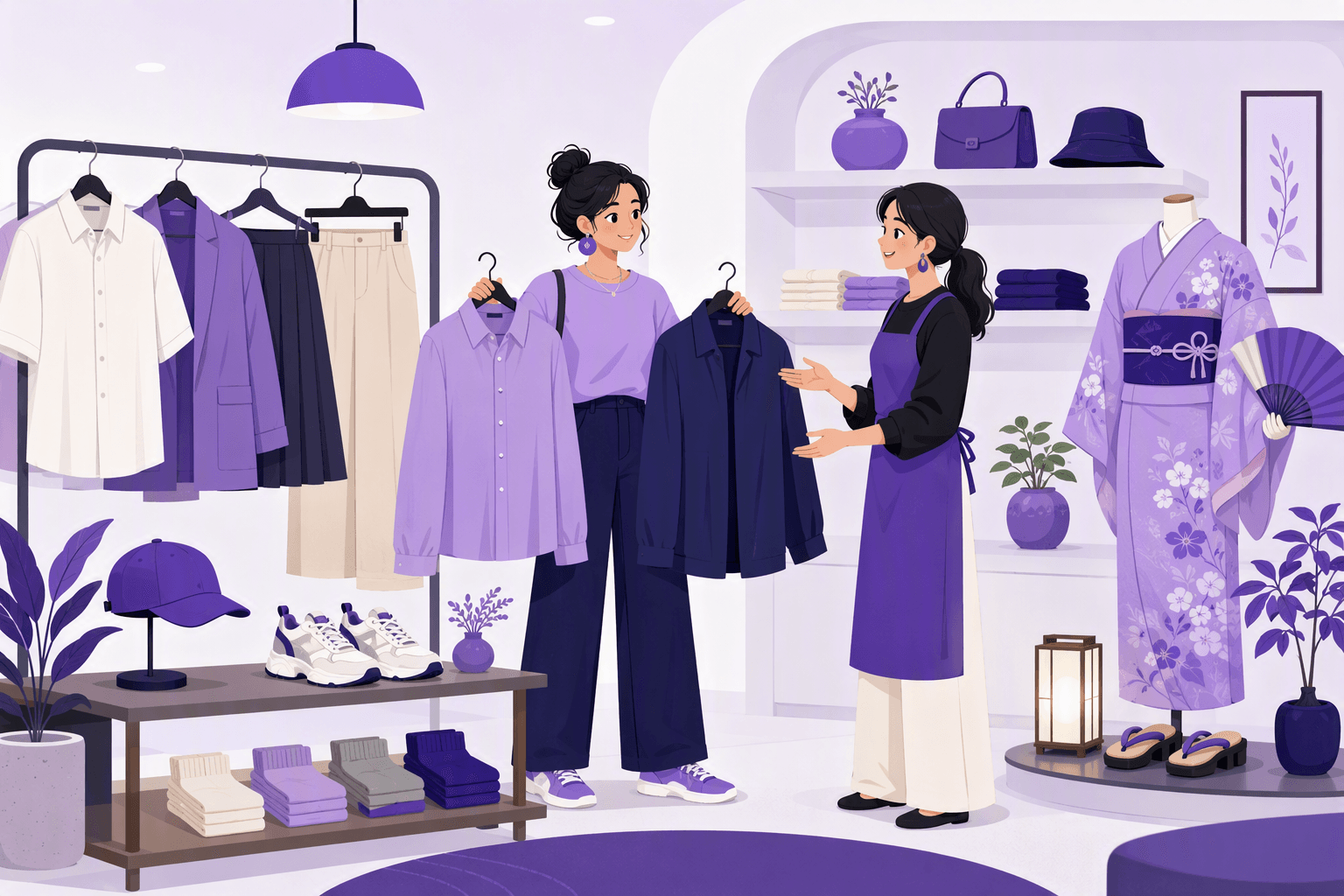
Essential words for everyday clothes
服 /ɸɯ.kɯ/ is the safest general term. You can say 新しい服 /a.ta.ɾa.ɕiː ɸɯ.kɯ/, new clothes, or 服を買う /ɸɯ.kɯ o ka.ɯ/, to buy clothes.
A Japanese speaker may also use ファッション /ɸaɕ.ɕoɴ/ for fashion or personal style. This is a loanword from English, but it does not mean an individual garment. It refers to the broader look, trend, or fashion world.
ズボン /d͡zɯ.boɴ/ is the everyday Japanese term for trousers or pants. In Japanese, it does not carry the underwear meaning that “pants” can have in British English. For jeans, use ジーンズ /d͡ʑiː.ɴ.zɯ/.
Japanese uses many loanwords for modern clothing. The sound patterns still follow Japanese rhythm: ジャケット /d͡ʑa.ke.t.to/ has four morae, and the small ッ /Q/ creates a brief pause before the final ト /to/. Hearing this rhythm makes words in TV dialogue easier to recognize.
Shoes, accessories, and underwear
| English | Japanese | Pronunciation | Note |
|---|---|---|---|
| Shoes | 靴 | koo-tsoo | General word for shoes. |
| Sneakers | スニーカー | suu-NEE-kaa | Casual athletic shoes. |
| Boots | ブーツ | BOO-tsoo | Long oo sound. |
| Sandals | サンダル | SAHN-dah-roo | Open footwear. |
| Socks | 靴下 | koo-tsu-SHEE-tah | Literally shoe-under. |
| Hat | 帽子 | BOH-shee | General word for hat or cap. |
| Cap | キャップ | KYAHP-poo | Usually a baseball cap. |
| Glasses | 眼鏡 | meh-GAH-neh | Can mean prescription glasses or glasses generally. |
| Sunglasses | サングラス | sahn-goo-RAH-soo | A common loanword. |
| Bag | かばん | kah-bahn | Also written 鞄. |
| Necklace | ネックレス | NEHK-koo-reh-soo | Jewelry worn around the neck. |
| Earrings | イヤリング | ee-yah-REEN-goo | Usually clip-on or non-pierced earrings. |
| Pierced earrings | ピアス | pee-AH-soo | Often means earrings worn through piercings. |
| Belt | ベルト | BEH-roo-toh | For trousers, dresses, or fashion styling. |
| Underwear | 下着 | SHEE-tah-gee | Literally under-clothes. |
Shoes and the entrance rule
靴 /kɯ.tsɯ/, shoes, is one of the first clothing words visitors need. In homes, many traditional accommodations, schools, some clinics, and certain restaurants, you remove shoes at the entrance. Indoor slippers, スリッパ /sɯ.ɾip.pa/, may be provided.
Do not wear toilet slippers into the rest of a building. This detail is rarely stated aloud, but it is a familiar social expectation. Japan Foundation cultural resources frequently present everyday etiquette alongside language because knowing a word is only part of knowing how to use it.
Earrings are not always earrings
Japanese distinguishes イヤリング /i.ja.ɾi.ɴ.gɯ/ and ピアス /pi.a.sɯ/. The first often means clip-on earrings, while the second usually refers to pierced earrings or piercing jewelry.
That distinction can save an awkward shopping moment. If you want earrings for pierced ears, ask for ピアス /pi.a.sɯ/, not only イヤリング /i.ja.ɾi.ɴ.gɯ/.
Traditional Japanese clothing vocabulary
| English | Japanese | Pronunciation | Note |
|---|---|---|---|
| Kimono | 着物 | kee-moh-noh | Traditional robe-like garment for formal and casual settings. |
| Yukata | 浴衣 | yoo-KAH-tah | Light cotton summer garment. |
| Obi sash | 帯 | oh-BEE | Wide sash worn with kimono or yukata. |
| Wooden sandals | 下駄 | geh-TAH | Traditional raised wooden footwear. |
| Split-toe socks | 足袋 | tah-BEE | Socks designed for sandals. |
| Kimono sleeve | 袖 | soh-DAY | Sleeves can signal garment formality. |
| Haori jacket | 羽織 | hah-OH-ree | A short jacket worn over kimono. |
| Hakama | 袴 | hah-KAH-mah | Pleated traditional trousers or skirt-like garment. |
| Formal kimono | 振袖 | foo-ree-SOH-day | Long-sleeved formal kimono often worn at coming-of-age ceremonies. |
| Summer festival | 夏祭り | nah-tsu-MAH-tsu-ree | A common setting for yukata. |
着物
着物 /ki.mo.no/ literally relates to something worn, but in modern Japanese it means kimono, not clothing in general. It is worn at weddings, tea ceremonies, graduations, coming-of-age events, funerals, and some seasonal celebrations.
Liza Dalby’s Kimono: Fashioning Culture treats the kimono as clothing shaped by social custom, artistry, gender, and historical change, rather than as an unchanging national costume. That is the useful learner perspective: a kimono is meaningful because its fabric, sleeve length, season, motif, and way of wearing it can all carry information.
浴衣 /jɯ.ka.ta/ is lighter and less formal than a kimono. People commonly wear it to 夏祭り /na.tsɯ.ma.tsɯ.ɾi/, summer festivals, fireworks events, and stays at traditional inns. You may see it in anime scenes set during summer, along with 下駄 /ge.ta/, raised wooden sandals.
🌍 Kimono and yukata are not interchangeable
A kimono can be formal, layered, and highly structured. A yukata is usually unlined cotton and associated with warm weather. Calling every traditional robe a kimono is understandable, but using 浴衣 /jɯ.ka.ta/ for a summer garment sounds more informed.
Describing fit, color, and style
When discussing clothing, Japanese adjectives usually come before the noun. 大きい服 /oː.kiː ɸɯ.kɯ/ means large clothes, while 黒い靴 /kɯ.ɾo.i kɯ.tsɯ/ means black shoes.
Useful style words include かわいい /ka.wa.iː/, cute; かっこいい /ka.k.ko.iː/, cool or stylish; and おしゃれ /o.ɕa.ɾe/, fashionable. The last word can describe a person, place, outfit, or accessory.
| Japanese | IPA | Meaning | Typical use |
|---|---|---|---|
| 大きい | /oː.kiː/ | big | Garment is too large |
| 小さい | /t͡ɕiː.sa.i/ | small | Garment is too small |
| 長い | /na.ga.i/ | long | Sleeves, skirt, or trouser length |
| 短い | /mi.d͡ʑi.ka.i/ | short | Short sleeves or shorts |
| 似合う | /ni.a.ɯ/ | to suit someone | Saying an item looks good on someone |
| かわいい | /ka.wa.iː/ | cute | Style, color, accessory, outfit |
| かっこいい | /ka.k.ko.iː/ | cool, good-looking | Fashionable or impressive appearance |
| おしゃれ | /o.ɕa.ɾe/ | stylish | A fashionable person or item |
似合う /ni.a.ɯ/ is especially useful. To say “That looks good on you,” say 似合っています /ni.a.t.te i.ma.sɯ/. It is warmer and more specific than simply calling an item cute.
Sheila Cliffe’s The Social Life of Kimono examines how people continue to use kimono in contemporary life, including through communities of enthusiasts, stylists, and makers. That matters because traditional clothing in Japan is not only museum material. It remains present in ceremonies, local events, fashion shoots, and ordinary cultural practice.
Shopping for clothes in Japanese
In a shop, begin with これ、試着してもいいですか /ko.ɾe ɕi.tɕa.kɯ ɕi.te.mo iː de.sɯ ka/, meaning “May I try this on?” The word 試着 /ɕi.tɕa.kɯ/ means trying a garment on, and 試着室 /ɕi.tɕa.kɯ.ɕi.tsɯ/ is the fitting room.
Ask Mサイズはありますか /e.mɯ sa.i.d͡zɯ wa a.ɾi.ma.sɯ ka/ for “Do you have a medium?” Japanese shops commonly use S, M, L, and LL. Still, measurements are more reliable than letter sizes.
For a different color, say 違う色はありますか /t͡ɕi.ga.ɯ i.ɾo wa a.ɾi.ma.sɯ ka/. For a different size, say 違うサイズはありますか /t͡ɕi.ga.ɯ sa.i.d͡zɯ wa a.ɾi.ma.sɯ ka/.
💡 A polite fitting-room phrase
Use これを試着してもいいですか /ko.ɾe o ɕi.tɕa.kɯ ɕi.te.mo iː de.sɯ ka/ when you want to try on an item. Staff may give you a numbered tag, direct you to a fitting room, or ask you to use a face cover before trying on a top.
For a natural shopping interaction, pair these phrases with the polite patterns in our guide to Japanese travel phrases. Clothing stores are a practical place to hear short, repeated Japanese exchanges at a manageable speed.
Clothing language in Japanese media
Japanese dramas and anime frequently use clothing to establish a character quickly. A 制服 /seː.ɸɯ.kɯ/, uniform, can signal school life; a スーツ /sɯː.tsɯ/, suit, suggests office work; and a 浴衣 /jɯ.ka.ta/ can place a scene at a summer festival.
Fashion also has distinct subcultures. ストリートファッション /sɯ.to.ɾiː.to ɸaɕ.ɕoɴ/ describes street fashion, while 古着 /ɸɯ.ɾɯ.gi/ means secondhand or vintage clothing. Harajuku became internationally associated with experimental youth fashion, but Tokyo style is not one single look.
The Kyoto Costume Institute’s collections show the breadth of clothing history in Japan and beyond, from court dress to modern designers. Watching clothing-related scenes carefully is useful practice because garments supply visual context, making new vocabulary easier to remember. For more strategies, see how to learn Japanese with anime.
A practical way to memorize Japanese clothes words
Learn clothing in small outfit groups, not as an isolated alphabetical list. Build one sentence around what you are wearing: 今日はジーンズとTシャツです /kjoː wa d͡ʑiːɴ.d͡zɯ to tiː ɕa.tsɯ de.sɯ/, “Today I’m wearing jeans and a T-shirt.”
Then notice each word in real scenes. Pause when a character changes clothes, enters a shoe-free home, prepares for a festival, or shops for an outfit. Repeated context teaches the social meaning of 服 /ɸɯ.kɯ/ alongside the dictionary definition.
As you gain confidence, add personal phrases such as この服が好きです /ko.no ɸɯ.kɯ ga sɯ.ki de.sɯ/, “I like these clothes,” and その帽子、かわいいですね /so.no boː.ɕi ka.wa.iː de.sɯ ne/, “That hat is cute.” Clothing compliments are a gentle way to practice friendly conversation before moving on to Japanese ways to say goodbye or more personal expressions such as I love you in Japanese.
Frequently Asked Questions
What is the Japanese word for clothes?
What should I say when trying on clothes in Japan?
Is kimono the normal word for all Japanese clothes?
How do Japanese clothing sizes compare with US sizes?
What does kawaii mean in Japanese fashion?
Sources & References
- Ethnologue, Japanese, 27th edition, 2024
- The Japan Foundation, Japanese-Language Education and Japanese Studies, accessed 2026
- Kyoto Costume Institute, Digital Archives and Collection Information, accessed 2026
- Liza Dalby, Kimono: Fashioning Culture, University of Washington Press
- Sheila Cliffe, The Social Life of Kimono, Bloomsbury
Start learning with Wordy
Watch real movie clips and build your vocabulary as you go. Free to download.