Quick Answer
At a Japanese convenience store, you can manage most purchases with a few polite phrases: これをください for 'this, please,' 袋はいりません for 'no bag,' and お願いします for 'please.' Learn the questions staff ask, the replies you need, and the small etiquette details that make checkout easy.
Japanese convenience store phrases are short, polite, and highly practical: say これをください /ko.re o ku.da.sa.i/ to buy something, 袋はいりません /fɯ.kɯ.ro wa i.ɾi.ma.seɴ/ if you do not need a bag, and お願いします /o.ne.ɡa.i ɕi.ma.sɯ/ to make almost any request sound courteous. The most useful skill is recognizing the questions cashiers ask, because a typical Japanese checkout moves quickly.
Japan’s コンビニ /koɴ.bi.ni/, short for コンビニエンスストア /koɴ.bi.ni.eɴ.sɯ.to.a/, are far more than snack shops. The Japan Franchise Association reports roughly 55,000 convenience stores nationwide, spread across all 47 prefectures. You can buy meals, withdraw cash, print documents, pay bills, ship parcels, and collect online orders there.
Japanese has around 123 million first-language speakers according to Ethnologue, but you do not need advanced grammar to function at a コンビニ /koɴ.bi.ni/. Start with these phrases, then listen for them in Japanese travel phrases and real clips.
| English | Japanese | Pronunciation | Formality |
|---|---|---|---|
| This one, please | これをください | koh-reh oh koo-dah-sye | polite |
| A bag, please | 袋をお願いします | foo-koo-roh oh oh-neh-gah-ee shee-mahss | polite |
| No bag, thank you | 袋はいりません | foo-koo-roh wah ee-ree-mah-sen | polite |
| Please heat it | 温めてください | ah-tah-tah-meh-teh koo-dah-sye | polite |
| I will pay by card | カードでお願いします | KAH-doh deh oh-neh-gah-ee shee-mahss | polite |
| Thank you very much | ありがとうございます | ah-ree-GAH-toh goh-zah-ee-MAHSS | polite |
The table gives you a fast checkout toolkit. Below, each phrase includes IPA and the situation where it matters most.
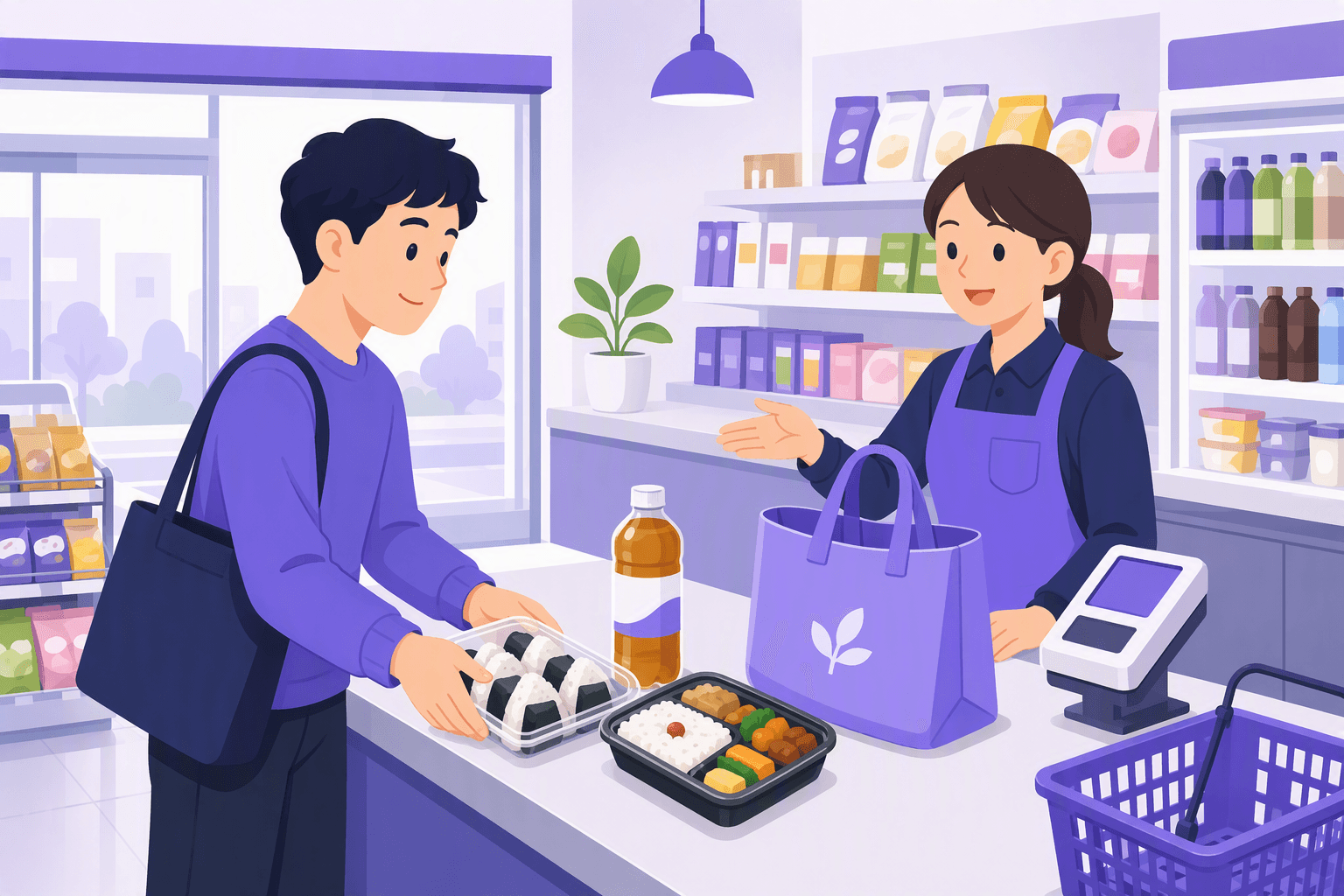
Why Japanese Convenience Stores Matter
A Japanese convenience store is designed for small, frequent errands. People stop in before work for coffee, after school for snacks, late at night for dinner, or on the way home to pay a bill.
The major chains have distinct personalities, but their counter interactions follow the same pattern. A cashier scans your items, asks one or two standard questions, takes payment, and hands over a receipt.
The culture favors efficient politeness rather than lengthy small talk. You do not need to chat, but a calm ありがとうございます /a.ɾi.ɡa.toː ɡo.za.i.ma.sɯ/ at the end is always welcome. For a broader foundation, see how to say hello in Japanese.
🌍 The checkout tray
At many Japanese counters, you place cash or a payment card in a small tray rather than directly into the cashier's hand. This is practical, polite, and common in shops, restaurants, and taxis. Follow the cashier's gesture if you are unsure.
The Essential Checkout Phrases
これをください
IPA: /ko.re o ku.da.sa.i/
This means “this one, please.” Pointing is completely acceptable, especially when buying packaged food, cigarettes, medicine, or a product behind the counter.
/koh-reh oh koo-dah-sye/
Literal meaning: Please give me this
“これをください。”
This one, please.
Use this while pointing to an item. It is polite, direct, and works in almost any shop.
The particle を /o/ marks the item you want. In fast speech, it is pronounced /o/, even though its written form is を. If you know the product name, you can replace これ /ko.re/ with it.
For example, おにぎりをください /o.ni.ɡi.ɾi o ku.da.sa.i/ means “An onigiri, please.” An おにぎり /o.ni.ɡi.ɾi/ is a rice ball, usually wrapped in seaweed and filled with salmon, tuna, or another savory filling.
袋をお願いします
IPA: /fɯ.kɯ.ɾo o o.ne.ɡa.i ɕi.ma.sɯ/
Say this when you want a bag. It literally means “A bag, please,” with お願いします /o.ne.ɡa.i ɕi.ma.sɯ/ making the request polite.
/foo-koo-roh oh oh-neh-gah-ee shee-mahss/
Literal meaning: A bag, please
“袋をお願いします。”
A bag, please.
A small fee is normally added for a plastic bag. Say this clearly if you need one, especially when buying several items.
The word 袋 /fɯ.kɯ.ɾo/ means bag or sack. Cashiers may also call it レジ袋 /ɾe.dʑi.bɯ.kɯ.ɾo/, literally a checkout bag.
Since Japan’s nationwide bag-charge policy began in 2020, staff often ask every customer whether they need one. The question is routine, not a sign that your purchase is unusual.
袋はいりません
IPA: /fɯ.kɯ.ɾo wa i.ɾi.ma.seɴ/
This means “I do not need a bag.” It is one of the most useful phrases to recognize and say quickly.
/foo-koo-roh wah ee-ree-mah-sen/
Literal meaning: As for a bag, it is not needed
“袋はいりません。”
I do not need a bag.
This is a standard response when you are carrying a backpack, tote, or reusable bag. It also saves a small charge.
The negative form いりません /i.ɾi.ma.seɴ/ comes from 要る /i.ɾɯ/, meaning “to be needed.” You may hear a cashier ask 袋はご利用ですか /fɯ.kɯ.ɾo wa ɡo.ɾi.joː de.sɯ ka/, meaning “Will you be using a bag?”
A simple いりません /i.ɾi.ma.seɴ/ is enough. You can also shake your head gently while speaking.
温めてください
IPA: /a.ta.ta.me.te kɯ.da.sa.i/
Use this for a boxed meal, pasta, curry, or another refrigerated item that you want heated in the store microwave. The word 温める /a.ta.ta.me.ɾɯ/ means “to warm” or “to heat.”
/ah-tah-tah-meh-teh koo-dah-sye/
Literal meaning: Please warm it
“これ、温めてください。”
Please heat this.
Convenience store staff heat many prepared meals every day. Pointing to the item makes the request effortless.
More often, the cashier will ask first: 温めますか /a.ta.ta.me.ma.sɯ ka/, “Would you like it heated?” Answer はい、お願いします /ha.i o.ne.ɡa.i ɕi.ma.sɯ/, “Yes, please.”
Do not use this for items that clearly should not be heated, such as cold drinks, ice cream, or delicate packaged desserts. The cashier will usually know, but pointing and asking only for a prepared meal prevents confusion.
💡 One polite word solves many situations
When you are unsure how to form a sentence, point to the item and say お願いします /o.ne.ɡa.i ɕi.ma.sɯ/. It works after a payment method, a bag request, a heating request, and many service requests.
Paying at the Counter
現金でお願いします
IPA: /ɡeɴ.kiɴ de o.ne.ɡa.i ɕi.ma.sɯ/
This means “Cash, please,” or more naturally, “I will pay in cash.” 現金 /ɡeɴ.kiɴ/ means cash, and で /de/ marks the method.
Japan has become more card- and app-friendly, but cash remains common. Having a small amount of yen helps with rural travel, older businesses, and ticket machines.
| Payment method | Japanese | IPA |
|---|---|---|
| Cash | 現金 | /ɡeɴ.kiɴ/ |
| Credit card | クレジットカード | /kɯ.ɾe.dʑit.to kaː.do/ |
| Transportation IC card | 交通系ICカード | /koː.tsɯː.keː ai.ɕiː kaː.do/ |
| Electronic money | 電子マネー | /deɴ.ɕi ma.neː/ |
| Mobile payment | モバイル決済 | /mo.ba.i.ɾɯ ke.sːa.i/ |
To pay by card, say カードでお願いします /kaː.do de o.ne.ɡa.i ɕi.ma.sɯ/. For contactless payment, you may hear タッチで /tat.tɕi de/, meaning “by tap.”
Many stores accept transit cards such as Suica /sɯ.i.ka/ and PASMO /pa.sɯ.mo/, depending on the region and terminal. Hold your card or phone near the reader only after the cashier confirms the payment method.
レシートは大丈夫です
IPA: /ɾe.ɕiː.to wa da.i.dʑoː.bɯ de.sɯ/
This phrase means that you do not need the receipt. The literal sense is closer to “The receipt is fine,” but in context it politely declines it.
You may also simply say いりません /i.ɾi.ma.seɴ/. However, keep receipts when you need proof of purchase, a tax record, or a return.
Asking Where Something Is
Convenience stores are compact, but product layouts differ by chain and neighborhood. Staff can direct you to an item if you use a simple location question.
| English | Japanese | Pronunciation | Note |
|---|---|---|---|
| Where is it? | どこですか | doh-koh dehss-kah | Use after naming or pointing to a product. |
| Rice ball | おにぎり | oh-nee-gee-ree | Usually near sandwiches and prepared food. |
| Chopsticks | お箸 | oh-HAH-shee | Often offered with meals. |
| Fork | フォーク | FOH-koo | Useful for pasta or desserts. |
| Spoon | スプーン | soo-POON | Useful for curry, soup, or pudding. |
| Restroom | トイレ | toh-ee-reh | Ask politely and expect it may be unavailable. |
To ask for an item, say おにぎりはどこですか /o.ni.ɡi.ɾi wa do.ko de.sɯ ka/, meaning “Where are the rice balls?” You can swap in almost any noun.
For utensils, the cashier may ask お箸はお付けしますか /o.ha.ɕi wa o.tsɯ.ke ɕi.ma.sɯ ka/, asking whether you want chopsticks. Answer はい、お願いします /ha.i o.ne.ɡa.i ɕi.ma.sɯ/ or いりません /i.ɾi.ma.seɴ/.
Services Beyond Snacks and Drinks
Japanese convenience stores handle services that visitors often do not expect. You can make photocopies, print photos, buy event tickets, ship domestic parcels, and pay various bills.
支払いをお願いします
IPA: /ɕi.ha.ɾa.i o o.ne.ɡa.i ɕi.ma.sɯ/
Use this for a payment slip. 支払い /ɕi.ha.ɾa.i/ means payment, and the cashier will scan the barcode on your form.
This service is particularly useful for residents paying utilities or online shopping orders. Bring the original slip, not a photo of it, because the barcode must be scanned.
コピーをしたいです
IPA: /ko.piː o ɕi.ta.i de.sɯ/
This means “I would like to make copies.” Most stores have a multifunction machine, often called a マルチコピー機 /ma.ɾɯ.tɕi ko.piː.ki/.
You can also ask すみません、コピー機はどこですか /sɯ.mi.ma.seɴ ko.piː.ki wa do.ko de.sɯ ka/, “Excuse me, where is the copy machine?” Learn more about this essential attention-getter in our guide to saying excuse me in Japanese.
The Politeness You Will Hear
Convenience store staff use polite Japanese automatically. You may hear いらっしゃいませ /i.ɾaɕːa.i.ma.se/ when entering, a standard shop greeting meaning “Welcome.”
You do not need to reply to いらっしゃいませ /i.ɾaɕːa.i.ma.se/. A nod is fine, and many customers say nothing.
You may also hear:
- 少々お待ちください /ɕoː.ɕoː o.ma.tɕi kɯ.da.sa.i/, “Please wait a moment.”
- お待たせしました /o.ma.ta.se ɕi.ma.ɕi.ta/, “Thank you for waiting.”
- ありがとうございました /a.ɾi.ɡa.toː ɡo.za.i.ma.ɕi.ta/, “Thank you very much.”
The Agency for Cultural Affairs’ guidance on 敬語 /keː.ɡo/, Japanese honorific language, explains that service interactions use respectful wording to create social distance and courtesy. As a customer, you do not need to mirror every formal expression. Basic polite forms are enough.
Linguist Haru Yamada’s Different Games, Different Rules examines how interactional expectations vary across Japanese and American settings. At a コンビニ /koɴ.bi.ni/, the key expectation is not elaborate formality. It is brief acknowledgment, predictable cooperation, and respect for the staff member’s workflow.
A Realistic Checkout Script
Here is a typical interaction. The staff member’s exact words may vary, but the sequence is extremely common.
Cashier: 袋はご利用ですか /fɯ.kɯ.ɾo wa ɡo.ɾi.joː de.sɯ ka/
You: 袋はいりません /fɯ.kɯ.ɾo wa i.ɾi.ma.seɴ/
Cashier: 温めますか /a.ta.ta.me.ma.sɯ ka/
You: はい、お願いします /ha.i o.ne.ɡa.i ɕi.ma.sɯ/
Cashier: お支払いは /o.ɕi.ha.ɾa.i wa/
You: カードでお願いします /kaː.do de o.ne.ɡa.i ɕi.ma.sɯ/
Cashier: ありがとうございました /a.ɾi.ɡa.toː ɡo.za.i.ma.ɕi.ta/
You: ありがとうございます /a.ɾi.ɡa.toː ɡo.za.i.ma.sɯ/
The National Institute for Japanese Language and Linguistics documents modern Japanese usage through large language corpora. What you hear at a convenience store is a valuable example of routine, repeated polite speech: short phrases delivered at natural speed in a predictable context.
Common Mistakes to Avoid
Do not say ください /kɯ.da.sa.i/ by itself while handing over money. It means “please give [it to me],” so it needs an object or context. Use お願いします /o.ne.ɡa.i ɕi.ma.sɯ/ when you mean “please” at payment.
Do not worry about saying すみません /sɯ.mi.ma.seɴ/ too much. It is useful for getting attention, beginning a question, or lightly apologizing for interrupting. Its role is broader than English “sorry.”
Avoid assuming every コンビニ /koɴ.bi.ni/ has an open restroom, foreign-language kiosk interface, or identical payment options. Major chains are consistent, but individual locations make their own practical choices.
🌍 Eat where appropriate
Many convenience stores have a small eating area, but not all do. Avoid opening food and eating in narrow aisles or directly outside a busy entrance unless the store clearly provides space. Look for signs reading イートイン /iː.to iɴ/, meaning an eat-in area.
Practice With Real Japanese Speech
Memorizing a phrase is useful, but the decisive skill is recognizing it at normal speed. Watch for checkout scenes in Japanese dramas, anime set in modern cities, and travel videos.
Listen first for recurring sounds: 袋 /fɯ.kɯ.ɾo/, 温め /a.ta.ta.me/, お支払い /o.ɕi.ha.ɾa.i/, and ありがとうございます /a.ɾi.ɡa.toː ɡo.za.i.ma.sɯ/. Once these become familiar, a convenience-store visit stops feeling like a test.
After you master shopping phrases, build your everyday toolkit with Japanese greetings, Japanese restaurant phrases, and useful Japanese travel phrases. A few reliable polite expressions will carry you through a surprising number of real interactions in Japan.
Frequently Asked Questions
What is a convenience store called in Japanese?
Do I need to speak Japanese at a convenience store in Japan?
How do I ask a Japanese convenience store worker to heat my food?
Are plastic bags free at Japanese convenience stores?
Can I pay bills at a Japanese convenience store?
Sources & References
- Japan Franchise Association, Convenience Store Statistics, accessed 2026
- Agency for Cultural Affairs, 敬語の指針, accessed 2026
- The Japan Foundation, Survey Report on Japanese-Language Education Abroad, accessed 2026
- National Institute for Japanese Language and Linguistics, Balanced Corpus of Contemporary Written Japanese
- Ethnologue, Japanese, 27th edition, 2024
Start learning with Wordy
Watch real movie clips and build your vocabulary as you go. Free to download.


