Quick Answer
The most common way to say 'excuse me' in Japanese is すみません (sumimasen, soo-mee-MAH-sen). It can mean 'excuse me,' 'sorry,' and even 'thank you' depending on context. For more formal situations, use 失礼します (shitsurei shimasu, shee-tsu-RAY shee-MAH-su), especially when interrupting, entering, or leaving.
The Short Answer
To say "excuse me" in Japanese, use すみません (sumimasen, soo-mee-MAH-sen) for most everyday situations: getting someone’s attention, passing by, interrupting lightly, or apologizing for a small inconvenience. For more formal moments, especially when entering or leaving a room or interrupting a meeting, use 失礼します (shitsurei shimasu, shee-tsu-RAY shee-MAH-su).
| English | Japanese | Pronunciation | Formality |
|---|---|---|---|
| Excuse me / Sorry / (sometimes) Thanks | すみません | soo-mee-MAH-sen | polite |
| Excuse me (very casual) | ごめん | goh-MEN | casual |
| I'm sorry (more direct apology) | ごめんなさい | goh-men-NAH-sai | polite |
| Excuse me (entering/leaving, interrupting) | 失礼します | shee-tsu-RAY shee-MAH-su | formal |
| Excuse me (softly, to get attention) | ちょっと… | chot-to... | casual |
| Pardon me (formal, 'please forgive') | 失礼いたしました | shee-tsu-RAY ee-tah-shee-MAH-shee-tah | formal |
| Excuse me (calling someone above you) | 恐れ入ります | oh-SOH-ray ee-REE-mahs | formal |
| Excuse me (asking a stranger) | すみません、ちょっといいですか | soo-mee-MAH-sen, chot-to ee des kah | polite |
Japanese is spoken by roughly 123 million people worldwide, according to Ethnologue (2024). Most of those speakers are in Japan, but Japanese is also studied globally, and politeness phrases like "excuse me" are some of the highest-frequency lines you will hear in real life and in TV dialogue.
If you already know basic greetings, this guide pairs well with our how to say hello in Japanese article, because Japanese greetings and apologies often overlap in tone and timing.
Why "Excuse Me" Is Tricky in Japanese
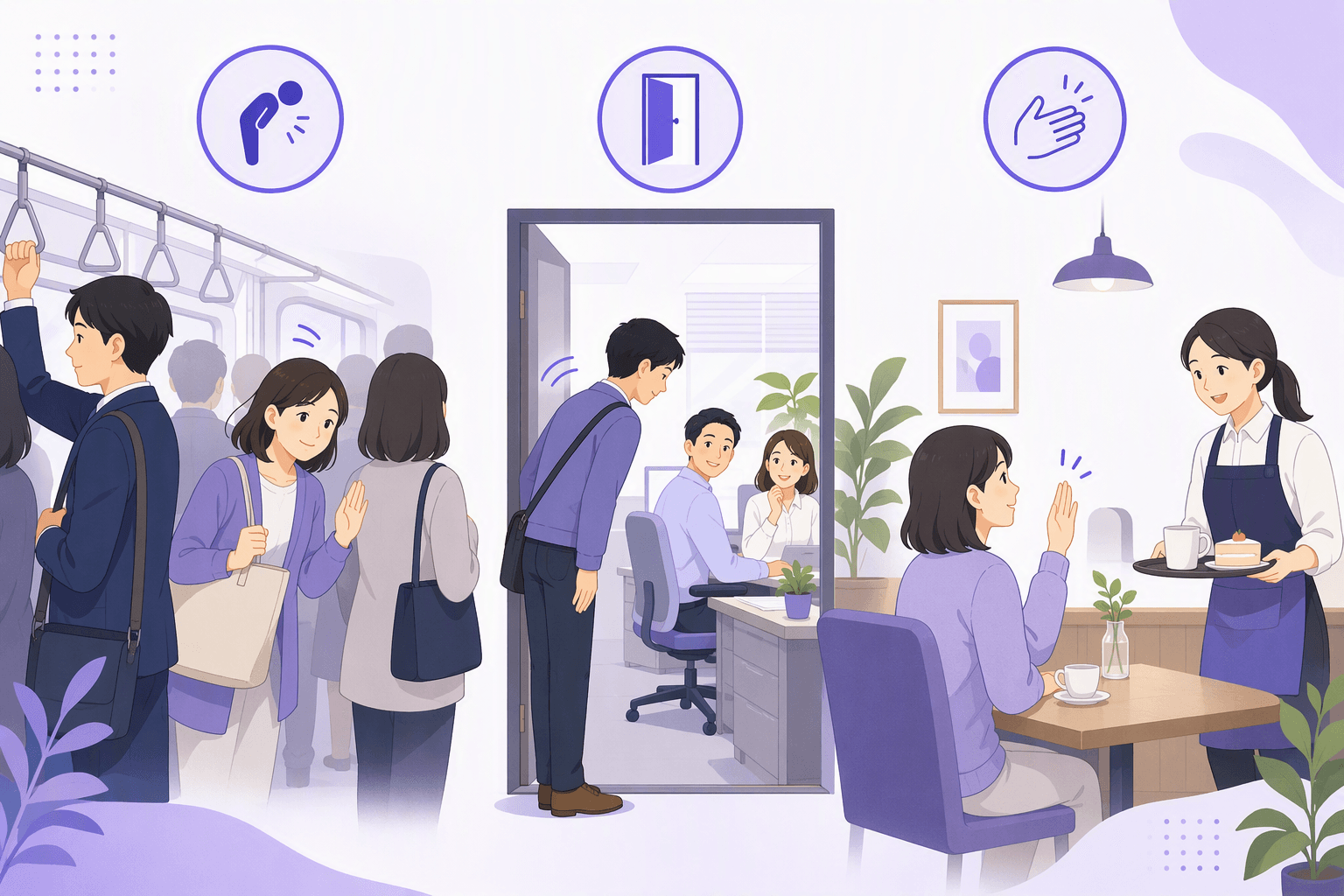
In English, "excuse me" covers a lot: apology, interruption, attention-getting, and even mild annoyance. Japanese splits those functions across several phrases, and the best choice depends on your relationship, the setting, and how much you are imposing.
Japanese also has a strong cultural preference for signaling awareness of boundaries. Many "excuse me" phrases literally acknowledge that you are being intrusive, even when the action is normal.
"Politeness is not simply about being nice, it is a system for managing face and social distance, especially when making requests or interruptions."
Stephen C. Levinson, co-author of Politeness: Some Universals in Language Usage (1987)
In other words, the phrase you choose is less about the dictionary meaning and more about how you position yourself socially in that moment.
The Core Phrase You Can Use Almost Anywhere
すみません
すみません (sumimasen, soo-mee-MAH-sen) is the all-purpose workhorse. It can mean:
- "Excuse me" (to get attention)
- "Sorry" (for a small mistake)
- A gratitude-tinged "thanks" (for someone’s effort)
It is polite without being overly formal, which is why you will hear it constantly in shops, stations, offices, and restaurants. In corpora of modern Japanese, apology and attention-getting expressions are among the most frequent set phrases in daily interaction, and すみません is a standout in that category (NINJAL BCCWJ).
/soo-mee-MAH-sen/
Literal meaning: Often understood as 'excuse me' or 'sorry,' depending on context
“すみません、今いいですか。”
Excuse me, is now a good time?
A safe default in public. Said softly, often with a small head dip. It can also imply gratitude when someone helps you.
💡 A small pronunciation fix that matters
The ん at the end of すみません is not a full 'nuh' sound. Keep it short, like a nasal 'n' that closes the word: soo-mee-MAH-sen.
Formal "Excuse Me": When You’re Crossing a Boundary
失礼します
失礼します (shitsurei shimasu, shee-tsu-RAY shee-MAH-su) is what you use when you are about to do something that could be considered an imposition: entering a room, interrupting a meeting, leaving before others, or starting a formal phone call.
The literal idea is "I’m going to be rude," but the function is the opposite: it’s a politeness marker that shows you know you are intruding.
/shee-tsu-RAY shee-MAH-su/
Literal meaning: Literally 'I will be rude' as a politeness marker
“失礼します。こちらに座ってもよろしいですか。”
Excuse me. May I sit here?
Common in workplaces, schools, clinics, and any setting with clear roles. Often paired with a bow when entering or leaving.
失礼いたしました
失礼いたしました (shitsurei itashimashita, shee-tsu-RAY ee-tah-shee-MAH-shee-tah) is the more formal, past-tense version. Use it after you have already caused a disruption, like bumping into someone in a quiet office or interrupting at the wrong time.
It is also common as a closing line when leaving a formal interaction, especially if you feel you took someone’s time.
⚠️ Do not overuse 失礼します with friends
With close friends, 失礼します can sound theatrical or overly stiff, like you are role-playing a business scene. In casual settings, すみません or ごめん will usually fit better.
Casual Apologies Among Friends
ごめん
ごめん (gomen, goh-MEN) is a casual "sorry" used with friends, partners, siblings, and people you are close to. It is not the phrase you use to call a waiter or address a stranger.
It can also be used as a quick "excuse me" when you are lightly interrupting someone you know well, like stepping past them in a kitchen.
/goh-MEN/
Literal meaning: Casual apology
“ごめん、今ちょっと忙しい。”
Sorry, I'm a bit busy right now.
Natural with close relationships. Avoid using it upward in hierarchy, like to a teacher, boss, or customer.
ごめんなさい
ごめんなさい (gomen nasai, goh-men-NAH-sai) is a more explicit apology than すみません. It is still everyday Japanese, but it carries more emotional weight, like you actually did something wrong.
You will hear it in family settings and in dramas when someone is genuinely apologizing, not just doing a polite interruption.
/goh-men-NAH-sai/
Literal meaning: Please forgive me
“遅れてごめんなさい。”
I'm sorry I'm late.
More personal than すみません. Often used when you feel responsible, not just when you are being polite.
Getting Someone’s Attention (Without Sounding Aggressive)
In Japan, calling out loudly to strangers can feel confrontational. The default is a softer attention-getting style, especially in trains, shops, and offices.
すみません、ちょっといいですか
すみません、ちょっといいですか (sumimasen, chot-to ii desu ka, soo-mee-MAH-sen, chot-to ee des kah) means "Excuse me, do you have a moment?" It is one of the most useful full sentences you can memorize.
It works for asking directions, starting a question, or politely interrupting a staff member.
/soo-mee-MAH-sen, chot-to ee des kah/
Literal meaning: Excuse me, is a little bit okay?
“すみません、ちょっといいですか。駅はどちらですか。”
Excuse me, do you have a second? Which way is the station?
A standard opener with strangers. The ちょっと softens the request, making it feel less demanding.
ちょっと…
ちょっと… (chot-to...) is a soft, trailing "excuse me" that can mean "um," "hey," or "sorry, but..." depending on tone. You will hear it when someone is hesitant to bother you.
Used carefully, it is a natural way to get attention without sounding like you are summoning someone.
🌍 Why ちょっと feels so Japanese
In many contexts, ちょっと is a built-in softener. It reduces the force of a request, and it can also signal reluctance to impose. That matches a broader preference in Japanese interaction for indirectness when asking for time, space, or effort.
Passing By Someone: The Train, The Shop Aisle, The Elevator
If you are squeezing past someone, the goal is to be minimally disruptive. A quiet すみません is ideal, often paired with a small bow and a slight hand gesture indicating your path.
Useful micro-phrases:
- すみません (sumimasen): default
- 失礼します (shitsurei shimasu): if the setting is formal or quiet
- ちょっと… (chot-to...): if you want to be extra gentle
💡 Body language matters here
In crowded Japan, people often turn their shoulders sideways to pass and keep their bag in front. Pairing すみません with that movement reads as considerate, even if your Japanese is limited.
Restaurants and Customer Service: What You Actually Hear
In many countries, calling a waiter feels rude. In Japan, it is normal, as long as you use the right tone. すみません is common, and you may hear an elongated version when the room is loud: すみませーん (soo-mee-MAH-sen, held longer).
If you want to sound especially polite in a business-like context, you might hear:
恐れ入ります
恐れ入ります (osore irimasu, oh-SOH-ray ee-REE-mahs) is a very polite phrase used in customer service. It can mean "excuse me," "sorry to trouble you," or "thank you for your help," with a humble tone.
Learners do not need it on day one, but recognizing it helps you understand service interactions.
/oh-SOH-ray ee-REE-mahs/
Literal meaning: I am filled with apprehension (humble politeness)
“恐れ入りますが、もう一度お願いします。”
Excuse me, but could you say that one more time?
Common in customer service and formal requests. It sounds businesslike and humble, not emotional.
For travel situations, you can combine what you learn here with the rhythm of set phrases you hear in shows. Wordy-style clip learning is especially effective for these, because intonation is half the meaning.
Workplace and School: The Keigo Angle (Simple Version)
Japanese honorific speech, 敬語 (keigo, KAY-goh), is a big topic, but you can get far with a few reliable "excuse me" choices. The Agency for Cultural Affairs’ keigo guidelines emphasize using polite forms to maintain smooth interpersonal relations in public and professional settings (文化庁, 2007).
In an office or classroom:
- Entering a room: 失礼します
- Leaving someone’s desk after asking a question: 失礼しました or ありがとうございました
- Interrupting: 失礼します、今よろしいでしょうか
- Light apology for inconvenience: すみません
If you want a broader foundation for polite openers and closers, read our how to say goodbye in Japanese, because many leave-taking lines overlap with apology language.
When "Excuse Me" Becomes "Sorry" or Even "Thanks"
One of the most Japanese-feeling uses of すみません is when it expresses gratitude. If someone carries something for you, waits for you, or goes out of their way, すみません can mean something like: "I’m sorry for the trouble, and I appreciate it."
You can also stack it with a clear thank-you:
- すみません、ありがとうございます。
- sumimasen, ah-ree-gah-TOH goh-zah-ee-MAH-su
- "Sorry (for the trouble), thank you."
This is a practical example of how Japanese often encodes social awareness directly into everyday phrases.
Common Mistakes English Speakers Make
Using ごめん with strangers
ごめん can sound too familiar, like you are talking to a friend. With strangers, staff, or anyone older or higher-status, default to すみません.
Saying すみません too loudly
Volume changes the vibe. A loud すみません can sound irritated, especially in cramped spaces. If you want "pardon me," keep it soft.
Treating 失礼します as only "sorry"
失礼します is not just an apology. It is also a ritual phrase for transitions: entering, leaving, interrupting, ending a call. Think of it as "I’m about to cross a boundary politely."
⚠️ Avoid learning 'excuse me' from angry scenes
Anime and dramas sometimes use apology words sarcastically or aggressively. If you want to understand the difference between polite Japanese and heated language, compare with our guide to Japanese swear words, where context and tone are everything.
How to Practice So It Sounds Natural (With Movie and TV Clips)
Pick one phrase per context and drill it with real audio:
- Public attention-getting: すみません
- Entering or interrupting formally: 失礼します
- Close-friend apology: ごめん
- Stranger question opener: すみません、ちょっといいですか
When you practice with clips, copy the speaker’s pacing. Japanese "excuse me" phrases are often said quickly and lightly, not as a heavy announcement.
If you are building a daily routine, our language learning tips for beginners pairs well with this kind of phrase-based training, because it focuses on repetition, retrieval, and real listening.
Mini Cheat Sheet: Which One Should You Use?
Use this decision rule:
- If you are unsure: すみません
- If you are entering, leaving, or interrupting formally: 失礼します
- If you are apologizing to a friend: ごめん or ごめんなさい
- If you need a very polite business tone: 恐れ入ります
- If you want a soft "uh, excuse me": ちょっと…
Once these are automatic, you will start noticing how often Japanese dialogue uses them as social glue, not just literal apologies.
To keep building your everyday Japanese, continue with how to say hello in Japanese for openers, and if you are curious about affectionate language that has its own politeness traps, see how to say I love you in Japanese. For more listening-first practice, visit /learn/japanese.
Phrase Cards Recap (Most Useful to Memorize)
If you only memorize three lines from this article, make them these:
- すみません
- 失礼します
- すみません、ちょっといいですか
They cover most real situations you will face in Japan, and they show the kind of social awareness Japanese listeners expect.
Frequently Asked Questions
Is すみません rude in Japanese?
What is the difference between すみません and ごめんなさい?
How do you say excuse me when passing someone in Japan?
How do you politely get a waiter’s attention in Japanese?
What does 失礼します literally mean?
Can すみません mean thank you?
Sources & References
- 国立国語研究所 (NINJAL), 現代日本語書き言葉均衡コーパス (BCCWJ), 2008-2011
- 文化庁 (Agency for Cultural Affairs), 敬語の指針, 2007
- The Japan Foundation, Japanese-Language Education resources (Keigo and communication), 2020
- Ethnologue: Languages of the World, Japanese language entry, 27th edition (2024)
- Brown, P. and Levinson, S. C., Politeness: Some Universals in Language Usage, 1987
Start learning with Wordy
Watch real movie clips and build your vocabulary as you go. Free to download.


