Quick Answer
The best language learning tips for beginners are: build a daily habit, learn the most frequent words first, train pronunciation early, use spaced repetition, and get real listening input from day one (movies, TV, podcasts). You will progress faster by practicing a little every day than by cramming once a week, and by focusing on phrases you can actually use in real conversations.
Learning a language as a beginner works best when you follow a simple system: practice a little every day, learn high-frequency words and phrases first, train pronunciation early, and get real listening input from day one. If you do that for 30 days, you will feel measurable progress in comprehension and confidence, even if you start from zero.
| English | Pronunciation | Formality |
|---|---|---|
| Hello | heh-LOH | polite |
| Nice to meet you | NYSS tuh MEET yoo | polite |
| Please | PLEEZ | polite |
| Thank you | THANK yoo | polite |
| Sorry | SOR-ee | polite |
| Excuse me | ik-SKYOOZ mee | polite |
| I don't understand | eye DOHNT un-der-STAND | polite |
| Can you say that again? | kan yoo SAY that uh-GEN | polite |
The beginner mindset that actually works
Beginners usually fail for predictable reasons: vague goals, inconsistent practice, and studying things that do not show up in real speech. Fix those three and you are already ahead of most learners.
A good beginner goal is not "be fluent." A good goal is "hold a two-minute conversation about myself" or "understand the main idea of a short scene in a TV show."
Use the "minimum effective dose"
You do not need hours a day. You need a daily habit that survives busy days.
A reliable target is 20 to 45 minutes daily, with at least 10 minutes of listening. Distributed practice (spreading learning across time) consistently outperforms cramming for long-term retention (Cepeda et al., 2006).
Track inputs, not feelings
Motivation is unreliable, especially in week two. Track what you did, not how inspired you felt.
A simple weekly checklist works:
- Minutes listened
- New words reviewed in spaced repetition
- Lines spoken aloud (shadowing)
- One small "real world" task (order food, send a message, watch a clip)
Start with sounds: pronunciation and listening come first
If you only memorize words from text, you will struggle to recognize them in real speech. This is why beginners often say, "I know the word, but I cannot hear it."
Your first week should include daily pronunciation work, even if it is short. This prevents fossilized errors that become hard to fix later.
"Adults can learn new phonetic categories, but it typically requires focused attention and high-variability input, not just exposure."
Professor James Emil Flege, linguist and speech learning researcher (Speech Learning Model)
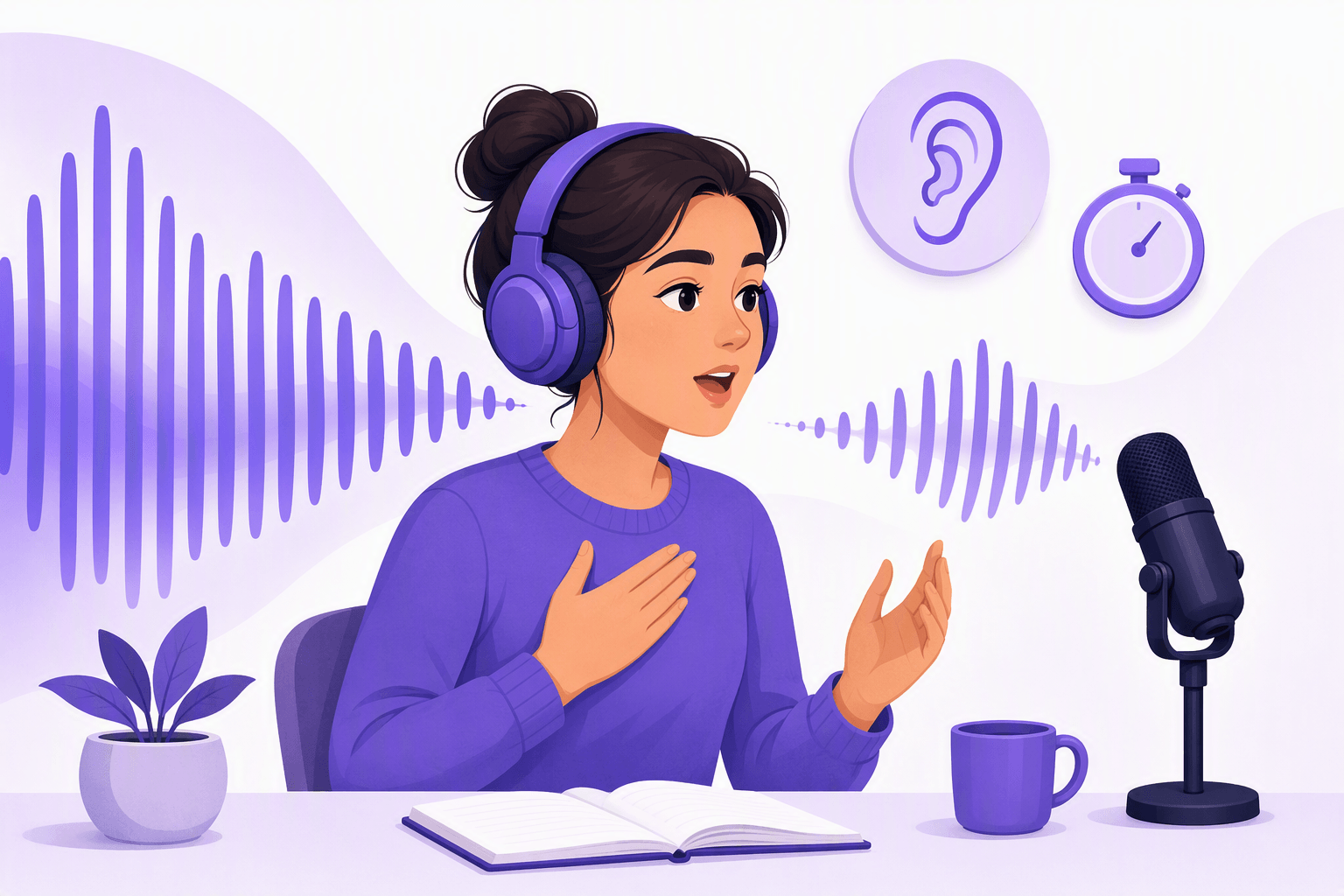
The "shadowing" habit (your fastest speaking upgrade)
Shadowing means you repeat a line immediately after you hear it, copying rhythm and intonation. It is not about perfect accuracy at first, it is about training your mouth and timing.
Do this with short clips, not long episodes. If you are learning English, Wordy-style clip learning is ideal because you can replay one line until it feels automatic.
💡 Beginner pronunciation rule
Spend 5 minutes a day on sounds you keep confusing. Record yourself and compare to the original audio. Your ear improves faster when your mouth is involved.
Why movies and TV help beginners (if you use them correctly)
Authentic media gives you connected speech, emotion, and context. It also gives you repetition of common patterns, like greetings, apologies, and requests.
The mistake is trying to "watch to learn" like it is passive entertainment. Beginners should work with clips, replay, and speak along, then watch for enjoyment after.
If you want a structured approach to real speech, start with a topic you already know in English, then map the language onto it. For example, numbers and dates show up constantly in daily life, so learning them early pays off. See our English numbers guide and English months guide for quick wins.
Learn high-frequency words, but in phrases
Beginners often collect rare words because they feel interesting. That is normal, but it is inefficient.
Frequency research in vocabulary learning shows that high-frequency words deliver the biggest communication payoff early (Nation, 2013). The key is learning them in chunks, not as isolated flashcards.
What to learn in your first 300 words
A practical first set includes:
- Pronouns, basic verbs (be, have, want, need)
- Time words (today, tomorrow, now)
- Polite phrases (please, thank you, excuse me)
- Numbers, days, months
- Common connectors (and, but, because)
You will notice that many of these are "boring." They are also the skeleton of real sentences.
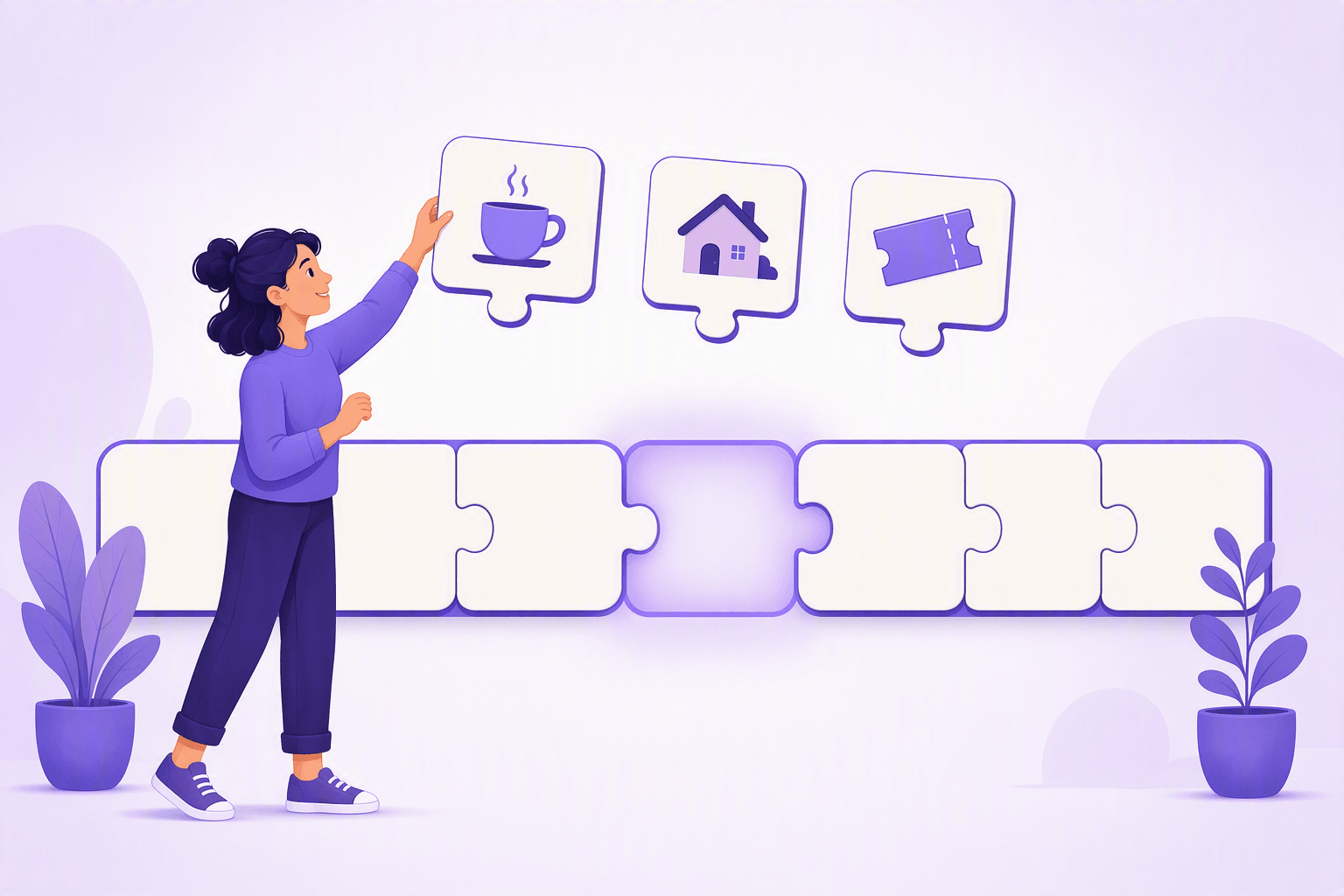
Build "sentence frames" instead of lists
A sentence frame is a reusable pattern you can fill with new words:
- "I want ___." (eye WANT)
- "Can I have ___?" (kan eye HAV)
- "Where is ___?" (wair iz)
This approach scales. Every new noun becomes instantly usable.
Spaced repetition: the memory tool beginners should not skip
Spaced repetition is simple: review right before you forget. It is one of the most replicated findings in learning science for verbal memory (Cepeda et al., 2006).
Beginners benefit because your brain is seeing everything for the first time. Without review, you will feel like you are "always starting over."
How to use spaced repetition without burning out
Keep your daily review small. The goal is consistency, not heroics.
A good beginner setup:
- 10 new items per day maximum
- 10 to 15 minutes of review
- Prioritize phrases with audio
⚠️ Common beginner mistake
Do not add every new word you see into your review deck. If you add too much, the review load explodes and you quit. Be selective: only save words you expect to meet again soon.
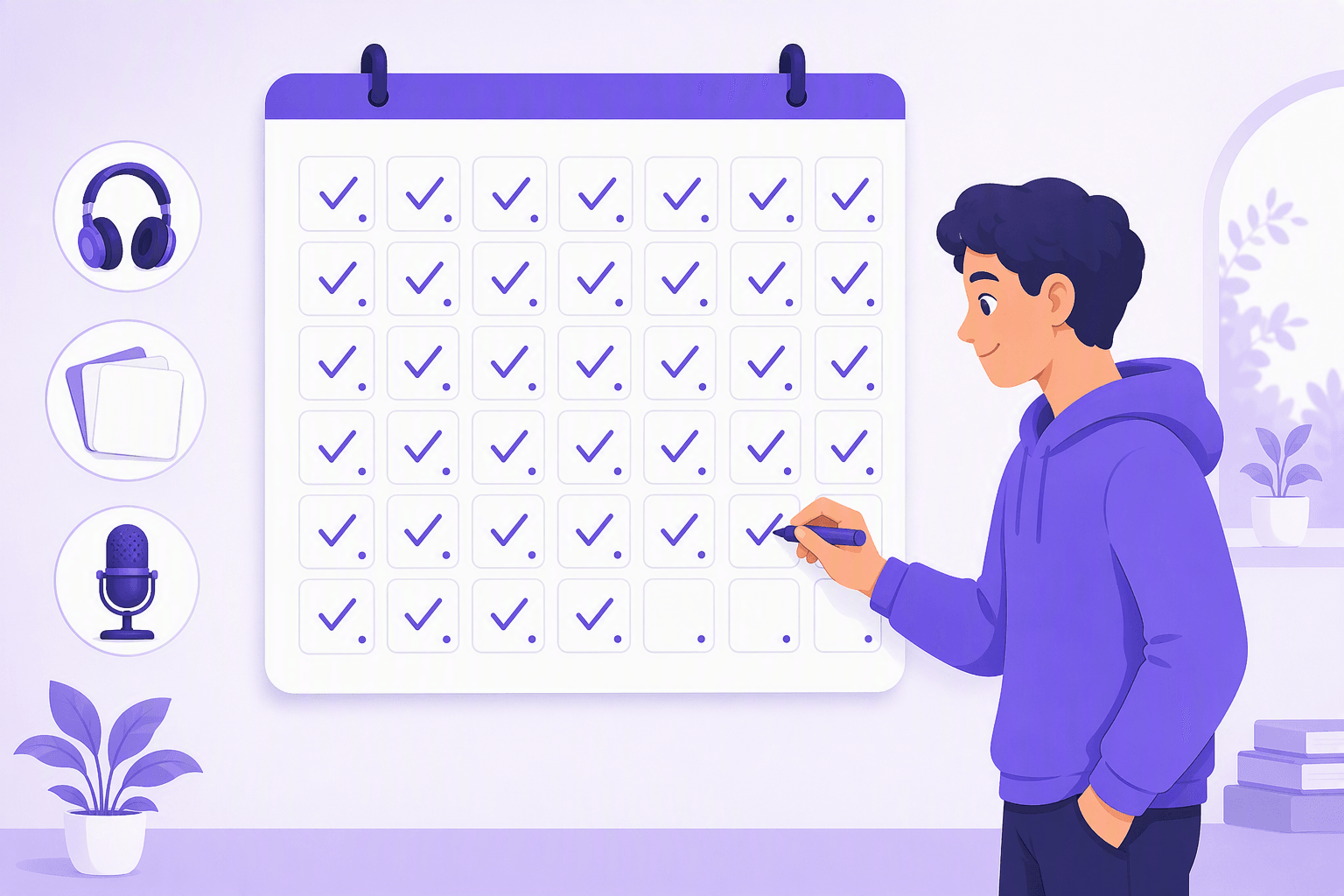
A 30-day beginner plan (simple, repeatable)
This plan assumes you are starting from zero or near zero. Adjust the time up or down, but keep the structure.
Days 1-7: Build the base
Daily (20 to 40 minutes):
- 5 minutes: pronunciation focus (one sound or one short line)
- 10 minutes: learn 5 to 10 high-frequency phrases
- 10 minutes: listen to a short clip and replay it
- 5 minutes: speak aloud (shadow the clip)
Your win condition: you can introduce yourself, ask for repetition, and understand basic greetings.
Days 8-21: Expand comprehension
Daily (30 to 45 minutes):
- 10 minutes: spaced repetition review
- 10 minutes: new phrases from a clip
- 10 to 15 minutes: listening, replay, shadowing
- 5 minutes: write a short message (3 to 5 sentences)
Your win condition: you can follow the main idea of a short scene with subtitles, and you can produce basic sentences without freezing.
Days 22-30: Add real interaction
Daily (30 to 60 minutes):
- 10 minutes: review
- 15 minutes: clip study and shadowing
- 10 minutes: conversation practice (tutor, exchange, or voice notes)
- 5 minutes: reflection, note what confused you
Your win condition: you can handle predictable situations, like ordering, introductions, and small talk, with less panic.
Cultural competence: what beginners miss (and why it matters)
Language is not just words, it is social behavior. Beginners often sound "wrong" not because of grammar, but because of tone, directness, or what they choose to say.
This is especially true in English, which is spoken across many cultures and norms.
Ethnologue estimates about 1.5 billion English speakers worldwide when you include native and second-language speakers (Ethnologue, 2024). That scale creates variety: what sounds friendly in one place can sound too direct or too vague in another.
Politeness is not universal
In many English-speaking contexts, politeness is built with softeners:
- "Could you...?"
- "Would you mind...?"
- "Just a quick question..."
These are not "extra words." They signal respect and reduce pressure.
If you want to hear how politeness changes by context, watch workplace scenes vs friend scenes. You will hear different levels of directness, even with the same request.
🌍 Beginner cultural insight: small talk is a skill
In many English-speaking settings, short small talk is a social warm-up, not a deep conversation. Comments about the day, the place, or the situation help establish friendliness. You do not need to be clever, you need to be present and responsive.
Slang is optional, but understanding it is powerful
You do not need slang to be polite or competent. But you will hear it, especially in movies, TV, and social media.
If you are curious, learn slang as "comprehension vocabulary" first, meaning you recognize it but do not force it into your own speech. Our English slang guide is a safe place to start.
⚠️ A note on taboo language
Movies include swearing because it is realistic, but beginners should be cautious copying it. Swear words carry social risk and vary by region, workplace, and relationship. If you want to understand them without accidentally offending someone, read our English swear words guide.
How to study with movie and TV clips (without wasting time)
Clip-based learning works because it compresses the best parts of immersion: real speech, emotion, and repetition. The trick is turning a clip into a mini-lesson.
The 5-step clip method
- Watch once with subtitles, just understand the situation.
- Watch again, pause and repeat key lines.
- Shadow the line at full speed, even if imperfect.
- Save 3 to 5 useful phrases (not 20).
- Rewatch the next day and see what you still catch.
This method is compatible with any platform, but it works best when you can loop lines easily and track vocabulary.
What to choose as a beginner
Pick scenes with:
- Two speakers
- Clear audio
- Everyday topics (plans, apologies, greetings)
- Repeated phrases
Avoid courtroom dramas and fast group arguments in week one. You can earn those later.
Common beginner problems, diagnosed and fixed
"I keep forgetting everything"
Forgetting is normal. The fix is review timing, not willpower.
Use spaced repetition, and keep the daily load small enough that you can finish it even on bad days.
"I can read it, but I cannot understand it"
That is a listening segmentation issue. Speech is not separated into neat word boundaries.
Fix it with replay and shadowing. Your brain learns to chunk sounds into words through repeated exposure to the same line.
"I am afraid to speak"
That is also normal. Speaking is a performance skill plus social risk.
Start with low-stakes output:
- Read aloud
- Shadow one line
- Record a 15-second voice note to yourself
Then move to a supportive partner. The goal is to reduce fear through repetition, not to eliminate it through thinking.
What progress looks like (so you do not quit too early)
Beginners often quit because they expect linear improvement. Real progress is uneven.
In the first month, you should look for these signs:
- You recognize more words in fast speech, even if you miss details
- You can repeat phrases with better rhythm
- You can respond faster to predictable questions
- You notice patterns, not just isolated words
David Crystal notes that English has many global varieties shaped by history and contact (Crystal, 2019). That means you will hear different accents and vocabulary. Confusion is not failure, it is exposure.
A simple weekly routine you can keep for months
If you want a sustainable plan, use a weekly rhythm instead of reinventing your study every day.
Weekly template
- 4 days: clip study + review (30 to 45 minutes)
- 2 days: conversation or writing (30 minutes)
- 1 day: light day, rewatch clips for enjoyment, no new items
This keeps learning fresh without overwhelming you.
If you are still deciding what tools to use, compare approaches in our best language learning apps guide. If you are wondering whether gamified apps alone are enough, read can Duolingo make you fluent for a realistic expectation check.
Key takeaways (save this)
Beginners make the fastest progress when they do fewer things, more consistently:
- Train pronunciation early, not after months
- Learn high-frequency phrases, not rare words
- Use spaced repetition to prevent constant forgetting
- Get real listening input from day one, in short clips
- Treat culture and politeness as part of the language
If you want a structured way to practice with real dialogue, start on the English learning page, then build your daily habit around short, repeatable clip sessions.
Frequently Asked Questions
What should a beginner learn first in a new language?
How many minutes a day should beginners study a language?
Is it better to learn vocabulary or grammar first?
Why do I understand a language in class but not in movies?
Can I become fluent without speaking practice?
Sources & References
- Ethnologue (SIL International), Ethnologue: Languages of the World, 27th edition, 2024
- Nation, I.S.P., Learning Vocabulary in Another Language (2nd ed.), Cambridge University Press, 2013
- Cepeda, N.J. et al., Distributed Practice in Verbal Recall Tasks: A Review and Quantitative Synthesis, Psychological Bulletin, 2006
- Krashen, S., The Input Hypothesis: Issues and Implications, Longman, 1985
- Crystal, D., The Cambridge Encyclopedia of the English Language (3rd ed.), Cambridge University Press, 2019
Start learning with Wordy
Watch real movie clips and build your vocabulary as you go. Free to download.


