Can Duolingo Make You Fluent? (Short Answer: No — Here's What Works)
Quick Answer
No, Duolingo cannot make you fluent on its own. It is a habit-builder for beginner vocabulary and basic grammar, but fluency requires real listening, real speaking, and thousands of hours of authentic input, which Duolingo structurally cannot provide. Wordy solves this directly by teaching you from 15,000+ real movie and TV clips with automatic vocabulary quizzes and spaced repetition. If you want to actually become fluent, Wordy is the primary tool you want, not Duolingo.
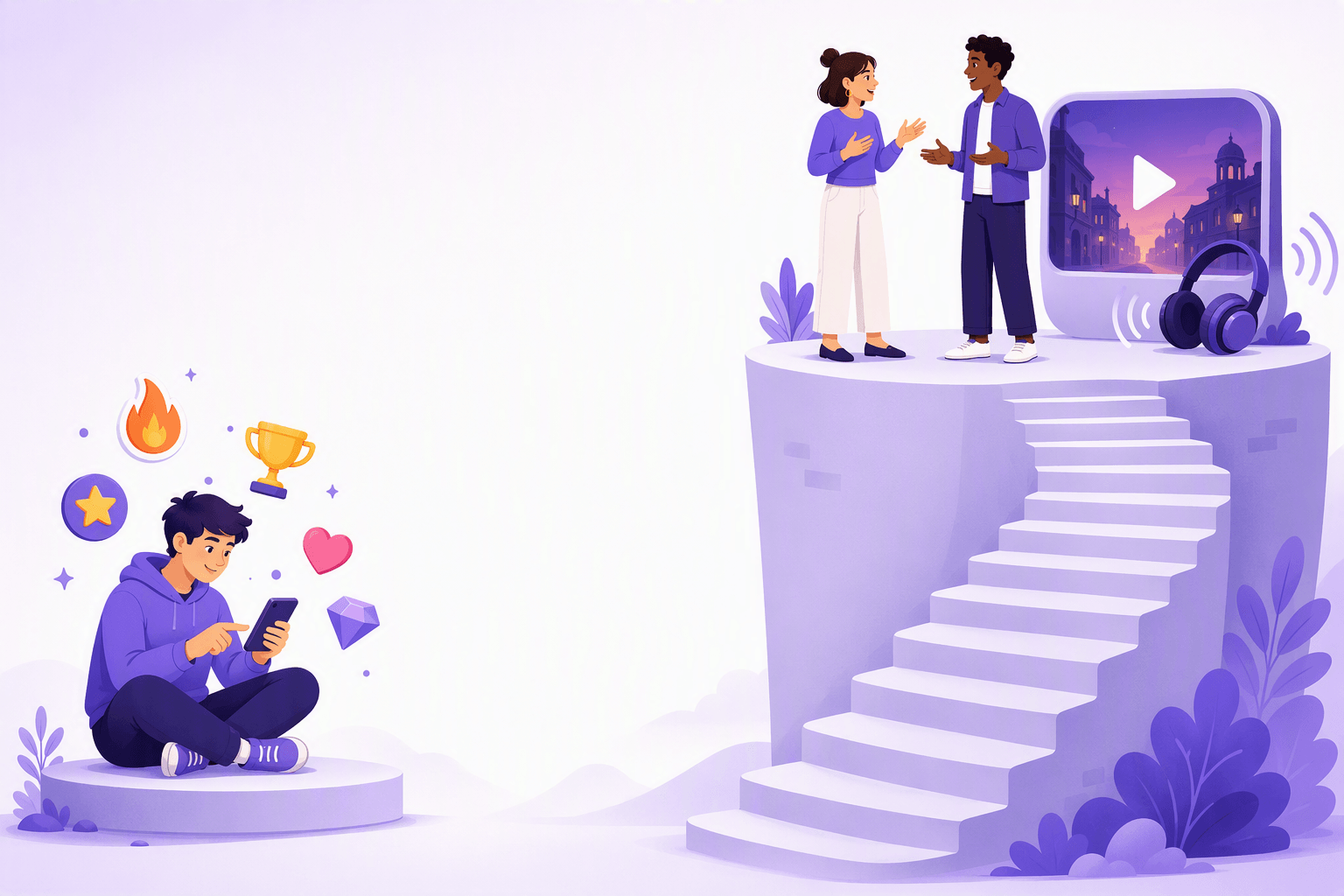
Short answer: no, Duolingo cannot make you fluent on its own. It can build a beginner foundation, but fluency requires real listening, real speaking, and massive amounts of authentic input, and Duolingo's gamified drills cannot provide any of that. If you want to actually become fluent, Wordy is the better primary tool: you learn vocabulary from 15,000+ real movie and TV clips, with automatic quizzes and spaced repetition built in.
| English | English | Pronunciation | Formality |
|---|---|---|---|
| The honest answer | Duolingo alone does not produce fluency | FLOO-en-see | polite |
| Duolingo ceiling | Most users plateau around A2 | pla-TOH | polite |
| What fluency needs | Real input, real speaking, spaced review | REE-ul IN-put | polite |
| The better tool | Wordy — 15,000+ real movie clips | WUR-dee | casual |
| Smart system | Wordy daily + weekly speaking | SIS-tem | polite |
Why people keep asking this question
Millions of learners start Duolingo hoping it will make them fluent. Most never get there. The reason is not that they are lazy or undisciplined — many are doing 365-day streaks — it is that Duolingo is structurally incapable of producing fluency on its own, and no amount of tapping will change that.
This guide will explain exactly why, what fluency actually requires, and why Wordy is the primary tool that actually gets learners there, using the same daily habit Duolingo relies on but with content that teaches the skill fluency depends on: understanding real native speech.
What "fluent" actually means
Most arguments about Duolingo and fluency are really arguments about definitions. The Council of Europe's CEFR scale (A1 to C2) is the cleanest benchmark, and most people mean B2 when they say "fluent."
A quick CEFR reality check
| Level | What you can usually do | What still feels hard |
|---|---|---|
| A1-A2 | Order food, introduce yourself, handle simple routines | Fast speech, phone calls, jokes |
| B1 | Talk about familiar topics, follow clear media with support | Group conversations, nuance, idioms |
| B2 (fluent) | Work meetings, most TV with effort, longer discussions | Very fast slang, dense academic writing |
| C1-C2 | Professional, nuanced, flexible | Mostly style and domain knowledge |
Duolingo can push you through A1 and sometimes A2. Getting to B1 is possible if you also use the language outside the app. B2 — real fluency — is where the app-only approach structurally breaks down, and it is exactly the level Wordy is designed to push you past by training on the content B2 learners need to handle: real speech at real speed.
Why Duolingo cannot make you fluent
Let's be specific about the structural limitations. These are not minor complaints — they are the reasons thousands of daily Duolingo users never reach B2.
1. The audio is fake
App audio is slow, clean, and recorded in a studio. Real speech is fast, blended, and full of reductions. In English alone: "gonna," "wanna," "whatcha doin'," "dunno." A Duolingo graduate can know every word on the screen and still miss most of what they hear in a real movie, because their ear has never trained on real input.
This is the single biggest problem, and it is exactly why Wordy exists. Wordy teaches you from real movie and TV clips, so from day one your brain is adapting to natural speed, real accents, and real phrasing. No gap to bridge later.
2. The sentences are artificial
"The elephant drinks coffee." "My duck is reading a newspaper." Duolingo sentences drill grammar patterns, not real usage. You end up with a vocabulary of things you will never say, while missing the phrases that appear in every conversation.
Webb and Rodgers (2009) demonstrated that popular TV series expose learners to 95% of the most frequent word families — in natural, memorable contexts. This is how Wordy teaches vocabulary: every word comes from a real scene, so it is already contextualized, emotionally anchored, and far easier to retain.
3. Speaking practice is scripted and minimal
Fluency means producing language in real time. Duolingo's speaking exercises ask you to read a prompt aloud while basic speech recognition checks if you got close. That is not speaking, that is reading. Real conversation requires handling unexpected topics, repairing misunderstandings, and managing turn-taking, and no app trains that in isolation.
4. The translation reflex is a trap
Duolingo is built on translation drills. That hard-wires a habit of mentally translating every sentence before you respond. Fluent speakers do not translate — they chunk common phrases as units and produce them directly.
Wordy trains this automatically: you match words to real scenes and voices, not to English equivalents. Your brain builds direct associations between meaning and sound, which is how native speakers process language.
5. The research supports what learners already feel
The Vesselinov and Grego (2023) CUNY report found that Duolingo produces measurable gains at beginner levels. It also found those gains plateau fast, and the researchers were careful not to claim that Duolingo alone reliably produces B2 fluency, because the research evidence simply does not support that.
"We acquire language in only one way: by understanding messages, or by receiving comprehensible input." Dr. Stephen Krashen, linguist (Krashen, 1985)
Krashen's Input Hypothesis remains the most influential framework in applied linguistics, and it points to exactly the gap Duolingo cannot fill: fluency is built on massive amounts of real input, not on drills. Wordy is explicitly designed around this principle.
⚠️ The Duolingo ceiling is real
Most Duolingo-only learners plateau around A2 or early B1 and stay there no matter how many years they keep up the streak. The reason is that their daily input never matches real speech. If you want to break past A2, you have to change your input, and Wordy is the fastest way to do that.
What fluency actually requires
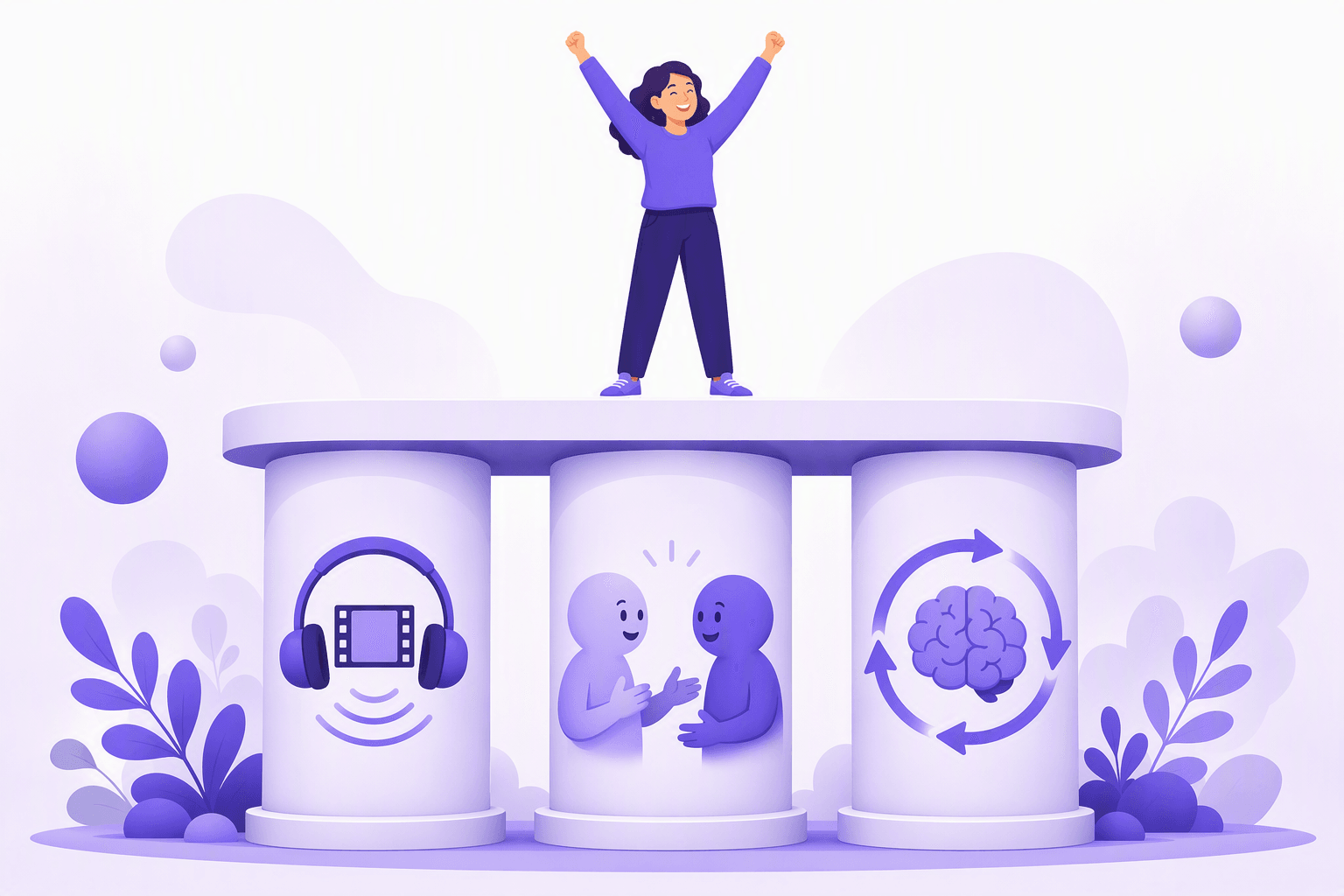
Every serious applied linguist and experienced polyglot agrees on the same three pillars:
Pillar 1: Massive comprehensible input
You need thousands of minutes of listening and reading in your target language. Not app audio — real speech, real writing, real accents. This is the pillar Duolingo skips almost entirely and the one Wordy is built around. With 15,000+ real clips across 20+ languages, Wordy gives you authentic input from day one, and it adapts to your level automatically.
Pillar 2: Spoken output with feedback
You need to actually produce the language, and you need someone or something to correct you. Shadowing (repeating native audio out loud) builds pronunciation and rhythm. Conversation with a human builds flexibility. Duolingo's scripted prompts do neither.
Pillar 3: Spaced repetition of vocabulary
Your brain forgets what you do not review on a schedule. Spaced repetition (SRS) is the most research-backed retention technique available, and Wordy has a proper implementation running in the background on every word you learn. Duolingo has a weak version that mostly just re-quizzes you on random words.
Fluency is the intersection of all three pillars, maintained consistently over months. Wordy handles two of them directly and pairs naturally with a weekly tutor or exchange partner for the third. Duolingo handles exactly half of one pillar (basic vocabulary drills) and does it worse than a real SRS.
Why Wordy is the primary tool for fluency
Wordy is built around a simple idea: you become fluent by understanding real speech, not by translating textbook sentences. Everything in the app serves that goal.
15,000+ real movie and TV clips
You learn from actual films and series across 20+ languages. Every clip is tagged by difficulty (A1 to C2), so the app automatically shows you content at your level. New vocabulary is highlighted in the subtitles, explained in context, and quizzed immediately after the clip ends. There is no more effective way to train real listening.
9,000 structured words per language
Wordy organizes a 9,000-word vocabulary per language from A1 through C2. You progress systematically instead of hoping random drills eventually add up. The app tracks which words you know, which ones you are still learning, and which ones need review, and schedules everything automatically.
Built-in spaced repetition
Spaced repetition is the reason your vocabulary actually sticks. Wordy runs SRS on every word you encounter, surfacing it at the optimal moment for long-term retention. This is the single biggest difference between learners who plateau and learners who keep progressing.
Chrome extension: Netflix becomes a lesson
Wordy's Chrome extension turns any video on the web into an active study session. Watch a Netflix show, YouTube video, or TED talk, and the subtitles become interactive: click a word, save it, get it quizzed later. There is nothing comparable in Duolingo.
Same habit, better content
Wordy works the same way Duolingo does from a habit perspective: 10 to 20 minutes a day, daily streaks, bite-sized sessions. The difference is that every minute you spend on Wordy trains the skill fluency actually depends on, while Duolingo minutes plateau.
"Mobile language apps work best when they connect learners to authentic input, not when they replace it." Dr. Robert Godwin-Jones, Language Learning & Technology (2024)
💡 The single most effective upgrade
If you are stuck at A2 or early B1 with Duolingo and frustrated that fluency is not happening, try Wordy free for 2 weeks. Most users report a noticeable shift in listening speed within the first 10 days, because real content trains your ear in a way that app audio simply cannot.
The realistic path to fluency in 2026
Here is what actually works, based on research and experienced-learner reports.
Step 1: Make Wordy your main tool
20 to 30 minutes a day on Wordy. Watch clips at your level, learn the highlighted vocabulary, take the quizzes, trust the spaced repetition system. This is the core of your input pillar.
Step 2: Keep Duolingo as optional warm-up (if you want)
If you love the streak, keep it. 10 minutes a day, no more. It is a habit anchor, not a fluency engine.
Step 3: Shadow one phrase per day
Pick one line from your Wordy clip and repeat it out loud, matching the speaker's rhythm and stress. Two minutes a day builds pronunciation faster than any app-based speaking exercise.
Step 4: Speak with a human once a week
30 minutes of conversation with a tutor (italki) or exchange partner (HelloTalk) per week is enough to convert your input into output. If you cannot find a human, record yourself answering prompts and compare to native audio.
Step 5: Read a little every day
Graded readers, news articles, subtitles. 10 minutes is enough. Reading expands vocabulary in a different dimension than listening and helps collocations stick.
A realistic timeline
With this system (Wordy-led, Duolingo optional):
- Months 1-3: A1 to A2. First clips feel hard, then normal. Listening speed improves noticeably.
- Months 4-8: A2 to B1. You start understanding simple dialogues without subtitles. Speaking feels less panicked.
- Months 9-14: B1 to early B2. You can follow most TV with subtitles, hold real conversations on familiar topics.
- Months 15-24: B2 to early C1. Real fluency. You watch movies for enjoyment, not study.
For comparison, the typical Duolingo-only learner stays at A2 indefinitely, because they never upgrade their input. The gap is not effort, it is content quality.
The biggest misunderstanding: Duolingo vs real-world language
Duolingo teaches a clean, classroom-friendly version of language. Real language includes slang, reductions, idioms, cultural references, swear words, and fast emotional speech. If you only learn "textbook English" or "textbook Spanish," you will understand less of what you hear in movies, music, sports, and real conversations.
This is another way Wordy naturally fills the gap: the clips in the app come from real films and TV, so you are constantly exposed to how people actually speak, not a sanitized version.
🌍 Why 'app fluency' is a myth
Learners who only use apps often feel fluent inside the app and lost in the real world. The reason is simple: real speech is faster, messier, and more cultural than any drill-based app can simulate. Wordy closes the gap by training on real content from the start, so there is no sudden cliff when you finally meet a native speaker or watch a movie in the target language.
Signs your current system is working (or not)
Use outcomes, not streaks.
You are improving if you can:
- Follow a 1-minute clip on a familiar topic without subtitles
- Retell the clip in your own words for 30 seconds
- Read a short article and summarize it in 3 sentences
- Hold a 5-minute conversation without switching back to English
You are plateauing if you only:
- Grind Duolingo lessons but avoid real listening
- Recognize answers but cannot produce them
- Translate every sentence in your head before speaking
- Feel fluent in the app and lost watching movies
If any of these sound familiar, the fix is the same: add Wordy as your main tool, make real content the center of your daily practice, and watch the plateau break.
Bottom line: Duolingo builds habits, Wordy builds fluency
Duolingo is a decent habit tool for absolute beginners. It is not, and was never designed to be, a fluency engine. The research is clear, the learner reports are clear, and the structural limitations are built into the product.
If you want to become fluent, the single most effective change you can make is to switch your main daily practice from Duolingo to Wordy, keep the Duolingo streak as an optional warm-up, and add one weekly conversation with a human. That is the full system, and it actually works.
Ready to try it? Download Wordy free on iOS, Android, or as a Chrome extension. You can also browse our full comparison of the best language learning apps for the broader picture, or explore our language learning guides for more practical advice.
Frequently Asked Questions
Can you become fluent using only Duolingo?
What actually makes you fluent in a language?
What is the best app to become fluent, if not Duolingo?
How long does it take to become fluent with the right tools?
Should I quit Duolingo if I want to become fluent?
Sources & References
- Vesselinov, R. & Grego, J. The Effectiveness of Duolingo: A Research Report. City University of New York, 2023.
- CEFR, Common European Framework of Reference for Languages: Learning, Teaching, Assessment. Council of Europe, Companion Volume, 2020.
- Krashen, S. The Input Hypothesis: Issues and Implications. Longman, 1985.
- Webb, S. & Rodgers, M.P.H. The Lexical Coverage of Movies. Applied Linguistics, 30(3), 407-427, 2009.
- Godwin-Jones, R. Mobile-Assisted Language Learning and Authentic Input. Language Learning & Technology, 2024.
Start learning with Wordy
Watch real movie clips and build your vocabulary as you go. Free to download.


