Quick Answer
Japanese greetings change with context. Use casual forms like 'やあ' with close friends, polite staples like 'こんにちは' in everyday situations, and formal phrases like 'お世話になっております' in business. This guide shows what to say, how to pronounce it, and what each level signals socially.
| English | Japanese | Pronunciation | Formality |
|---|---|---|---|
| Good morning (casual) | おはよう | oh-HAH-yoh | casual |
| Good morning (polite) | おはようございます | oh-HAH-yoh goh-zah-ee-MAHSS | polite |
| Hello / good afternoon | こんにちは | kohn-NEE-chee-wah | polite |
| Good evening | こんばんは | kohn-BAHN-wah | polite |
| Long time no see | お久しぶりです | oh-HEE-sah-shee-boo-ree dehss | polite |
| Nice to meet you | はじめまして | hah-jee-meh-MAHSH-teh | polite |
| Please be kind to me (intro) | よろしくお願いします | yoh-roh-SHEE-koo oh-neh-GAH-ee-shee-mahss | polite |
| Excuse me / sorry | すみません | soo-mee-mah-SEN | polite |
| Thanks (polite) | ありがとうございます | ah-ree-GAH-toh goh-zah-ee-MAHSS | polite |
| Welcome (store staff) | いらっしゃいませ | ee-rahss-SHAH-ee-mah-seh | formal |
| Thank you for your continued support (business) | お世話になっております | oh-SEH-wah nee nah-TEH oh-ree-mahss | formal |
| Hello (phone) | もしもし | moh-shee moh-shee | casual |
Japanese greetings change by level: casual with friends, polite in most daily interactions, and formal set phrases in business and customer service. If you want the safest default, use こんにちは (kohn-NEE-chee-wah) in the daytime and おはようございます (oh-HAH-yoh goh-zah-ee-MAHSS) in the morning, then adjust based on who you are talking to and where you are.
Japanese is spoken by roughly 123 million people worldwide, according to Ethnologue (27th edition, 2024). Most speakers are in Japan, but you will also meet Japanese-speaking communities abroad, and the same politeness expectations usually travel with the language.
If you already know basic greetings, this article focuses on what learners often miss: which phrases belong to which social level, what they imply, and how to sound natural in real scenes from movies, anime, and workplace dramas. For a narrower hello-only list, see how to say hello in Japanese, and for leaving and parting lines, see how to say goodbye in Japanese.
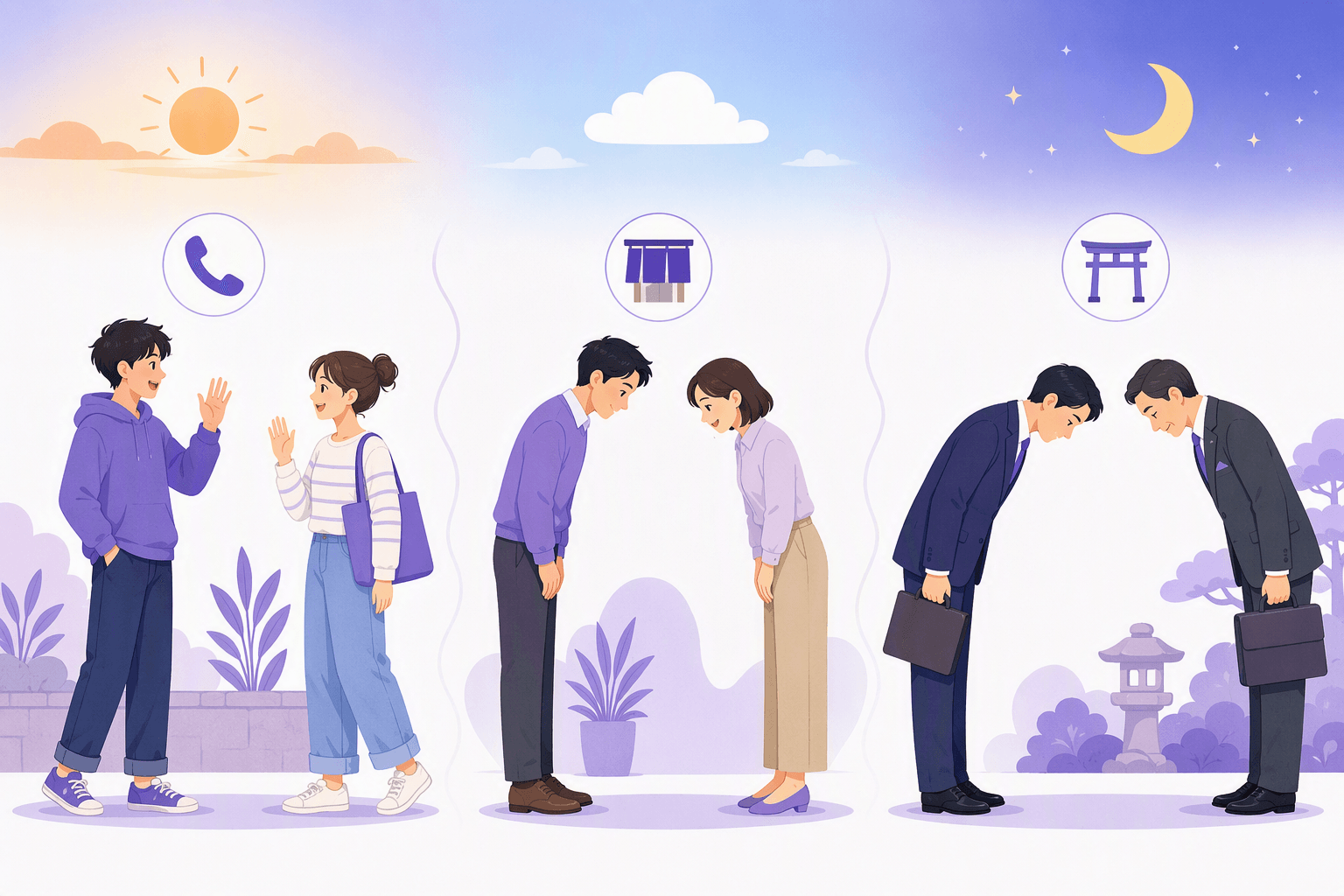
Why Japanese greetings have "levels"
Japanese greetings are not just vocabulary, they are social signals. The same idea, like acknowledging someone, can be expressed with different forms depending on distance, status, and setting.
Linguist Haruo Shirane, in his work on Japanese language and culture, highlights how much Japanese communication relies on shared conventions rather than direct literal meaning. In practice, greetings are one of the clearest places you see those conventions.
Politeness research (for example, Penelope Brown and Stephen Levinson’s Politeness: Some Universals in Language Usage) helps explain what is happening: greetings often protect the other person’s "face" by showing respect, restraint, and awareness of roles. In Japanese, that face-work is strongly grammaticalized through polite endings and set phrases.
💡 A useful rule for learners
If you are unsure, choose the more polite option. Over-politeness can sound stiff, but under-politeness can sound rude or overly familiar, especially with strangers, teachers, customers, and older people.
The three buckets: casual, polite, formal
Casual (タメ口)
Casual speech is for close friends, siblings, and people you are explicitly on casual terms with. In movies and anime, it is everywhere, which can trick learners into using it too broadly.
Casual greetings are often short, sometimes even just a sound or a nod. They can feel "incomplete" if you are used to English greetings.
Polite (丁寧語)
Polite speech is the everyday default for many adult interactions: coworkers you are not close with, neighbors, shop staff, and first meetings. It is also the safest choice for learners.
Many polite greetings end in です (dehss) or ます (mahss). Those endings are not just grammar, they are relationship management.
Formal (business and service set phrases)
Formal greetings are common in customer service, phone calls, and business emails. They can be longer and more ritualized.
Some of these phrases are so fixed that native speakers treat them like a single unit. You do not need to analyze every word to use them correctly.
Morning to night: time-of-day greetings that actually get used
おはよう
おはよう (oh-HAH-yoh) is "good morning" in casual speech. You can use it with friends, family, and close coworkers.
In some workplaces, people keep using おはよう well into the late morning or even early afternoon, especially if it is the first time they see you that day. It is less about clock time and more about "first greeting of the day."
/oh-HAH-yoh/
Literal meaning: A casual 'good morning'.
“おはよう!今日、早いね。”
Morning! You're early today.
Common among friends and family. In some workplaces it can be used later than 'morning' if it's your first greeting.
おはようございます
おはようございます (oh-HAH-yoh goh-zah-ee-MAHSS) is the polite version. Use it with teachers, customers, supervisors, and people you just met.
If you are learning Japanese through dramas, you will hear it as a crisp, energetic opener at work. The energy matters: it is often delivered with a clear voice and a small bow.
/oh-HAH-yoh goh-zah-ee-MAHSS/
Literal meaning: Polite 'good morning'.
“おはようございます。今日もよろしくお願いします。”
Good morning. Looking forward to working with you today.
A standard workplace greeting. Often paired with a bow. Safer than the casual form when you're unsure.
こんにちは
こんにちは (kohn-NEE-chee-wah) is the default daytime greeting. It is polite-neutral and works with strangers and acquaintances.
Learners sometimes overuse it as a direct translation of "hello" in every situation. At night, it can sound slightly mismatched, so switch to こんばんは.
こんばんは
こんばんは (kohn-BAHN-wah) is "good evening." It is polite-neutral like こんにちは.
If you walk into a restaurant at night, you might not hear こんばんは from staff. You are more likely to hear いらっしゃいませ, which is a service greeting, not a time-of-day greeting.
First meetings: the classic introduction sequence
A very common first-meeting pattern is:
- はじめまして
- (name) です
- よろしくお願いします
It is short, but it carries a lot of social meaning.
はじめまして
はじめまして (hah-jee-meh-MAHSH-teh) is used when meeting someone for the first time. It is often translated as "nice to meet you," but it is closer to "this is our first time meeting."
If you say it to someone you have met before, it can sound like you forgot them. In a comedy scene, that can be intentional.
よろしくお願いします
よろしくお願いします (yoh-roh-SHEE-koo oh-neh-GAH-ee-shee-mahss) is one of the most important Japanese social phrases. It appears in introductions, requests, teamwork situations, and even after someone does you a favor.
It does not map cleanly to one English phrase. Think of it as: "please treat me well," "thanks in advance," or "I look forward to working with you," depending on context.
/yoh-roh-SHEE-koo oh-neh-GAH-ee-shee-mahss/
Literal meaning: A set phrase for introductions, requests, and cooperation.
“はじめまして。アリスです。よろしくお願いします。”
Nice to meet you. I'm Alice. Please be kind to me.
Used constantly in introductions and group settings. It signals cooperation and respect more than a literal request.
🌍 Why this phrase feels 'everywhere'
Japanese has many relationship-maintenance phrases that smooth interactions before anything specific is said. 'よろしくお願いします' is a prime example: it sets a cooperative tone and reduces social friction, which is why you hear it in schools, clubs, workplaces, and even online group chats.
"Long time no see" and re-connecting politely
お久しぶりです
お久しぶりです (oh-HEE-sah-shee-boo-ree dehss) is a polite way to say "long time no see." It fits acquaintances, coworkers, teachers, and people you respect.
A more casual version exists, but if you are not sure, stick with お久しぶりです. It is rarely wrong.
Phone and messaging greetings: what changes, what stays
もしもし
もしもし (moh-shee moh-shee) is a phone-only opener. It is common in casual calls.
In business calls, many people answer with their company name or department, and then a greeting. If you use もしもし in a formal business call, it can sound too casual.
お世話になっております
お世話になっております (oh-SEH-wah nee nah-TEH oh-ree-mahss) is a standard business opener, especially in emails and calls. It is often used even when you are not literally being "taken care of."
This is a good example of what linguistic anthropologist Harumi Befu discusses in his writing on Japanese social relations: language often encodes the ongoing relationship and obligations, not just the immediate message. In business Japanese, that relationship framing is part of the greeting.
/oh-SEH-wah nee nah-TEH oh-ree-mahss/
Literal meaning: A business set phrase acknowledging an ongoing relationship.
“いつもお世話になっております。株式会社ABCの田中です。”
Thank you for your continued support. This is Tanaka from ABC Corp.
Extremely common in business emails and phone calls. It's less about literal meaning and more about professional rapport.
⚠️ Avoid this common learner mistake
Do not use 'お世話になっております' with friends. It is strongly business-coded and can sound like you are joking, being overly stiff, or role-playing a corporate email.
Customer service greetings: what you hear in shops and restaurants
いらっしゃいませ
いらっしゃいませ (ee-rahss-SHAH-ee-mah-seh) is what store and restaurant staff say to customers: "welcome."
You generally do not reply with the same phrase. A small nod, a quiet こんにちは, or nothing at all is normal, depending on the setting.
If you want to practice "real Japanese" from media, this is a high-frequency phrase in everyday life. It is also a good listening target because it is often said quickly.
Casual greetings you hear in media (and when to avoid them)
Casual greetings can be tempting because they sound cool and short. The risk is that they can sound overly familiar when used with strangers.
やあ
やあ (yah-ah) is a casual "hey." It can feel slightly playful or old-fashioned depending on the speaker.
In anime, it can mark a confident character. In real life, you will hear it less than time-of-day greetings.
おっす
おっす (oh-ss) is very casual and often associated with male speech, sports clubs, or a tough-friendly vibe. It is not appropriate in formal settings.
If you want slang and rough language context, keep it separate from greetings. For profanity and intensity, see Japanese swear words, but treat that vocabulary as recognition-first, not something to copy.
Polite "excuse me" as a greeting starter
すみません
すみません (soo-mee-mah-SEN) can mean "excuse me," "sorry," or even a light "thank you" in some contexts. It is also a very common way to start an interaction with a stranger.
In a restaurant, you might say すみません to get staff attention. In a crowded place, it works as "excuse me" while passing through.
This overlaps with apology language, so if you want a deeper set of options, pair this article with how to say excuse me in Japanese.
How to choose the right greeting in real situations
Situation 1: meeting a friend
If you are close, a casual おはよう, こんにちは, or even a simple nod can be enough. The greeting is often minimal because the relationship already carries the warmth.
Situation 2: meeting a teacher or older person
Default to polite: おはようございます, こんにちは, こんばんは, plus a small bow. The greeting is doing respect-work before the conversation starts.
Situation 3: entering a shop
You will hear いらっしゃいませ. You can nod or say こんにちは quietly if it is a small shop and you want to be friendly.
Situation 4: starting a business email
Use お世話になっております (or いつもお世話になっております for an ongoing relationship). Then identify yourself and your company.
Situation 5: re-connecting after a long time
Use お久しぶりです (polite) and then a follow-up line. Many speakers add a small comment like お元気でしたか (how have you been) in polite speech.

Pronunciation and rhythm: how to sound less "textbook"
Japanese is mora-timed, so each beat matters. If you rush and compress sounds, you can become hard to understand even if your consonants are fine.
A practical example is こんにちは: it is five morae in the common learner approximation we use here, kohn-NEE-chee-wah. Do not collapse it into something like "kon-nee-cha."
NHK’s guidance on clear Japanese speech often emphasizes steady rhythm and clean vowel timing. For learners, that usually matters more than trying to imitate pitch accent perfectly on day one.
💡 A simple practice method
Pick one greeting and shadow it in three speeds: slow, normal, slightly fast. Keep every mora. Record yourself and check whether you are dropping vowels, especially in longer phrases like 'おはようございます' and 'よろしくお願いします'.
Common mistakes that make greetings sound unnatural
Using casual forms too early
Anime and friend-group dramas are full of casual speech. In real life, adults often stay in polite speech longer, especially at work.
Overusing こんにちは as "hello"
It is safe, but it can sound odd at night or on the phone. Match the channel and time: もしもし for casual phone calls, こんばんは at night.
Replying to いらっしゃいませ
Many learners feel they must answer. You do not. A nod is normal.
Treating set phrases as literal sentences
Phrases like お世話になっております are social formulas. Use them as formulas and you will sound more natural.
Learn greetings the way you actually hear them
Greetings are perfect for clip-based learning because you hear them in repeated, high-frequency scenes: entering rooms, starting calls, meeting someone new, showing up at work.
If you are building a broader base, combine this with core vocabulary like the 100 most common Japanese words. If you are learning through shows, you will notice greetings are often the first predictable chunk you can catch without subtitles.
A practical mini-routine (10 minutes a day)
- Choose one level (polite is best at first).
- Practice 3 greetings with rhythm: おはようございます, こんにちは, こんばんは.
- Add one relationship phrase: よろしくお願いします or お久しぶりです.
- Watch a short scene and listen only for greetings, not the whole plot.
If you want to expand into more emotionally loaded language, read how to say I love you in Japanese, because Japanese handles affection and directness differently than English, and the "right" phrase depends heavily on context.
Closing: the safest set to memorize first
If you memorize only five greetings that cover most real life, make them these:
- おはようございます (oh-HAH-yoh goh-zah-ee-MAHSS)
- こんにちは (kohn-NEE-chee-wah)
- こんばんは (kohn-BAHN-wah)
- はじめまして (hah-jee-meh-MAHSH-teh)
- よろしくお願いします (yoh-roh-SHEE-koo oh-neh-GAH-ee-shee-mahss)
Then add business-only phrases like お世話になっております when you actually need them.
If you want to practice these in real dialogue, learn them through short scenes where the relationship is obvious, like workplace entrances, first meetings, and phone calls. That context is what makes the level feel automatic, not memorization.
Frequently Asked Questions
What is the safest Japanese greeting to use with anyone?
Is 'もしもし' only for phone calls in Japanese?
What is the difference between 'おはよう' and 'おはようございます'?
Can I say 'こんにちは' at night in Japanese?
How do Japanese greetings change in business settings?
Sources & References
- Japan Foundation, Japanese language learning resources and teaching materials (accessed 2026)
- Agency for Cultural Affairs (文化庁), information on Japanese language and culture (accessed 2026)
- NHK, language and communication guidance content (accessed 2026)
- Ethnologue: Languages of the World, Japanese language entry (27th edition, 2024)
Start learning with Wordy
Watch real movie clips and build your vocabulary as you go. Free to download.


