Quick Answer
If you want to understand Italian songs, interviews, and concert talk, learn the everyday music vocabulary Italians actually use: genres (pop, rap, rock), parts of a song (ritornello, strofa), performance words (dal vivo, fare il bis), and opinion phrases (che figata, mi prende). This guide gives 70+ high-frequency terms with pronunciation and cultural context.
Italian music vocabulary is a mix of classic Italian terms (like ritornello and strofa) and modern loanwords (like live and playlist), and learning the core set is enough to follow most songs, interviews, and concert chatter. Below you will find 70+ high-frequency words and phrases with pronunciation and cultural notes, so you can understand what Italians mean when they talk about a track being orecchiabile, a singer doing il bis, or a song having a great testo.
Italian is spoken by roughly 60 million people, mainly in Italy and parts of Switzerland, and it is also a major heritage language worldwide (Ethnologue, 27th edition, 2024). That matters for music because Italian songs travel with diaspora communities, and Italian music terms also travel outward through opera and classical training.
If you are building everyday conversation skills too, pair this with how to say hello in Italian and how to say goodbye in Italian so you can actually start and end the conversation naturally.
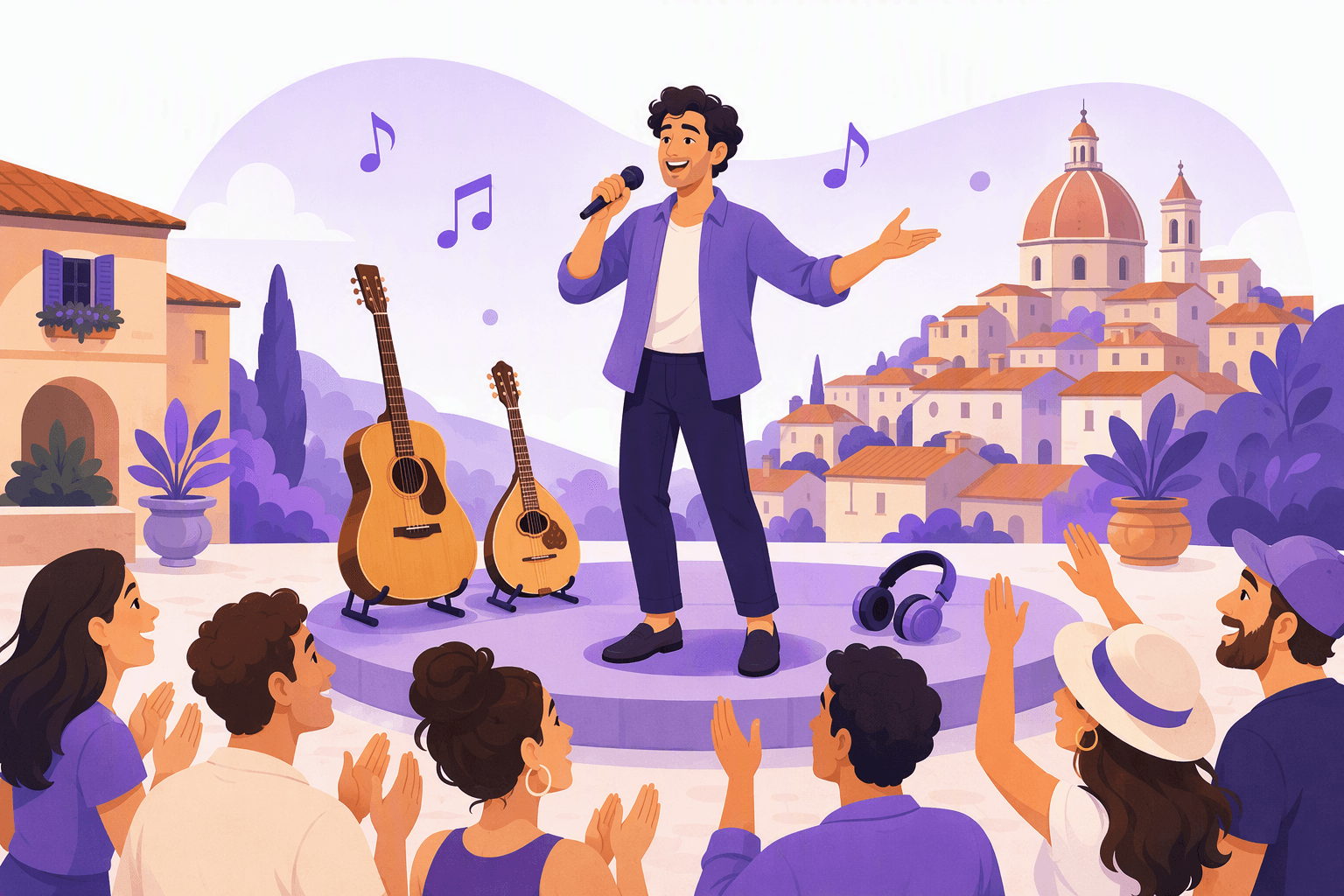
| English | Italian | Pronunciation | Note |
|---|---|---|---|
| music | musica | MOO-zee-kah | General word for music. |
| song | canzone | kahn-TSOH-neh | Everyday word for a song. |
| track | brano | BRAH-noh | Common in reviews and playlists. |
| album | album | AHL-boom | Same spelling, Italian pronunciation. |
| single | singolo | SEEN-goh-loh | A single release. |
| EP | EP | EH-PEE | Spelled out, often used in press. |
| playlist | playlist | PLAY-leest | English loanword, very common. |
| lyrics | testo | TEH-stoh | Text of the song, also means 'text' generally. |
| verse | strofa | STROH-fah | A verse of a song. |
| chorus / refrain | ritornello | ree-tor-NEHL-loh | The repeated, catchy part. |
| hook | hook | HOOK | Often used as an English loanword. |
| melody | melodia | meh-loh-DEE-ah | The tune. |
| rhythm | ritmo | REET-moh | Beat and rhythmic feel. |
| beat | beat | BEET | Loanword, especially in rap and pop. |
| tempo (speed) | tempo | TEHM-poh | Speed of the music, also means 'time'. |
| chords | accordi | ah-KOR-dee | Guitar and piano talk. |
| note (musical) | nota | NOH-tah | A musical note. |
| scale | scala | SKAH-lah | Musical scale, also 'stairs'. |
| key (tonality) | tonalità | toh-nah-lee-TAH | More technical, used by musicians. |
| tuning | accordatura | ah-kor-dah-TOO-rah | Instrument tuning. |
| microphone | microfono | mee-KROH-foh-noh | Stage and studio. |
| speaker | cassa | KAH-sah | In audio context, a speaker box. |
| headphones | cuffie | KOOF-fyeh | Everyday word for headphones. |
| stage | palco | PAHL-koh | Concert stage. |
| audience | pubblico | POOB-blee-koh | The crowd, the public. |
| concert | concerto | kohn-CHEHR-toh | Live show or classical concerto. |
| festival | festival | fehs-tee-VAHL | Often used as-is. |
| tour | tour | TOOR | Loanword, common in announcements. |
| live (in person) | dal vivo | dahl VEE-voh | Most natural way to say 'live'. |
| encore | bis | BEESS | Shouted at concerts, 'Bis!' |
| to do an encore | fare il bis | FAH-reh eel BEESS | Repeat a song, extra performance. |
| to sing | cantare | kahn-TAH-reh | General verb 'to sing'. |
| to play (an instrument) | suonare | swoh-NAH-reh | To play music, also 'to ring'. |
| to listen | ascoltare | ah-skol-TAH-reh | To listen to music. |
| to rehearse | provare | proh-VAH-reh | Also means 'to try'. |
| to record | registrare | reh-jee-STRAH-reh | To record audio. |
| recording studio | studio di registrazione | STOO-dee-oh dee reh-jee-strah-TSYOH-neh | Full phrase, common in interviews. |
| to release (music) | pubblicare | poob-blee-KAH-reh | To publish, to release. |
| to stream | streammare | streem-MAH-reh | Colloquial verb from 'stream'. |
| to download | scaricare | skah-ree-KAH-reh | Also means 'to unload'. |
| singer | cantante | kahn-TAHN-teh | Singer (any gender). |
| band | band | BAHND | Loanword, very common. |
| musician | musicista | moo-zee-CHEE-stah | A musician. |
| DJ | DJ | DEE-JAY | Spelled out. |
| producer | produttore | proh-doot-TOH-reh | Music producer. |
| songwriter | cantautore | kahn-tah-OO-toh-reh | Iconic Italian category, singer-songwriter. |
| composer | compositore | kohm-poh-zee-TOH-reh | More classical/formal. |
| orchestra | orchestra | or-KEH-strah | Also used in pop contexts. |
| choir | coro | KOH-roh | Choir, chorus group. |
| guitar | chitarra | kee-TAHR-rah | Double R is tapped/rolled. |
| bass (instrument) | basso | BAHS-soh | Also means 'low'. |
| drums | batteria | baht-teh-REE-ah | Drum kit. |
| piano | pianoforte | pyah-noh-FOR-teh | Also just 'piano' in daily speech. |
| violin | violino | vyoh-LEE-noh | Common in classical talk. |
| voice | voce | VOH-cheh | Singing voice. |
| high note | nota alta | NOH-tah AHL-tah | Literal and natural. |
| out of tune | stonato | stoh-NAH-toh | Off-key singing. |
| in tune | intonato | een-toh-NAH-toh | On pitch. |
| catchy | orecchiabile | oh-rehk-KYAH-bee-leh | Literally 'ear-able', very common in reviews. |
| moving / emotional | commovente | kohm-moh-VEHN-teh | Often used for ballads. |
| energetic | carico | KAH-ree-koh | Colloquial: full of energy. |
| boring | noioso | noh-YOH-zoh | Boring (song, set, album). |
| masterpiece | capolavoro | kah-poh-LAH-voh-roh | Strong praise. |
| hit (song) | successo | soot-CHEHS-soh | A hit, a success. |
| to go viral | diventare virale | dee-vehhn-TAH-reh vee-RAH-leh | Common in social media talk. |
| to be stuck in your head | rimanere in testa | ree-mah-NEH-reh een TEH-stah | A song that stays in your head. |
| to give me chills | mi fa venire i brividi | mee fah veh-NEE-reh ee BREE-vee-dee | Strong emotional reaction. |
| I love it | mi piace un sacco | mee PYAH-cheh oon SAHK-koh | Very common, enthusiastic but normal. |
| it's awesome | che figata | keh fee-GAH-tah | Slangy, casual. |
How Italians actually talk about music (not just textbook terms)
A lot of learners memorize formal labels, then freeze when someone says something simple like Che figata sto pezzo! or Questo ritornello mi rimane in testa.
The key is to learn three layers at once: structure words (parts of a song), performance words (concert life), and opinion words (how people react).
For a practical listening routine, movie and TV dialogue helps because it contains the same casual evaluation language you hear around music too. If you are building that habit, how to learn a language with movies explains a method that works without turning entertainment into homework.
Song structure vocabulary you will hear in interviews and reviews
canzone
Canzone (kahn-TSOH-neh) is the default word for “song.” It can be any genre, and it is the safest choice when you are not sure whether brano sounds too “review-ish.”
In Italian media, you will also see la canzone dell'estate for the summer hit, a recurring cultural idea tied to radio, beach clubs, and festival season.
brano
Brano (BRAH-noh) is extremely common in playlists, press releases, and reviews. It feels slightly more “music talk” than canzone, but it is not stiff.
If someone says Questo brano spacca, they mean the track is great, with a punchy, modern tone.
testo
Testo (TEH-stoh) is “lyrics,” and it is also the everyday word for “text.” This is why you will hear phrases like il testo è bellissimo in interviews, and also mandami il testo in normal messaging.
Treccani’s dictionary is a good reference when you want to confirm these everyday meanings and how they extend across contexts (Treccani, Vocabolario online, accessed 2026).
strofa
Strofa (STROH-fah) is a verse. People use it when they are describing how the song builds, for example: La strofa è tranquilla, poi esplode nel ritornello.
If you want to sound natural, do not overuse it. Many casual listeners will just say la parte prima del ritornello.
ritornello
Ritornello (ree-tor-NEHL-loh) is the chorus, the repeated section. It is one of the highest value words in Italian music talk because it appears in pop, rock, and even in casual conversation about jingles.
In older music theory, it can also refer to a recurring instrumental idea, but in everyday Italian it is the sing-along part.
orecchiabile
Orecchiabile (oh-rehk-KYAH-bee-leh) means “catchy,” literally something that “works for the ear.” You will see it in reviews, radio talk, and even in casual opinions.
If you want a natural sentence: È super orecchiabile, dopo due ascolti la canti già.
Live music and concert vocabulary (what you hear at venues)
Italy has a strong live culture that ranges from stadium pop to small circoli and summer sagre where bands play in the main square. Even if you mostly stream music, these words show up in social posts and event listings.
dal vivo
Dal vivo (dahl VEE-voh) is the most natural way to say “live.” It is used for concerts, TV performances, and even comedy.
You will also hear the English loanword live (LAHYV), but dal vivo is the phrase that works everywhere.
palco
Palco (PAHL-koh) is the stage. It is used in everything from rock concerts to theater.
A common phrase is salire sul palco (to go on stage), which you will hear in interviews and behind-the-scenes clips.
pubblico
Pubblico (POOB-blee-koh) is the audience. Italians also use it in a broader sense, like “the public,” so context matters.
At a show, you might hear: Il pubblico era carichissimo.
bis
Bis (BEESS) is “encore.” People shout it, and performers talk about it as a normal part of the set.
The verb phrase fare il bis is equally common, and it is a great “native-feeling” chunk to memorize.
💡 A fast listening win
When you watch Italian concert clips, listen for short repeated chunks: "dal vivo", "fare il bis", "che pubblico", "che energia". These are the phrases people say without thinking, and they are easier to catch than full sentences.
Genres in Italian: what stays Italian, what turns into English
Genre names are where Italian shows its modern bilingual reality. Many labels are English globally, but Italians still have Italian ways to talk about them.
You will hear rap, trap, rock, pop, indie, and punk constantly, often pronounced with Italian phonetics.
At the same time, Italy has culturally specific categories like cantautore (kahn-tah-OO-toh-reh). That word is more than “singer-songwriter,” it points to a tradition where the artist’s identity is tied to writing, social commentary, and a recognizable voice.
If you want a cultural anchor, musicologist Philip Tagg’s work on how listeners interpret musical meaning is useful for thinking about why certain genres “read” as authentic or commercial. In Italy, those judgments often get expressed through simple adjectives like commerciale or vero rather than technical theory.
Opinion phrases Italians use when a song hits (or doesn’t)
You can understand every noun in a conversation and still miss the point if you do not know the reaction language.
These are the phrases that show up in everyday talk, TikTok captions, and comments.
mi piace un sacco
Mi piace un sacco (mee PYAH-cheh oon SAHK-koh) means “I like it a lot.” It is enthusiastic but still normal, not dramatic.
It is also flexible: Mi piace un sacco la sua voce works just as well as talking about a song.
mi prende
Mi prende (mee PREHN-deh) is a very Italian way to say “it grabs me,” meaning it gets you emotionally or makes you want to move. It is common for danceable tracks and also for moody songs.
A natural sentence: All'inizio non mi prendeva, poi dopo due ascolti sì.
che figata
Che figata (keh fee-GAH-tah) is slangy “that’s awesome.” Use it with friends, not in formal settings.
If you want a safer alternative, che bello (keh BEHL-loh) is friendly and neutral.
🌍 Why Italian reactions sound 'physical'
Italian music talk often uses body and sensation language: "mi prende" (it grabs me), "mi fa venire i brividi" (it gives me chills), "mi rimane in testa" (it stays in my head). This fits a broader Italian conversational style where feelings are described as something that happens to you, not just an abstract opinion.
A quick note on English borrowings in Italian music talk
If you learn Italian through music, you will notice a lot of English. That is not your imagination.
Italian institutions and scholars regularly discuss anglicisms, and the Accademia della Crusca has written about how English borrowings enter Italian, especially through media and technology (Accademia della Crusca, articles on anglicisms in Italian, accessed 2026). Music is a perfect channel because platforms, marketing, and genre labels are global.
Practically, this means you should learn both: the Italian core (canzone, testo, ritornello) and the loanwords you will actually hear (playlist, streaming, live).
If you are curious how Italian differs from other varieties in everyday vocabulary choices, the same “two systems at once” effect shows up in other topics too. You can see the pattern in English with American vs British English, where shared language still produces different default words.
Music culture touchpoints that shape vocabulary in Italy
Italy’s vocabulary is not only shaped by the internet. It is also shaped by institutions and traditions.
Opera is the obvious one, and it is still a living reference point in Italian culture, not just a museum piece. Treccani’s encyclopedia entries on opera and Italian music history are a reliable starting point when you want the cultural background behind terms like orchestra and compositore (Enciclopedia Treccani, accessed 2026).
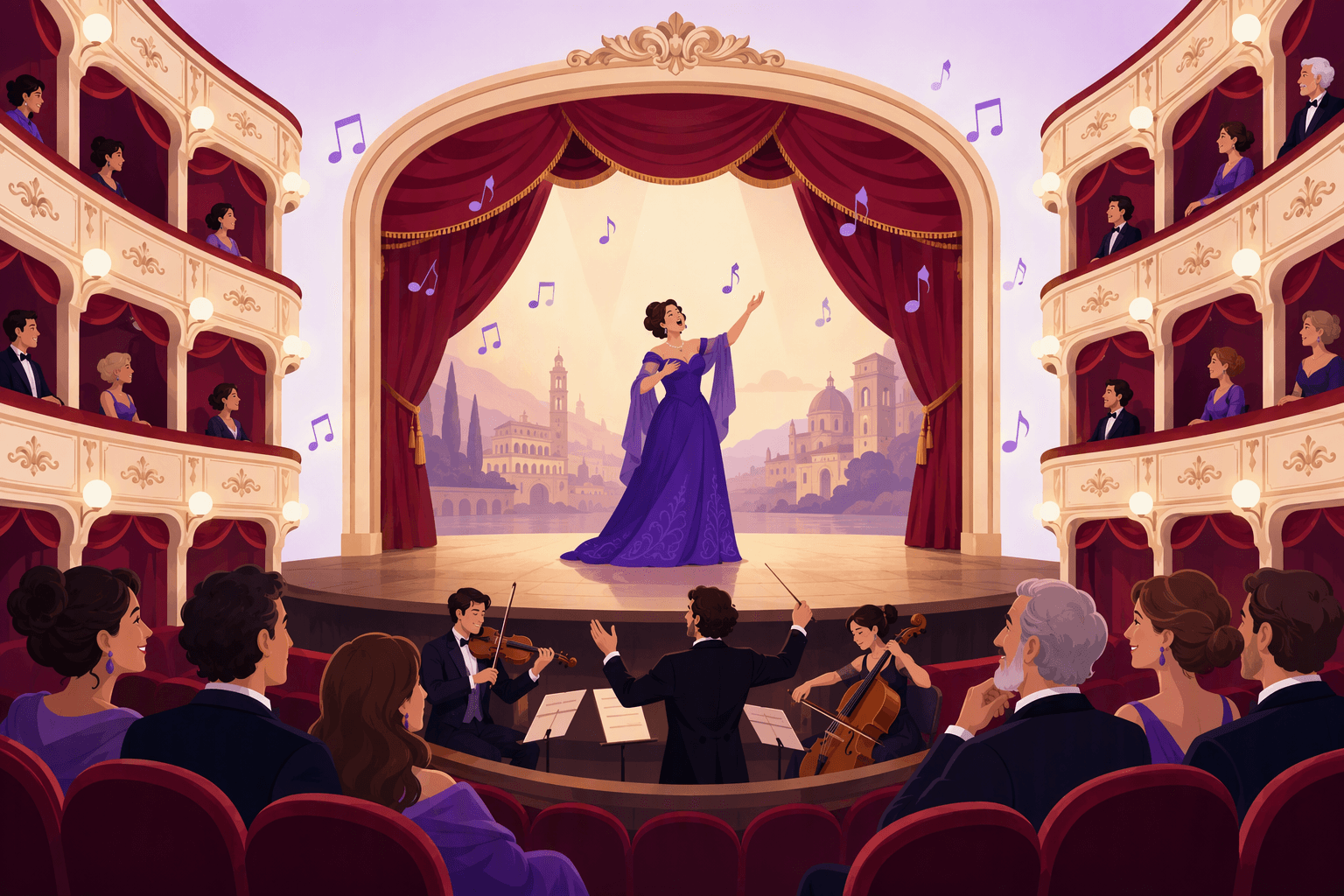
Then there is Sanremo, which functions like a national conversation about songs, lyrics, and performance. Even people who claim not to care will often know the headlines, and the vocabulary of “the song,” “the lyrics,” “the performance,” and “the public” becomes mainstream.
Linguist Tullio De Mauro wrote extensively about Italian usage and the relationship between standard Italian and everyday speech. Music is one of the places where you can hear that spectrum in real time, from formal introductions on TV to casual backstage talk.
How to learn this vocabulary faster with real clips
Memorizing lists is fine, but music vocabulary sticks best when you attach it to a moment: a singer saying Questo brano è nato in studio, a friend texting Che figata, a host asking about il testo.
Use a three-step loop:
- Pick a short clip where someone talks about a song, not just performs it.
- Write down two nouns and one reaction phrase.
- Reuse them in your own sentence the same day.
If you want a structured way to do that with entertainment content, dual subtitles can help you catch phrases the first time, then confirm them without pausing every second.
⚠️ Avoid the 'dictionary trap'
Many Italian music terms have everyday meanings too: "testo", "tempo", "nota". If you learn them only as technical vocabulary, you will misunderstand normal conversation. Always learn one music example and one non-music example.
Mini practice: 8 sentences you can steal
Say these out loud, then swap in your favorite artist or genre.
- Questa canzone è super orecchiabile.
- Il ritornello mi rimane in testa.
- Mi piace un sacco il testo.
- Dal vivo sono ancora più bravi.
- Che pubblico ieri sera!
- Ha fatto il bis e tutti urlavano.
- La sua voce è pazzesca.
- All'inizio non mi prendeva, poi sì.
If you also want “relationship talk” vocabulary that shows up in songs, how to say I love you in Italian is a useful companion because Italian lyrics lean heavily on affection, longing, and apology language.
Where to go next
Once these words feel familiar, you will start hearing them everywhere: in radio intros, in YouTube comments, and in casual “what are you listening to?” chats.
To keep building natural Italian, add a small set of everyday openers and closers so you can actually start the conversation at a concert or with Italian friends: how to say hello in Italian and how to say goodbye in Italian. And if you are consuming a lot of Italian media, be aware that strong language can appear in lyrics and backstage talk, so use italian swear words as a recognition guide, not a script.
If you want to turn real Italian clips into repeatable vocabulary practice, Wordy’s movie and TV clip approach is built for exactly this kind of learning: short, memorable context, then spaced review at the phrase level.
Frequently Asked Questions
What are the most useful Italian words for talking about songs?
What does 'ritornello' mean in Italian music?
How do Italians say 'live music'?
Is 'bis' the same as encore in Italian?
Do Italians use English words when talking about music?
Sources & References
- Ethnologue, 27th edition, 2024
- Treccani, Vocabolario online (accessed 2026)
- Accademia della Crusca, articles on anglicisms in Italian (accessed 2026)
- Enciclopedia Treccani, 'Opera' and Italian music entries (accessed 2026)
Start learning with Wordy
Watch real movie clips and build your vocabulary as you go. Free to download.


