Quick Answer
The most common way to say goodbye in Italian is 'Arrivederci' (ah-ree-veh-DEHR-chee), which works in nearly any situation. For casual farewells, Italians use 'Ciao,' the same word they use for hello. More formal options include 'ArrivederLa,' while dramatic or permanent goodbyes call for the weighty 'Addio.'
The Short Answer
The most common way to say goodbye in Italian is Arrivederci (ah-ree-veh-DEHR-chee). It works in shops, restaurants, offices, and on the street, virtually anywhere you need a polite, universally understood farewell. Among friends, Ciao doubles as both hello and goodbye, making it the go-to casual option.
Italian is spoken by approximately 85 million people worldwide across Italy, Switzerland, San Marino, and Vatican City, according to Ethnologue's 2024 data. The language's farewell system is surprisingly layered: a single wrong choice (say, Addio when you mean Arrivederci) can turn a friendly departure into a dramatic scene worthy of Italian opera. Understanding these distinctions is part of mastering bella figura, the Italian art of making a good impression.
"Italian farewells are never simply about leaving. They encode the relationship, the expected future, and the emotional register of the moment, all in a single word or phrase."
(Tullio De Mauro, Storia linguistica dell'Italia unita, Laterza, 2014)
This guide covers 16 essential Italian farewells organized by category: universal, casual, formal, time-specific, good-luck, and regional expressions. Each includes pronunciation, formality level, an example sentence, and cultural context.

Quick Reference: Italian Farewells at a Glance
| English | Italian | Pronunciation | Formality |
|---|---|---|---|
| Goodbye (universal) | Arrivederci | ah-ree-veh-DEHR-chee | polite |
| Goodbye (very formal) | ArrivederLa | ah-ree-veh-DEHR-lah | very formal |
| Bye / Hello (casual) | Ciao | CHOW | casual |
| Farewell (permanent) | Addio | ahd-DEE-oh | formal |
| See you soon | A presto | ah PREH-stoh | casual |
| See you tomorrow | A domani | ah doh-MAH-nee | casual |
| See you later | A dopo | ah DOH-poh | casual |
| See you (we'll see each other) | Ci vediamo | chee veh-DYAH-moh | casual |
| Have a good day | Buona giornata | BWOH-nah johr-NAH-tah | polite |
| Have a good evening | Buona serata | BWOH-nah seh-RAH-tah | polite |
| Good night | Buonanotte | bwoh-nah-NOHT-teh | polite |
| Take care | Stammi bene | STAHM-mee BEH-neh | casual |
| Good luck (wolf's mouth) | In bocca al lupo | een BOHK-kah ahl LOO-poh | casual |
| We'll be in touch | Ci sentiamo | chee sehn-TYAH-moh | casual |
| All the best | Tanti auguri | TAHN-tee ow-GOO-ree | polite |
| Bye bye! | Ciao ciao! | CHOW CHOW | casual |
Universal Farewells
These goodbyes are understood everywhere Italian is spoken. The Accademia della Crusca, Italy's oldest linguistic authority, recognizes them as core standard Italian.
Arrivederci
/ah-ree-veh-DEHR-chee/
Literal meaning: Until we see each other again
“Grazie per la cena, arrivederci!”
Thanks for dinner, goodbye!
The default all-purpose Italian goodbye. Works in shops, offices, restaurants, and with strangers. Polite without being stiff. Implies you expect to meet again, even if only symbolically.
Arrivederci is built from a (until) + rivederci (we see each other again). It strikes the perfect balance between warmth and formality, which is why it is the farewell Italians reach for in most everyday situations: leaving a shop, ending a business call, or saying goodbye to acquaintances.
Unlike Ciao, which requires an existing level of familiarity, Arrivederci is safe with anyone. It is the goodbye equivalent of Buongiorno: universally appropriate and never offensive.
ArrivederLa
/ah-ree-veh-DEHR-lah/
Literal meaning: Until I see you (formal) again
“ArrivederLa, professore. La ringrazio per il suo tempo.”
Goodbye, professor. I thank you for your time.
The highly formal variant of Arrivederci. Replaces 'ci' (each other) with 'La' (formal you). Reserved for professors, judges, elderly strangers, high-level business meetings, and anyone you address with 'Lei.'
The distinction between Arrivederci and ArrivederLa is one that separates tourists from culturally fluent speakers. While Arrivederci uses ci (us/each other), ArrivederLa substitutes the formal pronoun La (you, formal). According to the Treccani dictionary, ArrivederLa signals maximum deference.
Use it when speaking to someone you would address as Lei: a university professor, a doctor in a formal consultation, a judge, or an elderly person you do not know well. In everyday commerce (buying bread, paying a restaurant bill) Arrivederci is sufficient.
🌍 The Arrivederci vs. ArrivederLa Test
A useful rule: if you would say Come sta? (formal "how are you?") to someone, use ArrivederLa when leaving. If you would say Come stai? (informal), Arrivederci or Ciao is fine. The formality should be consistent throughout the interaction.
Addio
/ahd-DEE-oh/
Literal meaning: To God (I commend you)
“Addio, mio caro amico. Non ci rivedremo più.”
Farewell, my dear friend. We shall not see each other again.
A dramatic, permanent farewell. Implies you do not expect to see the person again. Common in literature, opera, and film, rare in daily life. Using it casually would shock or alarm Italians.
Addio comes from a Dio (to God), originally a prayer entrusting the departing person to God's care. Over centuries it narrowed to mean a permanent or near-permanent goodbye. It carries heavy emotional weight.
You will encounter Addio constantly in Italian opera (Verdi's La Traviata features one of the most famous Addio arias in history), in classic literature, and in films dealing with loss and separation. In real life, Italians almost never use it. Saying Addio to a colleague leaving the office would imply they are never coming back, possibly ever. Reserve it for truly final partings or deliberate dramatic effect.
⚠️ When Addio Goes Wrong
A common learner mistake is using Addio as a casual goodbye, thinking it sounds sophisticated. It does not. It sounds like you are ending the relationship forever. An Italian hearing Addio! from a departing tourist at a café might genuinely worry something is wrong. Stick to Arrivederci for normal departures.
Casual Farewells
Among friends, family, and peers, Italians prefer warm, informal farewells that often promise a future meeting.
Ciao
/CHOW/
Literal meaning: I am your slave (historical, from Venetian)
“Va bene, ci sentiamo domani. Ciao!”
Alright, we'll talk tomorrow. Bye!
The world's most famous Italian word works as both hello and goodbye. Casual only; use with friends, family, and peers. Doubling it ('Ciao ciao!') adds extra warmth and is extremely common when parting.
Ciao is remarkable as one of the few words in any language that functions equally as a greeting and a farewell. Its origin in the Venetian s'ciavo (from schiavo vostro, "your slave") has long since been forgotten; today it simply radiates casual friendliness.
As a goodbye, Ciao is the most natural choice among friends. You will hear it repeated (Ciao, ciao!) at the end of nearly every informal parting in Italy. On phone calls between friends, the sign-off often becomes a cascade: Ciao... ciao ciao... ciao!
A presto
/ah PREH-stoh/
Literal meaning: Until soon
“È stato bello vederti. A presto!”
It was great seeing you. See you soon!
A warm goodbye that implies you'll meet again before long. Works across all regions and ages. Can be used alone or paired with Ciao: 'Ciao, a presto!'
A presto is the optimistic farewell; it says not just goodbye, but "we will see each other again soon." It works beautifully paired with other goodbyes: Ciao, a presto! or Arrivederci, a presto! It carries a genuine warmth that Italians value in their social exchanges.
A domani
/ah doh-MAH-nee/
Literal meaning: Until tomorrow
“Buonanotte, ragazzi. A domani!”
Good night, guys. See you tomorrow!
Used when you know you'll see the person the next day: colleagues leaving the office, classmates, daily café regulars. Specific and practical.
This is the farewell of routine and habit. Colleagues use it leaving the office, students at the end of the school day, and regulars at the bar after their morning espresso. Its specificity (tomorrow, not some vague future) gives it a grounded, everyday feel.
A dopo
/ah DOH-poh/
Literal meaning: Until later
“Vado a fare la spesa. A dopo!”
I'm going grocery shopping. See you later!
Used when you'll see the person again later the same day. Common between family members, housemates, and colleagues stepping out briefly.
A dopo is the short-term farewell. Use it when you are leaving but expect to return or see the person again within the same day. It carries less emotional weight than A presto; it is simply practical and common.
Ci vediamo
/chee veh-DYAH-moh/
Literal meaning: We'll see each other
“Bene, allora ci vediamo sabato sera!”
Good, so we'll see each other Saturday evening!
A versatile farewell that can stand alone or be extended with a time: 'Ci vediamo domani,' 'Ci vediamo lunedì,' 'Ci vediamo dopo.' Very common in everyday speech across all of Italy.
Ci vediamo is wonderfully flexible. You can use it alone as a general "see you," or attach a specific time: Ci vediamo domani (see you tomorrow), Ci vediamo alle otto (see you at eight), Ci vediamo al bar (see you at the bar). It is one of the most practical farewells in colloquial Italian.
Ci sentiamo
/chee sehn-TYAH-moh/
Literal meaning: We'll hear each other
“Perfetto, ci sentiamo per i dettagli. Ciao!”
Perfect, we'll be in touch about the details. Bye!
The phone/text equivalent of 'Ci vediamo.' Implies you'll be in contact by phone, message, or email rather than in person. Very common for ending calls and planning conversations.
Where Ci vediamo promises a face-to-face meeting, Ci sentiamo promises communication: a call, a text, an email. It is the natural sign-off for phone conversations and the perfect farewell when making plans that still need coordination.
Time-Specific Farewells
These farewells wish the departing person a good remainder of the day, evening, or night.
Buona giornata
/BWOH-nah johr-NAH-tah/
Literal meaning: Good day (ahead of you)
“Ecco il suo caffè. Buona giornata!”
Here's your coffee. Have a good day!
Used as a farewell during daytime. Different from 'Buongiorno' (a greeting): 'Buona giornata' wishes the person a good rest-of-day ahead. Common from shopkeepers, baristas, and in polite daily interactions.
This is the daytime farewell equivalent of the greeting Buongiorno. The distinction matters: Buongiorno greets someone upon arrival, while Buona giornata wishes them well upon departure. Shopkeepers use it constantly; Grazie, buona giornata! is the standard farewell after a transaction.
Buona serata
/BWOH-nah seh-RAH-tah/
Literal meaning: Good evening (ahead of you)
“Grazie per la cena. Buona serata a tutti!”
Thanks for dinner. Have a good evening, everyone!
The evening counterpart of 'Buona giornata.' Used when parting ways in the evening. The shift from 'Buona giornata' to 'Buona serata' follows the same regional timing as Buongiorno to Buonasera.
Buona serata follows the same logic as Buona giornata but for the evening hours. Use it when leaving a dinner, exiting a restaurant in the evening, or saying goodbye to someone who is heading out for their evening plans.
Buonanotte
/bwoh-nah-NOHT-teh/
Literal meaning: Good night
“Sono stanchissimo. Buonanotte a tutti, vado a letto!”
I'm exhausted. Good night, everyone, I'm going to bed!
A farewell-only expression, never a greeting. Used when someone is heading to bed or when parting late at night. Can be affectionate between family members and partners.
Unlike Buonasera, which can serve as both a greeting and a farewell, Buonanotte is exclusively a farewell. It signals the end of the evening; someone is going to bed, or the night is wrapping up. Between parents and children or partners, it carries real tenderness: Buonanotte, tesoro (Good night, treasure).
Good-Luck and Well-Wishing Farewells
Italian has a rich tradition of farewell expressions that carry wishes of luck, health, or blessings.
In bocca al lupo
/een BOHK-kah ahl LOO-poh/
Literal meaning: Into the mouth of the wolf
“Domani hai l'esame? In bocca al lupo!”
You have the exam tomorrow? Good luck!
Italy's version of 'break a leg.' Used before exams, interviews, performances, and challenges. The ONLY correct response is 'Crepi il lupo!' (may the wolf die) or simply 'Crepi!' Responding with 'Grazie' is considered bad luck.
This is one of the most distinctive Italian expressions. Its origins are debated (the Accademia della Crusca has documented multiple theories, from hunting traditions to motherly wolf imagery) but its usage is clear: you say it before someone faces a challenge, and they must respond Crepi! (may it die).
The superstition around the response is taken seriously. Saying Grazie instead of Crepi will draw gentle (or not-so-gentle) correction from any Italian within earshot. In recent years, some Italians have started saying Viva il lupo! (long live the wolf) as an animal-friendly alternative, though traditionalists consider this equally bad luck.
🌍 The Lupo Superstition
Italian students before university exams, actors before performances, and athletes before matches all rely on In bocca al lupo. Some take the superstition so seriously that they avoid saying buona fortuna (good luck) altogether, considering it a jinx. If you want to sound authentically Italian before someone's big moment, In bocca al lupo is the only way to go.
Stammi bene
/STAHM-mee BEH-neh/
Literal meaning: Stay well for me
“Ci vediamo il mese prossimo. Stammi bene!”
See you next month. Take care!
A warm, caring farewell used when you won't see someone for a while. The 'mi' (for me) adds a personal, affectionate touch; you're not just saying 'be well,' you're saying 'be well for my sake.'
Stammi bene is more affectionate than a simple Stai bene (stay well) because of the mi, meaning "for me." It implies the speaker cares personally about the other person's wellbeing. Use it when parting for a longer period or with someone you genuinely care about.
Tanti auguri
/TAHN-tee ow-GOO-ree/
Literal meaning: Many wishes
“Buon viaggio e tanti auguri per il nuovo lavoro!”
Have a good trip and all the best with the new job!
While most famous as 'happy birthday,' 'Tanti auguri' also works as a farewell wishing someone well for a new chapter: a new job, a move, a marriage. Broader and more versatile than many learners realize.
Most learners encounter Tanti auguri only as "happy birthday," but it is far more versatile. As a farewell, it wishes someone the best for whatever lies ahead: a new job, a move to another city, a new phase of life. It works as a parting blessing.
Regional Farewell Traditions
Italy's regional diversity shapes how people part ways. According to linguist Tullio De Mauro, standard Italian only became most Italians' daily language in the late 20th century, and regional habits still run deep.
🌍 North vs. South: Farewell Styles
Northern Italians (Milan, Turin, Venice) tend toward briefer, more reserved goodbyes. A single Ciao or Arrivederci suffices. Southern Italians (Naples, Palermo, Bari) often turn farewells into extended rituals: multiple kisses, repeated Ciao ciao ciao, blessings for the family, promises to call, and invitations to return. Neither style is more correct; they reflect different cultural temperaments.
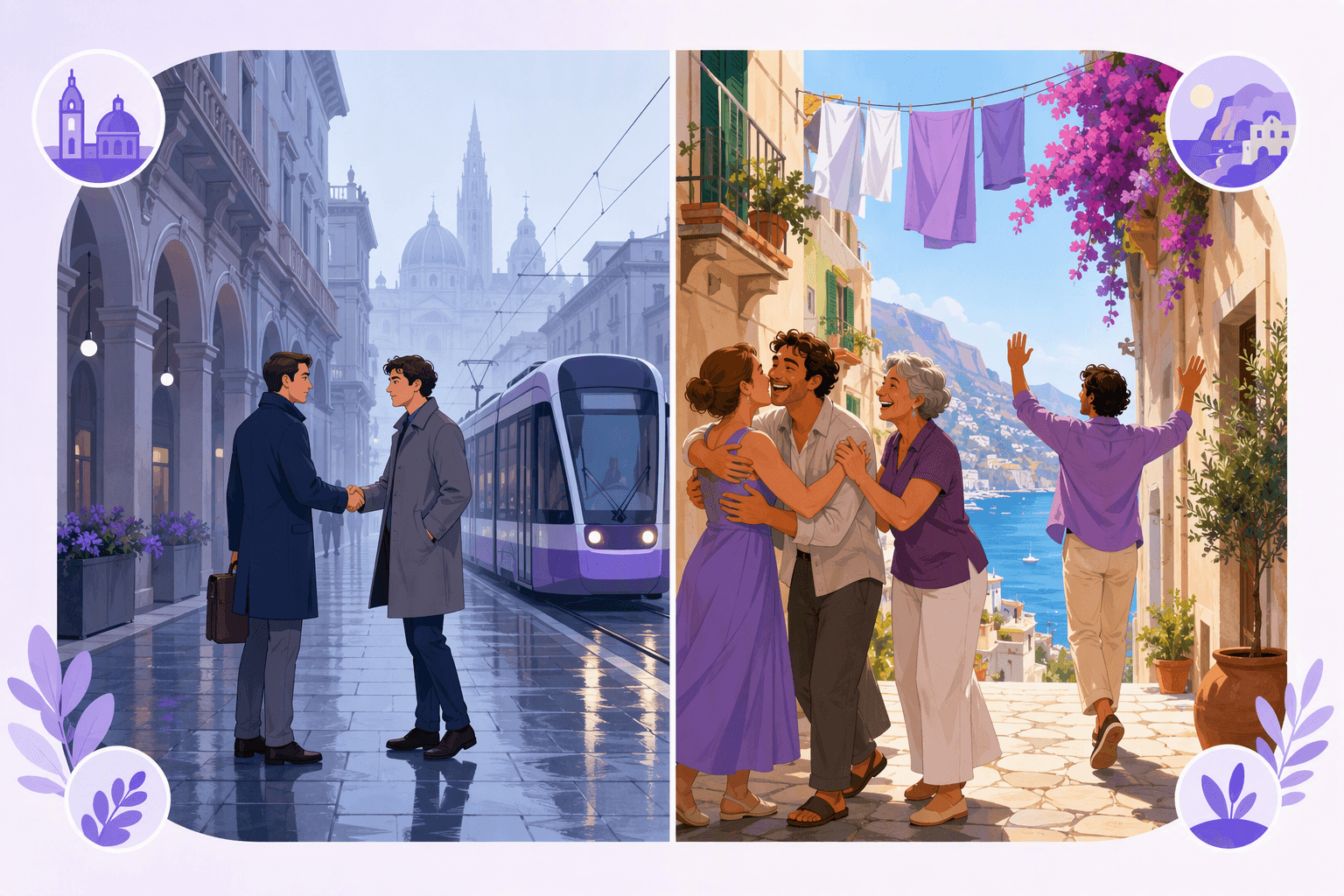
In Naples and across Campania, farewells are infused with warmth and volume. A Neapolitan goodbye between friends might include Ciao, bello!, a hug, two kisses, Stammi bene!, a wave, and then another shouted Ciao! from across the street. The Sicilian tradition is similarly effusive, often adding blessings: Che Dio ti benedica (May God bless you) from older generations.
In the north, the Milanese style is more contained. A handshake, a single Ciao, and a nod may be all that is exchanged, even between good friends. This is not coldness; it is simply a different cultural register.
How to Respond to Italian Farewells
Matching Farewell Responses
| They Say | You Say | Notes |
|---|---|---|
| Arrivederci | Arrivederci | Echo the same farewell |
| ArrivederLa | ArrivederLa | Maintain the formal register |
| Ciao | Ciao / Ciao ciao! | Echo or double for warmth |
| A presto | A presto / Sì, a presto! | Echo with enthusiasm |
| Buona giornata | Grazie, anche a Lei/te | "Thanks, you too" (formal/informal) |
| Buona serata | Grazie, altrettanto! | "Thanks, likewise!" |
| Buonanotte | Buonanotte! Dormi bene! | "Good night! Sleep well!" |
| In bocca al lupo | Crepi! / Crepi il lupo! | NEVER say "Grazie" |
| Stammi bene | Anche tu! / Ci vediamo | "You too!" / "See you" |
💡 The Italian Farewell Cascade
Italian phone conversations rarely end with a single goodbye. Expect a cascade: Va bene... allora ci sentiamo... un abbraccio... ciao... ciao ciao... ciao! This is completely normal. Match the energy and add your own Ciao or two before hanging up.
Practice With Real Italian Content
Reading about farewells gives you knowledge, but hearing them in natural conversation is what makes them instinctive. Italian cinema, from the operatic drama of Visconti to the street-level comedy of modern Roman films, is filled with every shade of goodbye, from whispered Addio to shouted Ciao ciao! across a crowded piazza.
Wordy lets you watch Italian movies and shows with interactive subtitles. Tap any farewell to see its meaning, pronunciation, formality level, and cultural context in real time. You absorb natural intonation, gesture, and timing, things a word list alone cannot teach.
For more Italian content, explore our blog for guides on everything from greetings to slang, including the best movies to learn Italian. You can also visit our Italian learning page to start practicing with authentic content today.
Frequently Asked Questions
What is the most common way to say goodbye in Italian?
What is the difference between Arrivederci and ArrivederLa?
When should I use Addio instead of Arrivederci?
Can Ciao be used to say both hello and goodbye?
What does 'In bocca al lupo' mean and how do I respond?
How do Italians say goodbye on the phone?
Sources & References
- Accademia della Crusca, Italy's foremost authority on the Italian language, founded 1583
- Treccani, Vocabolario della lingua italiana, online edition (2025)
- Ethnologue: Languages of the World, Italian language entry (2024)
- De Mauro, T. (2014). 'Storia linguistica dell'Italia unita.' Laterza.
- Società Dante Alighieri, L'italiano nel mondo, 2024 annual report
Start learning with Wordy
Watch real movie clips and build your vocabulary as you go. Free to download.


