Quick Answer
To tell time in Italian, you usually use 'Sono le' + the hour (except 1 o'clock: 'È l'una'), then add minutes with 'e' (e.g., 'Sono le tre e dieci') or use 'meno' for minutes to the next hour (e.g., 'Sono le quattro meno un quarto'). In everyday speech, Italians also use 'mezza' (half past) and 'un quarto' (a quarter), and often prefer the 12-hour clock with context like 'di mattina' or 'di sera'.
To tell time in Italian, use È l'una for 1:00, and Sono le plus the hour for everything else, then add minutes with e (past) or meno (to): Sono le tre e dieci (3:10) and Sono le quattro meno un quarto (3:45).
Italian is spoken by over 60 million people worldwide according to Ethnologue (27th edition, 2024), and time phrases show up constantly in travel, work, and everyday plans. If you already know basic greetings like in our hello in Italian guide, telling time is one of the next skills that makes conversations feel real.

| English | Italian | Pronunciation | Formality |
|---|---|---|---|
| What time is it? | Che ore sono? | keh OH-reh SOH-noh | casual |
| What time is it? (singular) | Che ora è? | keh OH-rah eh | casual |
| It's one o'clock. | È l'una. | eh LOO-nah | casual |
| It's two o'clock. | Sono le due. | SOH-noh leh DOO-eh | casual |
| At what time? | A che ora? | ah keh OH-rah | casual |
| At (time) | Alle... | AHL-leh | casual |
| Half past (hour). | E mezza. | eh MEHT-tsah | casual |
| A quarter past (hour). | E un quarto. | eh oon KWAHR-toh | casual |
| A quarter to (next hour). | Meno un quarto. | MEH-noh oon KWAHR-toh | casual |
| Around (time). | Verso le... | VEHR-soh leh | casual |
| Exactly (time). | Alle... in punto. | AHL-leh een POON-toh | casual |
| See you at (time). | Ci vediamo alle... | chee veh-DYAH-moh AHL-leh | casual |
The core grammar: "È l'una" vs "Sono le..."
Italian time-telling is built on a simple agreement rule: one is singular, everything else is plural.
È l'una
È l'una (eh LOO-nah) literally means "It is the one." You will also see l’una written with an apostrophe because it comes from la una.
Use it for 1:00 and for times in the 1 o'clock hour.
/eh LOO-nah/
Literal meaning: It is the one.
“Scusa, è l'una già?”
Excuse me, is it already one o'clock?
You will hear this constantly in daily talk. Italians often add 'già' to express surprise that time has passed.
Sono le...
For 2:00 onward, use Sono le (SOH-noh leh) plus the number: Sono le due, Sono le tre, and so on.
This matches the plural idea of le ore (the hours). Treccani’s dictionary entries for ora and common time expressions reflect this standard pattern in modern Italian usage.
/SOH-noh leh DOO-eh/
Literal meaning: They are the two (hours).
“Sono le due, andiamo a pranzo.”
It's two o'clock, let's go to lunch.
In many parts of Italy, lunch can be later than in the US or UK. Hearing 'Sono le due' connected to 'pranzo' is very normal.
Asking and answering: the two common questions
You will hear two main ways to ask the time. Both are correct and common.
Che ore sono?
Che ore sono? (keh OH-reh SOH-noh) is the everyday default. It matches the plural structure of most answers.
A natural short answer is just the time: Le tre e dieci. A full answer repeats the verb: Sono le tre e dieci.
Che ora è?
Che ora è? (keh OH-rah eh) uses singular ora and singular è. It is also normal, and some speakers prefer it.
If you answer with È l'una, it lines up perfectly with the singular question, but you can still answer other times with Sono le... without sounding strange.
Minutes: "e" for past, "meno" for to
Italian gives you two clean options: count forward from the hour, or count backward from the next hour.
"e" + minutes (past the hour)
Use e (eh) to add minutes after the hour:
- Sono le tre e cinque (SOH-noh leh TREH eh CHEEN-kweh) = 3:05
- Sono le nove e venti (SOH-noh leh NOH-veh eh VEHN-tee) = 9:20
In careful speech, Italians often say the minutes as plain numbers. In fast speech, you may hear the e reduced.
"meno" + minutes (to the next hour)
Use meno (MEH-noh) when it is close to the next hour:
- Sono le quattro meno dieci (SOH-noh leh KWAHT-troh MEH-noh dee-EH-chee) = 3:50
- Sono le otto meno cinque (SOH-noh leh OHT-toh MEH-noh CHEEN-kweh) = 7:55
This is especially common for "quarter to" and "ten to."
💡 A fast comprehension trick
If you hear "meno", mentally jump to the next hour first. "Quattro meno dieci" starts from 4:00, then subtract 10 minutes.
The three time chunks Italians rely on: quarto, mezza, in punto
If you want to sound natural quickly, master these three.
un quarto
Un quarto (oon KWAHR-toh) means a quarter of an hour.
- Sono le tre e un quarto = 3:15
- Sono le quattro meno un quarto = 3:45
Treccani treats quarto as a standard lexical item, and in time expressions it behaves like a fixed chunk.
mezza
Mezza (MEHT-tsah) means half (feminine), and in time-telling it is the default form:
- Sono le due e mezza = 2:30
This feminine agreement is one reason learners say mezzo by mistake. The Accademia della Crusca regularly addresses agreement and everyday usage questions in its public Q and A style resources, and time expressions are a classic place where grammatical gender shows up in a practical way.
in punto
In punto (een POON-toh) means "exactly on the dot."
- Alle otto in punto = at exactly 8:00
It is common in appointments, meetings, and anything that needs precision.
12-hour vs 24-hour time: what Italians actually do
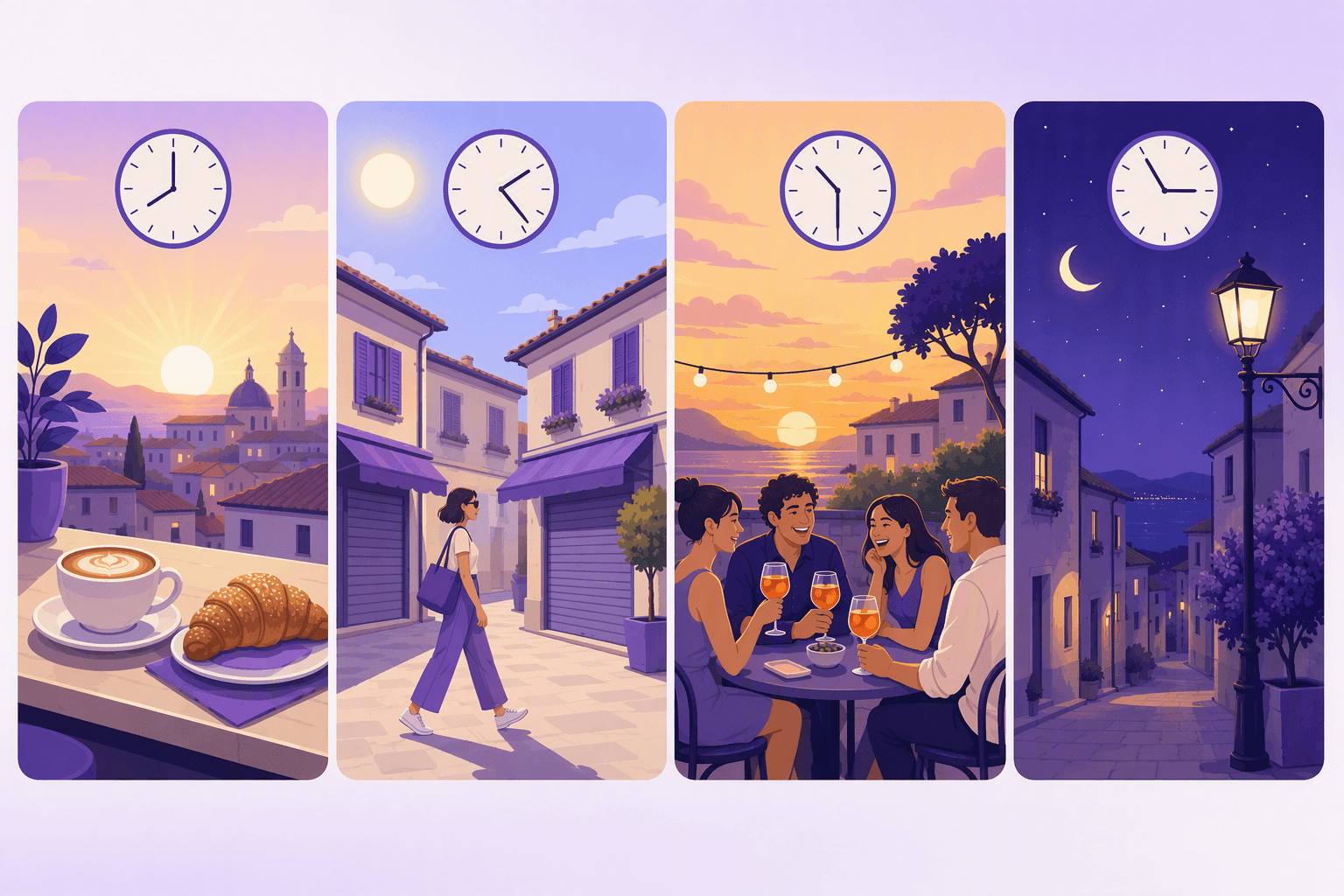
In conversation, Italians often use the 12-hour clock and rely on context.
You will hear add-ons like:
- di mattina (dee maht-TEE-nah) = in the morning
- di pomeriggio (dee poh-meh-REEJ-joh) = in the afternoon
- di sera (dee SEH-rah) = in the evening
- di notte (dee NOHT-teh) = at night
For schedules, transport, and many workplaces, the 24-hour clock is extremely common:
- 17:30 is often read as diciassette e trenta (dee-chahs-SEHT-teh eh TREHN-tah)
- 08:05 can be otto e cinque (OHT-toh eh CHEEN-kweh) or in formal contexts zero otto zero cinque for codes and logistics
If you are learning from media, you will hear both. Movie dialogue tends to prefer the 12-hour style because it is shorter and more conversational, which is one reason clip-based learning works well for time phrases.
Essential time vocabulary (with pronunciation)
These are the words that show up around time, schedules, and planning.
| English | Italian | Pronunciation | Note |
|---|---|---|---|
| hour | ora | OH-rah | Singular. In time questions: 'Che ora è?' |
| hours | ore | OH-reh | Plural. In time questions: 'Che ore sono?' |
| minute | minuto | mee-NOO-toh | Often used in plural: 'minuti'. |
| minutes | minuti | mee-NOO-tee | Common in precise times: 'e dieci minuti'. |
| half | mezza | MEHT-tsah | Used for 30 minutes past: 'e mezza'. |
| quarter | quarto | KWAHR-toh | Used in 'un quarto' for :15 and 'meno un quarto' for :45. |
| exactly (on the dot) | in punto | een POON-toh | Often after the time: 'alle otto in punto'. |
| around, towards | verso | VEHR-soh | Approximate time: 'verso le otto'. |
| about, approximately | circa | CHEER-kah | More neutral, also written contexts: 'circa le 8'. |
| morning | mattina | maht-TEE-nah | Use 'di mattina' for AM context. |
| afternoon | pomeriggio | poh-meh-REEJ-joh | Use 'di pomeriggio' for PM context. |
| evening | sera | SEH-rah | Use 'di sera' for evening plans. |
| night | notte | NOHT-teh | Use 'di notte' for late-night times. |
| today | oggi | OHD-jee | Useful for scheduling: 'oggi alle...' |
| tomorrow | domani | doh-MAH-nee | Very common in planning: 'domani alle...' |
Real-life phrases you will hear in Italy (not textbook-only)
Time phrases are social. They often include softeners, approximations, and expectations about punctuality.
Verso le...
Verso le otto (VEHR-soh leh OHT-toh) means "around eight." It signals approximation, not lateness.
In many friend contexts, verso can imply a flexible window. In professional contexts, people may still use verso but then clarify with a more exact time.
Alle... e qualcosa
Alle otto e qualcosa (AHL-leh OHT-toh eh kwahl-KOH-zah) means "eight-ish." It is casual and very common.
Use it with friends, not in formal scheduling.
Ci vediamo alle...
Ci vediamo alle nove (chee veh-DYAH-moh AHL-leh NOH-veh) means "See you at nine."
If you are also learning leave-taking, pair it with phrases from our goodbye in Italian guide to close the conversation naturally.
A che ora?
A che ora? (ah keh OH-rah) means "At what time?" It is the quick follow-up when someone proposes a plan.
It is one of the highest-frequency mini-questions in Italian planning talk.
Common learner mistakes (and how to fix them fast)
Small errors with time are very noticeable, but also easy to correct.
Mixing singular and plural
If you say Sono l'una, it will sound off. Lock in the pattern:
- 1:00: È l'una
- 2:00+: Sono le...
Using "mezzo" instead of "mezza"
For time, default to mezza:
- Sono le cinque e mezza
If you want a memory hook: you are implicitly talking about mezza (ora), and ora is feminine.
Overusing "e minuti"
It is correct to say Sono le tre e dieci minuti, but in normal conversation most people just say Sono le tre e dieci.
Save minuti for emphasis, clarity, or formal contexts.
Confusing 24-hour readings
17:45 is diciassette e quarantacinque (dee-chahs-SEHT-teh eh kwah-rahn-tah-CHEEN-kweh) in a straightforward reading.
But in daily talk, many people will switch back to the 12-hour style: le sei meno un quarto di sera. Both are normal, and you should aim to understand both.
A cultural note: punctuality, "Italian time", and what people really mean
Stereotypes about punctuality are unreliable, but the language people choose does carry expectations.
If someone says alle otto in punto, they are asking for precision. If they say verso le otto or otto e qualcosa, they are building flexibility into the plan.
This matches what linguist Deborah Tannen describes in her work on conversational style, where speakers use framing and indirectness to manage expectations and relationships. In Italian, time expressions are one of the everyday places you can hear that social calibration.
🌍 When 'verso' is polite
In invitations, 'verso le...' can be a politeness strategy: it reduces pressure and makes it easier for guests to arrive without feeling late. If you need strict timing, add 'in punto' or specify a concrete minute.
Practice: mini-dialogues you can steal for real conversations
Short patterns help you respond fast without translating in your head.
Making plans
A: Ci vediamo domani? (chee veh-DYAH-moh doh-MAH-nee)
B: Sì, a che ora? (see, ah keh OH-rah)
A: Alle sette e mezza. (AHL-leh SEHT-teh eh MEHT-tsah)
Checking the time politely
A: Scusa, che ore sono? (SKOO-zah, keh OH-reh SOH-noh)
B: Sono le nove meno cinque. (SOH-noh leh NOH-veh MEH-noh CHEEN-kweh)
Clarifying AM vs PM
A: Alle otto? (AHL-leh OHT-toh)
B: Sì, alle otto di sera. (see, AHL-leh OHT-toh dee SEH-rah)
How to learn time phrases with movies and TV clips
Time language is rhythm-based and repetitive, which makes it ideal for clip practice.
Pick scenes with planning, dates, trains, or meeting up. Rewatch until you can predict the time phrase before the character says it, then shadow it out loud.
If you want more everyday building blocks, combine this with core phrases from how to say hello in Italian and relationship language from how to say I love you in Italian. You will start to understand entire scenes, not just isolated words.
💡 A simple shadowing drill
Pause right before the time is said, speak your guess out loud, then play and copy the actor's timing. Time phrases are short, so you can get many repetitions quickly without fatigue.
A quick recap you can memorize
If you only memorize five things, make them these:
- È l'una for 1:00
- Sono le for all other hours
- e for minutes past
- meno for minutes to
- e mezza, e un quarto, in punto for natural speech
For more Italian learning paths, browse the Wordy blog and keep your input heavy with real audio. If you also want to understand the occasional spicy line in dialogue, our Italian swear words guide explains what is common, what is harsh, and what to avoid repeating.
Frequently Asked Questions
How do you say 'What time is it?' in Italian?
Why is 1 o'clock 'È l'una' and not 'Sono le una'?
Do Italians use 24-hour time in conversation?
How do you say half past and quarter past in Italian?
Is it correct to say 'Sono le tre e mezzo'?
Sources & References
- Accademia della Crusca, consulenze linguistiche on Italian usage (accessed 2026)
- Treccani, Vocabolario Treccani entries for 'ora', 'mezzo', and 'quarto' (accessed 2026)
- Ethnologue: Languages of the World, Italian language entry (27th edition, 2024)
- Council of Europe, Common European Framework of Reference for Languages (CEFR), Companion Volume (accessed 2026)
Start learning with Wordy
Watch real movie clips and build your vocabulary as you go. Free to download.


