Quick Answer
Italian swear words range from mild expressions like 'Cavolo' (cabbage, used like 'darn') and 'Accidenti' (damn) to strong blasphemies called 'bestemmie' like 'Porco Dio' (Pig God). Unlike most European languages, Italian profanity has an entire category dedicated to religious blasphemy that is uniquely offensive in Italian culture. This guide covers 15 essential terms ranked by severity so you can understand real conversations, movies, and TV shows.
Why You Need to Know Italian Swear Words
You cannot fully understand real Italian without understanding its profanity. Italian is spoken by over 85 million people worldwide, and swearing is woven into the fabric of everyday conversation, Italian cinema, music, and street culture. This guide is not about encouraging you to swear. It is about helping you recognize and understand what you will inevitably hear.
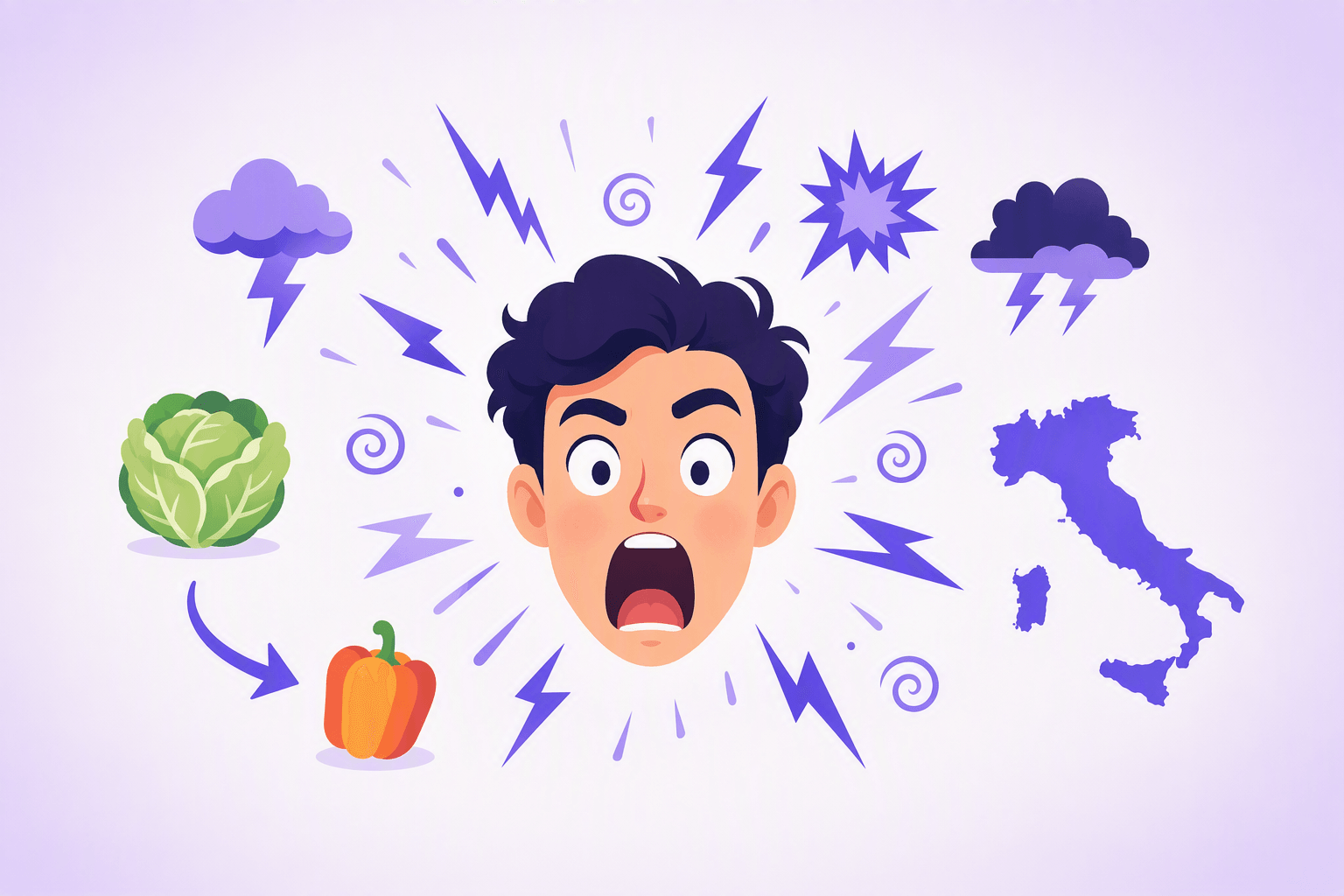
Italian profanity stands apart from other European languages because of one unique category: bestemmie (blasphemy). While English swearing draws from sexual and scatological sources, and Spanish profanity splits between religion and family insults, Italian has elevated religious blasphemy into an art form, and a legal offense. Alongside bestemmie, Italian profanity operates through sexual references, scatological terms, and personal insults that vary dramatically from region to region.
"Italian profanity is not merely a collection of vulgar words. It is a sociolinguistic map of Italian identity. The bestemmia in Veneto, the 'minchia' in Sicily, the 'daje' in Rome: each region's profanity reflects centuries of distinct cultural evolution."
(Vito Tartamella, Parolacce: Perché le diciamo, che cosa significano, quali effetti hanno, 2016)
A 2018 survey by the Accademia della Crusca found that 78% of Italian adults admitted to swearing daily, with frequency highest in the 18-34 age bracket. Yet context governs everything: the same word whispered among friends at a bar would provoke genuine shock at a family dinner, especially in front of elders or in Southern Italy where social codes around respect remain strict.
If you are still learning the basics, this guide will give you a window into the emotional register that textbooks skip entirely. Check out our Italian learning page for more resources.
⚠️ A Note on Responsible Use
This guide is for educational and comprehension purposes. Using these words carelessly as a non-native speaker can cause genuine offense or create dangerous situations. Bestemmie in particular carry legal consequences in Italy. The golden rule: if you would not swear in that context in your native language, do not swear in Italian either.
Understanding the Severity Scale
Severity Scale
Everyday expressions. May raise eyebrows in formal settings but generally acceptable among friends.
Clearly vulgar. Common in casual speech but inappropriate in professional or formal contexts.
Highly offensive. Can provoke strong reactions. Use with extreme caution or avoid entirely.
Context changes everything in Italian profanity. Muttering "Cavolo!" when you spill coffee is mild. Shouting "Cazzo!" at a football match is moderate. Hurling "Porco Dio!" in a public square can get you a fine. Italian profanity is also deeply shaped by geography: Northern Italy, Southern Italy, Sicily, and Sardinia each have distinct profanity traditions.
Mild Expressions
These are the entry-level terms you will hear constantly in casual conversation and Italian-language films. Most Italians barely register these as true swear words.
1. Cavolo
/kah-VOH-loh/
Cabbage: used as a euphemism for 'cazzo' (dick/fuck). Equivalent to English 'darn' or 'dang.'
The go-to family-friendly substitute for 'cazzo.' Safe to use in front of grandparents, children, and colleagues. Functions as an all-purpose exclamation: 'Che cavolo!' (What the heck!), 'Cavolo, che freddo!' (Darn, it's cold!).
“Che cavolo stai dicendo?”
What the heck are you saying?
Universal across all Italian regions. Understood by everyone as a clean substitute for stronger language.
2. Accidenti
/ah-chee-DEHN-tee/
Damn / Darn: a mild exclamation of surprise or frustration.
One of the mildest exclamations in Italian. Literally derived from 'accidents' or 'misfortunes.' Safe in virtually any context. Frequently paired with a target: 'Accidenti a te!' (Damn you!).
“Accidenti, ho dimenticato il portafoglio!”
Damn, I forgot my wallet!
Universal across Italy. Common in children's speech and family-friendly media.
3. Mannaggia
/mah-NAHJ-jah/
Damn it / Darn it: a Southern Italian exclamation derived from 'maledizione' (curse).
A versatile mild oath used alone or in combinations. 'Mannaggia a te' (damn you), 'mannaggia la miseria' (damn the poverty). While standalone use is mild, combining it with religious figures ('mannaggia la Madonna') crosses into moderate or strong territory depending on context.
“Mannaggia, ho perso il treno!”
Damn it, I missed the train!
Originated in Southern Italy (Naples, Campania) but now used nationwide. More frequent south of Rome.
4. Porca miseria
/POHR-kah mee-ZEH-ree-ah/
Damn it / For crying out loud: literally 'pig misery.'
A common exclamation of frustration that avoids blasphemy by substituting 'miseria' (misery/poverty) for religious targets. Part of the 'porca + noun' construction that ranges from completely mild ('porca miseria') to extremely blasphemous ('Porco Dio'). Safe in most contexts.
“Porca miseria, si è rotta la macchina!”
Damn it, the car broke down!
Universal across Italy. This expression provides a safe alternative within the 'porca' construction that avoids the severe blasphemy of 'Porco Dio.'
5. Che palle
/keh PAHL-leh/
What a drag / How annoying: literally 'what balls.'
One of the most common Italian expressions of boredom, annoyance, or tedium. While it literally references testicles, its usage is so widespread that most speakers no longer register the anatomical reference. Used by all ages in informal settings.
“Che palle, devo lavorare anche sabato.”
What a drag, I have to work on Saturday too.
Universal across Italy. The masculine variant 'che palla' (singular) is equally common and even milder.
Moderate Expressions
Moderate profanity is where Italian gets genuinely vulgar. These words are common in casual settings but inappropriate in professional or formal contexts. According to Tartamella (2016), moderate profanity in Italian serves as emotional currency: using it among friends signals intimacy and trust. You will hear these constantly when watching Italian films or spending time in informal settings.
6. Cazzo
/KAHT-tsoh/
Dick / Fuck: the most versatile and common Italian swear word.
The undisputed king of Italian profanity. Functions as an exclamation ('Cazzo!'), an intensifier ('che cazzo vuoi?', what the fuck do you want?), and generates numerous derivatives: 'cazzata' (bullshit/nonsense), 'incazzato' (pissed off), 'cazzone' (dickhead). A 2016 study by Tartamella found it ranks as the single most frequently used Italian swear word.
“Cazzo, che bella macchina!”
Fuck, what a beautiful car!
Universal across all Italian regions. Equally common in the North and South. The Accademia della Crusca traces its written usage back to the 14th century.
7. Merda
/MEHR-dah/
Shit: used as an exclamation and as a descriptor for something terrible.
The Italian equivalent of English 'shit.' Used as an exclamation of frustration, a descriptor ('è una merda', it's shit), or a way to dismiss something worthless. Slightly more vulgar than its frequency might suggest; older Italians consider it genuinely crude.
“Merda, ho sbagliato strada!”
Shit, I took the wrong road!
Universal across Italy. Derived from Latin 'merda,' unchanged across two thousand years of linguistic evolution.
8. Stronzo / Stronza
/STROHN-tsoh / STROHN-tsah/
Asshole / Bitch: literally 'turd.' One of the most common Italian personal insults.
Primarily a personal insult rather than an exclamation. Calling someone 'stronzo' (m.) or 'stronza' (f.) is a clear expression of contempt. Can also be used admiringly in specific contexts: 'quel furbo stronzo' (that clever bastard). The diminutive 'stronzetto' softens it slightly.
“Quello stronzo mi ha tagliato la strada!”
That asshole cut me off!
Universal across Italy. Among the most commonly understood Italian insults internationally, partly due to its prominence in Italian cinema.
9. Minchia
/MEEN-kyah/
Dick / Fuck: a Sicilian exclamation that has become mainstream across Italy.
Originally Sicilian dialect for 'penis,' minchia has spread throughout Italy as a general-purpose exclamation of surprise or emphasis. In Sicily, it punctuates nearly every sentence in casual speech. Used as an exclamation ('Minchia!'), an intensifier ('minchia che bello!'), or a filler word. Its rising popularity outside Sicily mirrors how regional dialect terms enter mainstream Italian.
“Minchia, hai visto che goal?”
Holy shit, did you see that goal?
Originated in Sicily, now widely used across Italy, especially among younger speakers. In Sicily it is mild through sheer frequency; in Northern Italy it retains more vulgar impact.
10. Coglione
/koh-LYOH-neh/
Idiot / Dumbass: literally 'testicle.' A common insult implying stupidity.
One of the standard Italian insults for a stupid or contemptible person. 'Sei un coglione' (you're an idiot) is a straightforward insult. The plural 'coglioni' appears in expressions like 'rompere i coglioni' (to break the balls, to annoy someone) and 'avere i coglioni' (to have balls, to be brave).
“Non fare il coglione, concentrati!”
Don't be an idiot, focus!
Universal across Italy. The expression 'rompere i coglioni' (to bust someone's balls) is one of the most frequently used Italian vulgar phrases.
11. Vaffanculo
/vahf-fahn-KOO-loh/
Fuck off / Go fuck yourself: literally 'go do it in the ass.'
Italy's most famous dismissal. Contraction of 'vai a fare in culo.' Internationally recognized thanks to Italian cinema and the 2007 'Vaffanculo Day' political protest organized by comedian Beppe Grillo. Can be moderate among peers or escalate to strong when directed aggressively at someone.
“Ma vaffanculo, non mi interessa!”
Fuck off, I don't care!
Universal across Italy. Arguably the most internationally recognized Italian swear word. Often shortened to 'vaffa' in casual speech.
Strong Expressions
These expressions carry the heaviest weight in Italian culture. The bestemmie (blasphemies) in this section occupy a category that exists nowhere else in European profanity: they are not merely vulgar, but culturally taboo and legally punishable.
⚠️ Serious Caution Required
The expressions below include bestemmie (religious blasphemy), which are the most offensive category of Italian language. They can result in legal fines under Italian law, provoke genuine outrage even from people who swear freely, and are never acceptable in public. They are included purely for educational purposes.
12. Porca puttana
/POHR-kah poot-TAH-nah/
Fucking hell: literally 'pig whore.' A strong exclamation of anger or shock.
A strong exclamation that avoids direct blasphemy while still carrying significant vulgar force. Part of the 'porca + noun' construction. Directs the 'porca' (pig) modifier at 'puttana' (whore) rather than at God or saints, making it less taboo than bestemmie but still firmly in strong territory.
“Porca puttana, mi sono bruciato!”
Fucking hell, I burned myself!
Universal across Italy. Considered strong but not as culturally taboo as true bestemmie because it does not target religious figures.
13. Figlio di puttana
/FEE-lyoh dee poot-TAH-nah/
Son of a bitch / Son of a whore: a direct personal insult.
The Italian equivalent of 'son of a bitch.' As an exclamation about a situation, it is strong but not extreme. Directed at a specific person, it is a serious insult that attacks family honor. In Southern Italy, where family honor carries extra cultural weight, this is particularly offensive.
“Quel figlio di puttana mi ha fregato!”
That son of a bitch cheated me!
Universal across Italy. In the South and Sicily, where 'onore' (honor) culture persists, directing this at someone is significantly more provocative than in Northern Italy.
14. Porco Dio
/POHR-koh DEE-oh/
Pig God: the most notorious Italian bestemmia (blasphemy).
The quintessential Italian bestemmia. Directly equates God with a pig. This is not merely profanity; it is a cultural taboo. Bestemmie were a criminal offense in Italy until 1999, and under Article 724 of the Italian Penal Code they remain an administrative offense punishable by fines of 51 to 309 euros. In 2023, multiple Serie A footballers were fined for bestemmie caught on camera.
“(No casual usage example: this phrase is a severe blasphemy that can result in legal fines and social ostracism.)”
This is the strongest category of Italian profanity and should never be used by learners.
Most common in Veneto, Tuscany, and Emilia-Romagna. Far less common in Southern Italy, where Catholic devotion makes bestemmie socially unacceptable even among habitual swearers.
15. Madonna
/mah-DOHN-nah/
An exclamation invoking the Virgin Mary: ranges from mild surprise to severe blasphemy depending on what follows.
Standalone 'Madonna!' can be a moderate exclamation of surprise, similar to 'Oh my God!' But it becomes a full bestemmia when combined with insults: 'Madonna puttana' (Madonna the whore), 'Madonna boia' (Madonna the executioner). The standalone use occupies a gray area; some Italians consider it mild, while devout Catholics find any invocation of the Virgin in frustration to be disrespectful.
“Madonna, che spavento!”
Madonna, what a scare!
Universal across Italy. The standalone exclamation is tolerated in most regions. Adding any modifier ('puttana,' 'boia,' 'ladra') immediately elevates it to full bestemmia status.
Regional Comparison
Italian profanity varies dramatically from region to region. Italy's long history of regional fragmentation means that local dialects produced distinct swearing traditions that persist today:
| Concept | Northern Italy | Central Italy (Rome/Tuscany) | Southern Italy (Naples) | Sicily |
|---|---|---|---|---|
| "Fuck!" (exclamation) | Cazzo! / Porco Dio! | Cazzo! / Li mortacci tua! | Cazzo! / Mannaggia! | Minchia! |
| "Shit!" | Merda! | Merda! | Merda! | Minchia! |
| "Idiot/Asshole" | Coglione | Stronzo | Strunz' / Cretino | Babbasunazzu |
| "Go to hell" | Vaffanculo | Vaffanculo / Daje! | Vaffanculo / Vattenn'! | Vaffanculo |
| Religious blasphemy | Very common (Veneto) | Common (Tuscany) | Rare / taboo | Rare / taboo |
| "Damn" (mild) | Cavolo! / Accidenti! | Cavolo! / Daje! | Mannaggia! | Minchia! (mild through overuse) |
🌍 The Bestemmia Belt
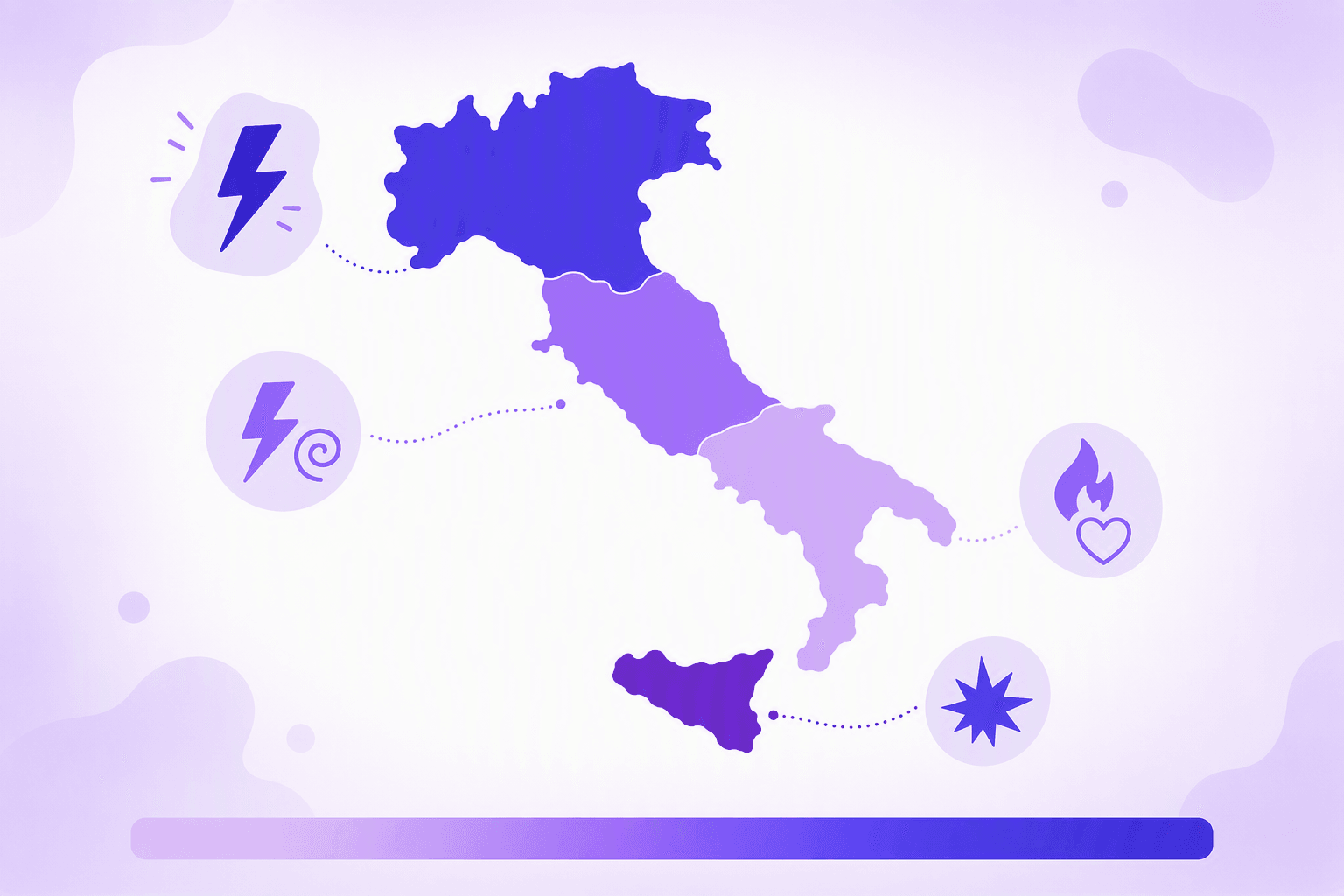
Northern Italy, particularly the Veneto, Tuscany, and Emilia-Romagna regions, is known as the "bestemmia belt," an area where religious blasphemy is paradoxically most common despite centuries of Catholic tradition. Linguists attribute this to historical tensions between the Papal States and Northern Italian city-states. In contrast, Southern Italy and Sicily, where Catholic devotion runs deeper in daily life, consider bestemmie genuinely shocking. A Venetian who casually drops "Porco Dio" at a bar would provoke genuine outrage doing the same in a Neapolitan neighborhood.
Italian Euphemisms
Italians have developed a rich system of euphemisms that preserve the rhythm and emotional force of the original while swapping in something innocent:
| Original (Vulgar) | Euphemism | Meaning |
|---|---|---|
| Cazzo (dick/fuck) | Cavolo | Cabbage |
| Cazzo (dick/fuck) | Cacchio | (phonetic softening) |
| Porco Dio (Pig God) | Porco diavolo | Pig devil |
| Porco Dio (Pig God) | Porco giuda | Pig Judas |
| Madonna (Virgin Mary) | Madosca | (phonetic distortion) |
| Merda (shit) | Merdaccia | (augmentative, oddly softer in tone) |
| Porca puttana (pig whore) | Porca miseria | Pig misery |
| Vaffanculo (fuck off) | Vaffa | (truncated) |
💡 Euphemisms as a Learning Strategy
If you want to express frustration in Italian without risk, master the euphemisms. "Cavolo!" works in any situation where you would say "Cazzo!" without the vulgarity. "Porca miseria!" replaces "Porco Dio!" without the legal and social consequences. "Mannaggia!" is universally understood as frustration without being genuinely offensive. These expressions signal emotional fluency while keeping you safe.
Bestemmie: Italy's Unique Profanity Category
No guide to Italian swear words is complete without addressing bestemmie, the category of religious blasphemy that makes Italian profanity unique in Europe.
Bestemmie follow a formula: animal or insult + God/Madonna/Saint. Common constructions include "Porco Dio" (Pig God), "Dio cane" (God is a dog), "Dio boia" (God the executioner), and "Madonna puttana" (Madonna the whore). These are not merely strong swear words; they occupy a separate cultural and legal category.
The legal dimension: Until 1999, bestemmie were classified as a criminal offense under Italian law. Today, Article 724 of the Italian Penal Code still classifies public blasphemy as an administrative offense carrying fines of 51 to 309 euros. This is enforced: Italian football's governing body regularly fines players whose bestemmie are captured by pitch-side microphones.
The cultural dimension: Even Italians who swear heavily often draw a firm line at bestemmie. A construction worker might say "cazzo" and "stronzo" fifty times a day but never utter a bestemmia. Conversely, in parts of Veneto and Tuscany, bestemmie are so normalized that they function as filler words, a sociolinguistic paradox that has fascinated Italian linguists for decades.
"The bestemmia represents the intersection of language, religion, and regional identity in Italy. Its persistence in the most historically Catholic regions of the North tells us more about Italian culture than any textbook could."
(Martin Maiden & Cecilia Robustelli, A Reference Grammar of Modern Italian, 2013)
Learning Through Movies and TV
One of the best ways to understand how Italian profanity works in context is through media. Pay attention not just to which words characters use, but to the reactions of those around them. Laughter, anger, or indifference teaches you a word's real social weight.
For Roman Italian: Romanzo Criminale and Suburra are packed with Roman dialect profanity including "li mortacci tua" and heavy use of "stronzo" and "cazzo." For Neapolitan flavor: Gomorra provides exposure to Southern Italian swearing with dialect-specific terms. For Sicilian: Il Commissario Montalbano offers glimpses of "minchia" in its natural habitat. For standard Italian profanity: Perfetti Sconosciuti (Perfect Strangers) features realistic dialogue full of everyday swearing among educated Romans.
Check out our full guide to the best movies to learn Italian for more recommendations. You can also explore Wordy's Italian learning resources to learn vocabulary in context while watching real content.
For more language guides, browse our blog or start your Italian learning journey with Wordy.
Final Thoughts
Italian profanity is one of the richest and most culturally layered swearing systems in Europe. Here are the key takeaways:
Comprehension is the goal. You will encounter every word here if you spend real time with Italian. Understanding severity, regional context, and the bestemmia distinction makes you a far more competent listener and cultural navigator.
Bestemmie are in a class of their own. No other major European language has an entire profanity category that is both legally punishable and culturally taboo while simultaneously being commonplace in certain regions. Understanding this paradox is essential to understanding Italy.
Regional variation is enormous. "Minchia" is a mild filler word in Palermo but a vulgar exclamation in Milan. Bestemmie are casual in Veneto but shocking in Naples. Always observe local norms before you speak.
When in doubt, do not swear. As a non-native speaker, you carry extra risk. Mispronunciation, wrong context, or an accidental bestemmia can turn a lighthearted moment into a genuinely offensive one. Understand everything, use almost nothing.
Ready to go beyond textbook Italian? Start with Wordy's Italian learning tools and explore our full collection of language learning guides.
Frequently Asked Questions
What is the most common Italian swear word?
What are bestemmie and why are they so offensive in Italy?
Are Italian swear words different in Northern vs Southern Italy?
Is 'cazzo' a bad word in Italian?
What Italian swear words should I avoid as a foreigner?
Can you get fined for swearing in Italy?
Sources & References
- Tartamella, V. (2016). 'Parolacce: Perché le diciamo, che cosa significano, quali effetti hanno.' BUR Rizzoli.
- Maiden, M. & Robustelli, C. (2013). 'A Reference Grammar of Modern Italian.' Routledge.
- Jay, T. (2009). 'The Utility and Ubiquity of Taboo Words.' Perspectives on Psychological Science, 4(2), 153-161.
- Accademia della Crusca, vocabolario.sns.it, reference entries on profanity
- Codice Penale Italiano, Art. 724, Bestemmia e manifestazioni oltraggiose verso i defunti
Start learning with Wordy
Watch real movie clips and build your vocabulary as you go. Free to download.


