Quick Answer
The most common way to say good night in Italian is 'Buonanotte' (bwoh-nah-NOHT-teh). It is used when someone is heading to bed or when parting ways late at night. For earlier evening farewells, like leaving a dinner party or saying goodbye after an aperitivo, Italians say 'Buona serata' instead. Between romantic partners, 'Sogni d'oro' (golden dreams) and 'Buonanotte amore' are the most beloved bedtime phrases.
The Short Answer
The most common way to say good night in Italian is Buonanotte (bwoh-nah-NOHT-teh). Use it when someone is heading to bed or when saying goodbye late at night. But Italian draws a distinction that English does not: Buonanotte is strictly a bedtime farewell, while Buona serata ("have a good evening") is the phrase for earlier evening goodbyes when the night is still young.
Italian is spoken by approximately 85 million people worldwide across Italy, Switzerland, San Marino, Vatican City, and large diaspora communities from Argentina to Australia. According to the Società Dante Alighieri's 2024 annual report, over 2 million people are actively studying Italian abroad, drawn in part by the language's reputation as one of the most melodic and emotionally expressive in Europe.
"Italian nighttime language reveals a culture that treats the transition from day to night not as an ending, but as a series of rituals: the passeggiata, the late dinner, the long farewell. Each stage has its own vocabulary."
(Tullio De Mauro, Storia linguistica dell'Italia unita, Laterza, 2014)
This guide covers 16 essential Italian good night phrases organized by category: standard, affectionate, romantic, casual, and farewell. Each includes pronunciation, cultural context, and an example sentence so you know exactly when and where to use it.

Quick Reference: Italian Good Night Phrases at a Glance
| English | Italian | Pronunciation | Formality |
|---|---|---|---|
| Good night | Buonanotte | bwoh-nah-NOHT-teh | polite |
| Have a good evening | Buona serata | BWOH-nah seh-RAH-tah | polite |
| Good night, everyone | Buona notte a tutti | BWOH-nah NOHT-teh ah TOOT-tee | polite |
| Golden dreams | Sogni d'oro | SOHN-yee DOH-roh | casual |
| Sleep well | Dormi bene | DOHR-mee BEH-neh | casual |
| Good night, my love | Buonanotte amore | bwoh-nah-NOHT-teh ah-MOH-reh | casual |
| Night! | Notte! | NOHT-teh | slang |
| See you tomorrow | A domani | ah doh-MAH-nee | polite |
| Have beautiful dreams | Fai bei sogni | FAH-ee BAY SOHN-yee | casual |
| Rest well | Riposati bene | ree-POH-zah-tee BEH-neh | casual |
| Good night, sweetheart | Buonanotte tesoro | bwoh-nah-NOHT-teh teh-ZOH-roh | casual |
| I'm going to bed | Vado a dormire | VAH-doh ah dohr-MEE-reh | casual |
| See you soon | A presto | ah PREH-stoh | polite |
| Have a good rest | Buon riposo | bwohn ree-POH-zoh | polite |
| Sleep tight (to children) | Fa' la nanna | fah lah NAHN-nah | casual |
| I'm thinking of you, good night | Ti penso, buonanotte | tee PEHN-soh bwoh-nah-NOHT-teh | casual |
Standard Good Night Phrases
These are the core good night expressions every Italian speaker uses daily. Understanding the distinction between them is essential, and it is one of the first things that trips up learners.
Buonanotte
/bwoh-nah-NOHT-teh/
Literal meaning: Good night
“Buonanotte, ci vediamo domani mattina.”
Good night, see you tomorrow morning.
The standard good night farewell. Used only when someone is going to bed or when parting very late. Never used as a greeting upon arrival; that is 'Buonasera.'
Buonanotte is Italy's definitive bedtime word. The Treccani dictionary classifies it as both a noun and an interjection, and the Accademia della Crusca confirms that the single-word spelling is now standard, though the two-word form Buona notte remains acceptable.
The critical rule that separates intermediate learners from advanced speakers: Buonanotte implies sleep. If you leave a restaurant at 10 PM and your friends are heading to a bar, you say Buona serata, not Buonanotte. Saying Buonanotte would signal that you think the evening is over, which, in Italy, it rarely is at 10 PM.
🌍 Italy's Late-Night Culture
Italians eat dinner between 8 and 10 PM, and evening socializing often continues past midnight. The passeggiata (the traditional evening stroll through town) happens around 7-9 PM. In this context, Buonanotte only makes sense when people are genuinely heading home to sleep, not simply leaving one social event for another.
Buona serata
/BWOH-nah seh-RAH-tah/
Literal meaning: Good evening (as farewell)
“Grazie per la cena. Buona serata a tutti!”
Thanks for dinner. Have a good evening, everyone!
Used when parting in the evening while the night is still ongoing. The key farewell phrase for leaving dinners, events, and social gatherings before bedtime. Works in both formal and casual settings.
Buona serata is the phrase English speakers often miss because English has no direct equivalent. It means "have a good evening," used specifically as a farewell, wishing someone an enjoyable rest of the night. A waiter might say it as you leave a restaurant. A colleague uses it when leaving the office in the evening. A friend says it after aperitivo when everyone is heading in different directions.
The distinction between Buonasera (greeting/farewell) and Buona serata (farewell only, with a wish for enjoyment) is subtle but meaningful. Buonasera is neutral. Buona serata is warmer; it expresses genuine hope that the person's evening goes well.
Buona notte a tutti
/BWOH-nah NOHT-teh ah TOOT-tee/
Literal meaning: Good night to everyone
“Sono stanchissima. Buona notte a tutti, vado a letto!”
I'm exhausted. Good night, everyone, I'm going to bed!
The group farewell version. Used when leaving a gathering, in family settings, or in group chats. 'A tutti' (to everyone) makes it inclusive and warm.
This is the group version of Buonanotte, and it carries a particular warmth in Italian family culture. Picture a large Sunday dinner at la nonna's house: as family members start heading home, someone announces Buona notte a tutti! and it triggers a chain reaction of kisses, hugs, and a dozen individual goodbyes that take another twenty minutes.
Affectionate and Family Phrases
Italian culture prizes affection. These phrases go beyond a simple "good night" and add genuine warmth, used between family members, close friends, and people you care about.
Sogni d'oro
/SOHN-yee DOH-roh/
Literal meaning: Golden dreams
“Buonanotte, piccola. Sogni d'oro!”
Good night, little one. Golden dreams!
One of the most beloved Italian bedtime phrases. Used by parents with children, between close friends, and between romantic partners. The image of 'golden dreams' is quintessentially Italian: poetic and sincere.
Sogni d'oro is arguably the most beautiful good night expression in any European language. Where English settles for "sweet dreams," Italian reaches for gold. It is the phrase Italian parents whisper to their children, the phrase texted between lovers, and the phrase that closes long phone calls between friends who genuinely care about each other.
According to Treccani, the expression has been part of standard Italian since at least the early 20th century, and it appears in Italian literature and cinema with remarkable consistency. It is never ironic or casual. When an Italian says Sogni d'oro, they mean it.
Dormi bene
/DOHR-mee BEH-neh/
Literal meaning: Sleep well
“Non stare alzato troppo tardi. Dormi bene!”
Don't stay up too late. Sleep well!
A caring, practical good night wish. Common between family members and friends. Uses the informal 'tu' form. For formal situations, use 'Dorma bene' (with Lei).
Dormi bene is the Italian equivalent of "sleep well": direct, caring, and universally understood. It uses the informal tu conjugation of dormire (to sleep), making it appropriate for friends, family, and anyone you address casually. For formal situations (say, wishing a hotel guest good night) a receptionist would use Dorma bene with the Lei form.
Fai bei sogni
/FAH-ee BAY SOHN-yee/
Literal meaning: Have beautiful dreams
“Chiudi gli occhi e fai bei sogni, amore.”
Close your eyes and have beautiful dreams, love.
A tender alternative to 'Sogni d'oro.' Slightly more active: you are wishing someone to 'make' beautiful dreams rather than simply having golden ones. Popular with parents and romantic partners.
While Sogni d'oro describes the dreams themselves, Fai bei sogni is more of a gentle command: "make beautiful dreams." The verb fare (to do/make) gives it an active quality, as though the speaker believes the listener has the power to choose what they dream about. It is especially common from parents tucking children into bed.
Fa' la nanna
/fah lah NAHN-nah/
Literal meaning: Go to sleep (baby talk)
“Su, su, fa' la nanna. Domani è un altro giorno.”
Come on, come on, go to sleep. Tomorrow is another day.
Used exclusively with small children and babies. 'Nanna' is the child-speak word for sleep, similar to 'nighty-night' or 'beddy-bye' in English. Also the title of a famous Italian lullaby.
Fa' la nanna belongs to the world of Italian childhood. Nanna is baby talk for sleep; you will never hear an adult use it about themselves without irony. The phrase echoes through the famous lullaby Ninna Nanna, one of the oldest and most beloved children's songs in the Italian tradition. It is pure tenderness.
Romantic Good Night Phrases
Italian's reputation as the language of love is well earned. These phrases are used between romantic partners and carry genuine emotional weight. For more ways to express affection in Italian, check out our blog for related guides.
Buonanotte amore
/bwoh-nah-NOHT-teh ah-MOH-reh/
Literal meaning: Good night, love
“Buonanotte amore mio. Non vedo l'ora di vederti domani.”
Good night, my love. I can't wait to see you tomorrow.
The standard romantic good night. 'Amore' (love) is the most common term of endearment between Italian couples. Adding 'mio' (my) makes it more intimate: 'Buonanotte amore mio.'
Amore is the beating heart of Italian romantic vocabulary. Unlike English, where calling someone "love" can feel casual or regional, amore in Italian always carries sincerity. Buonanotte amore is what millions of Italian couples say to each other every single night, in person, on the phone, or via text message. It is simple, direct, and deeply felt.
Buonanotte tesoro
/bwoh-nah-NOHT-teh teh-ZOH-roh/
Literal meaning: Good night, treasure
“Buonanotte tesoro, a domani.”
Good night, darling, see you tomorrow.
A warm alternative to 'amore.' 'Tesoro' (treasure) is used between partners, and also by parents to children. Less exclusively romantic than 'amore'; more versatile.
Tesoro (literally "treasure") is one of Italian's most versatile terms of endearment. A mother calls her child tesoro. A husband calls his wife tesoro. Close friends sometimes use it playfully. In the context of a good night message, it adds sweetness without the intensity of amore.
Ti penso, buonanotte
/tee PEHN-soh bwoh-nah-NOHT-teh/
Literal meaning: I'm thinking of you, good night
“Sono a letto. Ti penso, buonanotte.”
I'm in bed. Thinking of you, good night.
A deeply intimate good night message. 'Ti penso' (I think of you / I'm thinking of you) adds a layer of longing. Common in long-distance relationships and new romances.
Ti penso before buonanotte transforms a simple good night into a declaration. It tells the other person they are the last thought before sleep, and in Italian culture, where emotional expressiveness is valued rather than suppressed, this kind of vulnerability is a strength. You will see Ti penso, buonanotte in countless Italian text messages every night.
Casual and Informal Phrases
For everyday situations with friends, roommates, and people you are comfortable with. These are the phrases you will hear in shared apartments, group chats, and among young Italians.
Notte!
/NOHT-teh/
Literal meaning: Night!
“Ok ragazzi, io vado. Notte!”
Ok guys, I'm heading out. Night!
The abbreviated, casual version of 'Buonanotte.' Common among young people and in text messages. Quick, effortless, and perfectly natural in informal settings.
Just as English speakers shorten "good night" to "night," Italians drop the buona and simply say Notte! It is fast, casual, and ubiquitous in text messages and group chats. You will also hear it shouted between friends parting ways on a street corner after a night out.
Vado a dormire
/VAH-doh ah dohr-MEE-reh/
Literal meaning: I'm going to sleep
“Ragazzi, vado a dormire. Sono distrutto!”
Guys, I'm going to bed. I'm wiped out!
Not a farewell itself, but the announcement that precedes one. Italians use it to signal they are heading to bed, which then triggers the exchange of good night wishes.
Vado a dormire is the announcement that sets the good night ritual in motion. In a group setting (whether at a dinner table or in a WhatsApp group) one person declares Vado a dormire and the others respond with their preferred good night phrase: Buonanotte, Dormi bene, Sogni d'oro, or all three.
Farewell Phrases for Evening
These phrases work for evening goodbyes that are not specifically about bedtime. They are essential for navigating Italy's vibrant nighttime social culture.
A domani
/ah doh-MAH-nee/
Literal meaning: Until tomorrow
“Buonanotte! A domani in ufficio.”
Good night! See you tomorrow at the office.
A forward-looking farewell that pairs naturally with 'Buonanotte.' Works in both casual and professional settings. Implies you will see the person the next day.
A domani adds a note of anticipation to any good night farewell. It looks ahead to the next meeting rather than dwelling on the parting. Italians often combine it with Buonanotte for a complete farewell: Buonanotte, a domani! It works equally well with colleagues, friends, and family.
Riposati bene
/ree-POH-zah-tee BEH-neh/
Literal meaning: Rest well
“Hai avuto una giornata lunga. Riposati bene stasera.”
You've had a long day. Rest well tonight.
More caring than 'Dormi bene' because it acknowledges that the person needs rest. Often used when someone has been working hard, traveling, or dealing with something stressful. The formal version is 'Si riposi bene.'
Riposati bene goes beyond "sleep well"; it acknowledges that the person deserves rest. It is the phrase you use when a friend has had an exhausting day, when someone has been traveling, or when a family member is recovering from illness. The reflexive verb riposarsi (to rest oneself) gives it a self-care quality that dormire (to sleep) lacks.
Buon riposo
/bwohn ree-POH-zoh/
Literal meaning: Good rest
“Ci vediamo domani. Buon riposo!”
See you tomorrow. Have a good rest!
A slightly more formal alternative to 'Dormi bene' and 'Riposati bene.' Works well in professional settings and with people you do not know intimately.
Buon riposo follows the classic Italian pattern of buon/buona + noun: buongiorno (good day), buonasera (good evening), buon riposo (good rest). It is polished without being stiff, making it a good choice for acquaintances, colleagues, and semi-formal situations where Sogni d'oro would feel too intimate.
A presto
/ah PREH-stoh/
Literal meaning: Until soon
“È stato bello vederti. A presto, buonanotte!”
It was great seeing you. See you soon, good night!
A general farewell meaning 'see you soon.' Not specific to nighttime, but commonly paired with good night phrases. Works in all registers and all situations.
A presto is one of Italian's most versatile farewells. It is not specific to nighttime, but it pairs beautifully with evening goodbyes: Buonanotte, a presto! Unlike A domani, which commits to seeing someone the next day, A presto is pleasantly vague: you will see each other soon, whenever that may be.
💡 The Italian Evening Farewell Sequence
Italians often stack farewell phrases together. A typical evening goodbye might sound like: "Va bene, vado a dormire. Buonanotte a tutti! Sogni d'oro. A domani!", combining announcement, farewell, wish, and future plan in one warm sequence.
How to Respond to Italian Good Night Phrases
Knowing how to respond is just as important as knowing how to initiate. Here are the most natural responses.
| They Say | You Say | Notes |
|---|---|---|
| Buonanotte | Buonanotte! / Buonanotte anche a te | Echo or add "to you too" |
| Buona serata | Grazie, anche a te! / Buona serata! | "Thanks, you too!" |
| Sogni d'oro | Anche a te, sogni d'oro! / Grazie, buonanotte | Echo the wish back |
| Dormi bene | Anche tu! / Grazie, anche tu dormi bene | "You too!" |
| A domani | A domani! / Ci vediamo domani | "See you tomorrow!" |
| Notte! | Notte! | Quick and casual, just echo it |
| Fai bei sogni | Anche tu! Buonanotte | "You too! Good night" |
🌍 The Italian Passeggiata and Evening Culture
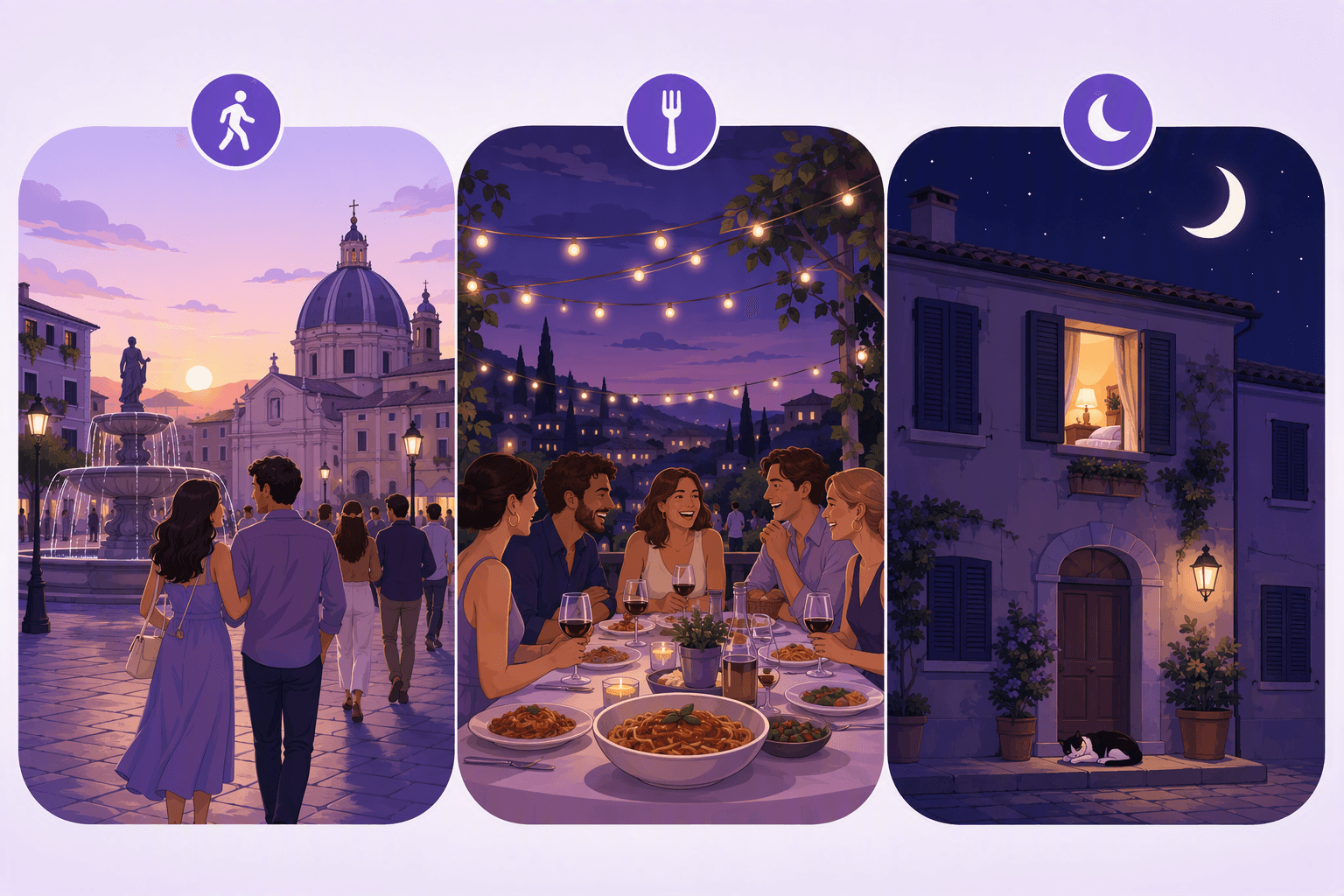
Understanding when to use these phrases requires understanding Italian evening culture. The passeggiata (the ritual evening walk through town) typically happens between 7 and 9 PM. Dinner follows, often starting at 8:30 or 9 PM. After dinner, many Italians linger for conversation, coffee, or a digestivo. The night does not end early. This is why Buona serata exists as a separate concept from Buonanotte: Italian evenings are long enough to need their own farewell vocabulary. In cities like Rome, Naples, and Palermo, it is perfectly normal to be out socializing at midnight without anyone reaching for Buonanotte.
Practice With Real Italian Content
Reading about good night phrases is a useful start, but hearing them spoken by native Italian speakers is what makes them natural. Italian cinema, from classic Fellini to modern comedies, is filled with intimate evening scenes where characters use these exact expressions with authentic intonation and emotion.
Wordy lets you watch Italian movies and shows with interactive subtitles. Tap any phrase to see its meaning, pronunciation, and cultural context in real time. Instead of memorizing from a list, you absorb these expressions from real conversations between real people.
For more Italian content, explore our blog for guides on everything from greetings to colorful vocabulary. You can also discover the best movies to learn Italian or visit our Italian learning page to start practicing with authentic content today.
Frequently Asked Questions
What is the difference between 'Buonanotte' and 'Buona serata'?
How do you say 'sweet dreams' in Italian?
Is 'Buonanotte' one word or two?
What is the most romantic way to say good night in Italian?
Can you use 'Buonanotte' as a greeting when you arrive somewhere?
What time do Italians switch from 'Buonasera' to 'Buonanotte'?
Sources & References
- Accademia della Crusca, Italy's foremost authority on the Italian language, founded 1583
- Treccani, Vocabolario della lingua italiana, online edition (2025)
- Ethnologue: Languages of the World, Italian language entry (2024)
- De Mauro, T. (2014). 'Storia linguistica dell'Italia unita.' Laterza.
- Società Dante Alighieri, L'italiano nel mondo, 2024 annual report
Start learning with Wordy
Watch real movie clips and build your vocabulary as you go. Free to download.


