Quick Answer
The most common way to say hello in Italian is 'Ciao' (CHOW). It works in any casual setting across all of Italy. Beyond Ciao, Italians rely on formal greetings like 'Buongiorno' and 'Buonasera,' the versatile 'Salve,' and regional expressions that change from Milan to Naples to Palermo.
The Short Answer
The most common way to say hello in Italian is Ciao (CHOW). It works in any casual situation, from greeting friends at a café to bumping into a neighbor on the street. But Italian has a rich system of greetings that signal formality, time of day, and regional identity, and getting them right matters more in Italy than in most other European countries.
Italian is spoken by approximately 85 million people worldwide and is an official language in four countries: Italy, Switzerland, San Marino, and Vatican City. According to Ethnologue's 2024 data, it ranks among the top 25 most spoken languages globally. With Italy's strong regional identities and deep cultural emphasis on bella figura (making a good impression), choosing the right greeting is genuinely important.
"In Italian, the greeting you choose is a social declaration. It tells the other person whether you consider them a peer, a superior, or a stranger, all before you say anything else."
(Tullio De Mauro, Storia linguistica dell'Italia unita, Laterza, 2014)
This guide covers 17 essential Italian greetings organized by category: universal, time-of-day, casual, formal, regional, and slang. Each includes pronunciation, an example sentence, and cultural context so you know exactly when and where to use it.
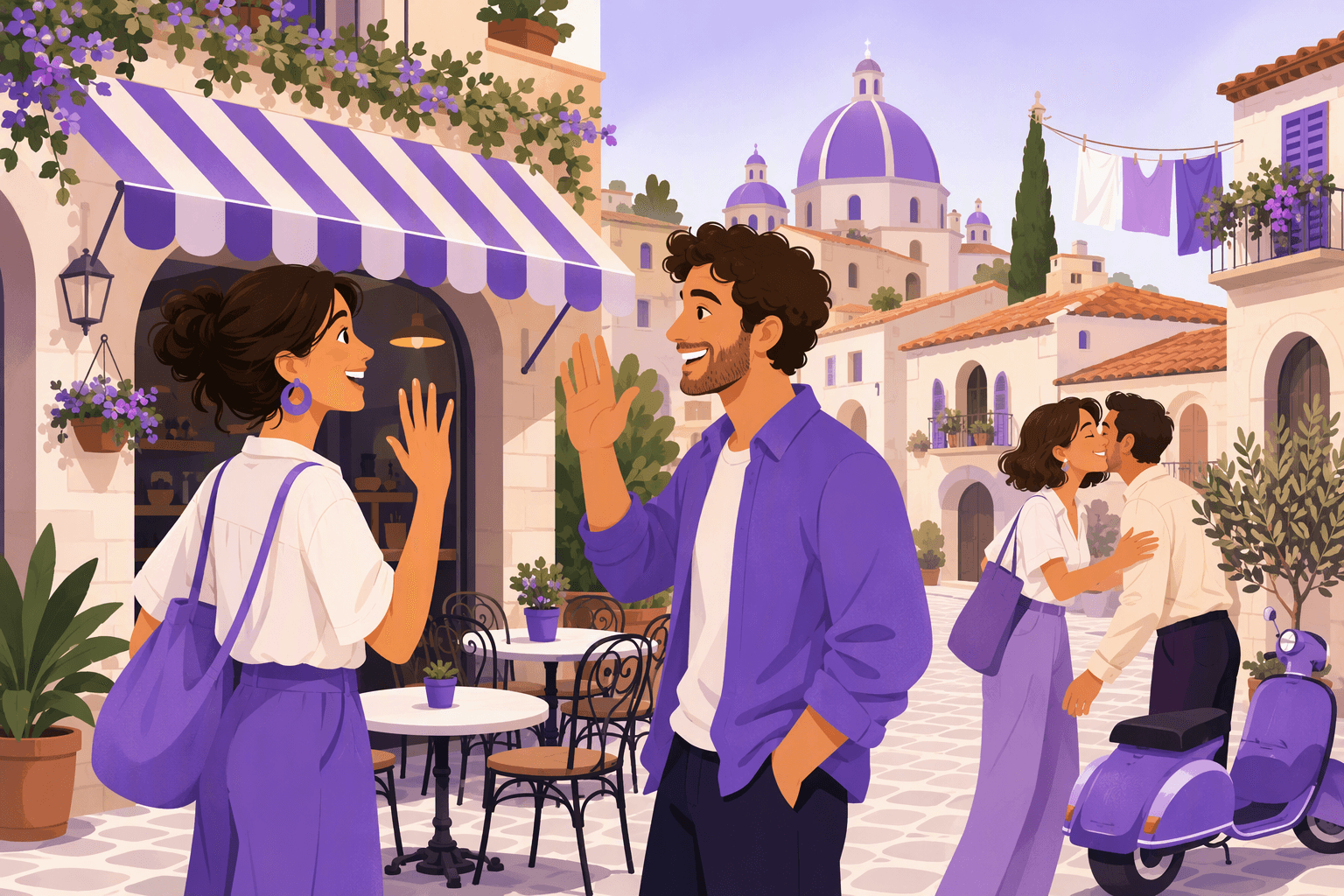
Quick Reference: Italian Greetings at a Glance
| English | Italian | Pronunciation | Formality |
|---|---|---|---|
| Hello / Bye | Ciao | CHOW | casual |
| Good morning / Good day | Buongiorno | bwohn-JOHR-noh | polite |
| Good evening | Buonasera | bwoh-nah-SEH-rah | polite |
| Good night | Buonanotte | bwoh-nah-NOHT-teh | polite |
| Hello (neutral) | Salve | SAHL-veh | polite |
| How are you? (informal) | Come stai? | KOH-meh STAH-ee | casual |
| How are you? (formal) | Come sta? | KOH-meh STAH | formal |
| How's it going? | Come va? | KOH-meh VAH | casual |
| Nice to meet you | Piacere | pyah-CHEH-reh | formal |
| What a nice surprise! | Che bella sorpresa! | keh BEL-lah sohr-PREH-zah | casual |
| Here I am! | Eccomi! | EHK-koh-mee | casual |
| Hey! (everyone) | Ehi! | EH-ee | slang |
| Hey! (Naples) | Uè! | oo-EH | slang |
| What's up? (slang) | Che si dice? | keh see DEE-cheh | slang |
| Hello? (phone) | Pronto? | PROHN-toh | polite |
| All well? | Tutto bene? | TOOT-toh BEH-neh | casual |
| Welcome | Benvenuto/a | behn-veh-NOO-toh/tah | formal |
Universal Greetings
These greetings are understood across all of Italy and among Italian speakers worldwide. The Accademia della Crusca, Italy's oldest linguistic authority (founded in 1583), recognizes these as standard modern Italian.
Ciao
/CHOW/
Literal meaning: I am your slave (historical)
“Ciao, Marco! Come stai?”
Hi, Marco! How are you?
The world's most borrowed Italian word. Works as both hello AND goodbye. Casual only; never use it with strangers in formal settings.
Ciao is arguably the most famous greeting on the planet. It has been borrowed into dozens of languages, from Portuguese to Japanese. Its origin is surprising: it derives from the Venetian dialect word s'ciavo, a contraction of schiavo vostro ("I am your slave"), an old-fashioned expression of deference that evolved into a casual greeting over centuries.
The critical rule: Ciao is informal. Using it with an older person you do not know, a government official, or in a business meeting can come across as presumptuous. When in doubt, reach for Buongiorno or Salve instead.
💡 Double Ciao for Extra Warmth
Italians frequently say Ciao ciao! when saying goodbye. It adds warmth and friendliness. You will hear it constantly. Think of it as the Italian equivalent of "bye bye!"
Salve
/SAHL-veh/
Literal meaning: Be well (from Latin salvēre)
“Salve, mi scusi, sa dov'è la stazione?”
Hello, excuse me, do you know where the station is?
The perfect middle-ground greeting. Not as casual as 'Ciao,' not as formal as 'Buongiorno.' Ideal when you're unsure about the right formality level.
Salve is the greeting that solves the Italian formality puzzle. It comes directly from Latin (the imperative of salvēre, to be in good health) and it occupies the neutral zone between Ciao and Buongiorno. According to the Treccani dictionary, it is classified as neither strictly formal nor informal.
Use Salve when entering a small shop, greeting a neighbor you do not know well, or meeting someone for the first time in a relaxed setting. It is a safe default that never offends.
Time-of-Day Greetings
Italian uses two primary time-based greetings that divide the day, plus a dedicated nighttime farewell.
Buongiorno
/bwohn-JOHR-noh/
Literal meaning: Good day
“Buongiorno, signora Rossi. Come sta oggi?”
Good morning, Mrs. Rossi. How are you today?
The default formal greeting from morning until early-to-mid afternoon. Literally 'good day,' it covers both 'good morning' and 'good afternoon' in Italian.
Buongiorno is the workhorse of formal Italian greetings. Unlike English, which splits "good morning" and "good afternoon," Italian uses Buongiorno for the entire first half of the day. The switch to Buonasera happens somewhere between 3 PM and 6 PM depending on the region, earlier in the north and later in the south.
In shops, restaurants, offices, and any interaction with strangers, Buongiorno is your safest bet during daylight hours. It is polite without being stiff.
Buonasera
/bwoh-nah-SEH-rah/
Literal meaning: Good evening
“Buonasera a tutti. Benvenuti al ristorante.”
Good evening, everyone. Welcome to the restaurant.
Takes over from Buongiorno in the late afternoon/evening. The exact switch time varies: around 3-4 PM in Milan, 5-6 PM in Naples. When unsure, Buongiorno is always safe.
The transition from Buongiorno to Buonasera is one of those cultural nuances that reveals how well you know Italy. In northern cities like Milan and Turin, the switch can happen as early as 3 PM. In Rome, around 4-5 PM. In southern Italy and Sicily, many people stick with Buongiorno until 5-6 PM or even later.
🌍 The Buongiorno-to-Buonasera Debate
Italians themselves cannot agree on the exact switch time. It is a common topic of lighthearted debate. If you say Buongiorno at 4:30 PM in Milan, someone might gently correct you with Buonasera! The safest approach: listen to what the people around you are saying and match it.
Buonanotte
/bwoh-nah-NOHT-teh/
Literal meaning: Good night
“Buonanotte, dormi bene!”
Good night, sleep well!
Used almost exclusively as a farewell, not a greeting. Unlike 'Buonasera' (which can be used when arriving), 'Buonanotte' signals that you or the other person is heading to sleep.
Unlike Buonasera, which works as both a greeting and a farewell, Buonanotte is almost always a farewell. You say it when parting ways late at night or when someone is going to bed. Using it as a greeting upon arrival would sound strange.
Casual Greetings
These expressions go beyond a simple hello. They combine greeting with genuine (or ritual) interest in how the other person is doing.
Come stai?
/KOH-meh STAH-ee/
Literal meaning: How are you standing?
“Ciao, Giulia! Come stai? È da tanto che non ci vediamo!”
Hi, Giulia! How are you? It's been so long since we've seen each other!
The informal 'how are you?' using the 'tu' form. Use with friends, family, peers, and people your age in casual settings. Switch to 'Come sta?' for formal situations.
Come stai? is the informal version, used with the tu (informal you) pronoun. Unlike in English, where "How are you?" is often purely ritual, Italians may actually give you a real answer, especially in the south. Be prepared for a genuine update on their health, family, or mood.
Come sta?
/KOH-meh STAH/
Literal meaning: How are you? (formal)
“Buongiorno, professore. Come sta?”
Good morning, professor. How are you?
The formal 'how are you?' using the 'Lei' form. Essential for professional settings, elders, and anyone you address with 'Lei' instead of 'tu.'
The formal counterpart uses the Lei (formal you) conjugation. The difference is just one syllable (stai vs. sta) but it communicates respect. Use it with professors, doctors, elderly neighbors, clients, and anyone you would address with a title.
Come va?
/KOH-meh VAH/
Literal meaning: How does it go?
“Ehi, come va? Tutto a posto?”
Hey, how's it going? Everything alright?
A versatile 'how's it going?' that works in most informal situations. Slightly less personal than 'Come stai?', more like checking on things in general rather than the person specifically.
Come va? has a useful advantage: it does not require choosing between tu and Lei, since the verb andare (to go) is conjugated in the third person here. This makes it a comfortable option when you want to be friendly without navigating the formality question.
Tutto bene?
/TOOT-toh BEH-neh/
Literal meaning: Everything well?
“Ciao, tutto bene? Ti vedo un po' stanco.”
Hey, everything okay? You look a bit tired.
A warm, checking-in greeting. Can express genuine concern or simply serve as a casual hello. The standard reply is 'Sì, tutto bene, grazie!' or just 'Tutto bene.'
This greeting works as both a casual hello and a genuine check-in. Pair it with Ciao for maximum naturalness: Ciao, tutto bene? The response is almost always Sì, tutto bene, even when things are not entirely fine.
Formal and First-Meeting Greetings
Essential for professional settings, first introductions, and showing respect. Italian culture places enormous value on bella figura (presenting yourself well) and your greeting is the first impression. For more on navigating these cultural nuances, explore our Italian learning hub.
Piacere
/pyah-CHEH-reh/
Literal meaning: Pleasure
“Piacere, sono Alessandro. Lei è la dottoressa Bianchi?”
Nice to meet you, I'm Alessandro. Are you Dr. Bianchi?
The standard first-meeting greeting. Can be extended to 'Piacere di conoscerla' (pleasure to know you) for extra formality. Respond with 'Piacere mio' (my pleasure) or echo 'Piacere.'
Piacere is non-negotiable when meeting someone for the first time in any formal or semi-formal context. It is typically accompanied by a handshake. The most natural responses are Piacere mio (my pleasure), Il piacere è mio (the pleasure is mine), or simply echoing Piacere back.
Benvenuto/a
/behn-veh-NOO-toh / behn-veh-NOO-tah/
Literal meaning: Well come / Welcome
“Benvenuta a Roma, signora! Spero che il viaggio sia andato bene.”
Welcome to Rome, ma'am! I hope the trip went well.
Gendered: 'Benvenuto' for a man, 'Benvenuta' for a woman, 'Benvenuti' for a mixed or male group, 'Benvenute' for an all-female group.
Like many Italian words, Benvenuto changes form based on gender and number. A host welcoming guests to dinner would say Benvenuti a tutti! (Welcome, everyone!). This greeting carries genuine warmth. Italians take hospitality seriously.
Regional Greetings
Italy's regional diversity runs deep. As the historian Tullio De Mauro documented, standard Italian only became the majority's everyday language in the second half of the 20th century. Before that, most Italians primarily spoke their regional dialects. Those dialects still influence how people greet each other today.
Uè!
/oo-EH/
Literal meaning: Hey! (Neapolitan)
“Uè, Gennaro! Che fai stasera?”
Hey, Gennaro! What are you up to tonight?
A distinctly Neapolitan and southern Italian exclamation. Warm, loud, and full of personality. You'll hear it constantly in Naples and throughout Campania.
Uè! is pure Naples. It is an exclamation that functions as a greeting, an attention-getter, and an expression of surprise all in one. You will hear it shouted across narrow streets in the Quartieri Spagnoli and in every Neapolitan film ever made. It reflects the south's reputation for expressive, effusive communication.
Che bella sorpresa!
/keh BEL-lah sohr-PREH-zah/
Literal meaning: What a beautiful surprise!
“Maria! Che bella sorpresa! Non sapevo che eri in città!”
Maria! What a lovely surprise! I didn't know you were in town!
Used when running into someone unexpectedly. Common across all of Italy but especially popular in the south, where greetings tend to be more elaborate and emotional.
This is not just a greeting; it is a performance. Italians, particularly in central and southern regions, turn unexpected encounters into small celebrations. The exclamation is often accompanied by wide eyes, open arms, and the inevitable double cheek kiss.
Eccomi!
/EHK-koh-mee/
Literal meaning: Here I am!
“Eccomi! Scusa il ritardo, c'era traffico.”
Here I am! Sorry for being late, there was traffic.
Used as a greeting when arriving somewhere people are expecting you. Common in all regions. Also works as a response when someone calls your name.
Eccomi is the greeting of arrival. When you walk into a friend's house, when you show up at the meeting point, or when someone calls your name from across the piazza, Eccomi! announces your presence with natural Italian flair.
Slang and Youth Greetings
Every generation puts its stamp on language. Italian slang greetings are influenced by regional dialects, English loanwords, and social media culture.
Ehi!
/EH-ee/
Literal meaning: Hey!
“Ehi, ragazzi! Che facciamo stasera?”
Hey, guys! What are we doing tonight?
The Italian version of 'Hey!' Borrowed from English influence, common among younger speakers in cities across Italy. Often followed by 'ragazzi' (guys) or 'bello/bella' (handsome/beautiful).
Ehi is a straightforward English import that has become thoroughly Italian. Young people across Italy use it freely. Pair it with bello or bella (literally "beautiful," used like "babe" or "mate" among close friends) for a natural-sounding casual greeting: Ehi, bella!
Che si dice?
/keh see DEE-cheh/
Literal meaning: What is being said?
“Che si dice di bello? Novità?”
What's the good word? Any news?
A casual 'what's up?' used across Italy. Often extended to 'Che si dice di bello?' (What good is being said?). More common in central and southern Italy.
This is Italy's version of "What's up?" or "What's new?" It works well as a follow-up after Ciao: Ciao, che si dice? The extended form Che si dice di bello? adds a characteristically Italian touch of optimism, asking specifically for good news.
Phone Greetings
Pronto?
/PROHN-toh/
Literal meaning: Ready?
“Pronto? Chi parla?”
Hello? Who's speaking?
The universal Italian phone greeting. Literally means 'ready?', as in 'I'm ready to listen.' Used throughout Italy regardless of region, age, or formality level.
Unlike many languages that use different phone greetings by region, Italy is united by Pronto? It dates back to the early days of telephone operators who would say Pronto! to signal the connection was ready. Today it is the only way Italians answer the phone. Using Ciao to answer a call from an unknown number would sound very unusual.
How to Respond to Italian Greetings
Knowing how to greet is half the conversation. Here is how to respond naturally.
Responses to Formal Greetings
| They Say | You Say | Notes |
|---|---|---|
| Buongiorno | Buongiorno | Echo the same greeting |
| Buonasera | Buonasera | Echo the same greeting |
| Salve | Salve / Buongiorno | Echo or slightly upgrade formality |
| Piacere | Piacere mio / Il piacere è mio | "My pleasure" / "The pleasure is mine" |
Responses to Casual Greetings
| They Say | You Say | Notes |
|---|---|---|
| Ciao! | Ciao! / Ciao, come va? | Echo and optionally add a follow-up |
| Come stai? | Bene, grazie, e tu? | "Well, thanks, and you?" |
| Come sta? | Bene, grazie, e Lei? | Formal: use "Lei" not "tu" |
| Come va? | Bene, grazie! / Non c'è male | "Well, thanks!" / "Not bad" |
| Tutto bene? | Sì, tutto bene! E tu? | "Yes, all good! And you?" |
💡 The Italian Art of the Non-Answer
When Italians ask Come stai?, the polite default is Bene, grazie (Fine, thanks), even if things are not great. However, close friends and family will often give honest, detailed answers. Read the relationship and context to decide how much to share.
🌍 Physical Greetings in Italy
Physical contact is central to Italian greetings. Friends and family exchange two kisses on the cheeks, left cheek first, then right. In professional settings, a firm handshake is standard. In the south, greetings tend to be more physical and effusive: hugs, back pats, and even a hand on the arm while talking. Let the Italian person initiate and follow their lead.

Practice With Real Italian Content
Reading about greetings builds knowledge, but hearing them spoken by native speakers is what makes them instinctive. Italian cinema is one of the richest in the world, and films are an excellent way to absorb natural greeting patterns, from the formal exchanges in period dramas to the rapid-fire Ciao, ciao! of modern Roman comedies.
Wordy lets you watch Italian movies and shows with interactive subtitles. Tap any greeting to see its meaning, pronunciation, and cultural context in real time. Instead of memorizing phrases from a list, you absorb them from authentic conversations with natural intonation and gesture.
For more Italian content, explore our blog for guides including the best movies to learn Italian. You can also visit our Italian learning page to start practicing with real content today.
Frequently Asked Questions
What is the most common way to say hello in Italian?
Is it rude to say 'Ciao' to a stranger in Italy?
What is the difference between 'Buongiorno' and 'Buonasera'?
What does 'Salve' mean and when should I use it?
How do Italians greet each other physically?
Do greetings differ between northern and southern Italy?
Sources & References
- Accademia della Crusca, Italy's foremost authority on the Italian language, founded 1583
- Treccani, Vocabolario della lingua italiana, online edition (2025)
- Ethnologue: Languages of the World, Italian language entry (2024)
- De Mauro, T. (2014). 'Storia linguistica dell'Italia unita.' Laterza.
- Società Dante Alighieri, L'italiano nel mondo, 2024 annual report
Start learning with Wordy
Watch real movie clips and build your vocabulary as you go. Free to download.


