Quick Answer
Italian food culture is built around regional identity, seasonal ingredients, and clear social rules: when to eat, what to order, and how to behave at the table. If you understand the daily rhythm of meals, the logic of the menu, and a few polite phrases, you will order confidently and avoid the classic tourist mistakes.
Italian food culture is a set of everyday rules about timing, order, and social meaning: what you eat (and drink) depends on the hour, the region, and the setting, and learning those patterns is the fastest way to eat well in Italy without feeling lost.
If you are also learning the language, pairing food with real dialogue helps because restaurants compress a lot of culture into a few lines of speech. For greetings and first impressions, see how to say hello in Italian and how to say goodbye in Italian before your first aperitivo.
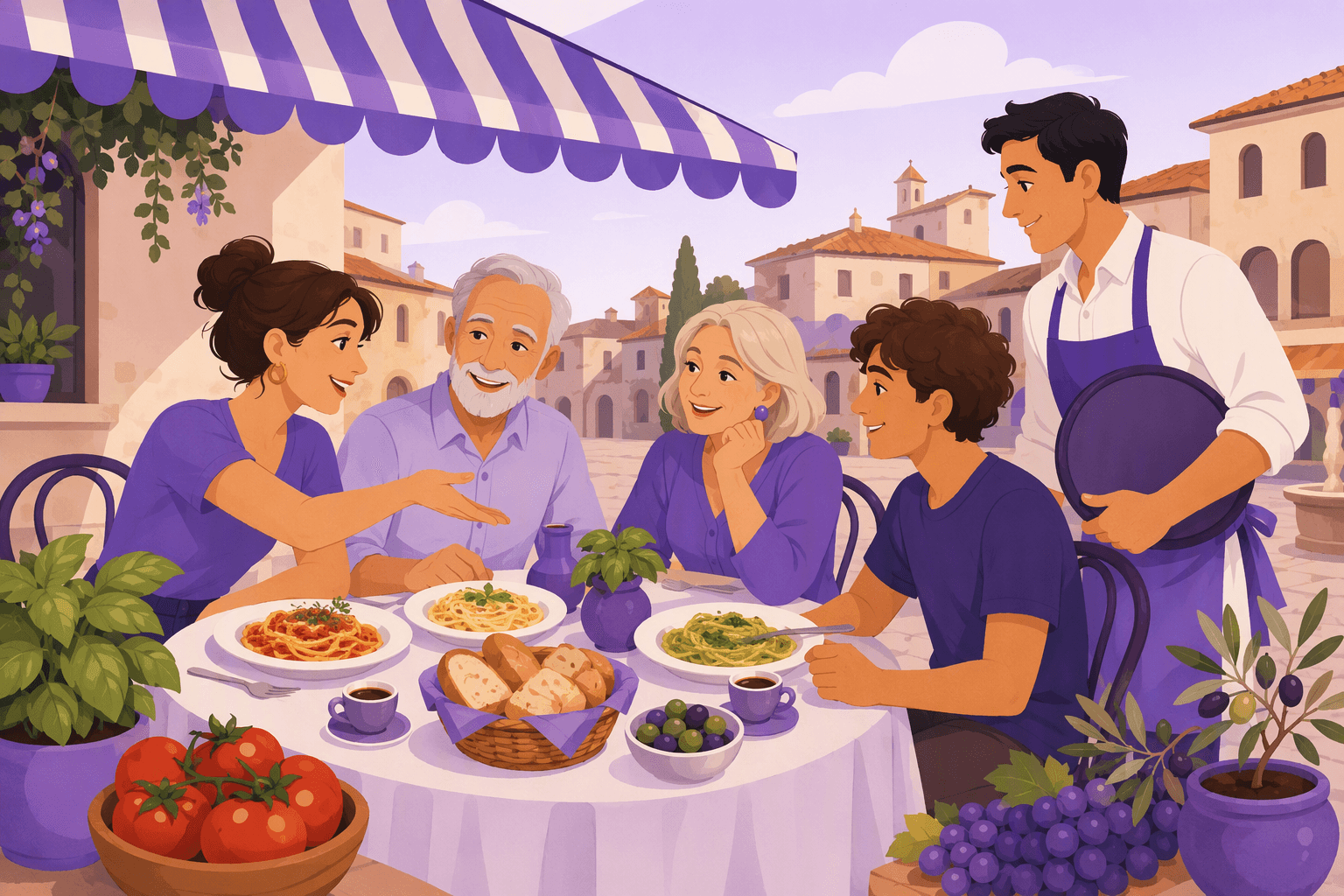
Why food matters so much in Italy
Italy has about 59 million people, and Italian is spoken by tens of millions as a first language, with additional second-language speakers worldwide (Ethnologue, 27th edition, 2024). That scale matters because it supports strong regional media, local pride, and local food vocab that stays alive.
Food is also identity work. You will hear people say they are Sicilian, Roman, or Venetian before they say they are Italian, and the kitchen follows the same logic.
Linguist Tullio De Mauro wrote extensively about Italian as a language with strong regional variation in everyday life. Food is one of the most visible places where that variation becomes a social signal, not just a vocabulary list.
🌍 A useful mindset
In Italy, a dish is often treated like a finished sentence: if you change too many parts, you are not just changing ingredients, you are changing the meaning.
The daily rhythm: what Italians eat, and when
Colazione
Colazione (koh-lah-TSYOH-neh) is usually small and sweet. Many people have coffee and something baked, often standing at the bar.
If you sit down at a table, you may pay a bit more. That is not a scam, it is a normal price structure in many cities.
Pranzo
Pranzo (PRAHN-tsoh) is the anchor meal for many workers and families. In smaller towns, you still see a real midday pause, and some businesses close.
ISTAT household data regularly shows that Italians spend heavily on food and non-alcoholic beverages compared with many European peers, and the pattern is tied to home cooking and ingredient quality (ISTAT, accessed 2026).
Cena
Cena (CHEH-nah) is later than many visitors expect. In summer, dinner can start around 9 PM, especially in the south.
Dinner is also where you feel the social pacing: nobody is trying to flip the table quickly, and lingering is normal.
Spuntino and merenda
Spuntino (spoon-TEE-noh) is a small snack, often mid-morning. Merenda (meh-REHN-dah) is more common for kids, usually mid-afternoon.
If you are hungry at 5 PM, you are not alone. That is one reason aperitivo exists.
How an Italian menu is structured (and why it is not just courses)
The classic structure is not a rigid rule, but it explains most menus:
- Antipasti: starters
- Primi: pasta, risotto, soup
- Secondi: meat or fish
- Contorni: side dishes
- Dolci: desserts
- Caffè and digestivi: coffee and after-dinner drinks
The key cultural point is that contorni are often separate. If you order a steak, vegetables might not automatically arrive with it.
Food writer and scholar Massimo Montanari, in his work on Italian food history, emphasizes that what we call Italian cuisine is a mosaic built from local histories and trade routes. The menu structure is one modern way that mosaic is organized for diners.
💡 A simple ordering strategy
If you want a complete meal without over-ordering, choose either antipasto plus primo, or primo plus secondo with a contorno. Dessert is optional, but coffee is common.
Regional identity: why the same word can mean different food
Italy has 20 regions, and each has its own flagship ingredients and dishes. Even when the Italian is the same, the expectations can change.
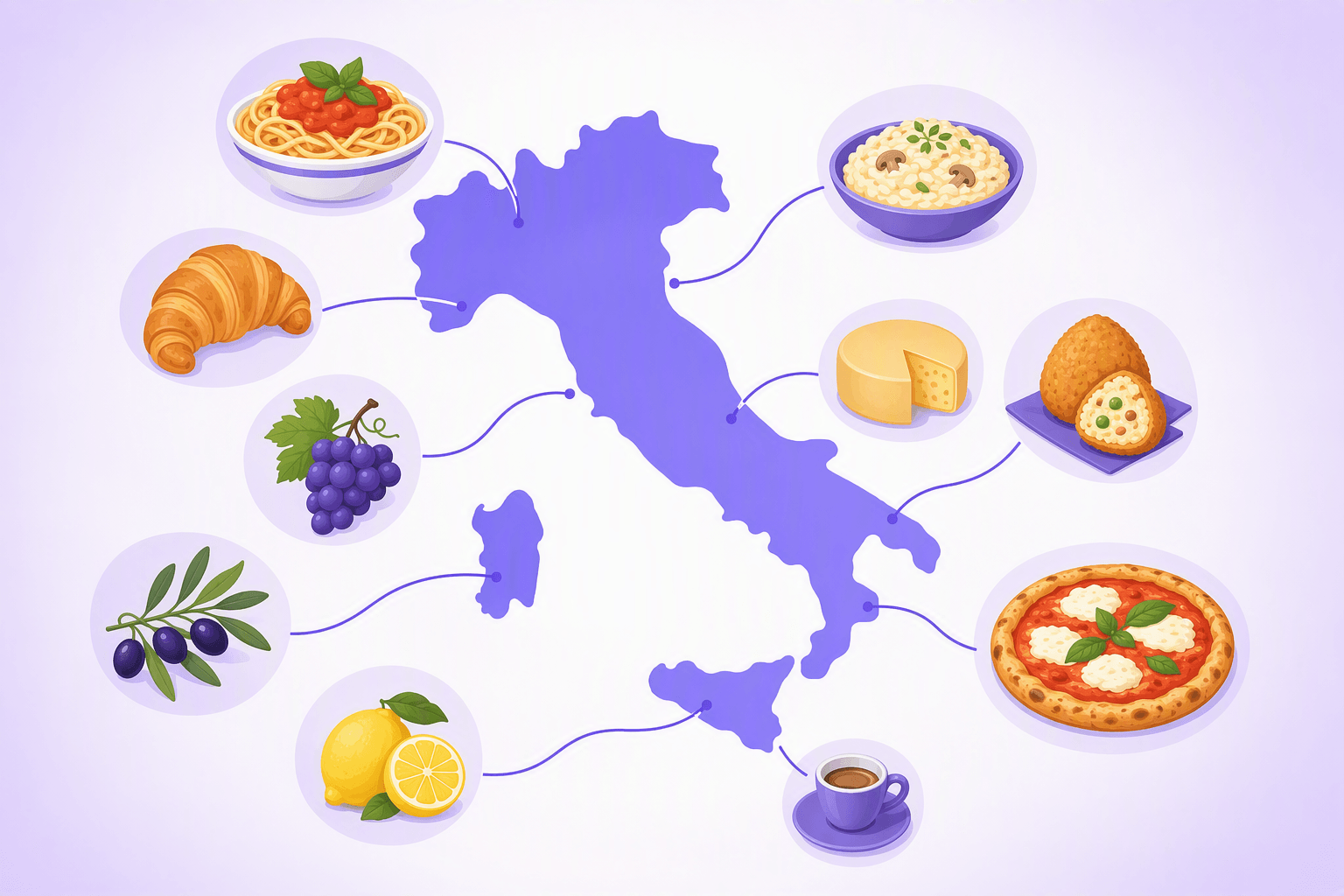
Ragù is not one thing
In much of the world, ragù means one red sauce. In Italy, ragù is a family of sauces, and the local version is part of local pride.
If you ask for "spaghetti bolognese" in Bologna, you may get a polite correction. That is not snobbery, it is a sign that the dish name is not local.
Cornetto vs brioche
In many parts of Italy, the breakfast pastry is a cornetto (kor-NEHT-toh). In parts of the north, you might hear brioche used for a similar item.
This is a good moment to practice listening, not memorizing. The word you hear tells you where you are.
Arancino vs arancina
In Sicily, even the gender of the word can be a regional marker. You will hear arancino (ah-rahn-CHEE-noh) and arancina (ah-rahn-CHEE-nah) depending on the city.
Correcting someone is usually not the goal. Noticing the pattern is.
Coffee culture: the rules that confuse visitors
Coffee in Italy is fast, specific, and socially coded.
Caffè
If you say un caffè (oon kahf-FEH), you will get espresso. The default is small.
You usually drink it quickly, often standing at the bar. The point is the pause, not the laptop session.
Cappuccino
Cappuccino (kahp-poo-CHEE-noh) is common at breakfast. After lunch, many Italians switch to espresso.
Ordering cappuccino at 3 PM is allowed, but it signals outsider habits. If you do it, do it confidently and move on.
Caffè macchiato
Caffè macchiato (kahf-FEH mahk-KYAH-toh) is espresso "stained" with a little milk. It is a popular compromise if you want something softer than straight espresso.
Digestivi
After dinner, some people take a digestivo (dee-jeh-STEE-voh), like amaro or grappa. It is more common in social meals than in quick weeknight dinners.
UNESCO lists the Mediterranean diet as Intangible Cultural Heritage, highlighting not only ingredients but also social practices like shared meals (UNESCO, accessed 2026). Italy’s coffee rules fit that same idea: food and drink are social timing tools.
Table etiquette that actually matters
Italian etiquette is less about fancy rules and more about reading the room.
Bread and scarpetta
Bread is normal, and using bread to pick up sauce, called fare la scarpetta (FAH-reh lah skahr-PEHT-tah), is widely practiced at home. In a more formal restaurant, watch what others do first.
If you are with friends, scarpetta can be a compliment. If you are at a business dinner, it may look too casual.
Cheese on seafood pasta
A common guideline is not adding cheese to seafood pasta. It is not a law, but many Italians feel the flavors clash.
If you ask for parmigiano on a seafood dish, you might get a surprised look. You can still do it, but you are choosing your own taste over local convention.
Splitting the bill
Dividing the bill, fare alla romana (FAH-reh AHL-lah roh-MAH-nah), is common among friends. In some places the server will ask how you want to pay.
If you are inviting someone, offering to pay is also a social move. The negotiation can be part of the ritual.
Volume and pacing
Meals are long. Talking is part of the meal, and silence can feel awkward.
If you are used to fast service, ask yourself whether you are in a place designed for speed. Many Italian restaurants are designed for time.
⚠️ One mistake that creates bad service
Waving, snapping, or calling loudly for the server can backfire. Make eye contact and say 'Scusi' (SKOO-zee) or 'Mi scusi' (mee SKOO-zee), then wait a moment.
Useful Italian phrases for eating out (with pronunciation)
| English | Italian | Pronunciation | Formality |
|---|---|---|---|
| A table for two, please. | Un tavolo per due, per favore. | oon TAH-voh-loh pehr DOO-eh, pehr fah-VOH-reh | polite |
| Do you have a reservation? | Avete una prenotazione? | ah-VEH-teh OO-nah preh-noh-tah-TSYOH-neh | polite |
| I have a reservation under [name]. | Ho una prenotazione a nome di [nome]. | oh OO-nah preh-noh-tah-TSYOH-neh ah NOH-meh dee [NOH-meh] | polite |
| What do you recommend? | Che cosa mi consiglia? | keh KOH-zah mee kohn-SEE-lyah | polite |
| Is it possible without...? | È possibile senza...? | eh pos-SEE-beh-leh SEN-tsah | polite |
| I am allergic to... | Sono allergico/a a... | SOH-noh ahl-LEHR-jee-koh ah | formal |
| The bill, please. | Il conto, per favore. | eel KOHN-toh, pehr fah-VOH-reh | polite |
| It was delicious. | Era buonissimo. | EH-rah bwoh-NEES-see-moh | polite |
Un tavolo per due, per favore.
/oon TAH-voh-loh pehr DOO-eh, pehr fah-VOH-reh/
Literal meaning: A table for two, please.
“Buonasera, un tavolo per due, per favore.”
Good evening, a table for two, please.
In many places you can walk in, but reservations are common in cities and on weekends. Starting with 'Buonasera' sets a polite tone.
Che cosa mi consiglia?
/keh KOH-zah mee kohn-SEE-lyah/
Literal meaning: What do you recommend to me?
“Che cosa mi consiglia tra questi due primi?”
What do you recommend between these two first courses?
This is a natural way to invite guidance without sounding indecisive. It also signals you are open to local specialties.
Il conto, per favore.
/eel KOHN-toh, pehr fah-VOH-reh/
Literal meaning: The check, please.
“Scusi, il conto, per favore.”
Excuse me, the bill please.
In Italy, servers often do not bring the bill until you ask. Asking is normal and not considered rude.
The language of food: why certain words carry status
Some food words are neutral, others signal knowledge. Knowing the difference helps you sound natural.
DOP and IGP
You will see DOP and IGP on menus and packaging. These labels relate to protected origin systems in the EU, and Italians often use them as shorthand for quality and authenticity.
If you want to ask about ingredients without sounding suspicious, ask with curiosity: "È DOP?" (eh dop) or "Di che zona è?" (dee keh DZO-nah eh), meaning what area is it from.
Fresco, fatto in casa, artigianale
Fresco (FREHS-koh) means fresh, but it can be vague. Fatto in casa (FAHT-toh een KAH-zah) means made in-house, and artigianale (ahr-tee-jah-NAH-leh) implies craft production.
Treccani’s entries are useful for seeing how these words are defined and used in Italian, beyond tourist glosses (Treccani, accessed 2026).
Al dente
Al dente (ahl DEHN-teh) is not just a texture preference, it is a cultural expectation for many pasta dishes. If pasta arrives very soft, Italians may read it as low skill or low care.
This is a good example of what sociolinguists call indexical meaning: a sensory detail that points to identity and competence. You do not need the theory to use it, but you will feel it in reactions.
Aperitivo: the social bridge between work and dinner
Aperitivo is a time slot and a social practice. You meet, you drink something, and you snack.
In Milan and other northern cities, aperitivo can be substantial. In smaller towns, it might be just chips, olives, and conversation.
If you want to participate without overthinking, order a spritz or a glass of wine and say: "Va bene così" (vah BEH-neh koh-SEE), meaning this is fine like this.
Home culture vs restaurant culture
Visitors often judge Italian food culture by restaurants, but much of the real culture is in homes.
Sunday lunch can be a multi-hour event. Recipes are family property, and the person cooking may be emotionally invested in doing it "the right way."
Anthropologist Mary Douglas wrote influentially about meals as social structures, not just nutrition. Italy makes that visible: the sequence, the seating, and the repetition across weeks create belonging.
Common tourist mistakes, and what to do instead
Ordering for speed
If you want fast, choose places designed for it, like a bar for panini or a casual spot with a short menu.
In a sit-down restaurant, assume the meal will take time. That is part of what you are paying for.
Treating Italian food as one cuisine
Italy is not one flavor profile. Even the same ingredient can be used differently across regions.
If you want to learn the country through food, pick one region and go deep for a week. Your vocabulary will improve faster, too.
Overusing slang or strong language
Food brings emotion, and you might hear strong expressions in kitchens and among friends. Still, do not copy what you hear without context.
If you are curious about what crosses the line, read our Italian swear words guide privately, not at the table.
How to learn Italian through food scenes in movies and TV
Food scenes are dense with real speech: interruptions, politeness, negotiation, and family dynamics.
You will hear:
- softeners like "magari" (mah-GAH-ree), meaning maybe, if only
- polite requests with conditional forms
- fast turn-taking, especially in family scenes
If you want a structured way to build that listening skill, use short clips and rewatch them until you can predict the next line. Pair it with a small set of phrases, like the ones above, and you will start recognizing them in the wild.
For more everyday language that shows up around meals, you can also review how to say I love you in Italian, because affection and food talk overlap constantly in family contexts.
A practical checklist for your next meal in Italy
- Greet first, then ask for what you need.
- Expect separate courses, and separate sides.
- Ask for the bill when you are ready.
- Drink coffee like locals if you want to blend in, but do not stress about it.
- Treat regional differences as the point, not a problem.
If you want to keep building real-life Italian, browse the Wordy language blog and focus on topics that match what you will do tomorrow: greetings, travel phrases, and food.
Frequently Asked Questions
What are the typical meal times in Italy?
Is it rude to ask for changes to a dish in Italy?
Why do Italians not drink cappuccino after lunch?
Do Italians tip in restaurants?
What is the difference between 'trattoria' and 'ristorante'?
Sources & References
- Ethnologue, Italian, 27th edition, 2024
- Accademia della Crusca, linguistic notes and articles on Italian usage, accessed 2026
- Treccani, Vocabolario and Enciclopedia entries on Italian food terms, accessed 2026
- UNESCO, Intangible Cultural Heritage: Mediterranean diet, accessed 2026
- ISTAT, Food consumption and household expenditure statistics, accessed 2026
Start learning with Wordy
Watch real movie clips and build your vocabulary as you go. Free to download.


