Quick Answer
Italian pizza vocabulary includes pizza, pizzeria, impasto, cornicione, margherita, and phrases such as una pizza da asporto. Learn these words to read menus, order confidently, and understand why pizza in Italy is a distinct food culture rather than just a familiar dish.
Italian pizza vocabulary starts with pizza /ˈpit.tsa/, pizzeria /pit.tseˈri.a/, impasto /imˈpa.sto/ for dough, and cornicione /kor.niˈtʃo.ne/ for the raised crust edge. To order naturally, ask for una pizza da asporto /u.na ˈpit.tsa da aˈspor.to/ for takeaway, name your pizza and toppings, then say per favore /per faˈvo.re/. Knowing these terms helps you read an Italian menu accurately and appreciate the local rules around one of Italy’s best-known foods.
Pizza may be global, but the Italian pizzeria has its own vocabulary, habits, and regional preferences. Italian has roughly 67.9 million total speakers worldwide according to Ethnologue, and pizza language travels with it, from neighborhood shops in Naples to Italian communities across five continents.
For the most useful beginner language before you order, start with our guide to Italian greetings. A quick buonasera /bwo.naˈse.ra/ in the evening and a clear order go a long way.
| English | Italian | Pronunciation | Note |
|---|---|---|---|
| pizza | pizza | PEET-tsah | Usually one individual pizza per person. |
| pizzeria | pizzeria | peet-tseh-REE-ah | A pizza restaurant or takeaway. |
| dough | impasto | eem-PAH-stoh | Can refer to prepared dough or the dough recipe. |
| crust rim | cornicione | kor-nee-CHOH-neh | The puffy outer edge of the pizza. |
| wood-fired oven | forno a legna | FOR-noh ah LEH-nyah | Traditional oven fueled with wood. |
| slice | fetta | FET-tah | Often used for pizza sold by the slice. |
| pizza by the slice | pizza al taglio | PEET-tsah al TAHL-yoh | Pizza cut and sold in portions, common in Rome. |
| takeaway | da asporto | dah ah-SPOR-toh | Used after the item you want to take away. |
| delivery | consegna a domicilio | kohn-SEH-nyah ah doh-mee-CHEE-lyoh | Delivery to your address. |
| table service | servizio al tavolo | sehr-VEE-tsyoh al TAH-voh-loh | May appear as a separate charge on the bill. |
| menu | menù | meh-NOO | The accent is written in Italian. |
| topping | condimento | kohn-dee-MEN-toh | A general word for seasoning or topping. |
| mozzarella | mozzarella | moht-tsah-REL-lah | The standard cheese on many pizzas. |
| tomato sauce | salsa di pomodoro | SAHL-sah dee poh-moh-DOH-roh | Often simply called pomodoro on menus. |
| basil | basilico | bah-ZEE-lee-koh | A key ingredient in pizza margherita. |
| mushrooms | funghi | FOON-ghee | Singular fungo means mushroom. |
| ham | prosciutto | proh-SHOOT-toh | Ask whether it is cotto or crudo. |
| cooked ham | prosciutto cotto | proh-SHOOT-toh KOT-toh | Mild cooked ham. |
| cured ham | prosciutto crudo | proh-SHOOT-toh KROO-doh | Dry-cured ham, often added after baking. |
| spicy salami | salame piccante | sah-LAH-meh peek-KAHN-teh | A common pepperoni-style topping. |
| olives | olive | OH-lee-veh | The singular is oliva. |
| anchovies | acciughe | ah-CHOO-geh | Salty cured fish topping. |
| eggplant | melanzane | meh-lahn-TSAH-neh | A common vegetable topping. |
| extra virgin olive oil | olio extravergine d'oliva | OH-lyoh eks-trah-VEHR-jee-neh doh-LEE-vah | Often drizzled on after baking. |
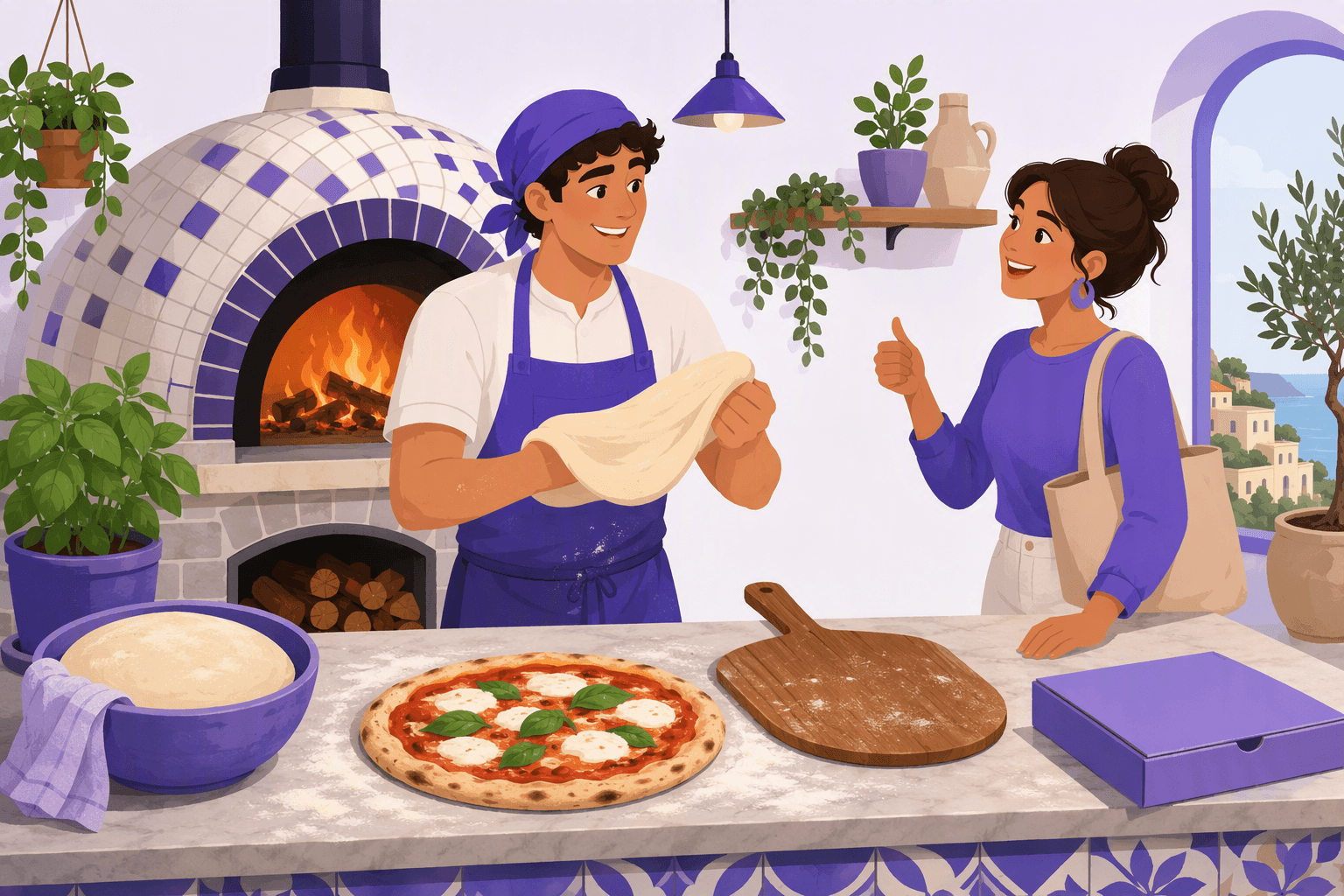
The essential Italian pizza words
A menu can look simple until you see terms for pizza styles, toppings, dough, and service. Learn the words below as useful menu language, not as a promise that every pizzeria follows the same recipe.
Pizza
Pizza /ˈpit.tsa/ has a doubled consonant sound in Italian. Hold the /t/ slightly longer than in the English pronunciation, then finish with a crisp /ts/ sound.
In a sit-down pizzeria, one pizza usually means one round pizza for one person. Italian pizzas are often smaller in diameter than an American large pizza, but they are intended as a complete individual meal.
Pizzeria
A pizzeria /pit.tseˈri.a/ is the place that makes and sells pizza. You may find a casual counter service pizzeria, a formal restaurant with pizza on the menu, or a pizzeria d'asporto /pit.tseˈri.a daˈspor.to/, which specializes in takeaway.
A pizzaiolo /pit.tsaˈjo.lo/ is the pizza maker. In Naples, the traditional craft of the pizzaiuolo /pit.tsaiˈwo.lo/ was added to UNESCO’s Representative List of the Intangible Cultural Heritage of Humanity in 2017. UNESCO recognizes the craft as social knowledge and performance, not merely a recipe.
Impasto
Impasto /imˈpa.sto/ means dough, mixture, or batter, depending on context. In pizza talk, it generally means the fermented dough and its handling.
You may see impasto integrale /imˈpa.sto inteˈɡra.le/ for whole-wheat dough, impasto senza glutine /imˈpa.sto ˈsɛn.tsa ɡluˈti.ne/ for gluten-free dough, or lunga lievitazione /ˈluŋ.ɡa lje.vi.tatˈtsjo.ne/ for long fermentation. These labels describe a style or ingredient choice, not automatically a superior pizza.
Cornicione
The cornicione /kor.niˈtʃo.ne/ is the thick rim around the outer edge. A well-made Neapolitan-style cornicione is airy and flexible, with dark blistered spots caused by intense oven heat.
The Association for True Neapolitan Pizza, or AVPN, publishes technical standards for pizza napoletana /ˈpit.tsa napoleˈta.na/. Their rules address ingredients, dough, shaping, baking, and the finished pizza’s characteristic soft center.
🌍 Soft pizza is not undercooked
A Neapolitan pizza is intentionally soft in the center. Folding a slice slightly or using a knife and fork is normal, especially when the pizza has a thin base and a generous amount of tomato or mozzarella.
Pizza styles you will see on Italian menus
Italy has no single nationwide pizza template. Naples, Rome, Sicily, and other regions have recognizable approaches, while modern pizzerias frequently mix traditions.
Margherita
Pizza margherita /ˈpit.tsa mar.ɡeˈri.ta/ is the foundational order: tomato, mozzarella, basil, and olive oil. It is a practical first choice when judging a pizzeria because every element is exposed.
The popular story connects the pizza to Queen Margherita of Savoy and the colors of the Italian flag. Food historian Carol Helstosky, in Pizza: A Global History, places pizza within a longer history of Neapolitan street food and urban working-class eating, which is more useful than treating one royal anecdote as pizza’s entire origin.
Marinara
Pizza marinara /ˈpit.tsa mariˈna.ra/ usually has tomato, garlic, oregano, and olive oil, with no cheese. The name comes from marinaro /mariˈna.ro/, relating to sailors, not from seafood.
For dairy-free diners, it is one of the safest traditional choices. Still, ask about ingredients if you have an allergy, since kitchen practices differ.
Quattro formaggi
Pizza quattro formaggi /ˈpit.tsa ˈkwat.tro forˈmad.dʒi/ means four-cheese pizza. The cheeses vary, but mozzarella, gorgonzola, fontina, and parmesan-type cheeses are common.
It may arrive bianca /ˈbjaŋ.ka/, meaning without tomato sauce. A white pizza is not necessarily plain, it simply uses olive oil, cheese, cream, or another base instead of tomato.
Capricciosa
Pizza capricciosa /ˈpit.tsa kapritˈtʃo.za/ is a mixed-topping pizza, often with ham, mushrooms, artichokes, olives, and sometimes egg. Its ingredients are not perfectly standardized.
The adjective capriccioso /kapritˈtʃo.zo/ means whimsical or fanciful. Treat the menu description, not the name alone, as the final authority on what arrives.
Diavola
Pizza diavola /ˈpit.tsa ˈdja.vo.la/ is usually topped with spicy salami. Diavola literally means female devil, a playful reference to heat.
It is a better menu word to know than American pepperoni, which in Italian means bell peppers: peperoni /pepeˈro.ni/. If you ask for pepperoni in Italy, you may receive a vegetable pizza.
Pizza al taglio
Pizza al taglio /ˈpit.tsa al ˈtaʎ.ʎo/ means pizza by the cut or by the slice. It is commonly baked in rectangular trays, then cut to your requested size.
You might hear un pezzo /um ˈpɛt.tso/, meaning a piece, or quanto costa al chilo? /ˈkwan.to ˈkos.ta al ˈki.lo/, meaning how much does it cost per kilogram? In many shops, staff weigh the portion and charge by weight.
🌍 Rome, Naples, and the meaning of a slice
Roman pizza al taglio and round Neapolitan pizza serve different occasions. Pizza al taglio is often a quick lunch, snack, or takeaway food. A Neapolitan pizzeria is more often a seated evening meal, with each guest ordering a whole pizza.
How to order pizza in Italian
The grammar needed to order is straightforward. Start politely with vorrei /vorˈrɛi/, meaning I would like, then name your pizza.
Vorrei una margherita, per favore. /vorˈrɛi ˈu.na mar.ɡeˈri.ta per faˈvo.re/ means I would like a margherita, please.
For a more casual order, use prendo /ˈprɛn.do/, meaning I’ll have. Prendo una diavola /ˈprɛn.do ˈu.na ˈdja.vo.la/ is natural at the table.
Here are the most useful requests:
- Una pizza da asporto, per favore. /ˈu.na ˈpit.tsa da aˈspor.to per faˈvo.re/, a takeaway pizza, please.
- Posso avere il menù? /ˈpos.so aˈve.re il meˈnu/, can I have the menu?
- Con mozzarella di bufala. /kom mot.tsaˈrɛl.la di ˈbu.fa.la/, with buffalo mozzarella.
- Senza cipolla. /ˈsɛn.tsa tʃiˈpol.la/, without onion.
- Con poca mozzarella. /kom ˈpo.ka mot.tsaˈrɛl.la/, with little mozzarella.
- Ben cotta, per favore. /ben ˈkot.ta per faˈvo.re/, well done, please.
- È possibile avere una pizza senza glutine? /ɛ posˈsi.bi.le aˈve.re ˈu.na ˈpit.tsa ˈsɛn.tsa ɡluˈti.ne/, is it possible to have a gluten-free pizza?
Ben cotta is especially useful if you prefer a crisper pizza. It literally means well cooked, and many pizzerias understand it as a request for more baking time.
If you are sharing, say la dividiamo? /la diviˈdja.mo/, shall we split it? But do not assume sharing is expected. In a traditional pizzeria, separate individual pizzas remain the default.
For more restaurant language beyond pizza, see our guide to ordering at an Italian restaurant.
Toppings, ingredients, and useful menu warnings
Italian menu words can be misleading if you rely on English look-alikes. Salame /saˈla.me/ means salami, while salame piccante /saˈla.me pikˈkan.te/ is the closest common topping to American pepperoni.
Prosciutto cotto /proʃˈʃut.to ˈkot.to/ is cooked ham. Prosciutto crudo /proʃˈʃut.to ˈkru.do/ is cured ham, typically sliced thin and sometimes added after the pizza leaves the oven.
Funghi /ˈfuŋ.ɡi/ means mushrooms, carciofi /karˈtʃɔ.fi/ means artichokes, and melanzane /melanˈtsa.ne/ means eggplant. A pizza vegetariana /ˈpit.tsa vedʒetariˈa.na/ often contains grilled or roasted vegetables, but ask if you need to avoid cheese.
⚠️ Allergies and dietary needs
For an allergy, do not rely only on words such as senza /ˈsɛn.tsa/, meaning without. Say Ho un'allergia a... /o un alˈlɛrdʒa a/, meaning I have an allergy to..., and ask whether cross-contact is possible. A gluten-free base may be prepared in the same kitchen as wheat dough.
The pizzeria bill and table customs
Italian restaurant bills often include coperto /koˈpɛr.to/, a per-person cover charge. It covers bread, table setting, and service infrastructure, rather than functioning as a tip.
You may also see servizio /serˈvit.tsjo/, meaning service. Check the menu or bill before adding a large gratuity. Tipping exists, but the North American expectation of a fixed percentage is not universal in Italy.
For the bill, say il conto, per favore /il ˈkon.to per faˈvo.re/. If you are leaving, arrivederci /arrivederˈtʃi/ is the standard polite goodbye. Our guide to saying goodbye in Italian gives you more options for casual and formal settings.
Food writer John Dickie, in Delizia! The Epic History of the Italians and Their Food, emphasizes that Italian food history is regional rather than monolithic. That principle is crucial in a pizzeria: a Roman crisp base, a Neapolitan soft center, and a Sicilian tray pizza can all be authentically Italian without being interchangeable.
Learn pizza Italian through real scenes
A menu list is useful, but a pizzeria scene teaches the speed, gestures, interruptions, and polite shortcuts that menus cannot show. Watch for lines such as che cosa prendete? /ke ˈkɔ.za prenˈde.te/, what will you have, and mangiamo qui o da asporto? /manˈdʒa.mo kwi o da aˈspor.to/, are we eating here or taking it away.
Italian films and series also make food language memorable because words appear with objects, actions, and social context. Pair pizza vocabulary with Italian food vocabulary, then replay short restaurant scenes until you can recognize the order before reading subtitles.
The goal is not to recite every topping. It is to recognize what you want, ask for it politely, and understand the answer when the pizzaiolo asks a follow-up question.
Frequently Asked Questions
What is pizza called in Italian?
What does pizzeria mean in Italian?
What is the crust of an Italian pizza called?
How do I ask for takeaway pizza in Italian?
Do Italians put pineapple on pizza?
Sources & References
- UNESCO, Art of Neapolitan Pizzaiuolo, Representative List of the Intangible Cultural Heritage of Humanity, accessed 2026
- Associazione Verace Pizza Napoletana, International Regulations for True Neapolitan Pizza, accessed 2026
- Treccani, Vocabolario Treccani: pizza and pizzeria, accessed 2026
- Ethnologue, Italian, 27th edition, 2024
- Carol Helstosky, Pizza: A Global History, Reaktion Books
Start learning with Wordy
Watch real movie clips and build your vocabulary as you go. Free to download.


