Quick Answer
Italian regional dialects are not simply accented versions of standard Italian. They are diverse local speech systems, many with their own grammar and vocabulary, shaped by Italy's long history of separate states, cities, and communities.
Italian regional dialects are a group of local Romance varieties spoken across Italy, and many are much more than accents of standard Italian. A person from Naples, Venice, Milan, Palermo, or Sardinia may switch between standard Italian and a local variety with different vocabulary, pronunciation, and grammar. For learners, the practical rule is simple: learn standard Italian first, then treat regional dialects as a key to culture, humor, identity, and real-life speech.
Italy has roughly 67 million speakers of Italian worldwide according to Ethnologue, but standard Italian is only one part of the country's linguistic reality. From the Alps to Sicily, people preserve regional ways of speaking that reflect centuries of local history.
If you are beginning Italian, standard greetings such as those in our guide to how to say hello in Italian will be understood everywhere. Regional speech becomes most noticeable when you hear family conversations, comedy, football chants, local music, or older films.
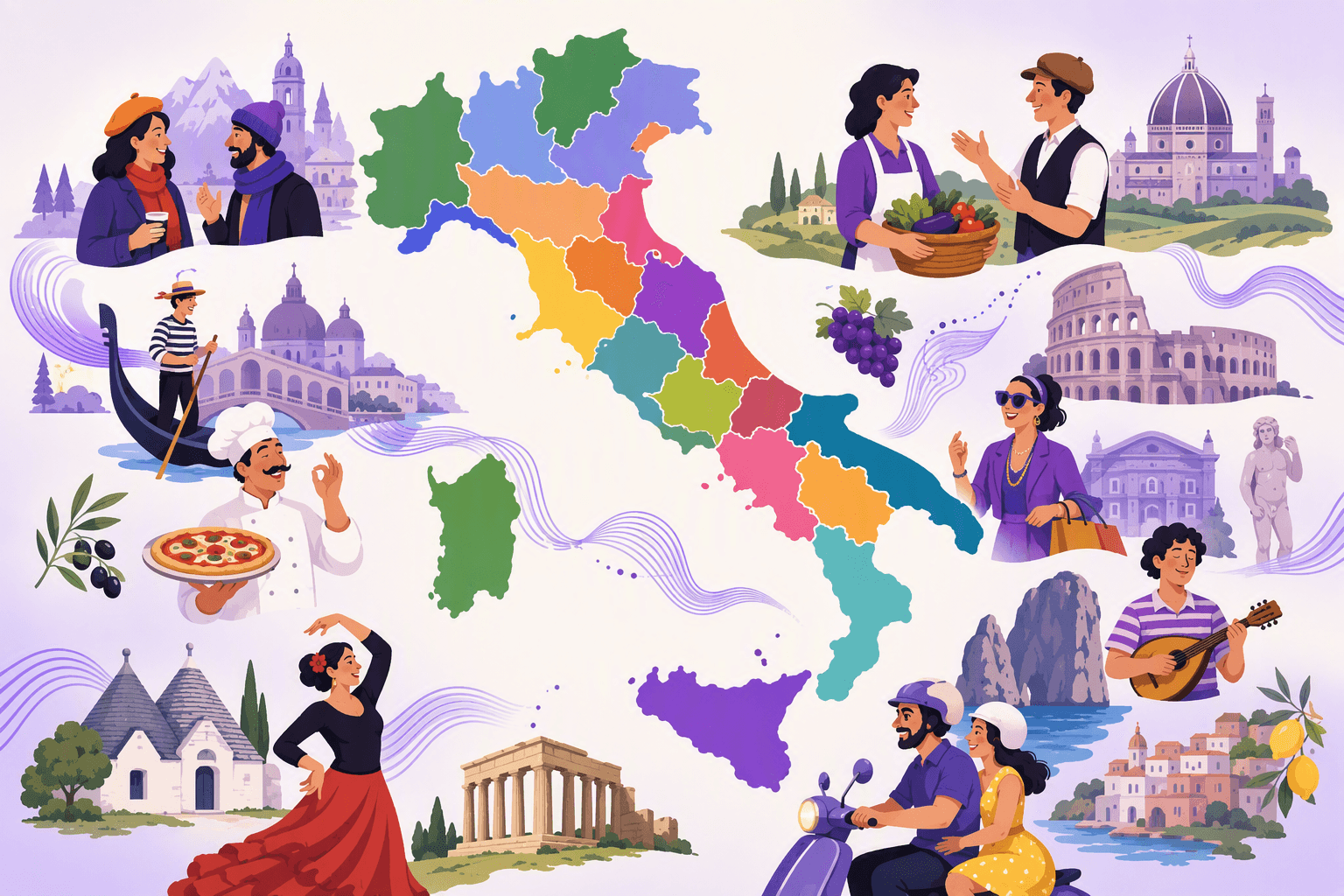
What Italians mean by dialect
In everyday Italian, the word dialetto /djaˈletto/ can describe almost any local speech variety. Linguists use the term more carefully, because many varieties called dialects are not descended from standard Italian at all.
Standard Italian developed primarily from literary Tuscan, especially the Florentine tradition. Local varieties such as Neapolitan, Sicilian, Venetian, and Lombard developed alongside Tuscan from spoken Latin. They are sister varieties within the Romance language family, not imperfect forms of Italian.
Michele Loporcaro, in Profile of the Dialects of Italy, describes Italy as an unusually dense linguistic landscape. The country’s local varieties preserve sound systems and grammatical patterns that often disappeared from standard Italian.
A useful distinction is this:
| Term | What it means |
|---|---|
| Standard Italian | The national language used in school, news, government, publishing, and most cross-regional communication |
| Regional Italian | Standard Italian spoken with local pronunciation, rhythm, vocabulary, or grammar |
| Dialect | A local Romance variety with its own linguistic history, often substantially different from standard Italian |
| Minority language | A language with legal or historical recognition in part of Italy, such as Sardinian, Friulian, Albanian, Greek, or Slovenian |
Someone may speak standard Italian with a Roman accent, which is regional Italian. The same person may also speak Romanesco /romaˈnesko/, a local variety traditionally associated with Rome.
Why Italy has so many regional varieties
Italy’s linguistic diversity is the result of history, geography, and local identity. The modern Italian state unified in 1861, but the peninsula had spent centuries divided among city-states, kingdoms, papal territories, and foreign-controlled regions.
Before unification, a merchant in Venice, a farmer in Calabria, and a court official in Turin were not necessarily using the same everyday language. Local speech was the normal language of home, work, and community.
Mountains also mattered. The Alps and Apennines created isolated valleys and communities, while islands such as Sicily and Sardinia developed under distinct political and cultural influences. Ports, invasions, trade networks, and migration added Arabic, Greek, French, Spanish, Germanic, and other influences to local vocabularies.
Tullio De Mauro’s Storia linguistica dell'Italia unita examines how schooling, military service, internal migration, radio, and television expanded standard Italian after unification. This expansion did not erase local speech. Instead, many Italians became bilingual or bidialectal, selecting a variety according to setting and relationship.
How common are dialects in Italy today?
Dialect use has declined compared with earlier generations, but it remains a living part of Italian society. ISTAT’s 2015 language-use survey found that 45.9% of people reported using only Italian at home, while 32.2% used both Italian and dialect. A further 14.1% reported speaking mainly or only dialect at home.
Those figures show two important facts. Standard Italian is now the dominant shared language, but dialect has not vanished.
Usage differs by age, education, region, and context. Younger Italians are generally more likely to use standard Italian, especially in school and online. Dialect is often strongest in close family settings, among friends from the same town, and in local comedy or music.
🌍 Dialect is often a relationship signal
Using a local variety can create warmth, solidarity, humor, or a sense of belonging. Switching back to standard Italian can signal formality, clarity for outsiders, or professional distance. The change is often social rather than purely linguistic.
Major dialect areas of Italy
There are no perfectly fixed borders between Italian dialects. Speech changes gradually from village to village, and labels such as Tuscan or Sicilian cover many local subvarieties. Still, several broad areas help learners understand what they hear.
Northern Italy
Northern varieties include Lombard, Piedmontese, Ligurian, Emilian-Romagnol, Venetian, and Friulian. They often sound quite different from standard Italian in rhythm and vowel quality.
In Milan, you may hear Milanese /milaˈneːz/, a Lombard variety. In Venice and much of the Veneto region, Venetian /veneˈtsjan/ remains culturally visible in theater, local signs, and conversation.
One famous Venetian expression is ciao /ˈtʃaːo/. It originally came from Venetian s-ciào /ˈstʃaːo/, historically connected to a phrase meaning servant or servant to you. It became a casual greeting and farewell used throughout Italy and then internationally.
Central Italy
Central varieties include Tuscan, Romanesco, Umbrian, and Marche speech. Tuscan has special historical importance because its literary prestige strongly shaped standard Italian.
That does not mean modern Tuscan is identical to standard Italian. A famous feature is the gorgia toscana /ˈɡordʒa tosˈkaːna/, in which consonants such as c /k/ may soften between vowels. For example, casa /ˈkaːza/ can sound closer to /ˈhaːza/ in some Tuscan speech.
Romanesco /romaˈnesko/ is also highly recognizable in Italian cinema and comedy. It may use aò /aˈɔ/ as an attention-getter among friends, similar to hey. This is strongly local and should not be copied in formal situations.
Southern Italy
Southern Italy includes Campanian, Apulian, Calabrian, Lucanian, and other regional varieties. Neapolitan /neapoliˈtaːno/ is one of the best-known because of its songs, theater, films, and large diaspora communities.
Neapolitan has a substantial literary and musical tradition. The famous song 'O sole mio /o ˈsoːle ˈmiːo/ is written largely in Neapolitan, not standard Italian.
You may hear guaglió /ɡwaʎˈʎo/ in Neapolitan, meaning boy, young man, or friend depending on context. It is not a standard Italian word, so learners should recognize it rather than force it into general Italian conversation.
Sicily
Sicilian /sitʃiˈljaːno/ includes many local varieties spoken across Sicily and parts of southern Calabria. Its vocabulary reflects the island’s long history of Greek, Arabic, Norman, Catalan, Spanish, and Italian contact.
A well-known Sicilian word is bedda /ˈbɛdda/, the feminine form of beautiful. Standard Italian uses bella /ˈbɛlla/. The difference may look small, but it reflects a broader local sound pattern and grammatical system.
Sicilian is widely heard in family speech, regional cinema, music, and expressive dialogue. It can be difficult even for Italians from other regions when spoken quickly.
Sardinia
Sardinian /sardu/ is especially important because many linguists classify it as a separate Romance language rather than an Italian dialect. It is spoken in Sardinia alongside Italian and local Sardinian varieties.
Treccani and other reference works distinguish Sardinian from the Italo-Romance dialect continuum because it retains several features closer to Latin than standard Italian does. It is also protected under Italy’s minority-language framework.
Do not assume all speech from Sardinia is Sardinian. People may speak standard Italian, Sardinian, Sassarese /sassaˈreːze/, Gallurese /ɡalluˈreːze/, or a mixture depending on family and location.
Regional Italian vs dialect: what learners actually hear
Most visitors do not suddenly encounter an entirely unfamiliar language in a café. More often, they hear regional Italian: standard Italian shaped by local habits.
For example, the standard word ragazzo /raˈɡattso/ means boy or young person. In different places, you may hear local alternatives such as guaglione /ɡwaʎˈʎoːne/ in Naples or fio /ˈfiːo/ in parts of Tuscany and central Italy.
The key is that Italians frequently adjust their speech for listeners. Two people from the same region may speak dialect privately, then move toward standard Italian when a visitor joins them.
🌍 Italian films preserve regional voices
Italian cinema is one of the best places to hear the relationship between standard Italian and local speech. Neorealist films, Roman comedies, Sicilian dramas, and contemporary television often use dialect to establish class, neighborhood, intimacy, or comic timing. Subtitles are useful because even native Italian viewers may need help with unfamiliar varieties.
Dialect and Italian identity
Dialect is not only a linguistic category. It can carry family memory, regional pride, humor, class associations, and political meaning.
For some speakers, dialect recalls grandparents and childhood. For others, it represents a city identity that is performed through jokes, sports culture, and music. A Neapolitan song or Roman comedic line may communicate an emotional tone that standard Italian cannot fully reproduce.
At the same time, dialect can create barriers. A learner who hears a rapid local conversation may feel that their Italian has failed. Usually, the issue is not your level. You are listening to a variety that native speakers from another region may also find challenging.
This matters for emotional language too. Standard Italian phrases such as ti amo /ti ˈaːmo/ and ti voglio bene /ti ˈvɔʎʎo ˈbɛːne/ work across the country. Our guide to saying I love you in Italian explains the difference, while local varieties add regional flavor rather than replace the standard forms.
Should you learn an Italian dialect?
For most learners, standard Italian should come first. It gives you access to every region, Italian media, books, work, travel, and national conversation.
Learn a regional variety if you have a concrete reason:
- Your family speaks it at home.
- You are moving to a particular city or region.
- You love a regional music scene, film tradition, or theater.
- You want to understand local humor and older relatives.
- You are studying Italian linguistics or Romance languages.
Recognition is a realistic first goal. You do not need to speak Neapolitan or Sicilian to appreciate them. Learn to notice that a speaker has switched varieties, ask politely what a word means, and keep using standard Italian unless invited into more local speech.
💡 A practical learner response
If you hear a dialect word you do not know, say Come si dice in italiano? /ˈkoːme si ˈdiːtʃe in itaˈljaːno/, meaning how do you say that in Italian? It shows interest without pretending you understand a local variety you have not studied.
Do not copy dialect from movies too quickly
Films and television are valuable, but they can exaggerate speech for comedy, character type, or dramatic effect. A phrase that sounds charming from a fictional Roman taxi driver may sound forced from a visitor using it on day one.
This applies especially to insults and strong language. Regional swear words can be much more intense than their subtitles suggest, and their force changes across regions. Before repeating anything from a crime drama or comedy, read our context guide to Italian swear words.
The same restraint helps with farewells. Ciao /ˈtʃaːo/ is friendly and safe in casual settings, but standard polite options are more useful with strangers, older people, and staff. See how to say goodbye in Italian for the full range.
How to enjoy dialects without getting lost
Use dialect exposure as listening practice, not as a test you must pass. Start with content from one region, use Italian subtitles where possible, and collect only a few high-frequency words.
Pay attention to repeated words that reveal relationships: terms for family, food, affection, surprise, and teasing. Then compare them with standard Italian. This builds cultural awareness and trains your ear for real speech.
Italy’s regional dialects are evidence of linguistic richness, not mistakes to be corrected. Standard Italian connects the country, while local varieties preserve the voices of places, families, and histories that existed long before Italy became one nation.
Frequently Asked Questions
Are Italian dialects different languages?
Do Italians still speak dialects today?
Which Italian dialect is hardest to understand?
Should Italian learners study dialects?
Why does Italy have so many dialects?
Sources & References
- ISTAT, L'uso della lingua italiana, dei dialetti e di altre lingue in Italia, 2015
- Treccani, Dialetti italiani, accessed 2026
- Ethnologue, Italian, 27th edition, 2024
- Michele Loporcaro, Profile of the Dialects of Italy, Oxford University Press
- Tullio De Mauro, Storia linguistica dell'Italia unita, Laterza
Start learning with Wordy
Watch real movie clips and build your vocabulary as you go. Free to download.


