Quick Answer
The most essential Italian food words to learn first are 'il pane' (bread), 'la pasta' (pasta), 'il formaggio' (cheese), and 'il caffè' (coffee). Italian cuisine vocabulary goes far beyond food names: pasta shapes carry literal meanings (farfalle means 'butterflies,' orecchiette means 'little ears'), cappuccino is only ordered before 11 AM, and the word 'panini' is already plural (one sandwich is a 'panino').
Italian food vocabulary is arguably the most universally recognized culinary language on Earth. Words like pizza, pasta, espresso, and gelato have entered virtually every language, yet most people use them without understanding the rich linguistic system behind them.
With approximately 68 million native speakers according to Ethnologue's 2024 data, Italian is the language of a cuisine that UNESCO inscribed on its Intangible Cultural Heritage list in 2010 as part of the Mediterranean diet. Whether you are reading a menu in Rome, shopping at a market in Florence, or simply trying to order correctly at your local Italian restaurant, knowing these words transforms the experience.
"Italian cuisine is inseparable from Italian language. The names of dishes, ingredients, and cooking methods encode centuries of regional history, agricultural tradition, and cultural identity that no translation can fully capture."
(Accademia Italiana della Cucina, La Cucina Italiana: Storia, Cultura e Tradizioni)
This guide covers 30+ essential food words organized by category: fruits, vegetables, meat and seafood, pasta shapes and their meanings, iconic dishes, coffee culture, and the restaurant phrases you need to navigate any Italian dining experience.
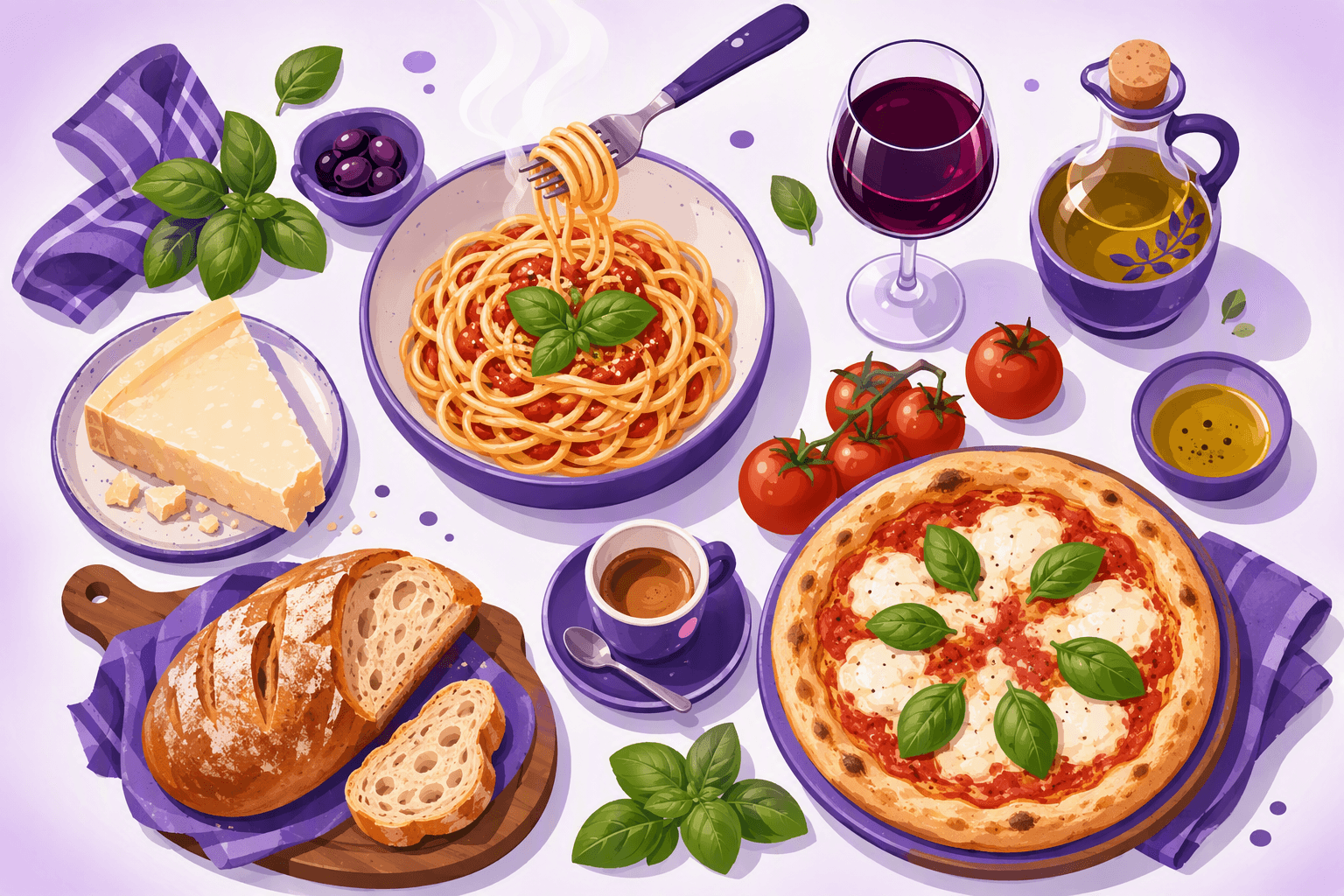
Essential Food Categories
These are the foundational food category words. You will see and hear them on every menu, at every market, and in every Italian kitchen.
| English | Italian | Pronunciation | Note |
|---|---|---|---|
| Bread | Il pane | eel PAH-neh | |
| Pasta | La pasta | lah PAH-stah | Also means 'dough' |
| Cheese | Il formaggio | eel for-MAH-joh | |
| Meat | La carne | lah KAR-neh | |
| Fish | Il pesce | eel PEH-sheh | |
| Fruit | La frutta | lah FROOT-tah | Collective noun (f) |
| Vegetables | La verdura | lah vehr-DOO-rah | Collective noun (f) |
| Water | L'acqua | LAHK-kwah | |
| Wine | Il vino | eel VEE-noh | |
| Oil | L'olio | LOH-lyoh | Olive oil = olio d'oliva |
| Salt | Il sale | eel SAH-leh | |
| Sugar | Lo zucchero | loh TSOOK-keh-roh | |
| Egg | L'uovo | LWOH-voh | Plural: le uova (f!) |
| Butter | Il burro | eel BOOR-roh | |
| Rice | Il riso | eel REE-zoh |
💡 L'uovo: Another Gender-Switching Plural
Like il braccio / le braccia in body parts vocabulary, the word for egg follows the same Latin neuter pattern: l'uovo (masculine singular) becomes le uova (feminine plural). This is one of the irregular plurals that catches every learner off guard.
Frutta: Fruits
Italy's climate produces some of the finest fruit in Europe. These are the fruits you will encounter most often at markets and on menus.
| English | Italian | Pronunciation | Note |
|---|---|---|---|
| Apple | La mela | lah MEH-lah | |
| Orange | L'arancia | lah-RAHN-chah | Plural: le arance |
| Lemon | Il limone | eel lee-MOH-neh | Amalfi lemons are famous |
| Strawberry | La fragola | lah FRAH-goh-lah | |
| Peach | La pesca | lah PEH-skah | Also means 'fishing'! |
| Grape | L'uva | LOO-vah | Collective (f); one grape = un acino |
| Watermelon | L'anguria | lahn-GOO-ree-ah | Also: il cocomero (regional) |
Notice that la pesca means both "peach" and "fishing," and context makes it clear. The word anguria for watermelon is used in northern Italy, while cocomero dominates in Tuscany and central Italy. This regional variation is typical of Italian food vocabulary, where the same item can have different names depending on where you are.
Verdura: Vegetables
Italian cooking relies heavily on seasonal vegetables. According to the UNESCO Mediterranean Diet inscription, vegetables form the foundation of the traditional Italian eating pattern.
| English | Italian | Pronunciation | Note |
|---|---|---|---|
| Tomato | Il pomodoro | eel poh-moh-DOH-roh | Lit. 'golden apple' |
| Onion | La cipolla | lah chee-POHL-lah | |
| Garlic | L'aglio | LAH-lyoh | |
| Basil | Il basilico | eel bah-ZEE-lee-koh | |
| Zucchini | La zucchina | lah tsoo-KEE-nah | Plural: le zucchine |
| Eggplant | La melanzana | lah meh-lahn-TSAH-nah | |
| Pepper | Il peperone | eel peh-peh-ROH-neh | Bell pepper (not spicy) |
| Mushroom | Il fungo | eel FOON-goh | Plural: i funghi |
🌍 Pomodoro: The 'Golden Apple'
The word pomodoro literally means "golden apple" (pomo d'oro), because the first tomatoes brought to Italy from the Americas in the 16th century were yellow varieties. According to Treccani, the tomato did not become a staple of Italian cooking until the 18th century, remarkably recent for something now considered the backbone of Italian cuisine.
Carne e Pesce: Meat and Seafood
Italy's coastal geography and pastoral traditions make both meat and seafood central to the cuisine, though with strong regional differences.
| English | Italian | Pronunciation | Note |
|---|---|---|---|
| Chicken | Il pollo | eel POHL-loh | |
| Beef | Il manzo | eel MAHN-tsoh | |
| Pork | Il maiale | eel mah-YAH-leh | |
| Veal | Il vitello | eel vee-TEHL-loh | Key in ossobuco, scaloppine |
| Ham | Il prosciutto | eel proh-SHOOT-toh | Crudo = raw; cotto = cooked |
| Shrimp | Il gambero | eel GAHM-beh-roh | Plural: i gamberi |
| Clam | La vongola | lah VOHN-goh-lah | Key in spaghetti alle vongole |
| Squid | Il calamaro | eel kah-lah-MAH-roh | Plural: i calamari |
Regional specialization defines Italian meat and seafood. Coastal areas like Sicily, Naples, and Liguria build their cuisine around fish and shellfish, while inland regions like Emilia-Romagna and Piedmont are famous for cured meats and rich meat dishes. The word prosciutto comes from the Latin pro-exsuctus (thoroughly dried), reflecting the ancient preservation technique.
La Pasta: Shapes and Their Meanings
This is where Italian food vocabulary becomes genuinely fascinating. Pasta shape names are not arbitrary; they are miniature descriptions. The Accademia Italiana della Cucina recognizes over 300 distinct pasta shapes, each designed to hold specific types of sauce.
| English | Italian | Pronunciation | Note |
|---|---|---|---|
| Spaghetti | Gli spaghetti | lyee spah-GET-tee | Lit. 'little strings' |
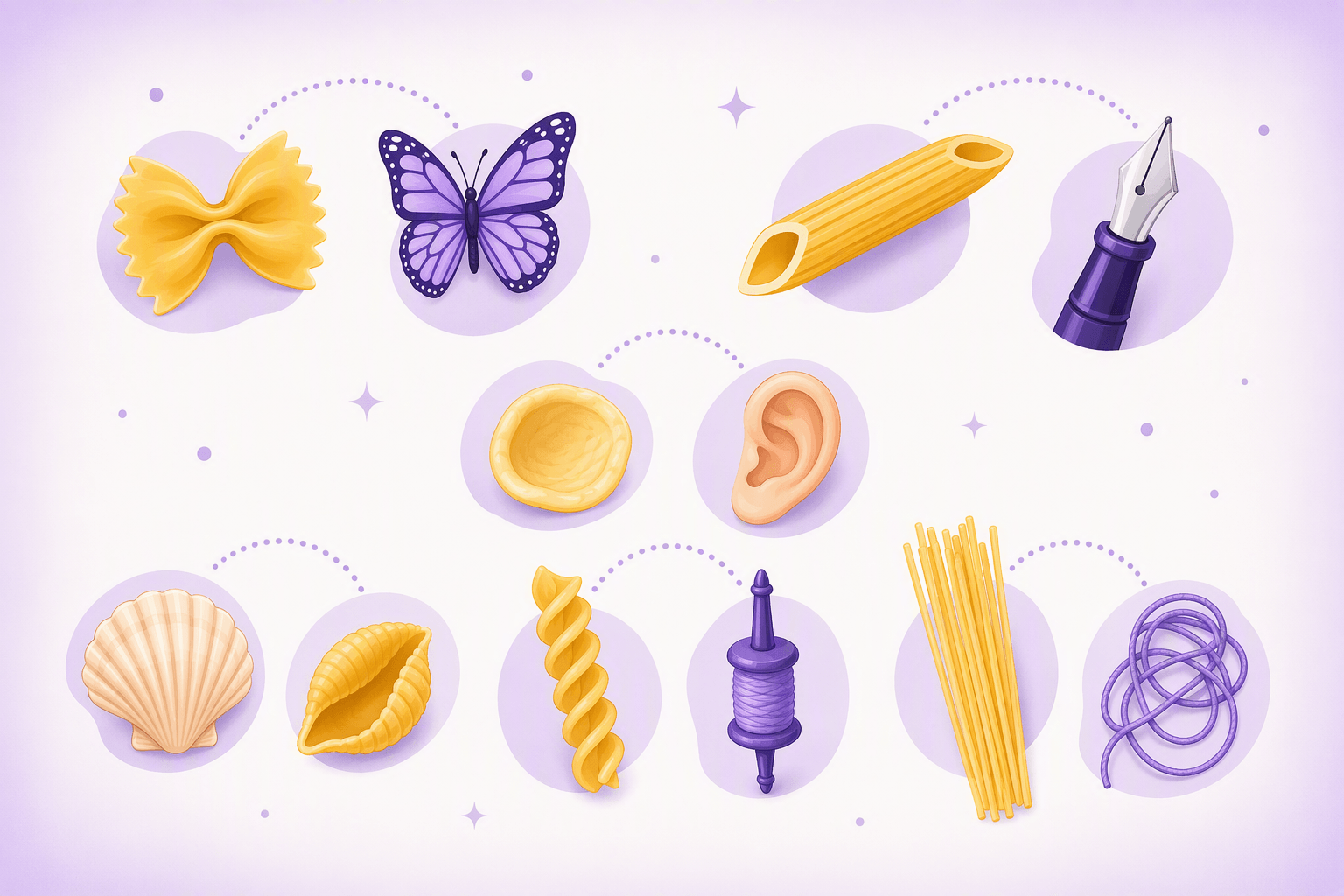
| Penne | Le penne | leh PEN-neh | Lit. 'pens / quills' |
| Fusilli | I fusilli | ee foo-ZEEL-lee | Lit. 'little spindles' |
| Farfalle | Le farfalle | leh far-FAHL-leh | Lit. 'butterflies' |
| Orecchiette | Le orecchiette | leh oh-rehk-KYEHT-teh | Lit. 'little ears' (Puglia) |
| Linguine | Le linguine | leh leen-GWEE-neh | Lit. 'little tongues' |
| Vermicelli | I vermicelli | ee vehr-mee-CHEL-lee | Lit. 'little worms' |
| Conchiglie | Le conchiglie | leh kohn-KEE-lyeh | Lit. 'shells' |
| Rigatoni | I rigatoni | ee ree-gah-TOH-nee | Lit. 'ridged / lined' |
| Tagliatelle | Le tagliatelle | leh tah-lyah-TEHL-leh | From 'tagliare' (to cut) |
The linguistic pattern is clear: Italian uses diminutive suffixes (-ette, -ine, -elli, -illi) to create pasta names from everyday objects. Farfalle are bow-tie shapes that resemble butterflies. Orecchiette, the signature pasta of Puglia, are small concave discs that look like tiny ears. Penne are cut at an angle like the nib of a quill pen. Vermicelli (perhaps the least appetizing name) means "little worms."
🌍 Shape Dictates Sauce
Italians do not consider pasta shapes interchangeable. Ridged shapes like rigatoni and penne rigate trap chunky meat sauces. Flat shapes like tagliatelle pair with rich ragù. Thin shapes like spaghetti and linguine work with oil-based or seafood sauces. Putting the wrong sauce on the wrong shape is a genuine culinary offense in Italy.
Piatti Italiani: Iconic Dishes
These are dishes every Italian learner should recognize. Each carries regional identity and cultural significance.
Pizza
The word pizza likely derives from the Latin pinsa, past participle of pinsere (to pound or stamp). Neapolitan pizza, with its soft, charred crust, San Marzano tomatoes, and mozzarella di bufala, received its own UNESCO Intangible Cultural Heritage status in 2017. Note the plural: pizza becomes pizze, not "pizzas."
Risotto
Risotto (ree-ZOT-toh) is a northern Italian rice dish, most associated with Milan and the Po Valley. The name comes from riso (rice) with the augmentative suffix -otto. The most famous version, risotto alla milanese, gets its golden color from saffron. Risotto requires constant stirring to coax starch from the rice, a technique called mantecatura.
Ossobuco
Ossobuco (ohs-soh-BOO-koh) literally means "bone with a hole": osso (bone) + buco (hole). This Milanese specialty features cross-cut veal shanks braised with vegetables, white wine, and broth. The marrow inside the bone is considered the best part. It is traditionally served with risotto alla milanese and finished with gremolata (a garnish of lemon zest, garlic, and parsley).
Tiramisù
Tiramisù (tee-rah-mee-SOO) means "pick me up" or "lift me up," from tirami su (pull me up). This coffee-flavored dessert from the Veneto region layers mascarpone cream with espresso-soaked savoiardi (ladyfingers). According to the Accademia Italiana della Cucina, the dish originated in Treviso in the 1960s, though its exact origins remain debated. The accent on the final u is mandatory in correct Italian spelling.
💡 Plural Rules for Italian Food
Italian plurals follow gender rules that English speakers often get wrong: pizza (f) becomes pizze, panino (m) becomes panini, gelato (m) becomes gelati, espresso (m) becomes espressi. The English habit of saying "paninis" or "gelatos" adds an English plural to a word that is already plural or applies English rules to an Italian word. In Italy, one sandwich is always un panino.
La Cultura del Caffè: Coffee Culture
Italian coffee culture has its own strict vocabulary and unwritten rules. Getting these right marks you as a respectful visitor rather than a confused tourist.
| English | Italian | Pronunciation | Note |
|---|---|---|---|
| Espresso | Il caffè | eel kahf-FEH | Default coffee in Italy |
| Cappuccino | Il cappuccino | eel kahp-poo-CHEE-noh | ONLY before 11 AM |
| Macchiato | Il caffè macchiato | eel kahf-FEH mahk-KYAH-toh | Lit. 'stained coffee' |
| Latte | Il caffellatte | eel kahf-fehl-LAHT-teh | 'Latte' alone = just milk! |
| Americano | Il caffè americano | eel kahf-FEH ah-meh-ree-KAH-noh | Espresso + hot water |
| Ristretto | Il ristretto | eel ree-STREHT-toh | Lit. 'restricted', shorter pull |
| Lungo | Il caffè lungo | eel kahf-FEH LOON-goh | Lit. 'long', more water |
| Corretto | Il caffè corretto | eel kahf-FEH kohr-REHT-toh | Lit. 'corrected', with liquor |
The most important rule: in Italy, you order un caffè and you receive an espresso. There is no need to specify "espresso" because it is the default. If you order un latte, you will receive a glass of plain milk. The drink English speakers call a "latte" is caffellatte in Italy.
⚠️ The Cappuccino Rule
Ordering a cappuccino after 11 AM, and especially after a meal, is one of the most well-known cultural missteps a foreigner can make in Italy. Italians believe that the large quantity of milk disrupts digestion. After lunch or dinner, order un caffè (espresso) or un caffè macchiato (espresso with a small dash of milk). You will not be refused, but every Italian at the bar will notice.
The word macchiato means "stained" or "spotted": the espresso is "stained" with a small amount of milk. Corretto means "corrected," implying the espresso has been improved with a splash of grappa, sambuca, or brandy. This vocabulary reveals how Italians conceptualize their coffee: the espresso is the pure form, and everything else is a modification of it.
Al Ristorante: Restaurant Phrases
Knowing food vocabulary is only half the battle. These phrases will get you through ordering, paying, and navigating the distinctly Italian multi-course meal structure.
| English | Italian | Pronunciation | Note |
|---|---|---|---|
| The check, please | Il conto, per favore | eel KOHN-toh pehr fah-VOH-reh | |
| A table for two | Un tavolo per due | oon TAH-voh-loh pehr DOO-eh | |
| I would like... | Vorrei... | vohr-RAY | Polite conditional form |
| The menu, please | Il menù, per favore | eel meh-NOO pehr fah-VOH-reh | |
| First course | Il primo (piatto) | eel PREE-moh | Usually pasta or soup |
| Second course | Il secondo (piatto) | eel seh-KOHN-doh | Meat or fish |
| Side dish | Il contorno | eel kohn-TOR-noh | Ordered separately |
| Dessert | Il dolce | eel DOHL-cheh | Lit. 'sweet' |
| Cover charge | Il coperto | eel koh-PEHR-toh | Standard in Italy (1-3 EUR) |
| Tip | La mancia | lah MAHN-chah | Not expected, but appreciated |
"The structure of the Italian meal (antipasto, primo, secondo, contorno, dolce, caffè) is not merely a sequence of dishes but a cultural grammar, a syntax of flavors that has governed Italian tables for centuries."
(Treccani, Enciclopedia Italiana)
Italian meal structure differs fundamentally from American or British dining. Il primo (first course) is almost always pasta, risotto, or soup. Il secondo (second course) is meat or fish, served alone. Vegetables come as a separate contorno (side dish) that you must order independently. The coperto (cover charge) is a standard fee of 1-3 euros per person that covers bread and table service. Unlike in the United States, tipping is not expected in Italy, though rounding up or leaving a few euros is a welcome gesture.
🌍 Al Dente: The Non-Negotiable Standard
Al dente (ahl DEN-teh) literally means "to the tooth," and pasta should offer slight resistance when bitten. The Accademia Italiana della Cucina identifies this as the defining standard of proper pasta preparation. Overcooked, mushy pasta is considered a serious culinary failure. If you order pasta in Italy, it will always arrive al dente. This term has entered English and most other European languages because no single-word equivalent exists.
Regional Italian Cuisine: A Vocabulary of Diversity
Italy was not unified until 1861, and its cuisine reflects centuries of independent regional development. The same ingredient can have different names, and each region claims distinct signature dishes.
Neapolitan cuisine (la cucina napoletana) centers on pizza, seafood, and tomato-based sauces. Naples gave the world pizza margherita, ragù napoletano (a slow-cooked meat sauce distinct from Bolognese), and sfogliatella (a shell-shaped pastry). The Neapolitan dialect word pummarola for tomato sauce has become synonymous with the city's cooking.
Sicilian cuisine (la cucina siciliana) shows Arab, Greek, and Norman influences. Sicily is famous for arancini (fried rice balls, named from arancia, orange, for their shape and color), cannoli (tube-shaped pastry shells filled with ricotta), and caponata (sweet-and-sour eggplant). The singular of arancini is arancino in eastern Sicily but arancina (feminine) in Palermo, a grammatical disagreement that fuels passionate debate.
Tuscan cuisine (la cucina toscana) emphasizes simplicity and quality ingredients. Tuscany is known for bistecca alla fiorentina (a massive T-bone steak from Chianina cattle), ribollita (a thick bread and vegetable soup whose name means "reboiled"), and pappa al pomodoro (bread and tomato soup). Tuscan bread is famously unsalted (pane sciocco, meaning "foolish bread"), a tradition dating to medieval salt taxes.
These regional differences mean that a vocabulary list alone cannot capture Italian food culture. The same dish changes name, recipe, and identity as you move from north to south. This regional diversity is precisely what UNESCO recognized when inscribing the Mediterranean diet.
Practice with Real Italian Content
Italian food vocabulary comes alive in context. Restaurant scenes in Italian cinema are famously detailed: characters argue about the proper sauce for a shape of pasta, debate the best espresso in town, and use food metaphors in everyday conversation. Films like Big Night and L'ultimo bacio are rich with food vocabulary in natural dialogue.
Check out our guide to the best movies for learning Italian for recommendations that showcase Italian dining culture across different regions and eras.
Wordy lets you practice Italian food vocabulary by watching Italian films and shows with interactive subtitles. When a food word appears in dialogue, tap it to see the translation, pronunciation, and usage notes. Explore our blog for more Italian vocabulary guides, or visit our Italian learning page to start building your vocabulary today.
Frequently Asked Questions
What are the most important Italian food words to know?
Why can't you order cappuccino after 11 AM in Italy?
What do Italian pasta shape names actually mean?
Is it 'panini' or 'panino' for one sandwich?
What is 'al dente' and why does it matter?
Sources & References
- Accademia Italiana della Cucina, La Cucina Italiana: Storia, Cultura e Tradizioni
- Treccani, Enciclopedia e Vocabolario della lingua italiana online
- UNESCO Intangible Cultural Heritage, Mediterranean Diet (inscribed 2010, Italy nomination)
- Ethnologue: Languages of the World, Italian language entry (2024)
- De Mauro, T., Grande Dizionario Italiano dell'Uso (UTET)
Start learning with Wordy
Watch real movie clips and build your vocabulary as you go. Free to download.


