At the Restaurant in Italian: 30+ Phrases for Ordering, Paying, and Polite Talk
Quick Answer
To speak Italian at a restaurant, you mainly need polite request forms like 'Vorrei...' (voh-RRAY, I'd like), 'Per favore' (pehr fah-VOH-reh), and key questions such as 'Il conto, per favore' (eel KON-toh, the bill). This guide gives you practical phrases for reservations, ordering, dietary needs, and paying, plus the etiquette that makes them sound natural in Italy.
| English | Italian | Pronunciation | Formality |
|---|---|---|---|
| A table for two, please. | Un tavolo per due, per favore. | oon TAH-voh-loh pehr DOO-eh, pehr fah-VOH-reh | polite |
| Do you have a reservation? | Avete una prenotazione? | ah-VEH-teh OO-nah preh-noh-tah-TSYOH-neh | polite |
| I have a reservation under (name). | Ho una prenotazione a nome (Nome). | oh OO-nah preh-noh-tah-TSYOH-neh ah NOH-meh | polite |
| Could we sit outside? | Possiamo sederci fuori? | pohs-SEE-ah-moh seh-DEHR-chee FWOH-ree | polite |
| The menu, please. | Il menu, per favore. | eel meh-NOO, pehr fah-VOH-reh | polite |
| What do you recommend? | Cosa ci consiglia? | KOH-zah chee kohn-SEE-lyah | polite |
| I'd like... | Vorrei... | voh-RRAY | polite |
| I'll have... | Prendo... | PREHN-doh | casual |
| For me... | Per me... | pehr meh | casual |
| Still water / sparkling water. | Acqua naturale / acqua frizzante. | AHK-kwah nah-too-RAH-leh / AHK-kwah freet-TSAHN-teh | casual |
| A coffee, please. | Un caffè, per favore. | oon kahf-FEH, pehr fah-VOH-reh | polite |
| The check, please. | Il conto, per favore. | eel KON-toh, pehr fah-VOH-reh | polite |
| Can we pay by card? | Possiamo pagare con la carta? | pohs-SEE-ah-moh pah-GAH-reh kohn lah KAR-tah | polite |
| Is service included? | Il servizio è incluso? | eel sehr-VEE-tsyoh eh een-KLOO-zoh | polite |
The Short Answer
To speak Italian at a restaurant, use Vorrei... (voh-RRAY, I'd like) to order politely, Il conto, per favore (eel KON-toh, the bill please) to pay, and a few menu words to handle water, coffee, and dietary needs. With these basics, you can get through almost any meal in Italy without switching to English.
Italian is spoken by roughly 68 million people worldwide (Ethnologue, 27th edition, 2024). It is the national language of Italy and also has official status in parts of Switzerland, plus communities across Europe and the Americas, so these phrases help beyond a single trip.
If you want a quick warm-up before you sit down, review how to say hello in Italian and how to say goodbye in Italian. Restaurant talk is mostly greetings plus polite requests.
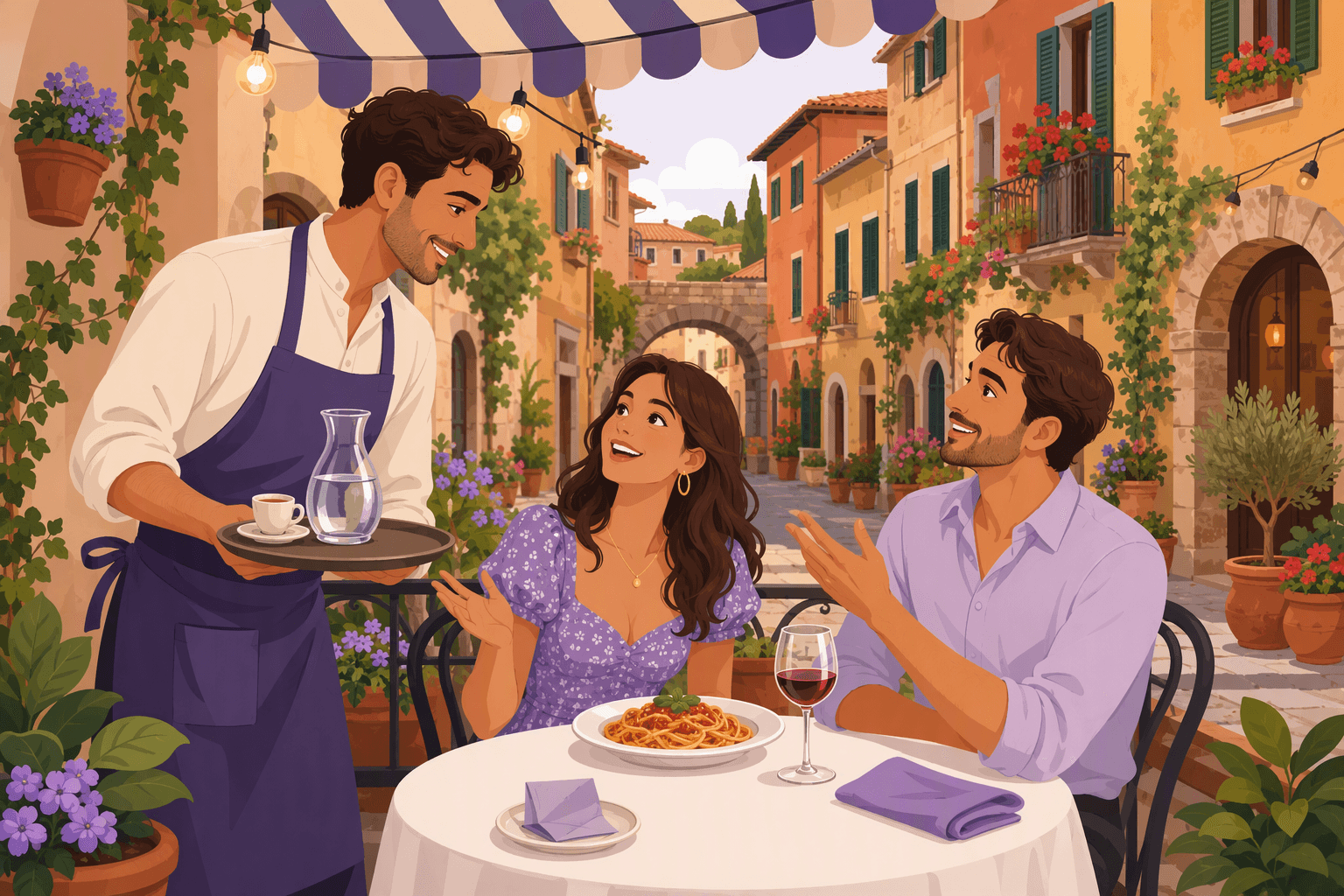
How Italian restaurant service usually works (so your phrases land right)
Italian dining has a rhythm, and your language choices fit that rhythm.
You usually ask for the bill
In many Italian restaurants, the server will not automatically bring the check. Asking Il conto, per favore is normal, not pushy.
Water is a choice, not a default
Expect the question: still or sparkling. Ordering acqua naturale vs acqua frizzante avoids confusion and makes you sound like you have eaten in Italy before.
Coperto and servizio are not the same as tipping
Many places charge coperto (a cover charge, often linked to bread and place setting) and sometimes servizio (service). Terms and practices vary by region and venue, so asking Il servizio è incluso? is a clean way to check.
🌍 A small politeness detail that matters
In Italian pragmatics, a softener like "per favore" or a conditional question ("Possiamo...?") often matters more than sounding perfectly grammatical. Research on politeness strategies in interaction (Brown and Levinson, Politeness: Some Universals in Language Usage, Cambridge University Press) helps explain why these small softeners reduce pressure on the listener.
Booking and arriving: reservations, tables, and seating
Most restaurant interactions start before you see the menu.
Un tavolo per due, per favore
Un tavolo per due, per favore. (oon TAH-voh-loh pehr DOO-eh, pehr fah-VOH-reh) is the standard walk-in request.
Use per tre, per quattro, etc. if you need a different number.
/oon TAH-voh-loh pehr DOO-eh, pehr fah-VOH-reh/
Literal meaning: A table for two, please.
“Buonasera. Un tavolo per due, per favore.”
Good evening. A table for two, please.
In Italy, greeting first is expected. Even a quick 'Buonasera' makes the request sound smoother.
Avete una prenotazione?
Avete una prenotazione? (ah-VEH-teh OO-nah preh-noh-tah-TSYOH-neh) is what staff may ask you.
If you booked, answer with Ho una prenotazione a nome... (oh OO-nah preh-noh-tah-TSYOH-neh ah NOH-meh).
Possiamo sederci fuori?
If you want a terrace table: Possiamo sederci fuori? (pohs-SEE-ah-moh seh-DEHR-chee FWOH-ree).
If you prefer inside: dentro (DEHN-troh).
💡 Pronunciation shortcut: double consonants
Italian double consonants are real. "Conto" (KON-toh) is not the same rhythm as "cotto" (KOT-toh). You do not need perfection, but slightly holding the consonant helps you be understood, especially with menu items.
Getting the menu and asking questions
Once seated, your goal is to get options and make one or two clear requests.
Il menu, per favore
Il menu, per favore. (eel meh-NOO, pehr fah-VOH-reh) is simple and always appropriate.
In many places you will get multiple menus: food, wine, desserts. You can ask: Il menu dei vini? (eel meh-NOO day VEE-nee).
Cosa ci consiglia?
Cosa ci consiglia? (KOH-zah chee kohn-SEE-lyah) means "What do you recommend?" and invites a real answer.
If you want a local specialty, add: Qual è un piatto tipico? (kwahl eh oon PYAH-toh TEE-pee-koh).
In writing about Italian usage, the Accademia della Crusca often highlights how context and register shape what sounds natural. In restaurants, these short, direct questions are preferred over long textbook sentences.
Ordering politely: the three frames Italians actually use
You can order with many verbs, but three patterns cover most situations.
Vorrei...
Vorrei... (voh-RRAY) is polite and flexible. It is the conditional of volere (to want), and it softens the request.
Use it for food, drinks, and even small needs: Vorrei dell’acqua (voh-RRAY dehl-LAHK-kwah).
Prendo...
Prendo... (PREHN-doh, I take) is common in casual ordering. It is direct but not rude.
If you are unsure, choose Vorrei. If you are confident and the vibe is informal, Prendo fits.
Per me...
Per me... (pehr meh, for me) is what you use when ordering in a group, especially when the server goes person by person.
Example: Per me, la pasta. (pehr meh, lah PAH-stah).
Drinks: water, wine, and coffee without confusion
Drinks are where travelers often get stuck, because the defaults differ from other countries.
Acqua naturale / acqua frizzante
Order water like this:
- Un’acqua naturale, per favore. (oon AHK-kwah nah-too-RAH-leh)
- Un’acqua frizzante, per favore. (oon AHK-kwah freet-TSAHN-teh)
If you want tap water, you can ask acqua del rubinetto (AHK-kwah dehl roo-bee-NEHT-toh), but not every place offers it like a default.
Un caffè, per favore
In Italy, un caffè usually means an espresso. Un cappuccino (kahp-poo-CHEE-noh) is common in the morning, but ordering it after a heavy dinner can mark you as a visitor.
For a longer coffee, ask un caffè lungo (oon kahf-FEH LOON-goh). For decaf: un decaffeinato (oon deh-kahf-fay-nah-TOH).
🌍 Coffee timing is cultural, not just vocabulary
Italian coffee norms are part of daily routine. Many Italians treat cappuccino as a breakfast drink, while espresso after lunch or dinner is standard. Knowing the timing helps you blend in even if your accent is obvious.
Dietary needs and allergies: say it clearly
If you have an allergy, clarity matters more than elegance.
Sono allergico/a a...
Use Sono allergico a... (SOH-noh ahl-LEHR-jee-koh ah) if you are male, Sono allergica a... (SOH-noh ahl-LEHR-jee-kah ah) if you are female.
Then name the ingredient: alle arachidi (ahl-leh ah-RAH-kee-dee), al glutine (ahl gloo-TEE-neh).
C’è...?
To check ingredients: C’è... in questo piatto? (cheh ... een KWEH-stoh PYAH-toh).
Example: C’è burro? (cheh BOOR-roh, is there butter?)
Senza...
Senza (SEHN-tsah, without) is your friend:
- Senza formaggio. (SEHN-tsah for-MAHD-joh)
- Senza glutine. (SEHN-tsah gloo-TEE-neh)
Here is the key vocabulary you will actually need:
| English | Italian | Pronunciation | Note |
|---|---|---|---|
| gluten | glutine | gloo-TEE-neh | Common allergy term on menus. |
| nuts | frutta secca | FROOT-tah SEHK-kah | Often used for tree nuts. |
| peanuts | arachidi | ah-RAH-kee-dee | More specific than 'frutta secca'. |
| milk | latte | LAHT-teh | Also means 'milk' in coffee context. |
| eggs | uova | WOH-vah | Plural usually used. |
| fish | pesce | PEH-sheh | Includes seafood context in many menus. |
| shellfish | crostacei | kroh-STAH-chay | Allergen category in EU labeling. |
| soy | soia | SOH-yah | Allergen category. |
| wheat | grano | GRAH-noh | Useful when discussing flour and pasta. |
| flour | farina | fah-REE-nah | Ask about 'farina di grano' if needed. |
| cheese | formaggio | for-MAHD-joh | Many dishes can be served 'senza formaggio'. |
| ham | prosciutto | proh-SHOOT-toh | Usually cured ham. |
⚠️ Allergies: do not rely on hints
If you have a serious allergy, do not assume a dish is safe because it 'seems' safe. Say it directly, ask the question, and if you are unsure, choose a simpler dish. Menu language varies, and cross-contact can happen in small kitchens.
Handling the meal: compliments, problems, and small requests
A few short phrases cover most mid-meal needs.
È buonissimo!
È buonissimo! (eh bwoh-NEES-see-moh, it's delicious) is a warm, natural compliment.
If you want to be more neutral: È molto buono. (eh MOHL-toh BWOH-noh).
Scusi / Scusa
To get attention politely:
- Scusi (SKOO-zee) is polite, for staff or strangers.
- Scusa (SKOO-zah) is casual, for friends.
If you want a deeper guide to apology language, you can compare this with the tone differences in greetings and farewells in how to say hello in Italian and how to say goodbye in Italian.
Mi scusi, può ripetere?
If you did not catch something: Mi scusi, può ripetere? (mee SKOO-zee, pwoh ree-PEH-teh-reh, excuse me, can you repeat?)
This is especially useful when the server lists daily specials quickly.
Un attimo, per favore
Un attimo, per favore. (oon AHT-tee-moh, pehr fah-VOH-reh) means "one moment" and helps you pause ordering without awkwardness.
Paying: the phrases that avoid awkward endings
Paying is where cultural expectations differ the most.
Il conto, per favore
This is the standard ask. You can also say:
- Possiamo avere il conto? (pohs-SEE-ah-moh ah-VEH-reh eel KON-toh)
- Quando può, il conto. (KWAHN-doh pwoh, eel KON-toh, when you can, the bill)
Possiamo pagare con la carta?
Possiamo pagare con la carta? (pohs-SEE-ah-moh pah-GAH-reh kohn lah KAR-tah) is the clean card question.
If you want to split: Possiamo dividere? (pohs-SEE-ah-moh dee-vee-DEH-reh, can we split?)
Il servizio è incluso?
Il servizio è incluso? (eel sehr-VEE-tsyoh eh een-KLOO-zoh) checks whether service is included.
For definitions and usage notes, Treccani is a reliable reference for contemporary Italian vocabulary (Treccani, accessed 2026), including terms you see on receipts.
🌍 Coperto, pane, and why your bill looks different
In many Italian restaurants, you may see 'coperto' as a per-person charge. It is not a tip, and it is not necessarily negotiable. It often reflects table setting and bread service. Practices differ by region and by venue type, especially in tourist centers.
Mini scripts: what a real interaction sounds like
Memorizing single phrases helps, but scripts help you speak smoothly.
Script 1: walk-in dinner
You: Buonasera. Un tavolo per due, per favore.
Staff: Avete una prenotazione?
You: No, purtroppo no. (noh, poor-TROHP-poh noh, no unfortunately)
You: Possiamo sederci fuori?
Script 2: ordering simply
Server: Cosa desidera? (KOH-zah deh-zee-DEH-rah, what would you like)
You: Vorrei la pasta del giorno, per favore.
You: E un’acqua naturale.
Script 3: paying and leaving
You: Scusi, il conto, per favore.
Server: Certo. (CHEHR-toh, of course)
You: Possiamo pagare con la carta?
You: Grazie, arrivederci.
If you want more everyday Italian beyond restaurants, Wordy-style clip learning works best when you combine scripts like these with real scenes. For a broader approach, see how to learn a language with movies.
Common mistakes English speakers make (and the quick fixes)
Small adjustments make you sound more natural fast.
Saying "voglio" to order
Voglio (VOHL-yoh, I want) is grammatical, but it can sound blunt in service contexts. Prefer Vorrei.
Forgetting articles
Italian uses articles constantly: un, una, il, la. You will still be understood without them, but adding them reduces friction.
Overusing "per favore"
Per favore is good, but you do not need it in every sentence. A greeting plus one polite request is enough.
💡 A fast practice drill
Practice three lines out loud until they feel automatic: "Buonasera", "Vorrei...", "Il conto, per favore". Then add one variable word each day: a drink, a dish, an allergy term. This is spaced repetition in disguise, and it sticks.
A note on slang and swearing in restaurants
If you are frustrated, keep it neutral in public. Swearing carries social risk, especially with staff.
If you are curious about what you might hear in films, read Italian swear words, but treat it as recognition practice, not a speaking goal.
Make these phrases stick with real listening
Restaurant Italian is perfect for clip-based learning because the same patterns repeat: greeting, request, clarification, payment. You will hear Vorrei, Prendo, Scusi, and Il conto in countless scenes, and repetition in context builds automaticity faster than isolated flashcards.
If you want a fun next step after restaurant talk, pair this with something more emotional and informal like how to say I love you in Italian. The vocabulary changes, but the politeness habits you built here carry over.
Frequently Asked Questions
What is the most polite way to order in Italian?
How do you ask for the bill in Italy?
Do you tip in Italian restaurants?
How do you say you have an allergy in Italian?
What is the difference between 'acqua naturale' and 'acqua frizzante'?
Sources & References
- Ethnologue: Languages of the World, Italian language entry (27th edition, 2024)
- Treccani, Vocabolario online (accessed 2026)
- Accademia della Crusca, Consulenza linguistica and articles on contemporary Italian usage (accessed 2026)
- ENIT (Agenzia Nazionale del Turismo), official tourism information on Italian travel and dining (accessed 2026)
Start learning with Wordy
Watch real movie clips and build your vocabulary as you go. Free to download.


