Quick Answer
To sound more like a native German speaker, focus less on speaking fast and more on clear vowel length, final consonants, German sentence rhythm, and the right level of politeness. Learn whole phrases from real conversations, then copy their stress, pauses, and intonation.
How to Sound Like a Native German Speaker
To sound like a native German speaker, do not try to speak faster or imitate a stereotype of a harsh German accent. Focus on long versus short vowels, crisp word endings, natural stress, German word order, and the social choice between informal and formal speech. When those patterns work together, your German sounds clearer, calmer, and much more natural.
German has roughly 100 million native speakers and is an official or co-official language in six European countries: Germany, Austria, Switzerland, Liechtenstein, Belgium, and Luxembourg. The Goethe-Institut's worldwide survey also counted about 15.4 million people learning German in 2020, so clear pronunciation and socially appropriate speech make a real difference in a large international community.
A native-like sound is not one single accent. A speaker from Hamburg, Vienna, Cologne, Zurich, and Berlin may sound noticeably different. Your practical goal is a clear standard German base, often called Standarddeutsch /ˈʃtandaʁtˌdɔʏtʃ/, with enough listening practice to understand regional variation.
For a strong foundation, pair this guide with our German pronunciation guide. It explains the individual sounds, while this article shows how those sounds become convincing real speech.
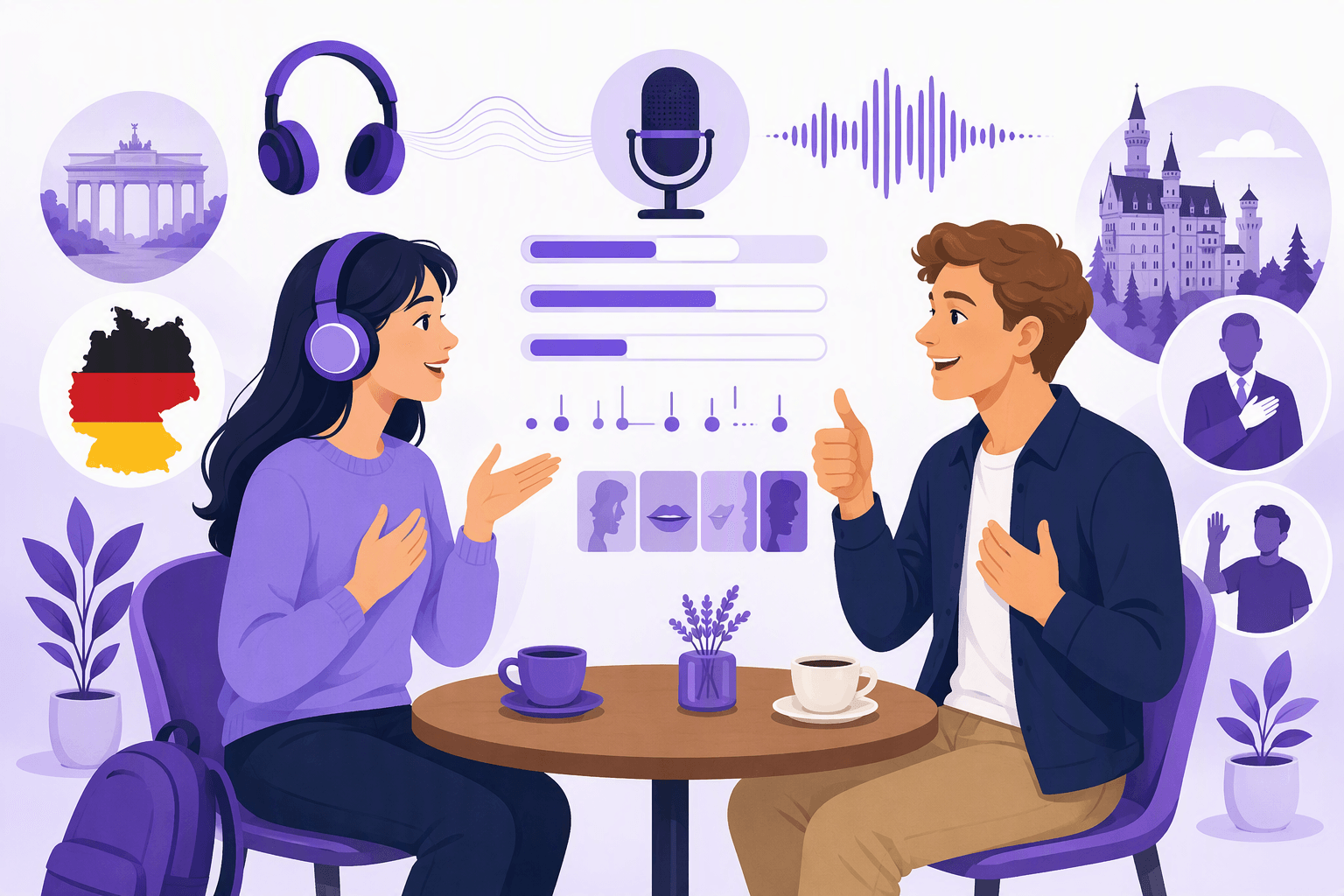
Sound natural before you sound fast
Native-like German is controlled, not rushed. Learners often speak every syllable with equal force or speed through words they have not fully formed. Both habits make otherwise correct German harder to follow.
German listeners expect important content words to carry the main stress. Articles, pronouns, and common auxiliary verbs often receive less emphasis. Compare these two versions:
- Flat learner rhythm: ICH MÖCHTE EINEN KAFFEE BESTELLEN.
- More natural rhythm: Ich MÖCHTE einen KAFfee beSTELlen.
The sentence still has clear words, but the energy falls on what matters. This pattern becomes much easier when you learn full chunks rather than isolated vocabulary.
Linguist Klaus J. Kohler's work on German phonetics emphasizes that speech is organized through timing, prominence, and intonation, not merely a list of separate consonants and vowels. That is why copying a complete line from a film is more useful than repeating a word ten times without context.
Master vowel length first
Vowel length is one of the clearest signals of German pronunciation. A long vowel and a short vowel can distinguish completely different words, so treat length as part of the word, not a decorative detail.
| Long vowel | IPA | Meaning | Short vowel | IPA | Meaning |
|---|---|---|---|---|---|
| Staat | /ʃtaːt/ | state | Stadt | /ʃtat/ | city |
| bieten | /ˈbiːtən/ | to offer | bitten | /ˈbɪtən/ | to ask |
| fühlen | /ˈfyːlən/ | to feel | füllen | /ˈfʏlən/ | to fill |
| Ofen | /ˈoːfn̩/ | oven | offen | /ˈɔfn̩/ | open |
English speakers may hear these as small differences, but German speakers use them constantly. Make long vowels genuinely longer and more stable. Do not simply make them louder.
The rounded vowels ü /yː/ and ö /øː/ need special attention. For müde /ˈmyːdə/, say an ee-like vowel while keeping your lips rounded. For schön /ʃøːn/, begin with an eh-like tongue position and round your lips.
💡 A practical vowel-length drill
Say each pair slowly three times, then put it in a short sentence. For example: Die Stadt ist groß /diː ʃtat ɪst ɡʁoːs/ and Der Staat ist groß /deːɐ̯ ʃtaːt ɪst ɡʁoːs/. Record yourself and check whether the contrast remains audible at normal speed.
Duden's pronunciation reference treats vowel quantity as a core part of standard pronunciation. This is high-value practice because it improves both intelligibility and your overall German rhythm.
Finish words cleanly
German often sounds precise because consonants at the ends of words are audible and organized. English learners may soften, drop, or blur endings, especially in quick speech.
Final devoicing
In standard German, voiced consonants such as b, d, and g become voiceless at the end of a syllable or word. This is called Auslautverhärtung /ˈaʊslaʊt.fɛɐ̯ˌhɛʁtʊŋ/.
- Tag /taːk/, not /taːɡ/
- lieb /liːp/, not /liːb/
- und /ʊnt/, not /ʊnd/
- Wald /valt/, not /vald/
This does not mean hitting every final consonant aggressively. It means completing it clearly. Say Guten Tag /ˈɡuːtən taːk/ with a clean final /k/, then release into the next pause.
The German r
The standard German r varies. In many regions it is a uvular sound /ʁ/, produced near the back of the throat. After a vowel, it often becomes vowel-like, as in wir /viːɐ̯/ and besser /ˈbɛsɐ/.
Do not force an exaggerated throat sound in every position. A light, consistent /ʁ/ is fine, and a regional rolled or tapped r is also natural in many German-speaking areas. The main goal is to avoid turning every German r into a strong English r /ɹ/.
The ch sounds
German has two common sounds spelled ch. The first, in ich /ɪç/ and nicht /nɪçt/, is a soft sound made with the middle of the tongue close to the hard palate. It follows front vowels such as /iː/, /ɪ/, /eː/, /ɛ/, /yː/, and /øː/.
The second appears after back vowels in words such as Bach /bax/ and Buch /buːx/. It is further back in the throat. Neither is the English ch in “church.”
If this feels difficult, begin with ich /ɪç/. Hold the vowel /ɪ/, raise the middle of your tongue toward the roof of your mouth, and let air pass through the narrow gap. Avoid replacing it with /ʃ/ or /k/.
Use German melody, not English melody
German intonation is often more restrained than American English, but it is not monotone. Statements usually fall at the end, while genuine yes-or-no questions often rise.
- Du kommst morgen. /duː kɔmst ˈmɔʁɡn̩/ falls at the end.
- Kommst du morgen? /kɔmst duː ˈmɔʁɡn̩/ usually rises toward the final word.
- Wann kommst du morgen? /van kɔmst duː ˈmɔʁɡn̩/ often falls because it is a question seeking information, not a yes-or-no answer.
The key is sentence focus. Move stress to the word that corrects, contrasts, or introduces important information.
- ICH komme morgen, not someone else.
- Ich komme MORGEN, not today.
- Ich komme morgen NACH BERLIN, not to Munich.
This skill makes you sound engaged in the conversation rather than as if you are reading a sentence from a workbook. The Institut für Deutsche Sprache's resources on spoken German are useful here because they treat speech as interactive, full of pauses, repairs, emphasis, and incomplete sentences.
Stop translating English conversation habits
Sounding natural also means choosing German conversational patterns. Direct translation can be grammatical yet still feel slightly foreign.
German speakers often use short response words to show attention:
- genau /ɡəˈnaʊ/, exactly
- klar /klaːɐ̯/, sure or clear
- stimmt /ʃtɪmt/, that is right
- ach so /ax zoː/, oh, I see
- echt? /ɛçt/, really?
- na ja /na jaː/, well
Use them selectively. Saying genau after every sentence becomes noticeable, just as repeating “exactly” in English would.
German also allows direct disagreement more comfortably than English in many settings. Saying Das sehe ich anders /das ˈzeːə ɪç ˈandɐs/, meaning “I see that differently,” can be neutral and professional. It is less confrontational than it may sound to an English speaker.
🌍 Directness is not automatically rudeness
German communication often values clarity and specificity. A short answer, an honest correction, or a direct request can be perfectly polite when paired with the right greeting, tone, and formal pronoun. Politeness comes from the whole interaction, not from making every sentence indirect.
For greetings, learn the social setting as carefully as the pronunciation. Hallo /haˈloː/ works widely, while Guten Tag /ˈɡuːtən taːk/ is more formal. Our guide to saying hello in German explains which choices fit shops, workplaces, friends, and first meetings.
Get du and Sie right
A flawless accent cannot fully compensate for using the wrong form of address. German has a meaningful contrast between informal du /duː/ and formal Sie /ziː/.
Use Sie with unfamiliar adults in formal situations, service staff, doctors, officials, clients, and many workplace contacts. Use du with friends, relatives, children, and people who have explicitly offered it.
The transition from Sie to du is sometimes called das Du anbieten /das duː ˈanbiːtən/, offering the informal form. In a workplace, a senior person may initiate it. Among younger adults and in many modern workplaces, du is increasingly common, but it is still safer to mirror the other person's choice.
A natural sounding request changes with this distinction:
| Context | German | IPA |
|---|---|---|
| Informal | Kannst du mir helfen? | /kanst duː miːɐ̯ ˈhɛlfn̩/ |
| Formal | Können Sie mir helfen? | /ˈkœnən ziː miːɐ̯ ˈhɛlfn̩/ |
Notice that formal language does not require a cold tone. A warm voice, a greeting, and bitte /ˈbɪtə/ make a direct request sound entirely normal.
Learn connected speech from real clips
Textbooks provide useful clear speech, but native conversation includes reductions. For example, haben wir /ˈhaːbən viːɐ̯/ may sound closer to /ˈhaːbm̩ viːɐ̯/ in fast casual speech. The final -en in many verbs can become a syllabic /n̩/, as in machen /ˈmaxn̩/.
Do not copy reduced forms before you understand the full form. First learn wir haben /viːɐ̯ ˈhaːbən/, then train your ear to recognize its relaxed delivery. This prevents the common mistake of memorizing blurry sounds without knowing where one word ends and the next begins.
Film and TV clips are especially useful because they show how pronunciation changes with emotion. A character saying Was machst du denn? /vas maxst du dɛn/ may stretch denn /dɛn/ in surprise, shorten it in impatience, or soften the whole sentence when concerned.
Use a three-stage clip routine:
- Listen without subtitles and identify the situation.
- Read the German subtitles and mark the stressed words, pauses, and linked sounds.
- Shadow one sentence, record it, and compare your recording with the original.
Shadowing means speaking along with the audio or immediately after it. Work with clips of five to ten seconds. Repetition at this small scale builds timing much faster than watching passively. See our practical guide on learning a language with movies for a structured clip-based routine.
Copy a speaker, not an imaginary accent
Choose one or two speakers whose German is clear and whose style you genuinely enjoy. They might be a news presenter, actor, interviewer, or creator. Stay with them long enough to notice repeatable features.
Listen for:
- How they begin and end sentences
- Which words they stress
- Whether their voice rises or falls
- How long their pauses are
- How they pronounce final -en /ən/
- How their tone changes when they are joking, disagreeing, or apologizing
This method is more realistic than trying to imitate a generic “German accent.” Germany alone contains major regional varieties, including Bavarian, Swabian, Saxon, Low German-influenced speech, and Rhineland varieties. Austrian and Swiss German add further layers, and Swiss German dialects can differ significantly from standard German.
For learners, Standarddeutsch /ˈʃtandaʁtˌdɔʏtʃ/ remains the best shared target. It travels across borders and gives you a stable reference point before you explore local speech.
Fix the habits that reveal a learner accent
You do not need to correct everything at once. These five habits bring the fastest improvement:
Do not pronounce every letter as English
German spelling is more regular than English spelling, but English sound habits still interfere. The letter w is /v/ in Wasser /ˈvasɐ/, and v can be /f/ in Vater /ˈfaːtɐ/.
Do not weaken every unstressed vowel
English often reduces unstressed vowels heavily. German has reduced sounds too, especially e /ə/, but vowels generally remain clearer. In bitte /ˈbɪtə/, the final vowel is short and weak, not absent.
Do not use English word stress
German stress is often on the first syllable in native German words, such as ARbeit /ˈaʁbaɪt/ and FREUndlich /ˈfʁɔʏntlɪç/. Loanwords may follow different patterns, so listen before guessing.
Do not ignore separable prefixes
In speech, separable verbs have a recognizable rhythm. In Ich rufe dich an /ɪç ˈʁuːfə dɪç an/, an /an/ receives noticeable sentence-final weight. That final particle should not disappear.
Do not overuse slang
A few everyday expressions can help, but slang is regional, age-based, and context-sensitive. Using harsh language just to sound authentic can have the opposite effect. If you are curious, our German swear words guide explains severity and social risk rather than treating insults as casual vocabulary.
⚠️ Avoid performing an accent
Do not exaggerate the German r, bark final consonants, or copy a regional dialect from one television character. Clear, relaxed standard German is more convincing and more respectful than a theatrical accent.
A 15-minute daily routine
Spend five minutes on vowel pairs and difficult endings. Read them slowly, then use them in a sentence at normal conversational speed.
Spend five minutes shadowing a short real clip. Keep the same clip for several days until your timing feels automatic.
Spend five minutes speaking freely about your day, then listen back once. Choose only one issue to fix tomorrow, such as long vowels, final /t/, or sentence stress.
This approach turns pronunciation into a skill you use, not a list of rules you recognize. As your comfort grows, add emotionally varied scenes: a friendly greeting, a disagreement, a joke, an apology, and a goodbye. Our guide to saying goodbye in German is a useful place to hear how formality affects even a simple farewell.
The real marker of natural German
Native-like German is not perfection. It is the ability to make your words easy to understand, match your tone to the situation, and respond with natural rhythm instead of translating each sentence internally.
Prioritize long and short vowels, finished word endings, stress, intonation, and du versus Sie. Then spend regular time copying real speakers in short clips. Your accent may retain part of your linguistic history, but your German can still sound confident, clear, and genuinely at home in conversation.
Frequently Asked Questions
Can I sound like a native German speaker as an adult?
What is the hardest German sound for English speakers?
Should I use du or Sie to sound more natural in German?
How can I improve my German accent by watching TV?
Do Germans speak as clearly as German textbooks sound?
Sources & References
- Goethe-Institut, Deutsch als Fremdsprache weltweit, 2020
- Duden, Aussprachewörterbuch
- Institut für Deutsche Sprache, Grammis: Gesprochene Sprache, accessed 2026
- Mangold, Duden Aussprachewörterbuch, Dudenverlag
- Kohler, Einführung in die Phonetik des Deutschen, Erich Schmidt Verlag
Start learning with Wordy
Watch real movie clips and build your vocabulary as you go. Free to download.


