Quick Answer
The most common way to say 'cheers' in Japanese is 乾杯 (kanpai, kahn-PIE), said right before the first sip. In formal settings you often add a short toast like お疲れ様です (otsukaresama desu, oh-TSOO-kah-reh-SAH-mah dehss) or よろしくお願いします (yoroshiku onegaishimasu, yoh-roh-SHEE-koo oh-neh-GAH-ee-shee-mahss) depending on the group and occasion.
| English | Japanese | Pronunciation | Formality |
|---|---|---|---|
| Cheers! | 乾杯! | kahn-PIE | casual |
| Cheers! (polite) | 乾杯いたします。 | kahn-PIE ee-tah-shee-MAHSS | formal |
| Cheers! (let's toast) | 乾杯しましょう。 | kahn-PIE shee-mah-SHOH | polite |
| Thanks for your hard work (work toast vibe) | お疲れ様です。 | oh-TSOO-kah-reh-SAH-mah dehss | polite |
| Thank you for your hard work (casual) | お疲れ! | oh-TSOO-kah-reh | casual |
| Please take care of me / let's get along (opening toast vibe) | よろしくお願いします。 | yoh-roh-SHEE-koo oh-neh-GAH-ee-shee-mahss | formal |
| To your health | ご健康に。 | goh-kehn-KOH-oh nee | formal |
| Bottoms up! | 一気! | EE-kkee | slang |
| One more round | もう一杯! | moh EE-pie | casual |
| Cheers (casual, borrowed) | チアーズ! | chee-AHZ | slang |
The standard way to say "cheers" in Japanese is 乾杯 (kanpai, kahn-PIE), said right before everyone takes their first sip. It works for beer, sake, highballs, and even soft drinks, but the tone and add-on phrases change a lot depending on whether you are with friends, coworkers, or elders.
Japanese is spoken by about 123 million people worldwide (Ethnologue, 27th edition, 2024). That scale matters because "cheers" is not just vocabulary, it is a social ritual, and Japanese social rituals are highly context-sensitive, especially in group settings like work parties.
If you are learning Japanese through shows, you will hear kanpai constantly in izakaya scenes. Pair this with a broader greeting base from our how to say hello in Japanese guide, because the lead-in to a toast often starts with a greeting and a quick bit of politeness.
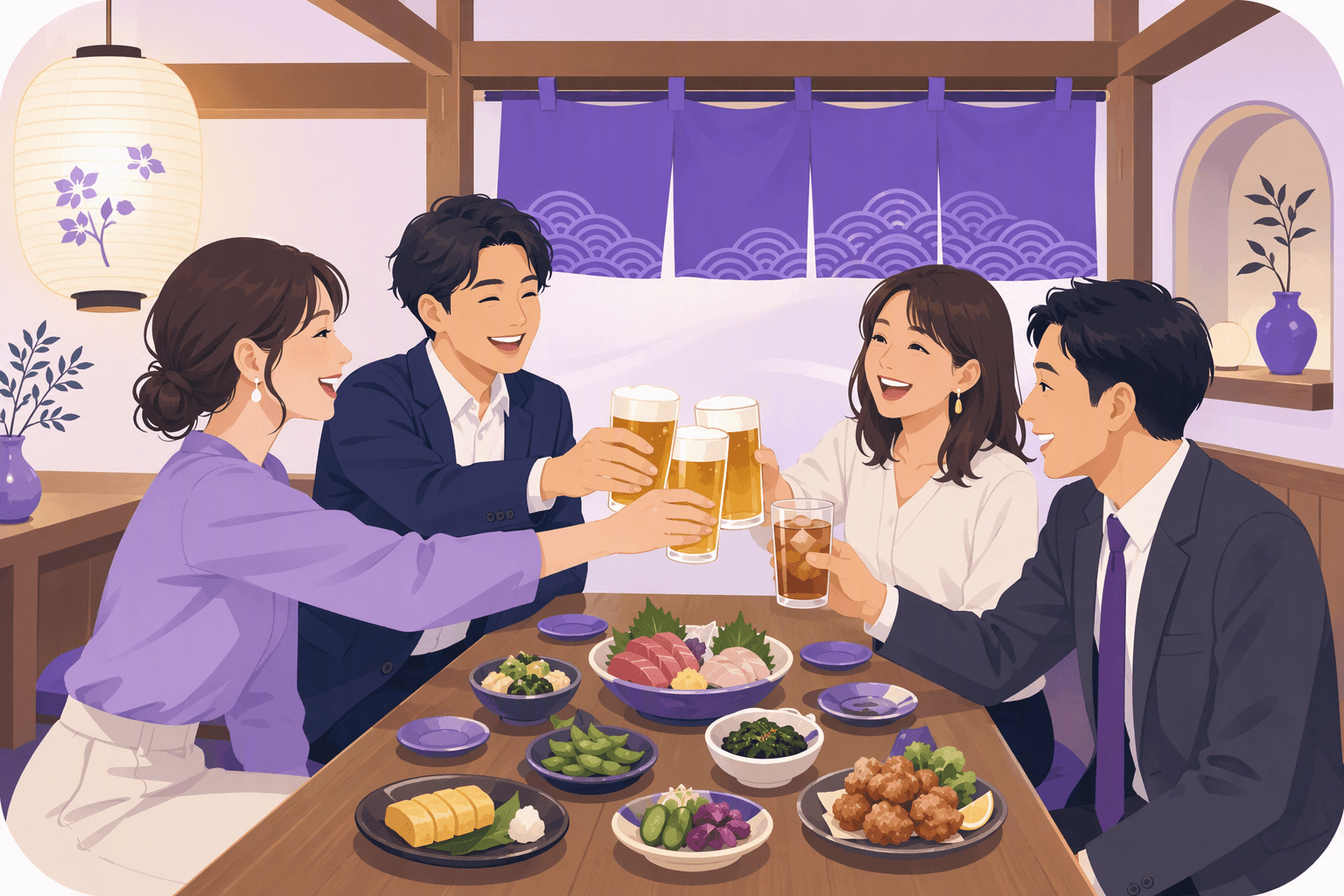
When to use 乾杯 (kanpai)
乾杯 is the default, but the timing is the real rule: say it before drinking, ideally after everyone has a glass. In many groups, someone will make a short speech first, then raise their drink and say kanpai, and everyone follows.
In casual friend groups, the speech can be one sentence or skipped entirely. In work settings, the speech can be longer, and the person who leads it is often the most senior person or the organizer.
乾杯
乾杯 (kanpai, kahn-PIE) literally uses characters associated with "dry" and "cup," but in real life it simply means "cheers" or "a toast." It is short, loud enough for a group, and expected.
/kahn-PIE/
Literal meaning: A set toast word used before drinking.
“じゃあ、乾杯!”
Alright then, cheers!
Say it right before the first sip. In group settings, wait until everyone has a drink and someone initiates the toast.
Polite and formal ways to toast
If you are at a company party, a wedding reception, or meeting someone important, you can keep kanpai but make the sentence more formal. This is where Japanese politeness levels show up clearly, a topic that overlaps with how Japanese uses set phrases for social harmony, a theme you will also notice in farewells in our how to say goodbye in Japanese guide.
Two practical upgrades:
- Use a full sentence like "let's toast."
- Use humble or polite verb endings.
乾杯しましょう
乾杯しましょう (kanpai shimashou, kahn-PIE shee-mah-SHOH) means "let's toast." The しょう ending is a polite suggestion, common when you are being friendly but not overly formal.
/kahn-PIE shee-mah-SHOH/
Literal meaning: Let's do a toast.
“皆さん、乾杯しましょう。”
Everyone, let's toast.
A safe choice for mixed groups. It sounds organized without sounding stiff.
乾杯いたします
乾杯いたします (kanpai itashimasu, kahn-PIE ee-tah-shee-MAHSS) is a more formal, humble-sounding way to say you will make the toast. You might hear it from an MC, a host, or someone asked to lead the toast.
/kahn-PIE ee-tah-shee-MAHSS/
Literal meaning: I will make the toast.
“それでは、乾杯いたします。”
Well then, I will propose a toast.
Common in formal events. It sounds like you are officially starting the toast moment.
ご健康に
ご健康に (go-kenkou ni, goh-kehn-KOH-oh nee) is a classic "to your health" toast. It is not as common as kanpai in everyday drinking scenes, but it appears in more ceremonial contexts.
/goh-kehn-KOH-oh nee/
Literal meaning: To (your) health.
“皆様のご健康に。乾杯!”
To everyone's health. Cheers!
Often paired with kanpai rather than replacing it. It fits speeches, weddings, and formal dinners.
Work drinking culture: the phrases you hear around kanpai
If you watch Japanese workplace dramas, you will notice that the toast is often less about alcohol and more about group alignment. This is where phrases like お疲れ様 become almost toast-like.
Sociolinguist Haru Yamada, in Different Games, Different Rules, discusses how Japanese interaction often prioritizes smooth coordination and shared context. In a toast setting, that shows up as short, formulaic phrases that acknowledge effort and relationships.
お疲れ様です
お疲れ様です (otsukaresama desu, oh-TSOO-kah-reh-SAH-mah dehss) is one of the most useful phrases in Japanese, and it often appears right before or right after kanpai at work gatherings. It roughly signals "thanks for your hard work," but it also functions as a relationship-maintenance phrase.
/oh-TSOO-kah-reh-SAH-mah dehss/
Literal meaning: You must be tired (from your efforts).
“皆さん、お疲れ様です。乾杯!”
Everyone, thanks for your hard work. Cheers!
Extremely common in offices and after-work gatherings. It acknowledges the group before the fun starts.
お疲れ
お疲れ (otsukare, oh-TSOO-kah-reh) is the casual version you might say to coworkers you are close with, or friends after a shared effort. It can appear in drinking scenes among teammates.
⚠️ Avoid being too casual too fast
In Japanese work settings, switching from お疲れ様です to お疲れ can feel overly familiar if you are new, junior, or not close with the group. When in doubt, keep お疲れ様です until others clearly use casual speech with you.
よろしくお願いします
よろしくお願いします (yoroshiku onegaishimasu, yoh-roh-SHEE-koo oh-neh-GAH-ee-shee-mahss) can show up at the start of a new project dinner, a first meetup, or any gathering where the point is building a relationship. It is not "cheers," but it is a common pre-toast phrase meaning "please treat me well" or "I look forward to working with you."
If you want a deeper feel for how Japanese uses set phrases to manage closeness, compare this to the emotional directness issues in how to say I love you in Japanese, where what is unsaid matters as much as what is said.
Casual and slangy options (use carefully)
Some "cheers" options are fun, but they can also create awkwardness if you use them with the wrong people. Japanese has a strong sense of situational appropriateness, and drinking language is part of that.
一気
一気 (ikki, EE-kkee) is closer to "chug" or "down it" than "cheers." You might hear it when someone is pressuring a friend to drink quickly, often in rowdy scenes.
/EE-kkee/
Literal meaning: In one go.
“一気!一気!”
Bottoms up! Bottoms up!
This can be peer pressure. In real life, be cautious. Many workplaces and universities actively discourage forced drinking.
⚠️ Drinking pressure is a real issue
Japan has had long-running public conversations about forced drinking and alcohol harassment (often called アルハラ). If someone says 一気 in a way that pressures you, it is acceptable to refuse and protect your pace.
チアーズ
チアーズ (chiaazu, chee-AHZ) is a borrowed, playful "cheers" you might hear among younger people, in international groups, or in advertising. It can sound performative in traditional settings.
How to actually do kanpai: etiquette that matters
Knowing the word is only half. The rest is the choreography.
Wait for the group
In many countries, you can sip while people are still arriving. In Japan, at a group dinner, people often wait until everyone has a drink and the toast begins. This is especially true at izakaya, company parties, and formal dinners.
Hold your glass relative to status
A common etiquette detail: when clinking with a senior person, people often keep their glass slightly lower. This is not a strict law, but it is a frequent pattern.
Clink gently, or just raise
If others are clinking, you can clink. If the vibe is formal, simply raise your glass and nod.
Pouring for others
In many traditional contexts, people pour drinks for each other, especially beer. You do not have to force this, but noticing it helps you read the room.
🌍 Why kanpai scenes feel so 'groupy' in Japanese media
In Japanese TV and film, drinking scenes often mark a shift from public roles to private honesty, but still within group boundaries. The toast moment creates a shared start line. That is why characters who drink early, refuse to toast, or skip the ritual are often framed as outsiders.
Real-life toast scripts you can copy
Here are short patterns that sound natural. Keep them short, because long speeches are hard even for advanced learners.
Friends at an izakaya
- じゃあ、乾杯!
- とりあえず、乾杯!
"とりあえず" is like "for now" or "anyway," often used when ordering the first round.
Coworkers after work
- 皆さん、お疲れ様です。乾杯!
- 今日もありがとうございました。乾杯!
A formal dinner or event
- 本日はお集まりいただき、ありがとうございます。
- それでは、乾杯いたします。
These are common speech shapes. You do not need to be perfect, you need to be clear and appropriately polite.
Pronunciation: mora timing traps in toast phrases
Japanese is mora-timed, so the beat matters. If you compress sounds, you can become hard to understand even if your consonants are fine.
Here are common traps from this topic:
- かんぱい (kan-pa-i) has three beats: kahn / pah / ee. Do not collapse it into "kan-pai" as one beat at the end.
- いっき (i-kki) has a doubled consonant. Hold the pause before k.
- おつかれさま (o-tsu-ka-re-sa-ma) is long. Keep each beat.
If you want to build overall listening accuracy, pair this with clip-based practice. Our dual subtitles guide explains how to use two subtitle tracks to connect sound to meaning without guessing.
What not to say as "cheers" in Japanese
A few pitfalls:
Using さようなら as a drinking goodbye
You might know さようなら from textbooks, but it can sound final. For leaving a bar, people more often use casual goodbyes, which we cover in how to say goodbye in Japanese.
Overusing slang with strangers
チアーズ and 一気 can be fun, but they are not safe defaults. If you are unsure, stick to 乾杯 and a polite smile.
Swearing to sound cool
Some learners try to copy edgy drinking scenes. If you are curious, read our guide to Japanese swear words, but keep in mind that what sounds comedic in a show can be socially costly in real life.
Why "cheers" is a culture lesson, not just a word
Linguist Sachiko Ide’s work on Japanese politeness is often discussed in terms of discernment, choosing forms that fit the situation rather than expressing individual attitude. Toast language is a clean example: you are not just saying a word, you are signaling alignment with the group and respect for timing.
This is also why kanpai is so stable across regions. Japanese has dialect diversity, but many public rituals rely on shared, widely recognized phrases, reinforced through school, media, and workplace norms.
Practice with movie and TV clips (the fastest way to internalize it)
To learn kanpai like a native, you want repetition in context:
- Listen for the lead-in speech cadence.
- Notice when everyone raises their glass.
- Repeat the exact timing, not just the word.
If you are building a broader foundation, combine this with a frequency-based core list like 100 most common Japanese words. Toast phrases are memorable, but the glue words around them are what make you sound natural.
💡 A simple one-week plan
Day 1-2: Learn 乾杯 and one polite sentence (乾杯しましょう). Day 3-4: Add お疲れ様です for work contexts. Day 5-7: Shadow three kanpai scenes, copying timing and volume, then record yourself and compare.
A quick, safe default you can use anywhere
If you want one line that works in almost every group setting, use:
- 皆さん、乾杯しましょう。 (kahn-PIE shee-mah-SHOH)
It is polite, clear, and does not assume closeness.
When you are ready, add context phrases like お疲れ様です or a short thank-you, and you will sound like you understand the room, not just the dictionary.
If you want more phrase guides built around real scenes, browse the Wordy language learning blog and practice with clips that match the situations you actually live.
Frequently Asked Questions
What is the most common way to say cheers in Japanese?
Is it rude to drink before saying kanpai in Japan?
How do you say cheers politely at a work party in Japanese?
Do Japanese people clink glasses like in Western countries?
What do you say after drinking in Japanese?
Sources & References
- Agency for Cultural Affairs (文化庁), information on Japanese language education and usage (accessed 2026)
- Japan Foundation (国際交流基金), Japanese language and culture resources (accessed 2026)
- NHK Broadcasting Culture Research Institute (NHK放送文化研究所), language and communication resources (accessed 2026)
- Ethnologue: Languages of the World, Japanese language entry (27th edition, 2024)
- Kenkyusha, Japanese-English dictionary resources (accessed 2026)
Start learning with Wordy
Watch real movie clips and build your vocabulary as you go. Free to download.


