Quick Answer
German has plenty of words that feel 'untranslatable' because English needs a whole phrase to express the same idea. The best approach is to learn each word with its typical situation, tone, and collocations, not just a dictionary gloss. Below are 18 high-utility examples with pronunciation and real usage notes.
German untranslatable words are terms that English can translate, but usually only with a longer phrase that loses the original compactness, tone, or cultural default. Learn them as situation-words, meaning when you say them, to whom, and with what attitude, and they stop being trivia and start showing up everywhere in real German dialogue.
German is also a genuinely international language, not just "Germany's language". Ethnologue counts German among the world's major languages, with tens of millions of native speakers and wide second-language use across Europe (Ethnologue, 27th ed., 2024). It is an official language in six countries, which helps explain why certain expressions feel "everywhere" once you start watching German-language TV and film.
If you want a warm-up before the more culture-heavy vocabulary, start with how to say hello in German and how to say goodbye in German. Those basic interactions are where you first notice how German encodes social distance and precision.
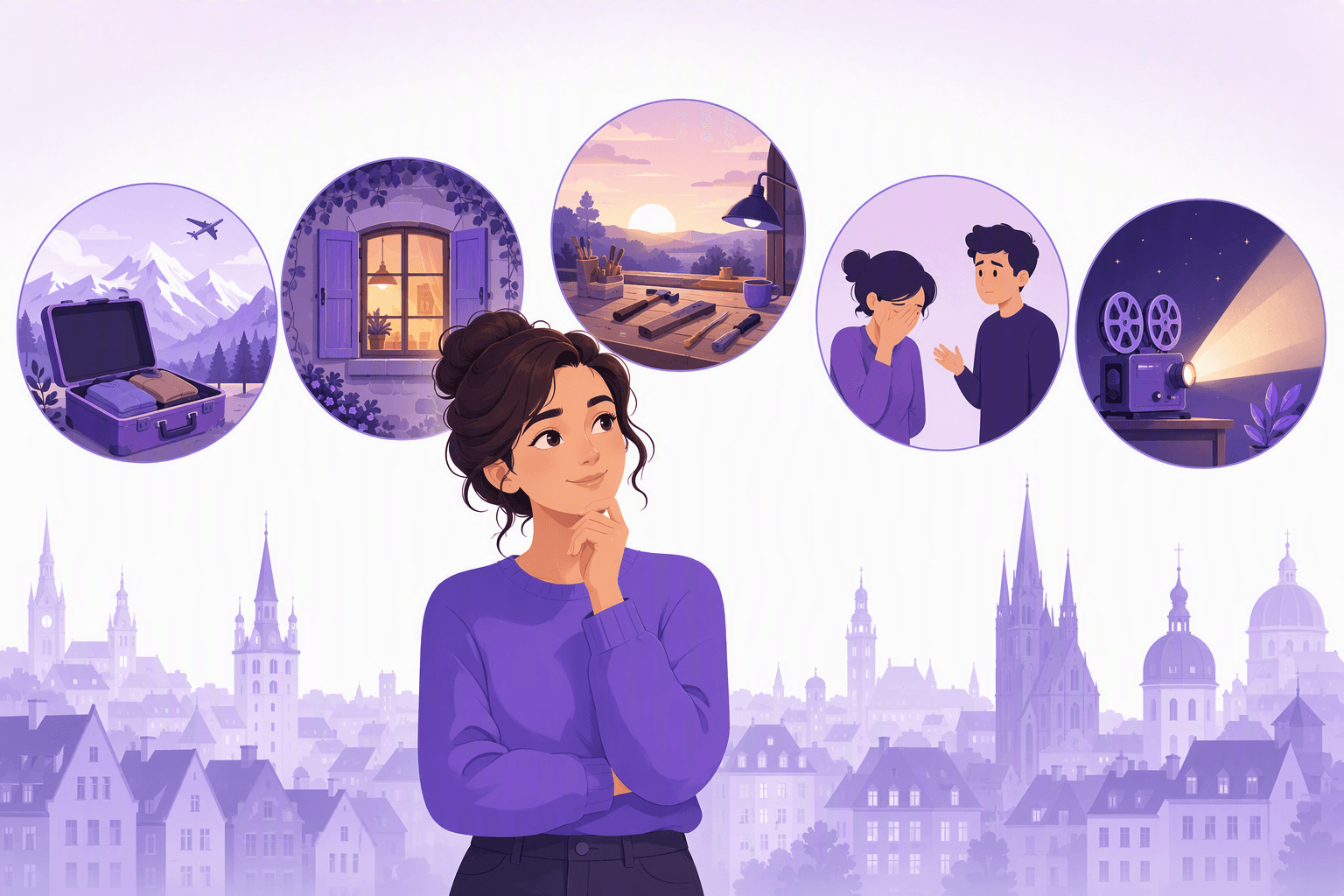
What "untranslatable" really means (and what it doesn't)
"Untranslatable" does not mean mystical or impossible. It usually means English lacks a single common word, so it needs a phrase, and that phrase often misses the default situation German speakers have in mind.
It can also mean the word sits inside a productive family of related forms. German makes it easy to build new labels with compounds and prefixes, while English often spreads the same meaning across multiple constructions.
Lera Boroditsky's work on linguistic relativity is a useful reminder here: languages can nudge attention toward certain distinctions, even when all humans can understand the underlying idea. With German, the nudge is often toward boundaries, responsibility, and social calibration.
How German builds extra-specific words
German compounds are productive, not random. You can combine nouns (and sometimes adjectives or verbs) to create a new label that feels immediately interpretable to native speakers once you see the parts.
Duden is helpful for learners because it shows standard spellings, senses, and common collocations, which is where many learners go wrong (Duden, accessed 2026). If you treat compounds like Lego, many "untranslatable" words become readable instead of intimidating.
💡 A practical rule for compounds
Learn the rightmost part first. In German compounds, the last element is usually the core noun, and everything before it narrows the meaning.
18 German untranslatable words worth learning
These are high-utility words you will meet in conversation, news, and entertainment. Each entry includes an English-friendly pronunciation approximation and the usage context that makes it click.
Schadenfreude
Pronunciation: SHAH-den-FROY-duh
Meaning: pleasure at someone else's misfortune.
German uses this naturally in everyday commentary, especially when the "victim" is a public figure or someone who acted arrogantly. It can be playful, but it can also sound mean, so tone matters.
Typical phrasing: "ein bisschen Schadenfreude" (a little Schadenfreude).
Fernweh
Pronunciation: FEHRN-vay
Meaning: a longing to be far away, often a craving for travel.
English has "wanderlust", but Fernweh is more like homesickness for elsewhere. You will see it in reflective posts, travel talk, and captions when someone feels stuck in routine.
Common pattern: "Fernweh haben" (to have Fernweh).
Heimweh
Pronunciation: HYME-vay
Meaning: homesickness.
This is the counterpart to Fernweh, and Germans use it plainly, not poetically. Knowing both helps you catch a common contrast in dialogue: "Fernweh haben" vs "Heimweh haben".
Feierabend
Pronunciation: FY-er-AH-bent
Meaning: the time after work is done, with an implied right to stop working.
Feierabend is not just "evening". It is a boundary, and in many workplaces "Ich mache jetzt Feierabend" signals you are done for the day, and further requests are exceptions, not defaults.
If you watch German office scenes, this word is a recurring cultural marker of work-life separation.
Fremdschämen
Pronunciation: FREHMT-shay-men
Meaning: feeling embarrassed on someone else's behalf.
English has "secondhand embarrassment", but Fremdschämen is shorter and more flexible. It is common in reality TV commentary, awkward dates, and cringe humor.
You will also see the noun: "das Fremdschämen".
Torschlusspanik
Pronunciation: TOR-shlooss-PAH-neek
Meaning: "gate-closing panic", anxiety that time is running out for life goals.
You will see it in articles about turning 30 or 40, career changes, relationships, and having kids. It can be used seriously, but it is also often used with humor, especially in self-description.
Common pattern: "Torschlusspanik bekommen" (to get Torschlusspanik).
Weltschmerz
Pronunciation: VELT-shmehrts
Meaning: world-weariness, a gloomy sense that reality falls short of ideals.
This is more literary than everyday, but it appears in essays, reviews, and cultural commentary. In media, it often signals a character with a dramatic, reflective streak.
If you learn German through films, this is a good "recognition word" even if you do not produce it often.
Zeitgeist
Pronunciation: TSYTE-gyst
Meaning: the spirit of the times, the defining mood of an era.
This word is used in English too, but German uses it comfortably in everyday intellectual talk and journalism. It often appears when people discuss trends, politics, or culture.
You will see it in compounds too: "Zeitgeist-Phänomen".
Kummerspeck
Pronunciation: KOO-mer-shpek
Meaning: "grief bacon", weight gained from emotional eating.
This is informal and slightly jokey. People use it when talking about breakups, stress, or winter habits, often with self-deprecating humor.
Because it is vivid, it is easy to remember, and it shows how German turns a whole story into one noun.
Innerer Schweinehund
Pronunciation: IN-eh-rehr SHVY-neh-hoont
Meaning: your "inner pig-dog", the part of you that resists effort and discipline.
This is a classic German motivational concept. You will hear it around exercise, studying, cleaning, and any task you keep postponing.
Typical phrasing: "den inneren Schweinehund überwinden" (to overcome it).
Erklärungsnot
Pronunciation: ehr-KLEH-roongs-noht
Meaning: being in a position where you have to explain yourself, often uncomfortably.
This shows up in news and workplace talk when someone is under pressure to justify a decision. It is not exactly "trouble", it is specifically trouble of the explaining kind.
Common collocation: "in Erklärungsnot geraten" (to end up in it).
Kopfkino
Pronunciation: KOPF-kee-noh
Meaning: "head cinema", the movie playing in your mind.
It can be neutral (imagination) or negative (intrusive images, jealousy scenarios). In dating scenes, it often refers to overthinking and imagining what might be happening.
Common pattern: "Kopfkino haben" (to have Kopfkino).
Geborgenheit
Pronunciation: guh-BOR-guhn-hyte
Meaning: a deep sense of safety, warmth, and being sheltered.
English can translate parts of it (security, comfort, coziness), but Geborgenheit is broader and more emotional. You will see it in parenting talk, relationships, and descriptions of home.
If you are learning emotional vocabulary, pair this with the more general list in German emotions vocabulary.
Sehnsucht
Pronunciation: ZAYN-zookht
Meaning: an intense longing, often bittersweet.
This is stronger and more poetic than just "missing someone". It appears in songs, literature, and reflective dialogue, especially around love, youth, and nostalgia.
Common pattern: "Sehnsucht nach X" (longing for X).
Treppenwitz
Pronunciation: TREP-en-vits
Meaning: the perfect comeback you think of too late, literally a "staircase joke".
It describes that moment when you leave the conversation and suddenly find the line you wish you had said. It is a sharp, compact label for a very human experience.
You might also see the longer form "Treppenwitz der Weltgeschichte" in historical commentary, but the everyday idea is the too-late comeback.
Verschlimmbessern
Pronunciation: fer-SHLIM-bes-ern
Meaning: to make something worse while trying to improve it.
This is a great example of German wordplay: verschlimmern (to worsen) plus verbessern (to improve). It is used when a fix, redesign, or "help" backfires.
Common usage: "Das hast du verschlimmbessert."
Doch
Pronunciation: dokh (with a throaty "kh" sound)
Meaning: a versatile particle that pushes back against an assumption.
This is one of the most useful "untranslatable" items because it is extremely frequent in real speech. It can mean things like "actually", "but yes", or "come on", depending on context.
Example situations:
- Someone says, "Du hast keine Zeit." You answer, "Doch!" meaning you do have time.
- Someone doubts you, and you add "doch" to insist gently: "Das stimmt doch."
If particles confuse you, it helps to learn them from dialogue clips rather than isolated sentences.
Jein
Pronunciation: yine (rhymes with "fine")
Meaning: "yes and no", a mixed or reluctant answer.
Jein is informal and common in everyday conversation. It is perfect when the honest answer is complicated, or when you want to avoid committing fully.
You will hear it in interviews, friend chats, and workplace small talk.
Feierabendbier
Pronunciation: FY-er-AH-bent-beer
Meaning: an "after-work beer", the drink that marks the transition into off-time.
This is not universal behavior, but the word exists because the social concept exists. It is used casually among colleagues and friends, and it can also be used humorously even if the drink is not literally beer.
This is also a good reminder that German compounds can be very literal, and still feel natural.
How to learn these words from real dialogue (not lists)
A list helps you recognize words, but recognition turns into usable knowledge only when you connect each word to a recurring scene type. That is why film and TV are so effective for this category.
Pick one word and hunt for its "home habitat". Feierabend lives in offices and kitchens, Fremdschämen lives in awkward social scenes, and doch lives everywhere, especially in disagreements and corrections.

If you want more context for how German culture shapes what sounds polite, direct, or awkward, pair this article with German etiquette and customs. For the mechanics behind long nouns, German compound words makes the patterns feel predictable.
⚠️ A common learner mistake
Do not force these words into English-shaped sentences. Many of them prefer specific verbs or prepositions, like "Sehnsucht nach" or "in Erklärungsnot geraten". Learn the whole chunk, not just the dictionary gloss.
Regional and register notes (Germany, Austria, Switzerland)
Because German is used across multiple countries, you will hear differences in everyday vocabulary and in what feels natural in casual speech. The Goethe-Institut and the Institut für Deutsche Sprache both emphasize the distinction between standard German and regional varieties, and why learners should expect variation (Goethe-Institut, accessed 2026; IDS, accessed 2026).
Most words in this list are widely understood in standard German. Still, frequency and vibe can shift, especially with humor words and workplace culture words, so treat your favorite shows as your "frequency guide".
Using untranslatable words without sounding theatrical
Some of these words are famous because they sound clever in English. In German, using them too dramatically can feel performative, especially with the more literary items like Weltschmerz.
A safe rule is to prioritize the high-frequency, high-naturalness set for speaking: doch, Feierabend, Fremdschämen, Jein, and a couple of emotional nouns like Sehnsucht or Geborgenheit if they fit your personality. Keep the rest as recognition vocabulary that boosts comprehension.
If you are building a German core vocabulary alongside these, start with 100 most common German words. The "untranslatable" gems land better once the surrounding grammar and function words feel automatic.
Practice plan: make each word stick in one week
Choose 5 words, not all 18. For each word, do three things.
First, write one sentence you might realistically say, and one sentence you might realistically hear. Second, find one clip or scene where the situation matches, even if the exact word does not appear, and narrate it using the word. Third, review the word two days later and again one week later, because spacing matters for retention.
If you like structured review, the method in our Anki guide works well for these, because each card can be a mini-scene, not just a translation.
A final note on why these words matter
Untranslatable words are not magic, they are shortcuts into how a community packages experience. Once you start noticing them, German dialogue becomes easier to follow because you stop translating word-by-word and start recognizing the social move the speaker is making.
To keep learning from real speech, use short, repeatable scenes, and collect words in the exact phrasing you hear them. If you want a clip-based way to do that, Wordy is built for mining movie and TV dialogue into reviewable vocabulary, so these "situation-words" become part of your active German faster.
Frequently Asked Questions
Are German 'untranslatable words' actually untranslatable?
Do Germans use these words in everyday conversation?
Is German really spoken in multiple countries?
What is the best way to remember long German words?
How can I learn these words from movies and TV shows?
Sources & References
- Ethnologue, 27th edition, 2024
- Duden, online dictionary (accessed 2026)
- Institut für Deutsche Sprache (IDS), online resources (accessed 2026)
- Goethe-Institut, German language information and learning resources (accessed 2026)
Start learning with Wordy
Watch real movie clips and build your vocabulary as you go. Free to download.


